Militariarg.com
  • Home
  • Army
  • Aviation
  • Navy
  • Uniforms and Badges
  • Arms and Weapons
  • Equipment
  • Vehicles
  • Operational and Organizational Structure, Security Forces, Transportation, Books, Models and More.
  • Argentine Confederation Era. 1829 - 1852.
  • From 1852 to 1910 (French fashion)
  • Bunker 1982: South Atlantic War Militaria
  • International Militaria
  • Argentina WWII Era (Neutral) Reenactment Impression
  • Links ~ Enlaces
Picture

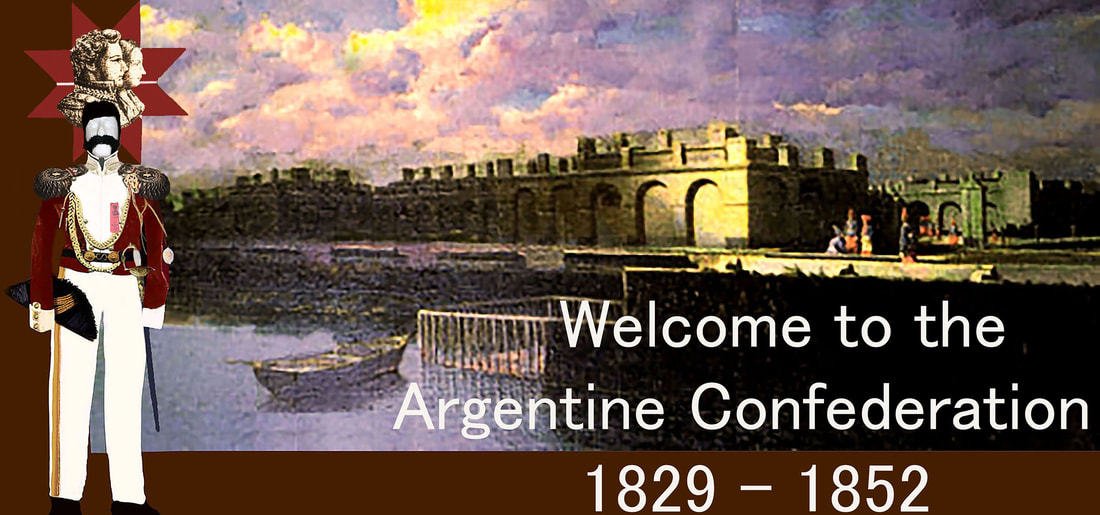
The Rosas's Era; A pivotal moment in the formation of the Southern Cone's geography. 

The political project of Juan Manuel de Rosas is best understood as a strategic tension between the two concepts, using the "Pan-gaucho" cultural identity as a tool to pursue the geopolitical "Reconstruction of the Viceroyalty"

Misiones Orientales (Today Rio Grande do Sud)

The Cisplatine War, 1825–1828 was a Argentine military victory. However, the diplomatic outcome orchestrated by British mediator Lord Ponsonby contradicted the battlefield results.
Despite Fructuoso Rivera’s successful 1828 campaign to recover these lands, the resulting Preliminary Peace Convention (1828) recognized them as Brazilian territory in exchange for peace.

Banda Oriental - The "Buffer State" (Today Uruguay)

Britain’s primary goal was to ensure no single power (neither Argentina nor Brazil) controlled both banks of the Río de la Plata. By creating an independent Banda Oriental, they established a "cotton between two crystals," ensuring the estuary remained an international zone rather than an Argentine lake.

Patagonia, Malvinas and adjascent islands of the South Atlantic.

The British occupation of the Malvinas (Falkland) Islands in January 1833 occurred just as Juan Manuel de Rosas was launching his 1833 Desert Campaign. While British historical accounts often emphasize a reassertion of sovereignty following disputes with the U.S. and Argentina over fishing rights, the timing aligns with a period of intense Argentine expansion toward the south.

Multi-front struggle to prevent the complete disintegration of the Argentine state into smaller, European-dominated "buffer" republics.

The Northern Threat: The Peru-Bolivian ConfederationThe War of the Confederation (1837–1839) was a direct existential threat to the northern provinces of Salta and Jujuy.Marshal Andrés de Santa Cruz, seeking to restore the old colonial boundaries of High Peru, invaded northern Argentina in 1837. His forces occupied much of Jujuy and northern Salta.

A key point of the conflict was the province of Tarija, which had been part of the United Provinces but was annexed by Bolivia. Rosas fought to recover it and protect Salta and Jujuy from similar permanent annexation. Although Argentine forces struggled on the battlefield, the Chilean victory at Yungay (1839) caused the collapse of Santa Cruz's Confederation, forcing the return of occupied Argentine territories.

The Eastern Threat: The Mesopotamian "Republic"During the Guerra Grande (1839–1851), British and French diplomats actively explored "balkanizing" the Río de la Plata to ensure free river access.
There were recurring plans to merge Entre Ríos, Corrientes, and Uruguay into a single independent state. This "Mesopotamian Republic" would have served as a massive buffer state under European influence, permanently bypassing the Buenos Aires Customs House.Internal Rebellion: Local caudillos like Corrientes' leaders often aligned with these foreign interests against Rosas to gain economic independence for their provinces.Internationalization: The Anglo-French Blockade (1845–1850) was the military attempt to force this separation by opening the rivers to foreign trade without Rosas's permission. 

The Internationalization of the Rivers

The most drastic change in the map after the fall of Rosas was not just the lines on paper, but the access to the interior. Rosas famously "chained" the Paraná River (the Battle of Vuelta de Obligado) to prevent foreign ships from bypassing the Buenos Aires Customs House. He believed that only Buenos Aires should manage and tax the trade of the entire interior.

The Post-1852 Opening

Immediately after defeating Rosas at Caseros, Justo José de Urquiza signed treaties for the free navigation of the rivers (1852/1853). This "internationalized" the Paraná and Uruguay rivers, allowing foreign powers specifically the British and French to trade directly with interior ports like Rosario and Paraná without paying duties to Buenos Aires.

"Federation or Death" - Paraguay

The core of Rosas's "Viceroyal Reconstruction" vision, which largely stalled the constitutional process in favor of territorial restoration. Up to Caseros (1852), the map of the Argentine Confederation was defined by Rosas's refusal to accept any permanent legal organization that did not formally re-incorporate the territories of the old Viceroyalty of the Río de la Plata, including Paraguay.The "Rosas map" effectively treated Paraguay not as a foreign nation, but as a rebellious province of the Argentine Confederation.

The map's shift from Rosas's era to the post-Caseros period was, in many ways, the definitive legal surrender of the "Viceroyalty" dream.

Bartolomé Mitre, the man who spent much of his life fighting to dismantle Rosas's system, eventually became one of the most significant figures to rehabilitate Rosas's image as a "guardian of sovereignty."In his later years, particularly in his correspondence and historical reflections, Mitre acknowledged that while he detested Rosas’s domestic tyranny, the "Restorer of the Laws" had been an unyielding wall against foreign intervention.

In his last years at the Palacio San José, Urquiza reportedly expressed a pragmatic respect for Rosas's ability to maintain order. He came to see Rosas not just as a tyrant, but as a leader who understood the "raw material" of the Argentine people the gauchos and the rural masses better than the constitutionalist lawyers in Santa Fe.

By the end, Urquiza and Mitre both realized that while they had defeated the man, they were still governed by the geographical and economic reality that Rosas had spent twenty years defending.

Unlike Mitre or Urquiza, who eventually conceded that Rosas was a "necessary evil" for sovereignty, Sarmiento’s recognition was more sociological: he realized that Rosas was not just a tyrant, but a natural, inevitable product of the Argentine landscape and its "barbaric" rural culture.

​Rosas hit on the cultural bedrock that survived even when the "Viceroyalty" project failed politically. While the diplomats in London, Paris, and Rio de Janeiro were busy drawing lines on maps to create buffer states and international rivers, they couldn't cut the shared "nervous system" of the region: the Gaucho, often called "The Patria Gaucha". This cultural geography ignores modern passports. 

Picture
Picture
Picture
Picture
Picture
Picture
Powered by Create your own unique website with customizable templates.