Militariarg.com
  • Home
  • Army
  • Aviation
  • Navy
  • Uniforms and Badges
  • Arms and Weapons
  • Equipment
  • Vehicles
  • Operational and Organizational Structure, Security Forces, Transportation, Books, Models and More.
  • Argentine Confederation Era. 1829 - 1852.
  • From 1852 to 1910 (French fashion)
  • Bunker 1982: South Atlantic War Militaria
  • International Militaria
  • Argentina WWII Era (Neutral) Reenactment Impression
  • Links ~ Enlaces

​The Argentine Confederation after the Battle of Caseros (1852 - 1861):
Picture
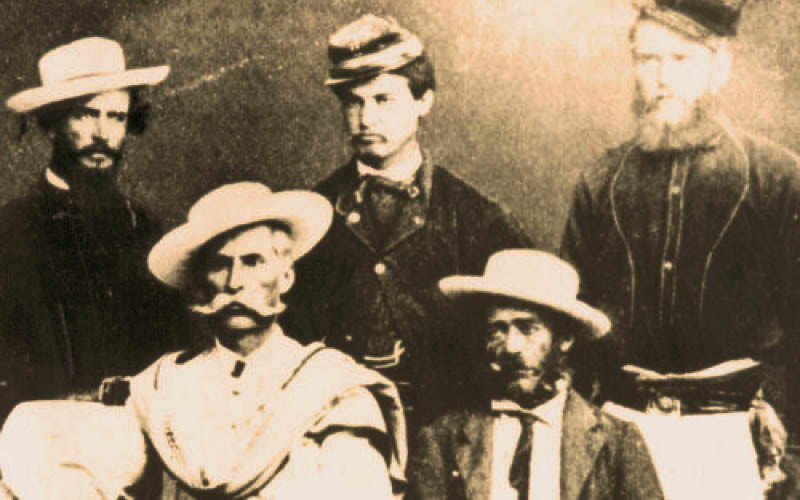
​After the Battle of Caseros, Buenos Aires had become a separatist state held by the Unitarian Party. When losing Buenos Aires and the Eastern Band, the rest of the confederated provinces, they were without leadership.  Separated and seriously weakened, they marched thus to their final defeat in the Battle of Pavon in 1861. After the Battle of Pavon, there were a series of provincial uprisings headed by Caudillos, which were repelled by the army of Buenos Aires (Process of organization and national unification). In the photo above, you can see the staff of General Felipe Varela. In the photo you can see a mixture of civilian or gaucho clothes and the remains of military uniforms. The officer in the middle is wearing an early French kepi of the Second Empire in civilian clothes.  He is like the man on his left, but he is wearing a cavalry shirt from the Argentine Confederation.
In several daguerreotypes shortly after 1852, there are military officers and national guardsmen of the Argentine Confederation, from various provinces, with French uniforms of the Second Empire tailors, as well as the armies and the national guards of Buenos Aires. The troops of the Argentine Confederation post-1852 still wore the old uniforms of the Federal Army combined with uniforms of the French regulation and with clothes and weapons of other origins, since each province had its own foreign trade. This was the main reason why, in 1852, some federal chiefs allied with the unitary leaders (Argentines and Uruguayans) and the Emperor of Brazil to defeat the Government of Rosas and its customs centralism. Paradoxically after the Federal defeat at the Battle of Pavon, the Unitarians of Buenos Aires subjugated the rest of the weak provinces and imposed National Unity and customs centralism.
Picture
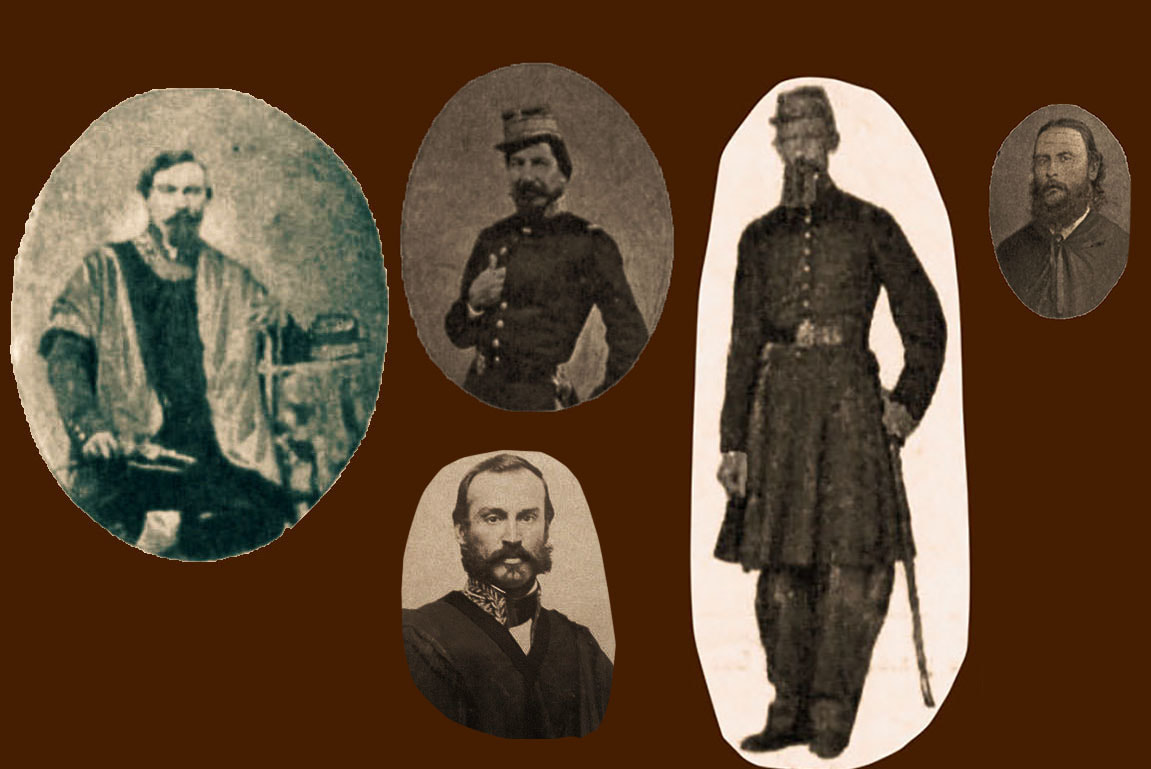
 General Ricardo Lopez Jordan. General Carmelo Campos (Lieutenant of the Gral Lopez Jordan). Coronel Ramon Gallo. Sergeant Major (Major) Simon Luengo. Nicomedes Coronel. 
With the exception of General Lopez Jordan, the rest are wearing French made uniforms. The tunics are model 1845, the same model used at that time by the National Guard of Paris, and French colonial kepis of the time (Napoleon III). General Lopez Jordan wears under his poncho a jacket of high officer of the time of the Argentine Confederation, which were of the same style as those used since the War of Independence.
Picture
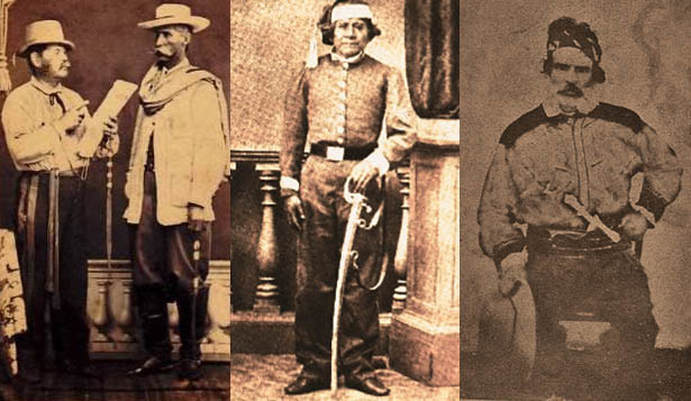
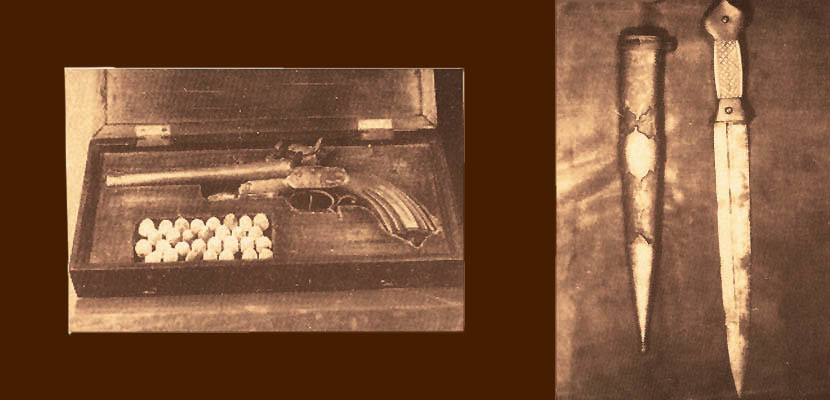
​In those daguerreotypes, protagonists of armed uprisings appear, along with resistance to the authority of Buenos Aires. On the left, the legendary  General Juan de Dios Videla when he was Lieutenant General to Felipe Varela on his right.  In the middle General Indian Chief Catriel and the provincial Caudillo Ángel Vicente Peñaloza. General Juan de Dios Videla was a veteran of the Battle of Caseros, commanding as a colonel a Cavalry Division of the Argentine Confederation that took his name during the battle. He still wears the pants of a high ranking officer of the Confederation. Cacique Catriel wears a red blouse from the time of the Argentine Confederation. The photos below, weapons and knives that Angel Vicente Peñaloza had used.
Picture

​Political, Art and literary legacy of the Argentine Confederation towards the end of the 19th century.
Picture
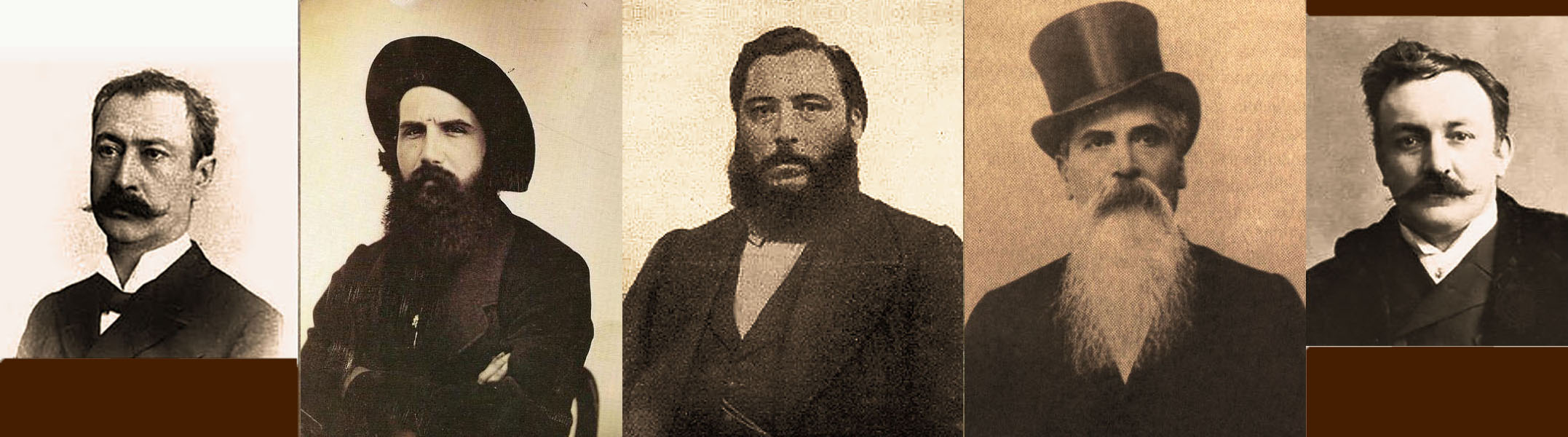
Adolfo Saldias author of "History of the Argentine Confederation, 1881/1883". Lucio V. Mansilla author of "An Excursion to the Ranquel Indians".José Hernández author of the epic poem "Martín Fierro". Leandro Nicéforo Alem, veteran of the battles of Cepeda, Pavon and the War of the Triple Alliance, politician and deputy of the nation in 1895. Roque Sáenz Peña, journalist, military of the Argentine National Guard and Peruvian general, veteran of the War of the Pacific, politician and ex-president of Argentina between 1910 to 1914. 
Picture
Picture
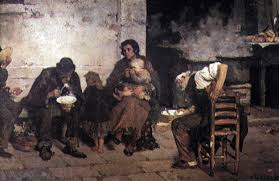
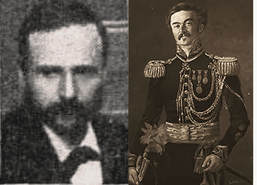
Reynaldo Giudici. Giudici (1853 - 1921), was an Argentine (Italian born painter). Among his works are the portrait of General Pacheco, and "The soup of the poor".

​The Unitarians and the Federals:

Picture
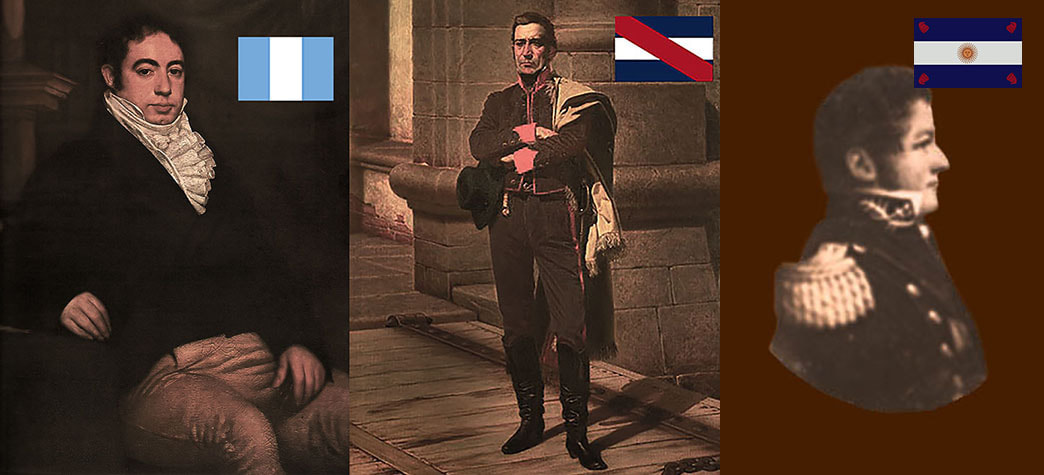
Bernardino Rivadavia (Unitarian flag), Gervasio Artigas (Federal flag) and Juan Manuel de Rosas (Argentine Confederation flag).
​The maximum political exponent of the Federal Party was José Artigas the founder of the "Union of the Free Peoples". The Unitarian Party had Bernardino Rivadavia as the promoter of the liberal ideology, and as liberal centralism in the style of the French state. The ex-Spanish colonies of the Rio de la Plata, were divided into a long struggle for centralism or federalism. However, in the course of that struggle there were clashes between federals. Federal warlords fought allies with the Unitary Caudillos against the centralism of the Federal Government of Buenos Aires. In the Battle of Caseros, Federal and Unitarian under the command of General Urquiza joined together with the Empire of Brazil against the Government of the Argentine Confederation. In Buenos Aires, Federal and Unitarian forces joined under orders of Juan Manuel de Rosas against what they called a kind of second war against Brazil. For this reason, the Battle of Caseros cannot be considered another page of the struggle between Unitarians and Federals. After the Battle of Caseros, the Unitarian Party and the Federal Party officially dissolved in 1862 and 1868 respectively. The two antagonistic sides were diluted in adapting new ideological tendencies but with their liberal or conservative remnants.

The military uniform style under Juan Manuel de Rosas in Argentina (1820–1852) was distinctive for its overt political symbolism and widespread use of the

color red. 
The style was generally based on the existing Argentine standard uniforms, which had some Spanish and older French elements (like certain shako models), but the dominant feature was the imposition of the Federalist color: 

Dominant Color: Crimson red (colorado) was mandatory for both soldiers and civilians associated with the regime. Rosas himself led a regiment known as the "Gaucho Colorados" (Red Gauchos) from early in his career.

Uniform Components: Soldiers wore red jackets or tunics, red caps, and red chiripás (a type of blanket wrapped and used as trousers, common for the gaucho cavalry which formed a core of his forces).

Political Insignia: Every person on the state payroll, military included, was required to wear a prominent red badge with the inscription "Federation or Death".

Totalitarian Aesthetic: The use of red was enforced in an almost totalitarian manner, extending to house doors and windows, flagpoles, and civilian clothing accessories, making it a ubiquitous visual signifier of loyalty to Rosas and the Federalist cause. 

The emphasis was less on a single, sophisticated European cut and more on enforcing a unifying, highly visible political color onto existing practical military and civilian clothing. The specific French military fashion influence (like the widespread adoption of the kepi by all branches) came after Rosas's defeat in 1852, when the Unitarians took power in Buenos Aires and modernized their forces.

British style did influence the Rosas-era uniforms, although the most prominent feature remained the political color red. The influence came from the general adoption of European military standards, including British ones, in post-independence South American armies.
 
Here's how British influence was incorporated:


Cut and Design: The basic cut of some of the formal tunics and coats likely incorporated elements of the contemporary British military fashion, which, like other European styles, featured structured coats, high collars, and specific button arrangements.

Accessories and Equipment: The use of specific equipment items like cross-belts, cartridge boxes, and certain types of headwear (such as shakos, which were popular in many European armies, including the British) often mirrored British and French designs.

Civilian vs. Military Fashion: During this period in Buenos Aires, the more privileged women of society "adopted a style of dress between the English and French," indicating a general awareness and blending of both nations' fashion influences in the region at the time. 

Ultimately, under Rosas, the British influence was blended into a uniquely Argentine look that was dominated by the crimson red color, which served as a powerful symbol of political allegiance to the Federalist cause. The formal adoption of a purely French uniform style occurred only after Rosas's fall in 1852.
Post-1852 Fashion Shift:
(Argentine Confederation without Rosas and with Urquiza)

The style change was implemented by the victorious coalition's leaders who took control of Buenos Aires. Regardless of the coalition's composition during the battle itself, the new dominant government in Buenos Aires quickly modernized its forces and aligned itself with French military fashion, moving away from the highly politicized, red-dominated Rosas-era look.
Modernization = French Style: Adopting French military style was a global trend at the time, signifying a modern, professional, and cosmopolitan army. It marked a decisive break from the aesthetic of the Rosas period.

So, while the alliances were mixed at Caseros, the subsequent governance of Buenos Aires, led by figures who sought European standardization (specifically French), drove the widespread adoption of the kepi and French-cut uniforms throughout their forces.

1852. Federals and Unitarians in alliance against the "automaton"

Mitre called Rosas "Automata" or "Automaton *" because he moved according to the pre-set internal logic of old Hispanic-Catholic laws rather than the modern, liberal reason Mitre championed. Rosas was strongly rooted in blind obedience to laws and traditions based on the Catholic faith. For Mitre, this "mechanical" governance was dangerous because it lacked the flexibility of a secular republic. It created a system where individuals performed their roles in society like gears in a machine, driven by religious and traditional duty rather than civic agency and the unthinking obedience Rosas demanded from his followers ("slaves" according to Urquiza). 

(*To an intellectual like Mitre or Sarmiento, an "Automaton" represented three specific thingsIn the mid-19th century, the term: "Automaton" (autómata) carried a much more specific and politically charged meaning than it does today. It was a bridge between the clockwork toys of the 18th century and the rising industrial machines of the 19th. In the mid-19th century, the word "robot" didn't even exist—it wasn't coined until 1920. When Mitre used the term
"automata," he was thinking of clockwork mechanisms 'juguetes de relojería').

In Caseros Battle, Unitarians and Federals joined forces in the Grand Army to defeat Rosas, but they did not necessarily want to destroy the Federal structure he had consolidated. It was something like "a Peronism without Perón" during the 20th century. In the case of Rosas it was "a federalism without Rosas". 

​Rosas as an economic obstacle for the "federals"

Rosas used the Federal Pact of 1831 to ensure that all foreign trade had to pass through the port of Buenos Aires. This monopoly allowed Buenos Aires to collect all customs revenues, enriching the city while preventing provinces like Entre Ríos from trading their cattle, wool, and hides directly with European markets.
For Urquiza, Rosas was no longer a "Restorer of Laws" but an economic obstacle. He needed free navigation of the rivers (the Paraná and Uruguay) to export his province's products without paying the heavy "toll" of Buenos Aires.

Following Caseros, the "Federalist machine" was captured at Caseros, the liberal elite (the "Unitarians" and liberal Federals) sought to replace Rosas's traditionalist software with Masonic values secularism, universal education, and Republican law effectively turning the "automaton" of the state toward a different ideological direction. The new leadership (including Urquiza) aimed to implement a constitutional federalism. They wanted to keep the Federalist identity of the provinces which had become the "automatic" tradition of the people while removing the "Automaton Dictator" .

It is a well-documented historical fact that both Bartolomé Mitre and Domingo Faustino Sarmiento were high-ranking Freemasons. Sarmiento, for instance, was a 33rd-degree Mason and famously used Masonic principles of secularism and universal enlightenment to lay the groundwork for Argentina’s secular education laws. 

While he led the Federalist forces, Urquiza is also widely suspected of being a Freemason. His leadership of the "Grand Army" at the Battle of Caseros represented a tactical alliance between Masons and liberal reformists to remove Rosas.
For these men, Freemasonry represented the "civilizing" influence of Europe—reason, secularism, and institutional progress which they felt was being stifled by Rosas.

Freemasonry in Unitarians and Federals.

Following the defeat of Rosas, Domingo Faustino Sarmiento returned to Argentina. Having been initiated into Freemasonry during his exile in Chile (specifically in the Logia Unión Fraternal of Valparaíso), he brought with him the organizational framework and "lights" to re-establish the craft in Buenos Aires. The "miracle" (or the political calculation) of the post-Caseros era was that the Masonic Temple became the neutral ground where former enemies, (Unitarians and Federals) could finally sit at the same table. In the lodges, they replaced the polarizing labels of "Savage Unitarian" or "Death-dealing Federal" with the title of "Brother." This allowed them to negotiate the 1853 Constitution and the future of the country in private, ritualized spaces.

On December 11, 1852, just months after Caseros, Logia Unión del Plata No. 1 was formally founded. It is considered the mother lodge of modern Argentine Freemasonry. This lodge became a central hub for the generation that would build the modern Argentine state. Key figures like Bartolomé Mitre and Sarmiento used these Masonic spaces to debate and plan the secular and liberal reforms that Rosas had resisted.

1853. The Federalist Constitution 

After Caseros, the country split again between the Argentine Confederation (the provinces) and the State of Buenos Aires (Mitre). They fought at Cepeda (1859) and Pavón (1861). After Pavón, Mitre (the Unitarian/Liberal) and Urquiza (the Federal) reached a political "gentleman's agreement." Mitre became President of a unified nation in 1862, finally merging the two factions into a single modern state.

The transition from the civil wars to the Constitution of 1853 is one of the most fascinating "pivots" in history.There isn't a single "day" the war ended, but rather a series of stages where the conflict transformed from a blood feud into a political debate. It seems contradictory, if the "Unitarians" (who wanted a central government) eventually won and took power, adopted a Federalist Constitution. 

1853. Urquiza's Presidency

The first constitutional presidential elections at a national level in Argentina occurred in November 1853, shortly after the sanctioning of the Constitution of 1853. Justo José de Urquiza (Federal Party) was elected as the first president under the new constitutional framework.


​These elections took place while the country was still divided. The State of Buenos Aires had seceded and did not participate, meaning Urquiza governed the Argentine Confederation from the capital in Paraná, Entre Ríos. It was not until 1862 that the first presidential election involving the entire country (including Buenos Aires) was held, resulting in the victory of Bartolomé Mitre.

1859. Battle of Cepeda

In 1859, the "Argentine machine" faced its most critical  failure. The country was physically split in two: the Argentine Confederation (the interior provinces) and the State of Buenos Aires (the wealthy, separatist port).

The Battle of Cepeda (October 23, 1859)

Urquiza, as President of the Confederation, was tired of Buenos Aires acting as an independent country and keeping all the customs gold. He marched on the city to force it back into the national "automaton."

Urquiza crushed Mitre. Mitre’s infantry was brave, but Urquiza’s veteran federalist cavalry decimated the porteño flanks. Mitre was forced to flee back to the city of Buenos Aires by sea.

The Pact of San José de Flores (November 11, 1859)
After the military defeat, the two factions signed a peace treaty. This is where the "Masonic/Liberal" diplomacy took over from the battlefield.

Buenos Aires agreed to join the Argentine Confederation and accept the Constitution of 1853. In exchange for joining, Buenos Aires was allowed to propose amendments to the Constitution. This was a critical win for Mitre; it allowed the "Port" to rewrite the rules of the game before fully plugging back into the machine.
 The Financial Delay: Crucially, Buenos Aires kept control of its customs house revenues for a "transitional" period.

The 1859 Paradox: Historians often ask: Why didn't Urquiza just enter the city and take it by force after winning at Cepeda?
Some suspect that Urquiza (a high-ranking Mason) didn't want to destroy the elite of Buenos Aires (also Masons like Mitre). Or maybe He wanted a "reconciliation," not a massacre.
Strategic Error: By being lenient and staying outside the city, Urquiza gave Mitre the time to reorganize, re-arm, and eventually win the "final round" at Pavón in 1861.

Picture
Left: Mariano Fragueiro (Unitarian Party). Right: Santiago Derqui (Federal Party).
1859. Derqui's Presidency

Presidential elections were held in Argentina on 5, 6 and 7 September 1859 to choose the second president of the Argentine Confederation. Santiago Derqui was elected president.

​
The Buenos Aires Province seceded from the Confederation as the State of Buenos Aires on 11 September 1852 and did not participate in elections until 1862. 
​
Liberal Party (Ex-Unitarian). Head: Bartolome Mitre and Valentin Alsina.

The military guarantor of the Argentine Confederation, General Justo José de Urquiza, lost control over his appointed successor, Santiago Derqui, and this led Buenos Aires Governor Bartolomé Mitre to take up arms in defense of autonomy against what he saw as Derqui's reneging on their 1860 gentlemen's agreement.

​The "Farmer" of Southampton

Rosas lived for 25 years in exile at a rented farm called Burgess Street Farm in Swaythling, near Southampton.

The "Restorer of Laws", spent his days doing manual labor. He milked cows, planted potatoes, and lived a Spartan, austere life. Despite having fought British blockades and being a staunch defender of Hispanic traditions, he chose the United Kingdom as his refuge, living under the protection of the very empire he had once defied.

His massive fortunes and estancias in Argentina were confiscated. Rosas lived in relative poverty. He often complained in letters about his financial struggles, though he received occasional (and secret) financial help from loyalists and friends like Justo José de Urquiza—a final "Federalist" gesture from his former enemy.
​
Rosas died on March 14, 1877, at the age of 84.
In Argentina, his name remained a taboo for decades. Mentioning him favorably could damage a career, as happened to Adolfo Saldías.

Historical records and personal letters suggest that after Rosas went into exile in 1852, Urquiza privately admitted that Rosas was perhaps the only one who truly understood how to govern the "turbulent" Argentine people of that era.

Passive Silence vs. Active Command
San Martin, Rosas and Perón.

Rosas. Once he boarded the Conflict for England in 1852, Rosas effectively "unplugged" himself from Argentine politics. He became a silent spectator. He never issued orders to his followers, never planned a return, and lived as a private farmer. He accepted his fate. Despite living in what he described as "misery" (pobreza franciscana), he never accepted a single cent from the British Government. To do so would have validated the Unitarian accusation that he was a "client" of a foreign power.

Peron. During his 18-year exile (1955–1873), Perón never stopped governing from afar. From the "Puerta de Hierro" in Madrid, he sent tapes, letters, and messengers to maintain control over the "peronist machine." He used his exile as a tactical retreat to wear down his enemies, famously saying, "Time is on my side."
His primary financial backbone came from Argentine labor unions. Despite his proscription, the General Confederation of Labor (CGT) and other loyalist syndicates sent funds to Madrid to sustain his leadership and political operations.
Perón used his exile as a "court." He received a constant stream of union leaders, politicians, and businesspeople who provided material support in exchange for his political directives and future favor.

The exile of José de San Martín (1824–1850) is the "original template" for the others, but it is defined by a stoic, almost tragic political ostracism. But it is documented that San Martín received his military pension and financial support through channels that were inextricably linked to the French financial system. Much of his comfort came from his close friend, Alejandro Aguado, a banker who had been a soldier under Napoleon.

​The "Trilogy" of San Martín, Rosas, and Perón is the holy trinity of Argentine Historical Revisionism. It suggests a single, unbroken "line of national sovereignty" that connects the 19th and 20th centuries against the "Liberal narrative of Rivadavia, Sarmiento and Mitre. And that is the ultimate "glitch" in the Revisionist narrative. While the Trilogy links them by the Saber, San Martín’s intellectual "software" was often closer to the men who hated Rosas than to Rosas himself.
​The political feud between José de San Martín and Bernardino Rivadavia is one of the most critical fractures in Argentine history, as it fundamentally altered the course of the Independence wars and drove the Liberator into his long exile.

Towards the end of 2025, a news story appeared in which a Masonic "Great lodge" (Founded on 1857) in Buenos Aires revealed that General Perón was a Freemason. In fact, a possible relationship between Perón and the Italian P2 lodge was always mentioned. It was a complex mix of "official" claims and historical circumstantial evidence, but it is not "proven". But this last revelation was surprising and supposedly documented. 

Why did the Grand Lodge wait until November 2025 to "confirm" this? Critics argue that the Lodge is trying to stay relevant in modern Argentine discourse.

The confirmation of Perón's Masonic ties-specifically his high rank-fundamentally changes historians' interpretations of the GOU (Group of United Officers). Historically, the GOU presented itself as a Catholic-nationalist bulwark against "foreign influences" such as Freemasonry. The 1943 coup was driven by the desire to maintain Argentina's neutrality in World War II and to "purify" the nation of liberal (Masonic) influence. However , if the leader of the GOU was a Freemason, the history of the group will be exposed to brutal historical revision. Although it is not clear why the lodge revealed this now, the appearance of these documents-if Perón's affiliation with Freemasonry is confirmed, added to that already proven in San Martín - would leave Rosas as the only one in the trilogy who was not a Freemason.

Unlike San martin and "now Perón", there is no official evidence or historical consensus that Juan Manuel de Rosas was a Freemason. In fact, most historical evidence points to him being a staunch opponent of the secret society. Rosas was the ultimate leader of the Federalist Party, which relied on a strong alliance with the Catholic Church and traditional Hispanic values. 
During his rule (1829–1852), Freemasonry was largely associated with his enemies, the Unitarians (Unitarios). The Unitarians were liberal, pro-European, and often members of lodges that Rosas viewed as "foreign agents" working against Argentine sovereignty.
Rosas promoted the "Holy Federation" (Santa Federación), an ideology that placed Catholicism at the center of the state. He viewed secret societies as subversive threats to his "law and order".

The Battle of Pavón

The Battle of Pavón (September 17, 1861) was the definitive "glitch" that finalized the conquest of the interior by the Port of Buenos Aires. It is one of the most debated battles in Argentine history because of the mysterious behavior of Justo José de Urquiza. 

The Paradox of the Battle
On paper, the Confederation had the advantage. Urquiza had a larger army (approx. 17,000–18,000 men) and a superior cavalry that successfully routed Bartolomé Mitre's While his cavalry was winning, his center (composed of untrained militias) began to buckle under the disciplined fire of Mitre's infantry flanks. Instead of committing his 4,000-man reserve to win the day, Urquiza simply turned his horse and abandoned the field, retiring to his province of Entre Ríos. 

Why did Urquiza leave?
Historians still argue over whether it was a "betrayal" or a calculated retirement: 

Official reports stated Urquiza was suffering from a painful illness that made it impossible for him to command.

Many suspect a secret agreement between Mitre and Urquiza (both high-ranking Masons) to avoid further bloodshed and reach a "gentleman’s agreement" to unify the country under Buenos Aires's financial leadership.

Economic Realism. Urquiza likely realized that even if he won the battle, he couldn't win the war. The Confederation was bankrupt, while the State of Buenos Aires had the "gold" from the customs house. 

With Urquiza gone, the Confederation government under Santiago Derqui collapsed. 

​Victorious at the 1861 Battle of Pavón, Mitre obtained important concessions from the national army - notably the amendment of the Constitution to provide for indirect elections through an electoral college comprised - by design - somewhat disproportionately of electors from the nation's hinterland provinces.

Juan Esteban Pedernera
served as the interim President of the Argentine Confederation for a brief period from November 5, 1861, to December 12, 1861, in the chaotic aftermath of the Battle of Pavón. Pedernera's presidency was short-lived and a direct result of the military and political collapse of the Confederation government, paving the way for a unified Argentina under Bartolomé Mitre

Provisional Power.  (Dec 1861 – Oct 1862). After the resignation of Juan Esteban Pedernera and the collapse of the Confederation, Mitre assumed national authority as the "Governor of Buenos Aires in charge of the National Executive Power". This was a non-constitutional period where he governed by decree to organize the state.

The Election (Sept 1862). Following the reorganization of the legislative power, indirect elections were held on September 4, 1862. Mitre was the only candidate and received unanimous support from the newly formed Electoral College.
Constitutional Inauguration: On October 12, 1862, he formally assumed the six-year term that would last until 1868........
​
1862 Mitre's Presidency
Picture
Left: Bartolome Mitre (President). Right: Marcos Paz (Vice-President). Both Liberal Party.

The 1862 Argentine presidential elections were held to elect the first president of the Argentine Republic , following the end of the War between the State of Buenos Aires and the Argentine Confederation , which resulted in a victory for the former. Bartolomé Mitre , of the Liberal Party , also of the Liberal Party, was elected vice president , who was then the de facto president of the country and commander of the Buenos Aires army, was elected to serve from 1862 to 1868. Marcos Paz.

Mitre was the only candidate because the Argentine Confederation had effectively dissolved. Its leaders (like Urquiza) had retired from national politics, and its last president, Santiago Derqui, had resigned.

At the time, elections were indirect (via an electoral college) and characterized by open voting, which naturally favored the dominant military power. Because Mitre's "Liberal" party controlled the army and the only functioning state apparatus (Buenos Aires), there was no organized force left to oppose him.

Critics often use this term because Mitre exercised extraordinary powers that blurred the lines of the 1853 Constitution.
Before being elected, Mitre acted as the "Governor of Buenos Aires in charge of National Affairs." He essentially governed by decree to organize the very elections that would later confirm him as President.

While he championed "Liberalism," his rule was marked by the subordination of provincial autonomy to the interests of Buenos Aires. He frequently used the "Federal Intervention" clause to remove provincial governors who did not align with his national project. 

Repression of the Provinces
Mitre’s presidency was undeniably a period of violent repression against provincial resistance. 

"Guerra de Policía" (Police War)
Mitre famously argued that the rural uprisings (montoneras) were not political movements but "criminal acts." This allowed him to treat rebels as bandits rather than soldiers, leading to the summary execution of captured leaders.

Chacho Peñaloza
The most famous instance of repression was the pursuit and execution of the Federalist caudillo Ángel "Chacho" Peñaloza in 1863. After surrendering, Peñaloza was beheaded and his head displayed on a pike in a public squarea brutal message to the "automata" of the interior.

Felipe Varela
Later, Mitre’s forces crushed the rebellion of Felipe Varela, who rose up against the War of the Triple Alliance and the "Porteño" (Buenos Aires) domination. 

In summary, while the 1862 election followed the "forms" of the Constitution, Mitre's rule was a hegemonic imposition backed by military force to ensure that the provinces would finally fall into line with the modern, liberal "software" he brought from his Masonic and Unitarian circles. 

1861 - 1874
End of the armed conflict. Federalists and Unitarians united march together to electoral defeat.


The Federalists in Argentina fought against the Unitarian Party until the second half of the 19th century to determine the country's political organization, a conflict settled in 1861 after the Battle of Pavón. There, the Unitarian Bartolomé Mitre defeated Urquiza. However, in 1853, the party left a lasting legacy by influencing the drafting of the Argentine Constitution, whose federal structure has remained in force within the country's legal framework.

The Federal party continued to exist until 1874, when the conservative National Autonomist Party emerged, consolidating the resulting federal-unitary consensus. Despite this, this political faction lost strength after the military defeat at Pavón. This decline accelerated after Urquizar lost the 1868 presidential election to the liberal Domingo Faustino Sarmiento.

The successor of the original Federal Party 

1862 - 1874. The successor of the original Federal Party was the Autonomist Party founded by Adolfo Alsina (son of Valentin). But, in 1874 

1874. National Party (Liberalism - Conservatism).

The National Party had the sole objective of promoting the presidential candidacy of Nicolás Avellaneda , a candidacy considered surprising at that time, given the two strong figures in which Argentine politics was polarized due to the decision to federalize the City of Buenos Aires: Adolfo Alsina ( Autonomist Party ) and Bartolomé Mitre ( Nationalist Party)

Autonomist Party  had two successors:

1877 - 1878. Republican Party. Roque Sáenz Peña, Aristóbulo del Valle, Leandro Alem, Lucio Vicente López, José Manuel Estrada. They defended the banners of Federalism, but none of them vindicated Rosas.

1874 - 1916. National Autonomist Party. Julio Roca and Carlos Pellegrini.

The period coincided with a strong territorial, economic and population expansion, within the framework of an agro-export model associated with the British Empire, and the consolidation of the institutions of a republican and federal State, designed by the Constitution of 1853 with the reforms of 1860. 
In a strict political sense Julio Argentino Roca was not a "Rosista" and He did not defend "Old Federalism" in its traditional, rural sense; instead, he impose a "New Federalism" that functioned like a centralized machine..

Argentine historical revisionism (Revisionismo)

Adolfo Saldías is considered the founding father of Argentine historical revisionism (Revisionismo), a movement that sought to challenge the "official history" established by Mitre and Sarmiento. He was originally a disciple of Bartolomé Mitre.

When he told Mitre he wanted to write a serious history of the Rosas era, Mitre encouraged him and even gave him access to documents. Unlike previous historians who relied on personal bias, Saldías sought archival rigor. He traveled to England to interview Manuela Rosas (Rosas's daughter) and gained access to the private archives Rosas had taken into exile.

When Saldías published Historia de la Confederación Argentina (1881–1887), Mitre was horrified. He accused Saldías of "glorifying a tyrant" and publicly disowned the work. 

Saldías’s work dismantled the core myths used by the "Unitarian" elite to describe the Rosas era. He rejected Sarmiento’s Civilization vs. Barbarism dichotomy. Instead of seeing Rosas as a mindless beast, he described the Federalists as a political faction with rational, legitimate economic and territorial interests.
He highlighted Rosas’s role in defending Argentine territory against European powers (such as the French and British blockades), transforming Rosas from a "tyrant" into a defender of national sovereignty.

Validation of the "Automata"
While Mitre viewed Rosas’s followers as mechanical toys, Saldías portrayed them as the foundation of a new national identity and the precursors of federalist democracy. 

Saldías was a liberal and a Freemason, making him a "moderate" revisionist. He didn't set out to be a fanatic; he wanted to be an objective historian.

In the 1920s and 30s, a new generation (like the Irazusta brothers and José María Rosa) took Saldías’s foundation and turned it into a more aggressive, anti-liberal, and nationalist political movement that influenced Peronism.
This historiographical conflict remains central to Argentine politics today, with Rosas and Mitre serving as symbols for different visions of the country.

Obviously Perón read Saldías

In 1938, while serving as a military attaché in Italy, Juan Domingo Perón wrote a significant letter to his parents that revealed his early shift toward Historical Revisionism. This letter is often cited as proof that Perón had begun to reject the "official" Liberal history taught by Mitre and Sarmiento long before he took power. 

Perón wrote to his parents expressing his admiration for Juan Manuel de Rosas. He argued that Rosas had been unfairly demonized by the "official" history written by his enemies (Mitre and the Unitarians). He praised Rosas for defending Argentine sovereignty against the British and French blockades. For Perón, Rosas was not a "barbaric" dictator, but a leader who protected the nation's interests from foreign imperial powers.

A "Great Argentine"

In the letter, Perón reportedly told his parents that as he studied more history, he realized Rosas was "one of the greatest Argentines" and that the history books had lied to their generation. Perón noted that his own family history was tied to these events, as his ancestors had lived through the Rosas era. He urged his parents to reconsider their view of the "Restorer of Laws" based on the bravery Rosas showed in the face of European intervention. 

This letter is a landmark for historians because it shows that the core of Peronist ideology—national sovereignty, social order, and a rejection of liberal elitism was already forming in Perón's mind years before 1945. It also highlights how the Revisionist movement of the 1930s (led by figures like Saldías and the Irazusta brothers) had deeply influenced the Argentine military's young officers.

The Saldias Effect

In 1960s, General Eduardo Alberto Uriburu (Argentine Revolution), author of "Plan Europe", was a fervent admirer of Rosas, for this reason he suffered the consequences at a time when Rosas was a controversial issue. Paradoxically the Uriburu family was the definition of the Argentine "Caste" aristocratic, conservative, and historically linked to the liberal-conservative order. However, Eduardo Alberto Uriburu broke the mold. In the late 19th and early 20th centuries, Rosas was still a "taboo" figure in the Argentine Army, which viewed itself as the heir to Mitre’s "civilizing" mission.

For Uriburu, the 1845 defense against the Anglo-French blockade was not just a historical event but a strategic template, to reflect his position of not depending on the PAM (Military Assistance Plan) with the United States, diversifying suppliers from Europe, which should tranfer technology and open industries in Agentina as part of the agreement. 

The relationship between Perón’s IAPI (Instituto Argentino de Promoción del Intercambio) and General Eduardo Alberto Uriburu’s "Plan Europa" represents a fundamental tension between two different models of Argentine nationalism: one led by the state to empower the working class, and another led by the military to achieve strategic industrial autonomy.
Powered by Create your own unique website with customizable templates.