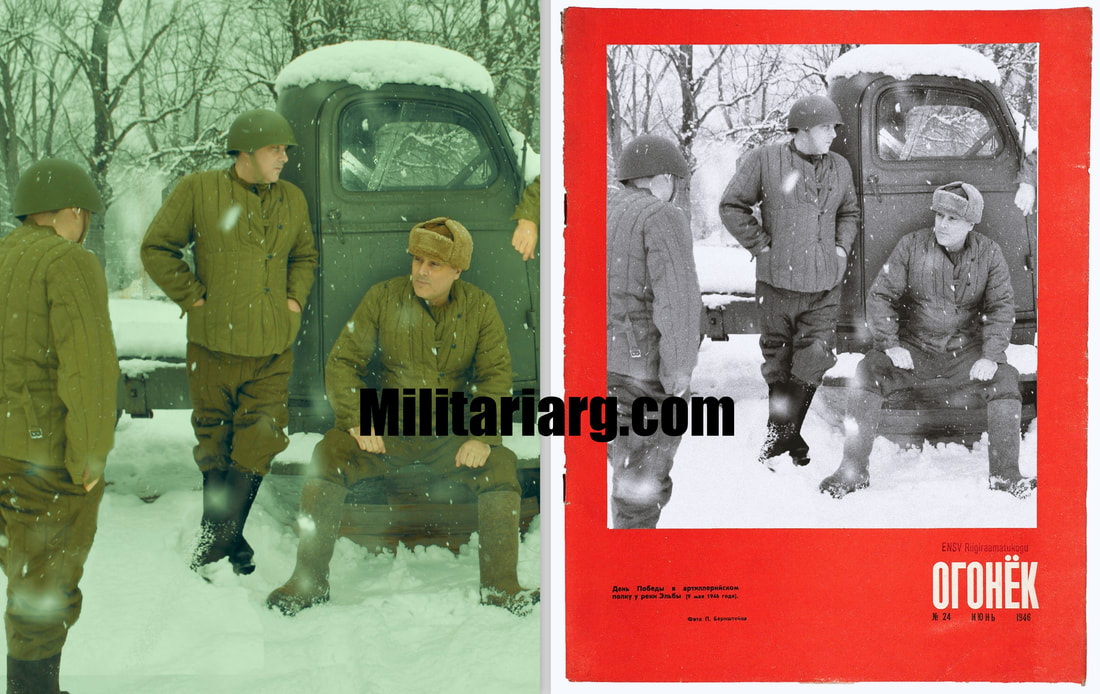
WW2 Soviet reenactment. G506 tractor truck. Telogreika Vatnik quilted jacket an trousers, Valenki boots and original WWII era (Dated 1946) Ssh 40 Soviet Helmet.
M36 Wehrmacht Early War Uniform
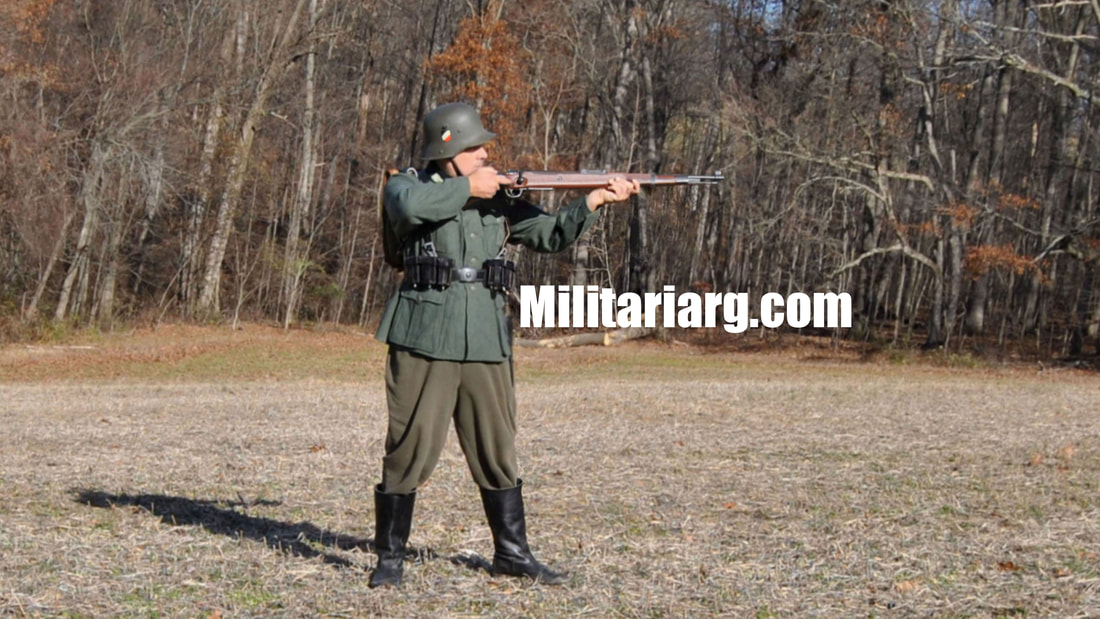
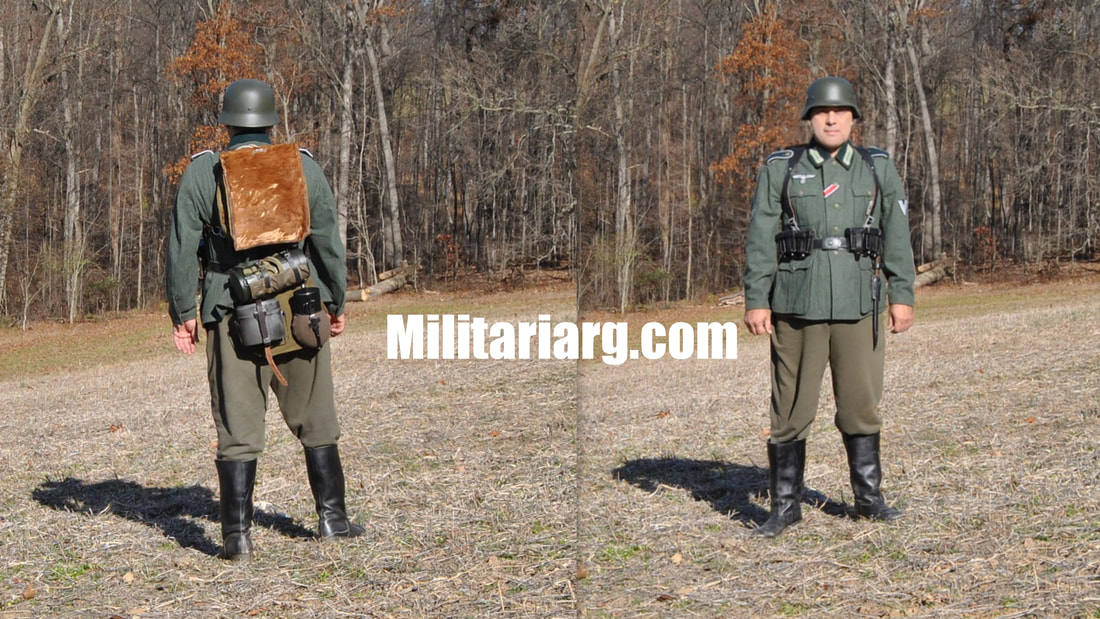
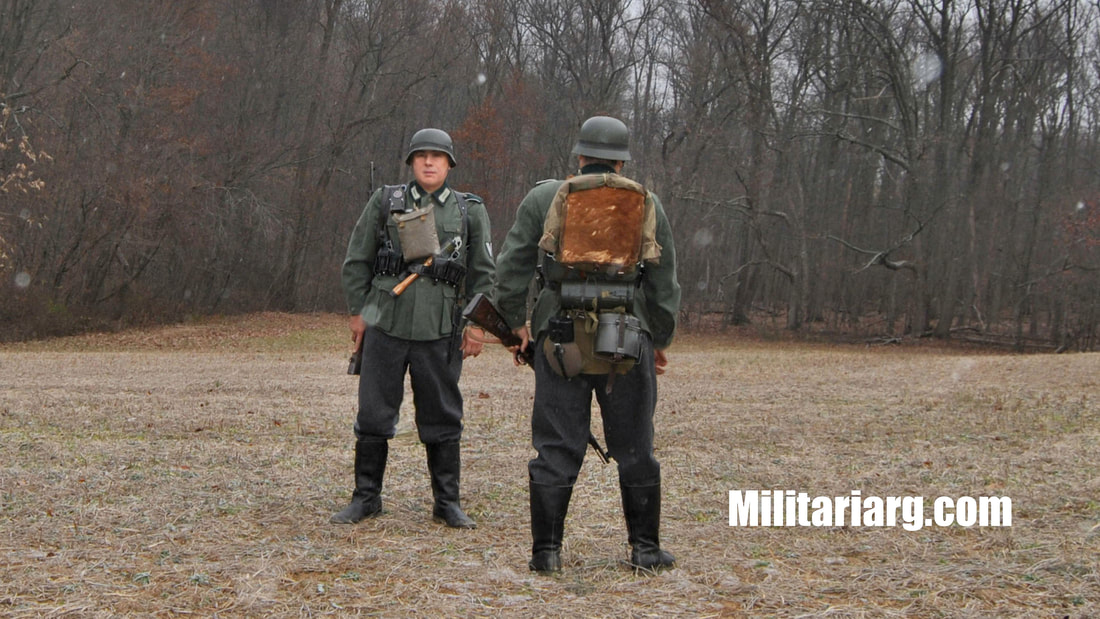
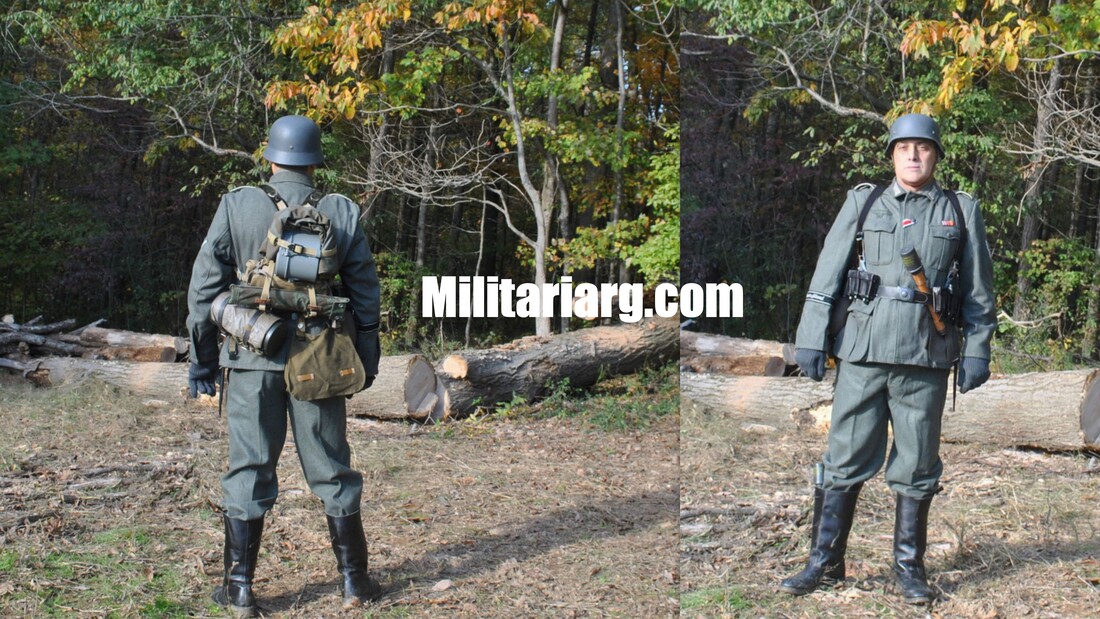
Mauser K98, M36 tunic, marching boots, transitional Geman helmet.
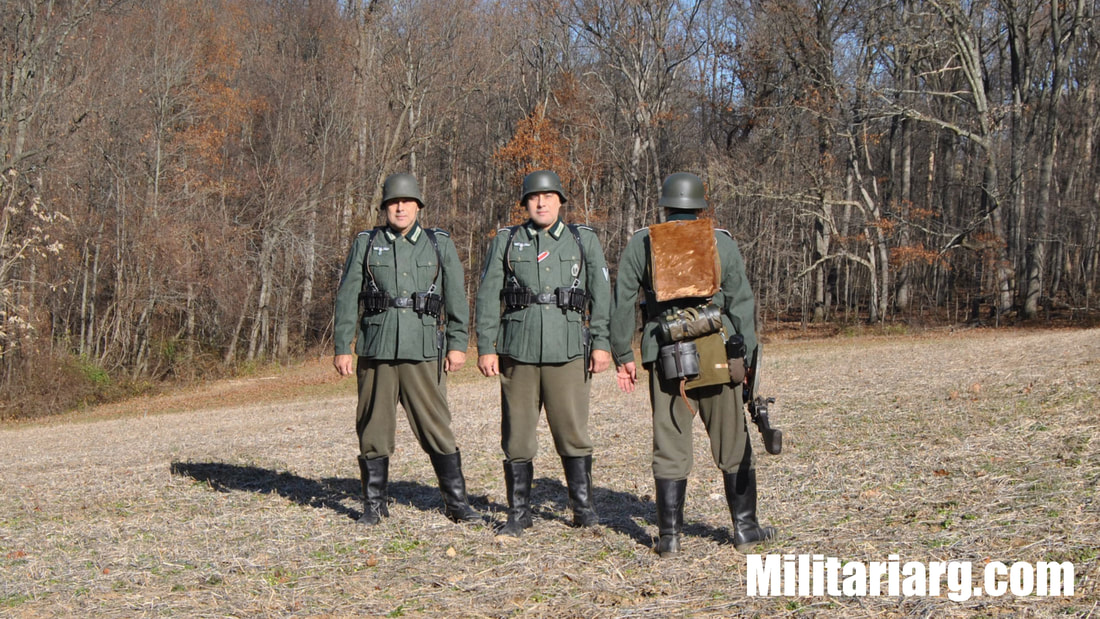
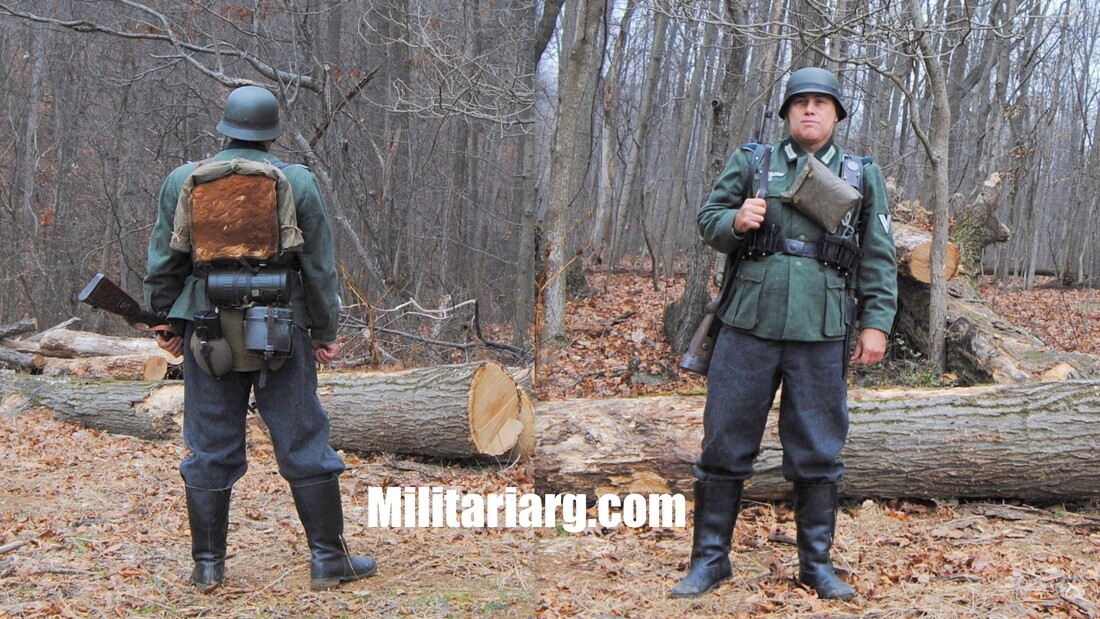
Introduced in 1936, the M36 feldbluse (field tunic) was the standard issue for all ranks of the Wehrmacht and Waffen-SS at the start of the war and remained in use throughout the conflict, although later, simplified models (M40, M42, M43) became predominant.
The tunic was made from a high-quality, field-grey (grey-green) wool blend fabric.
A distinctive feature was the dark bottle-green wool collar and shoulder strap bases, a carryover from earlier Reichswehr uniforms.
It featured four large, external patch pockets with scalloped flaps and central box pleats.
The front closure used five pebbled metal buttons.
The tunic included an internal system with straps and belt hooks to distribute the weight of equipment onto the shoulders, making it more comfortable for soldiers in the field.
M36 uniform was the primary early-war German field tunic, identifiable by its dark bottle-green collar and pleated pockets, while transitional helmets were modified World War I-era helmets used as a temporary measure before the introduction of the M35.
Transitional Helmets
"Transitional" helmets refer to original World War I-era steel helmets (primarily the M1918 model) that were reissued and modified for the German armed forces during the early 1930s until sufficient numbers of the new M35 helmet could be produced. However, its use in the early days of WW2 is documented.
This old helmets were stripped, repainted an "apple green" color, and fitted with the updated Model 1931 (M31) liner system and chinstraps used in the M35.These helmets essentially retained the deeper, more flared skirt and prominent ventilation lugs of their WWI predecessors but featured contemporary Wehrmacht decals (the national shield on the right and the army eagle on the left).
"Transitional" helmets refer to original World War I-era steel helmets (primarily the M1918 model) that were reissued and modified for the German armed forces during the early 1930s until sufficient numbers of the new M35 helmet could be produced. However, its use in the early days of WW2 is documented.
This old helmets were stripped, repainted an "apple green" color, and fitted with the updated Model 1931 (M31) liner system and chinstraps used in the M35.These helmets essentially retained the deeper, more flared skirt and prominent ventilation lugs of their WWI predecessors but featured contemporary Wehrmacht decals (the national shield on the right and the army eagle on the left).
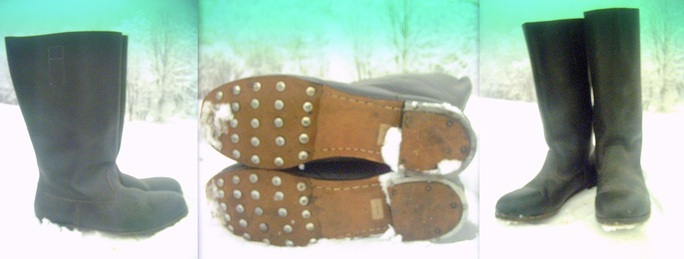
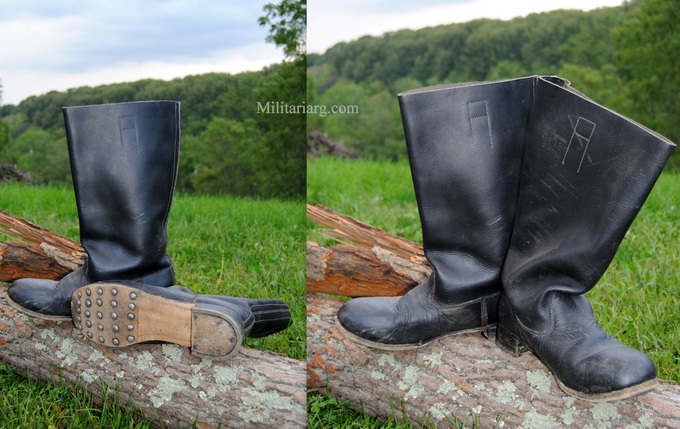
The standard German Wehrmacht marching boots, known as Marschstiefel ("marching boots") and commonly referred to as "jackboots," were calf-high, pull-on leather boots that were a traditional part of the German soldier's uniform for generations.
The boots were made of high-quality, sturdy cowhide or horsehide leather and originally issued in brown, with soldiers instructed to blacken them with polish.
The soles were made of thick leather, reinforced with between 35 and 45 steel hobnails and a steel heel iron for durability and longevity, not primarily for grip on hard surfaces. A metal scuff plate was also fitted to the toe.
The jackboot was a pull-on design with no laces (except for a separate ankle-height work boot variant), which meant they could be put on quickly. They often had internal leather or HBT tape pull straps to assist in putting them on. German soldiers often nicknamed them "Knobelbecher" (dice shakers).
As the war progressed and raw materials like leather became scarce, the standard Wehrmacht footwear evolved significantly:
Height Reduction (1939): The height of the boot shaft was reduced in November 1939 from 35-41 cm to 29-35 cm to save on leather.
The jackboot was a pull-on design with no laces (except for a separate ankle-height work boot variant), which meant they could be put on quickly. They often had internal leather or HBT tape pull straps to assist in putting them on. German soldiers often nicknamed them "Knobelbecher" (dice shakers).
As the war progressed and raw materials like leather became scarce, the standard Wehrmacht footwear evolved significantly:
Height Reduction (1939): The height of the boot shaft was reduced in November 1939 from 35-41 cm to 29-35 cm to save on leather.
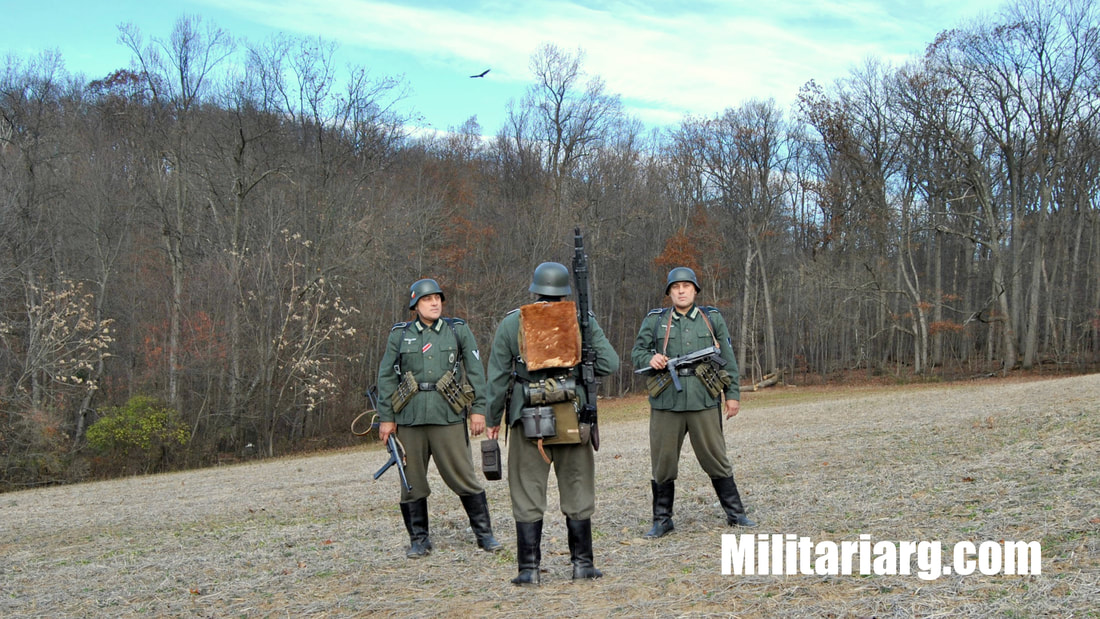
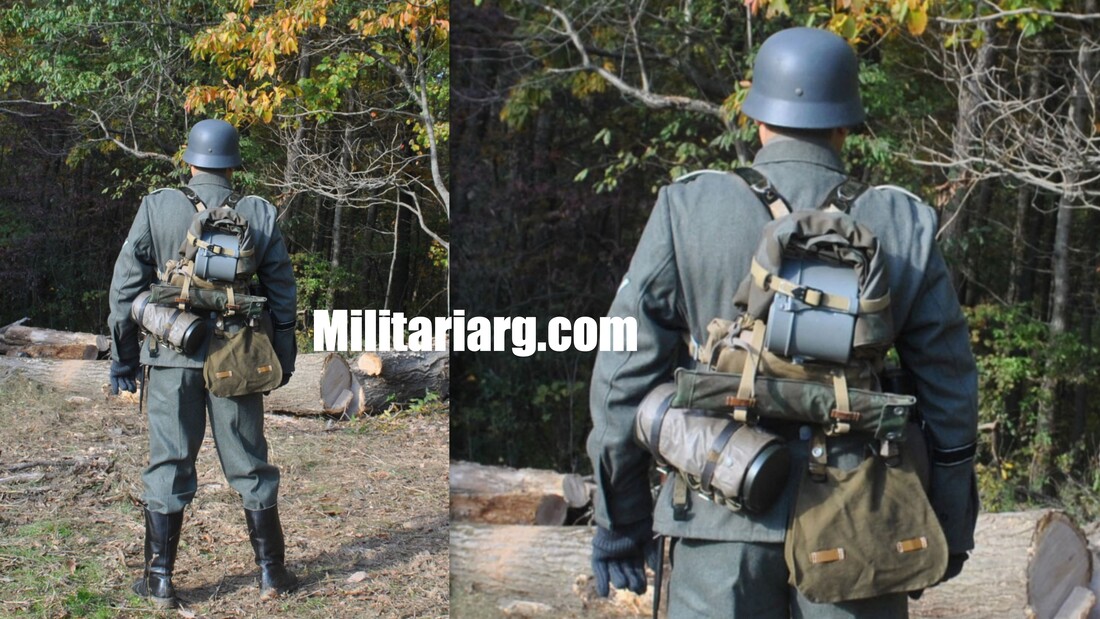
M39 "pony fur" backpack was officially called the Tornister (knapsack) and was standard issue for German infantry in the early and middle stages of World War II. The "pony fur" was actually cowhide with the hair left on. The primary difference between the Tornister M39 and the Tornister M34 "pony fur" backpacks centered on how they were carried and their compatibility with the soldier's load-bearing equipment.
M16 (transitional), M35 Heer double decal German helmet and M39 tornister backpack.
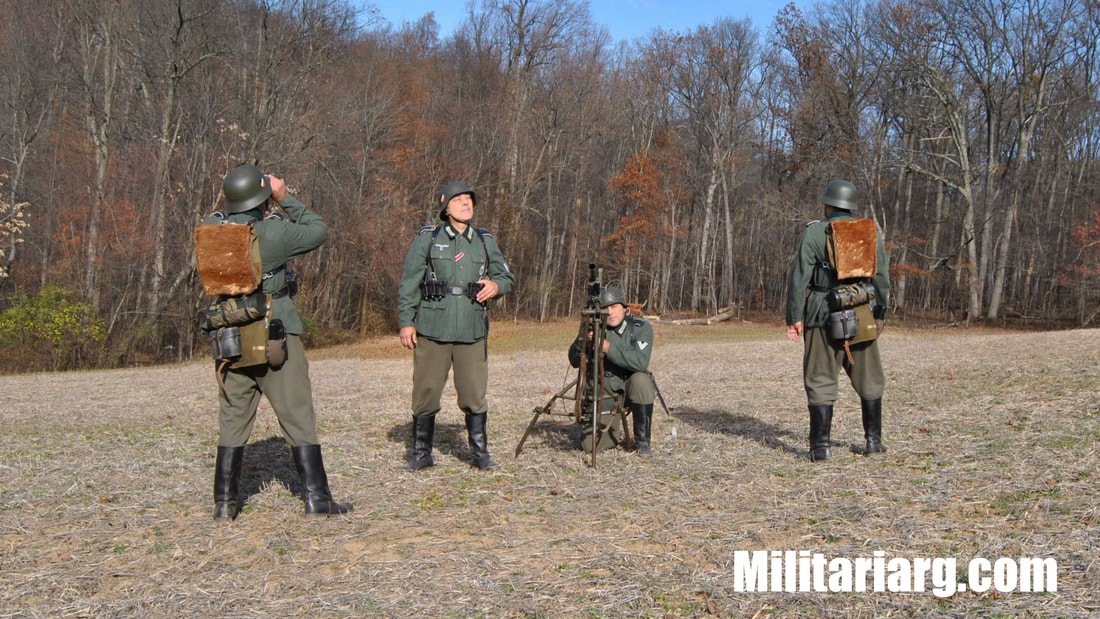
In 1939, the basic infantry webbing (load-carrying equipment) of the Wehrmacht was based on sturdy leather components designed to last and distribute weight effectively.
Model 1936, M36 uniform; M35 helmet, M36 tunic and M36 stone gray trousers, M39 tornister.
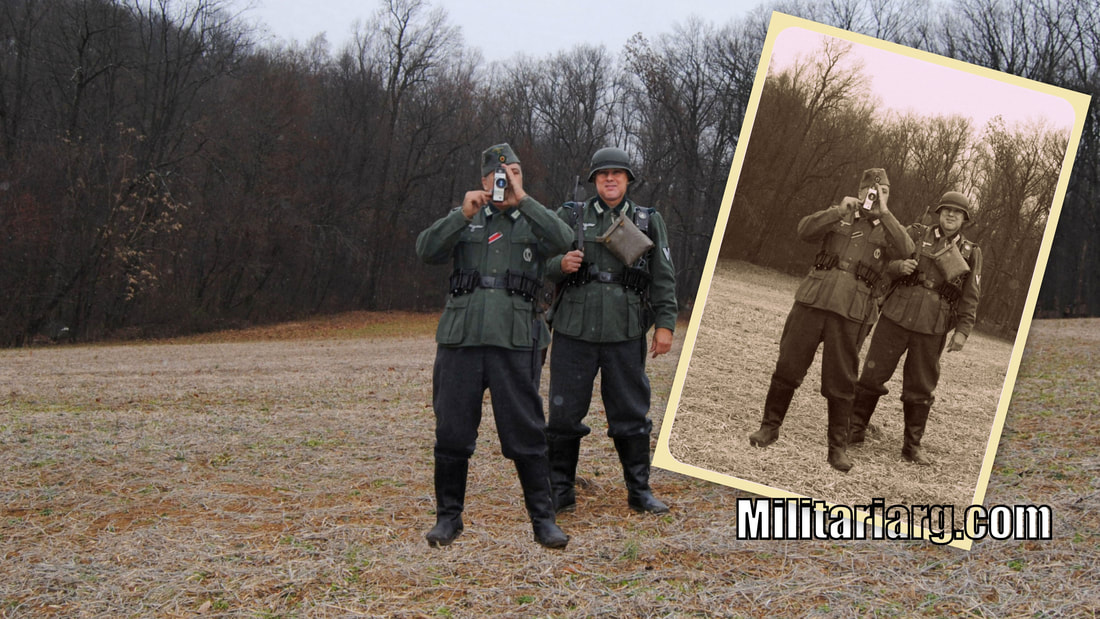
The Basic Load-Bearing System
The standard system consisted primarily of three components: the belt, ammunition pouches, and the Y-straps (introduced around the same time as the war started).
1. The Leather Belt (Koppel)
This was a simple, strong black leather belt with a standard width. The buckle was made of aluminum in 1939 and featured the Wehrmacht eagle and the motto "Gott mit uns" ("God with us").
2. Ammunition Pouches (Munitionstaschen)
For the standard Karabiner 98k rifle, each infantryman carried two ammunition pouches (one on each hip) made of blackened leather. Each pouch had three compartments designed to hold two 5-round stripper clips each, giving the soldier 60 rounds of readily available ammunition.
3. Y-Straps (Koppeltragegestell)
This was the critical component for weight distribution. The Model 1939 Y-straps were made of black or brown leather.
In 1939, the basic infantry webbing (load-carrying equipment) of the Wehrmacht was based on sturdy leather components designed to last and distribute weight effectively.
The Basic Load-Bearing System
The standard system consisted primarily of three components: the belt, ammunition pouches, and the Y-straps (introduced around the same time as the war started).
1. The Leather Belt (Koppel)
This was a simple, strong black leather belt with a standard width. The buckle was made of aluminum in 1939 and featured the
The straps went over the shoulders and attached to the front of the belt using hooks, and to the back of the belt with a single central hook. They also featured D-rings on the back to clip on the Tornister M39 (backpack) or Sturmtasche (assault bag).
This system effectively transferred the weight of the ammunition, bayonet, field gear, and backpack from the waist to the shoulders, a significant ergonomic improvement.
The Basic Load-Bearing System
The standard system consisted primarily of three components: the belt, ammunition pouches, and the Y-straps (introduced around the same time as the war started).
1. The Leather Belt (Koppel)
This was a simple, strong black leather belt with a standard width. The buckle was made of aluminum in 1939 and featured the Wehrmacht eagle and the motto "Gott mit uns" ("God with us").
2. Ammunition Pouches (Munitionstaschen)
For the standard Karabiner 98k rifle, each infantryman carried two ammunition pouches (one on each hip) made of blackened leather. Each pouch had three compartments designed to hold two 5-round stripper clips each, giving the soldier 60 rounds of readily available ammunition.
3. Y-Straps (Koppeltragegestell)
This was the critical component for weight distribution. The Model 1939 Y-straps were made of black or brown leather.
In 1939, the basic infantry webbing (load-carrying equipment) of the Wehrmacht was based on sturdy leather components designed to last and distribute weight effectively.
The Basic Load-Bearing System
The standard system consisted primarily of three components: the belt, ammunition pouches, and the Y-straps (introduced around the same time as the war started).
1. The Leather Belt (Koppel)
This was a simple, strong black leather belt with a standard width. The buckle was made of aluminum in 1939 and featured the
The straps went over the shoulders and attached to the front of the belt using hooks, and to the back of the belt with a single central hook. They also featured D-rings on the back to clip on the Tornister M39 (backpack) or Sturmtasche (assault bag).
This system effectively transferred the weight of the ammunition, bayonet, field gear, and backpack from the waist to the shoulders, a significant ergonomic improvement.
Other Essential Gear Carried on the Webbing
In 1939, soldiers also carried the following items clipped to the belt:
Bayonet: The S84/98 III bayonet was carried in a steel scabbard on the left hip.
Mess Kit (Kochgeschirr): The standard three-piece mess kit was usually strapped to the top of the backpack or sometimes clipped to the belt when the backpack wasn't carried.
Canteen (Feldflasche) and Bread Bag (Brotbeutel): These items were typically attached to the belt via the smaller, dark brown canvas Brotbeutel, which functioned like a small haversack worn on the right or left hip/rear. The canteen often clipped onto the bread bag strap.
This robust leather system was the basis for the early war German infantryman's load and remained largely unchanged in design, although the materials transitioned to canvas and webbed fabric later in the war to save leather.
In 1939, soldiers also carried the following items clipped to the belt:
Bayonet: The S84/98 III bayonet was carried in a steel scabbard on the left hip.
Mess Kit (Kochgeschirr): The standard three-piece mess kit was usually strapped to the top of the backpack or sometimes clipped to the belt when the backpack wasn't carried.
Canteen (Feldflasche) and Bread Bag (Brotbeutel): These items were typically attached to the belt via the smaller, dark brown canvas Brotbeutel, which functioned like a small haversack worn on the right or left hip/rear. The canteen often clipped onto the bread bag strap.
This robust leather system was the basis for the early war German infantryman's load and remained largely unchanged in design, although the materials transitioned to canvas and webbed fabric later in the war to save leather.
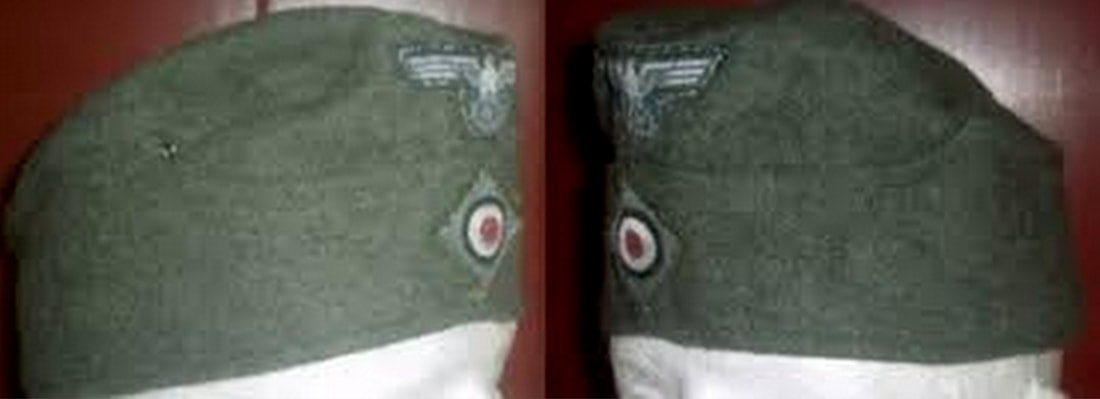
M34 German field cap.
Wehrmacht M34 overseas field cap. (Replica).
The M34 Field Cap (Feldmütze 34) was the standard garrison and field headwear of the German Wehrmacht, adopted in 1934. It was a simple, practical, and highly recognizable soft cloth cap issued to all branches of the armed forces (Army, Navy, and Air Force).
M36 Greatcoat.
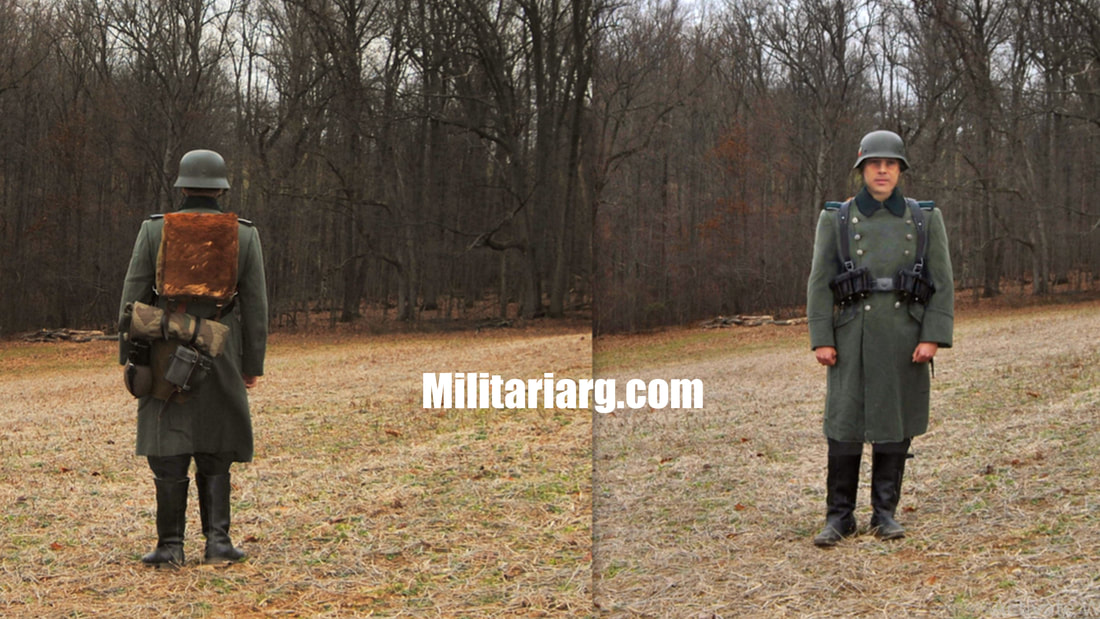
The M36 greatcoat (Mantel M36) was the standard issue, double-breasted overcoat for all Wehrmacht personnel in the early war years, designed to provide warmth and protection in cold and wet weather.
The standard Wehrmacht M38 gas mask was stored in a metal canister which was waterproof when closed, not a fabric bag. The separate item designed to be impermeable was a small gas cape pouch made of rubberized fabric.
In 1939, the primary model of trousers used by the German Heer (Army) was the Tuchhose (cloth trousers) of the Model 1936 (M36) or very similar Model 1937 pattern. The most distinctive feature was their color: Steingrau (stone grey). This was a slightly different shade from the field-grey of the tunic and greatcoat. The trousers were a simple, straight-leg design, meant to be worn with the tall marching boots ("jackboots").
They featured a high waist, a button fly, and suspender attachment points and two side slash pockets, one rear pocket, and a small watch pocket. They were made of a sturdy wool blend.
M36/M37 trousers used by the Wehrmacht in 1939 were very similar to their World War I predecessors in both style and color, reflecting a strong continuity in German military tailoring tradition.
The style of the trousers used in 1939 was essentially the traditional pattern that had been in use since the early 1900s, with only minor modifications after WWI:
Both WWI and early WWII trousers featured a distinct high waist, designed to fit correctly with the belt and suspend the weight of gear. They were a straight-leg cut intended to be worn tucked into the tall marching boots ("jackboots").
The main stylistic difference was a minor update in the 1920s that added a right rear pocket to the existing design.
In 1939, the primary model of trousers used by the German Heer (Army) was the Tuchhose (cloth trousers) of the Model 1936 (M36) or very similar Model 1937 pattern. The most distinctive feature was their color: Steingrau (stone grey). This was a slightly different shade from the field-grey of the tunic and greatcoat. The trousers were a simple, straight-leg design, meant to be worn with the tall marching boots ("jackboots").
They featured a high waist, a button fly, and suspender attachment points and two side slash pockets, one rear pocket, and a small watch pocket. They were made of a sturdy wool blend.
M36/M37 trousers used by the Wehrmacht in 1939 were very similar to their World War I predecessors in both style and color, reflecting a strong continuity in German military tailoring tradition.
The style of the trousers used in 1939 was essentially the traditional pattern that had been in use since the early 1900s, with only minor modifications after WWI:
Both WWI and early WWII trousers featured a distinct high waist, designed to fit correctly with the belt and suspend the weight of gear. They were a straight-leg cut intended to be worn tucked into the tall marching boots ("jackboots").
The main stylistic difference was a minor update in the 1920s that added a right rear pocket to the existing design.
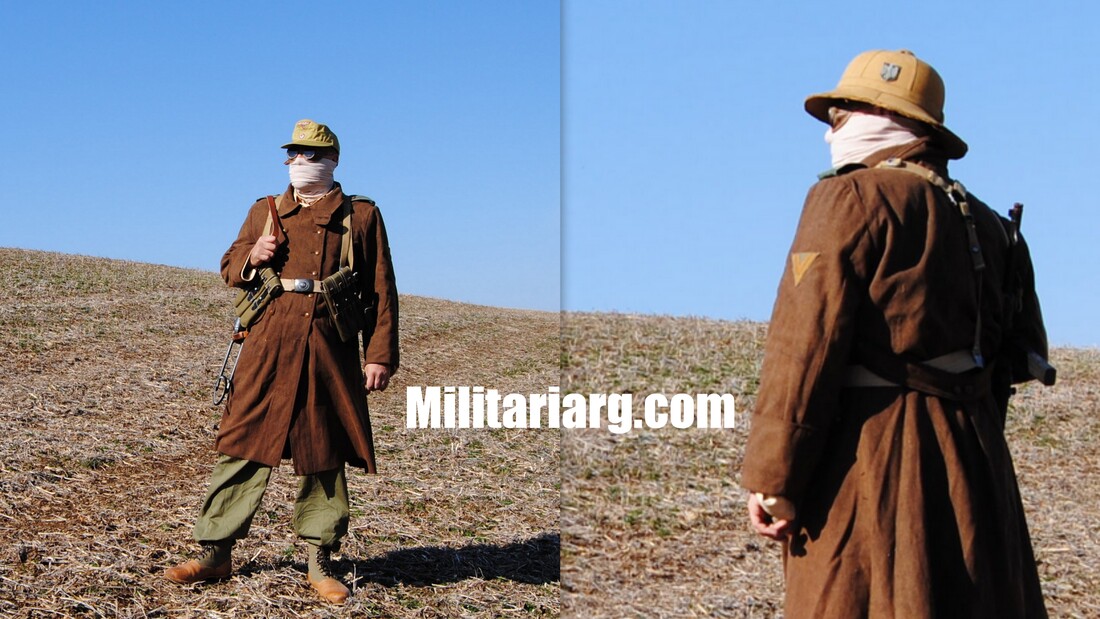
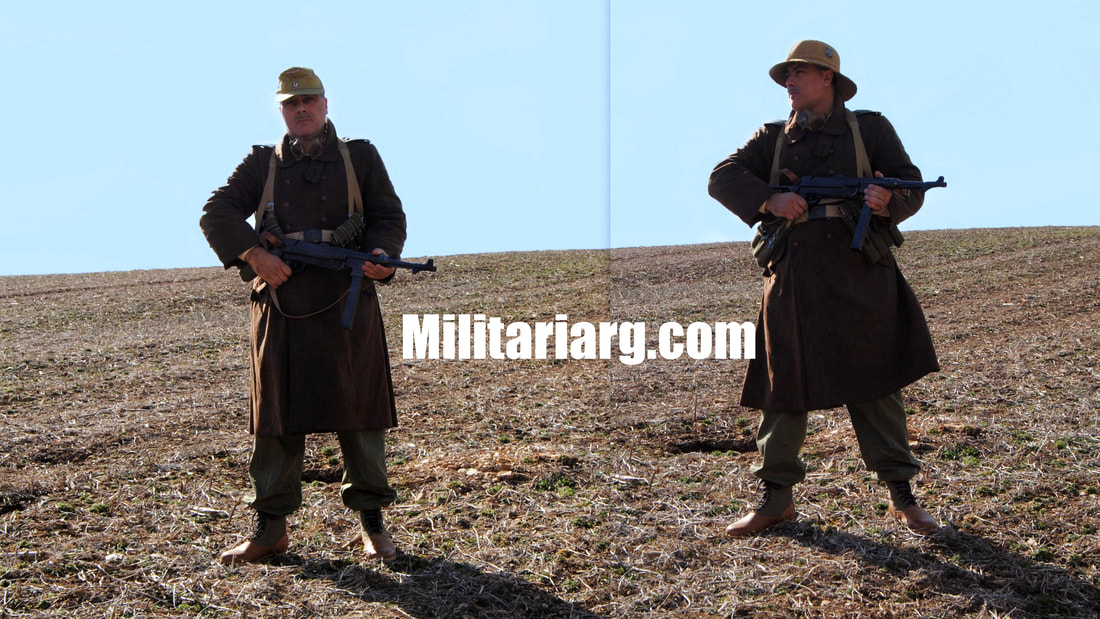
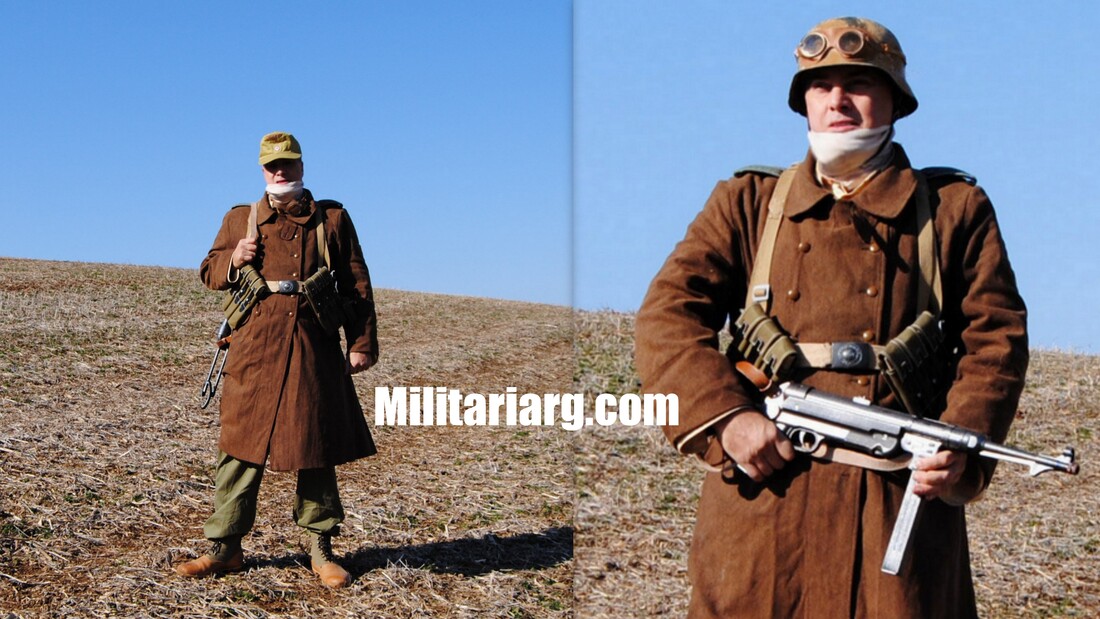
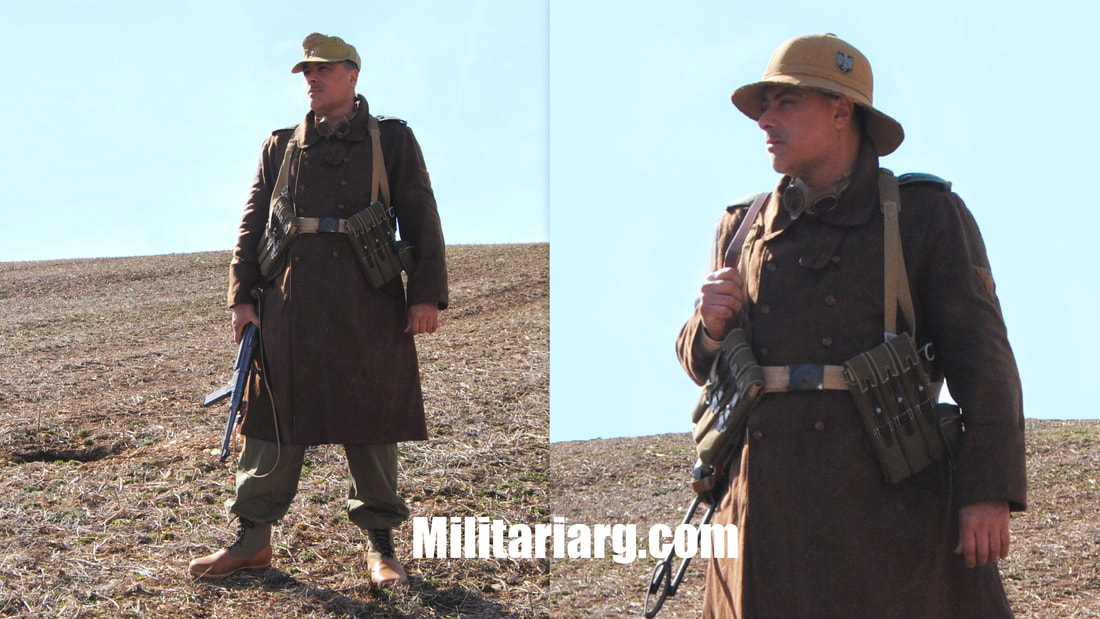
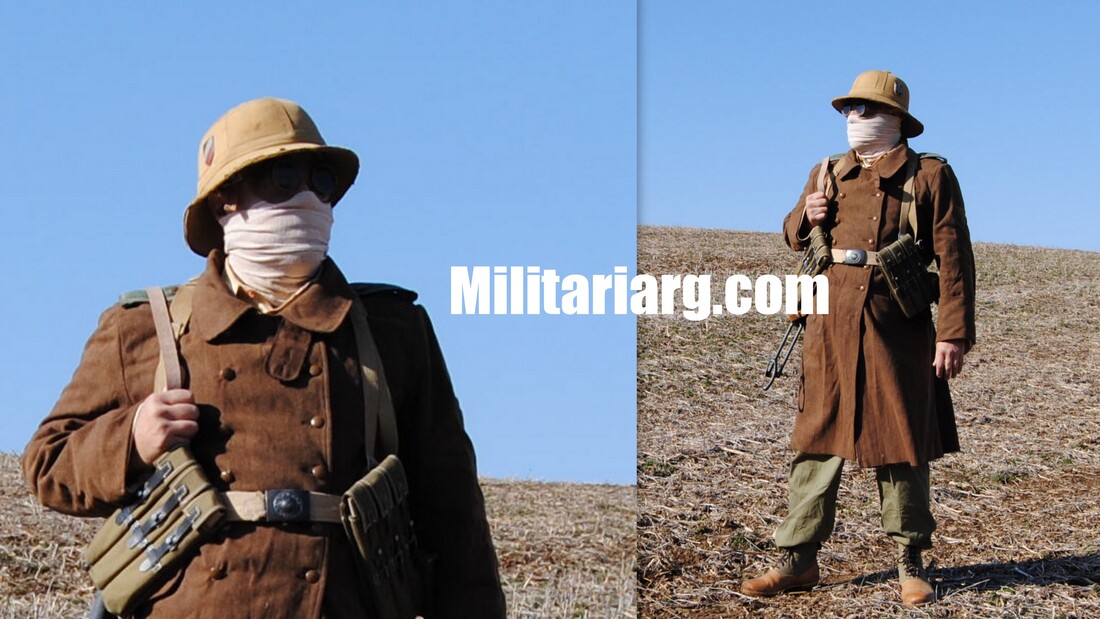
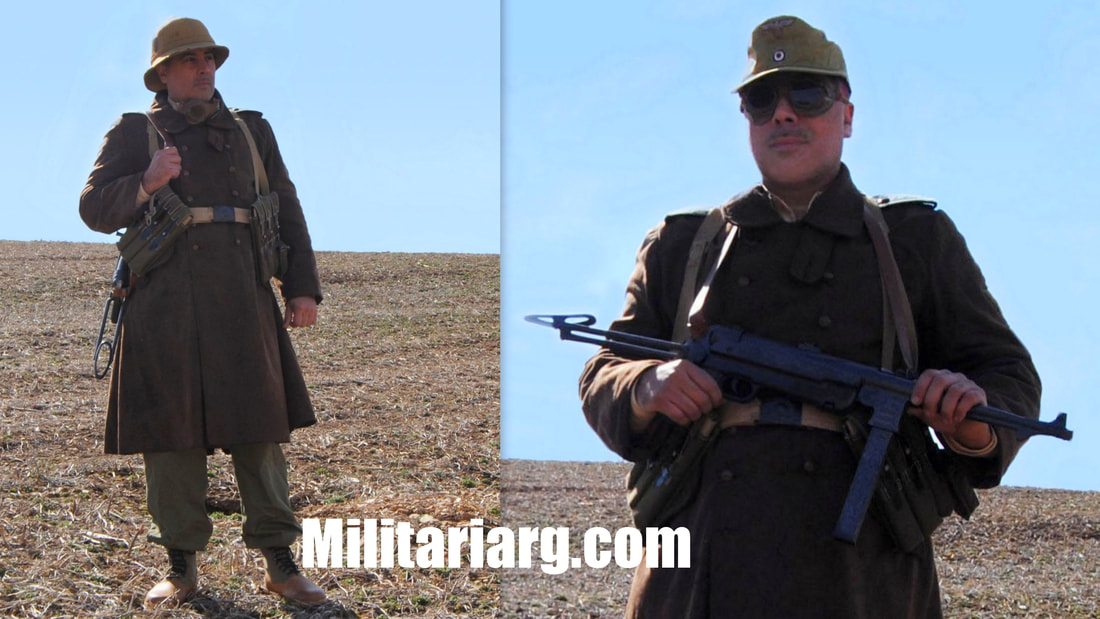
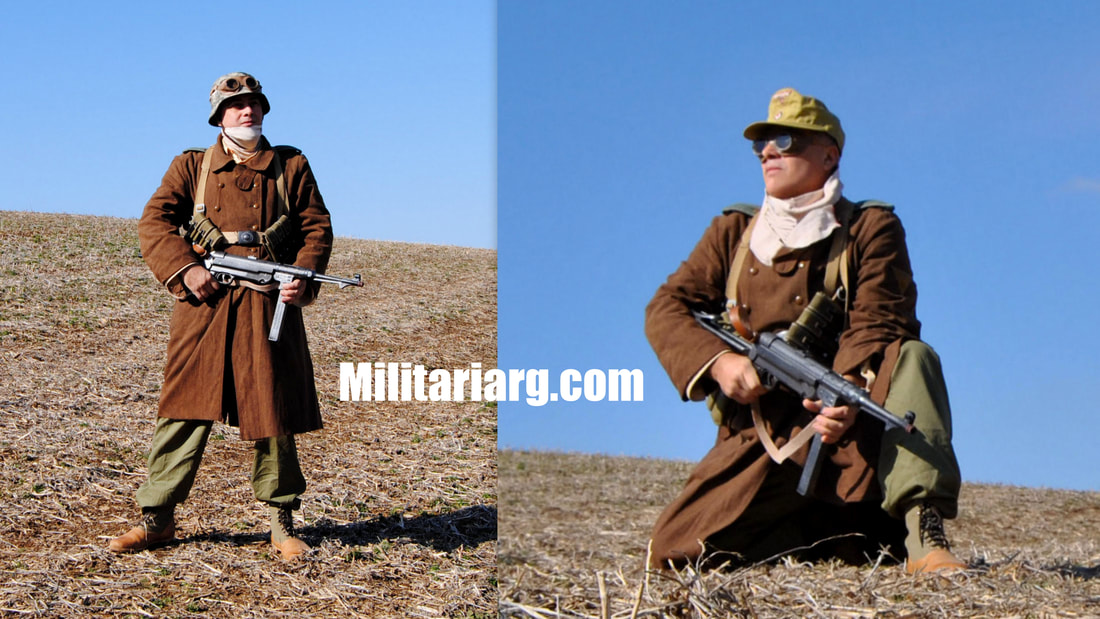
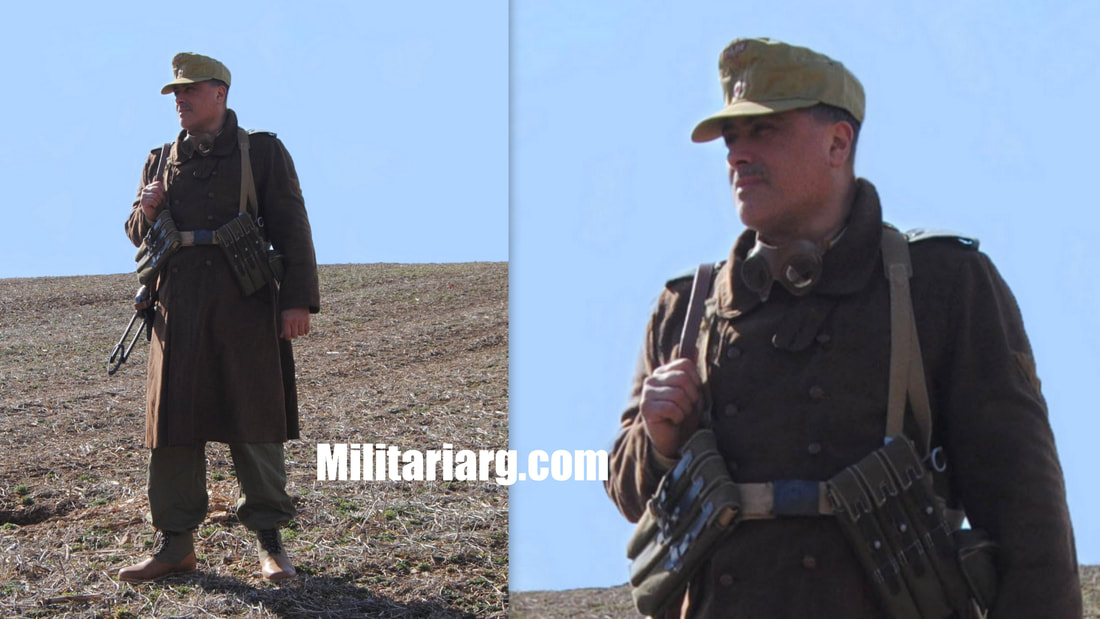
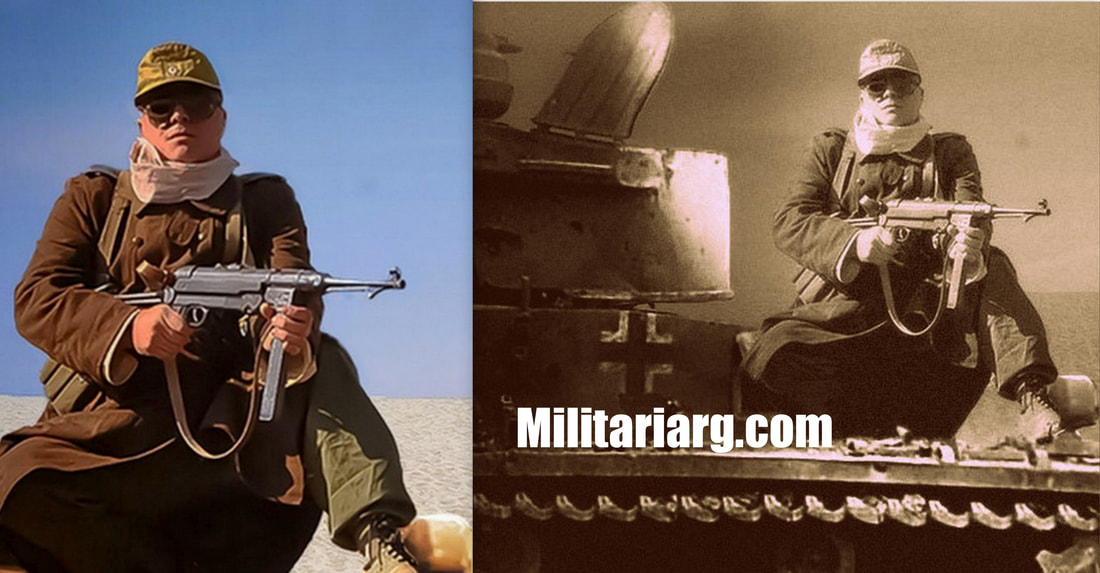
Panzer Armee Afrika Korps (DAK). El Alamein, Gazala Bir Hakeim. 900 Motorized (Panzer) Pioneir Bataillon Engineer. 90th Leichte (Light Infantry Division).
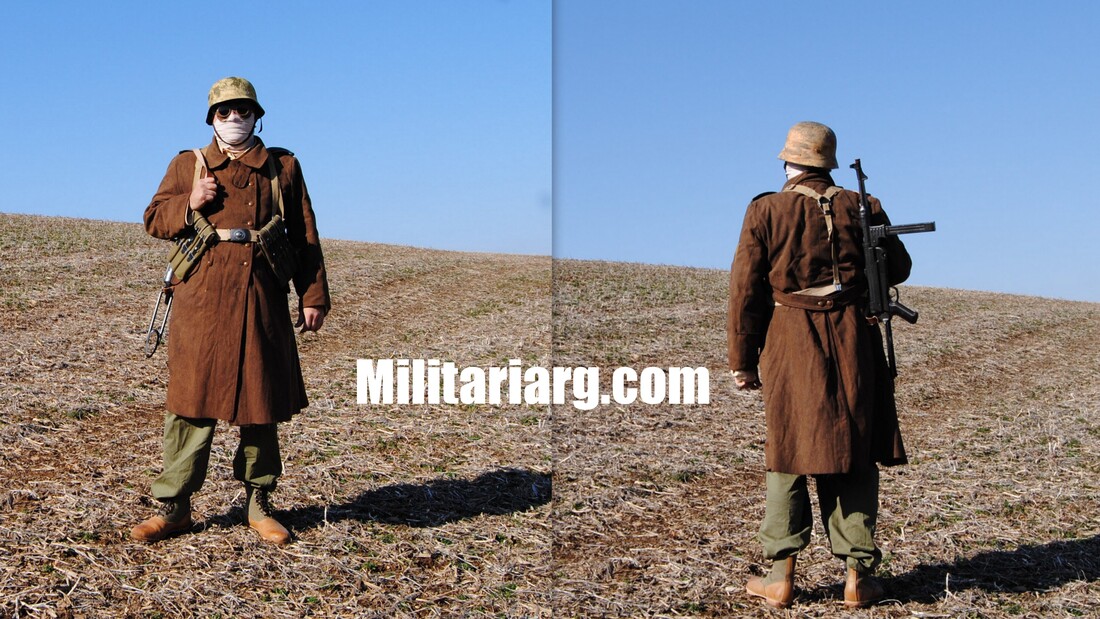
The Deutsches Afrikakorps (DAK) uniform was the specialized tropical uniform issued to German Army (Heer) forces deployed to North Africa and other Mediterranean and Balkan regions from 1941 onwards. It was made from lightweight cotton to cope with the heat, a major departure from the standard European wool field grey uniforms.
The DAK uniform had a distinct appearance, primarily in shades of olive green, tan, or khaki that often faded to a creamy sand color under the harsh sun.
Tropical Tunic (M1940/M1942): The standard tunic was a thigh-length blouse made of cotton twill. The first pattern (M40) had four pleated pockets and scalloped flaps, similar to the European tunic, while a later M42 pattern simplified production by removing the pocket pleats. Unlike the M36 field tunic, the tropical version did not have a dark green collar and featured tropical-specific insignia.
Tropical Trousers & Shorts: Soldiers were issued matching long trousers, which often had tapes at the bottom to pull them tight at the ankles. To combat the heat, shorts were also issued and worn widely, although their use on the front lines was often restricted by regulations to avoid unnecessary injury.
Steel Helmet (Stahlhelm): The standard M35 or M40 steel helmet was painted a sand color, often with sand added to the paint for a camouflage texture, and used in battle.
Headwear:
Tropical Field Cap (M40): A soft, visored field cap was very popular and featured a long peak to shade the eyes. The interior was sometimes lined with red fabric, believed by German engineers to help keep the head cool.
Pith Helmet (Tropenhelm): A cork-based pith helmet with a cotton covering was issued but proved unpopular and ineffective, mainly seeing use in garrison or ceremonial roles.
Tropical Field Cap (M40): A soft, visored field cap was very popular and featured a long peak to shade the eyes. The interior was sometimes lined with red fabric, believed by German engineers to help keep the head cool.
Pith Helmet (Tropenhelm): A cork-based pith helmet with a cotton covering was issued but proved unpopular and ineffective, mainly seeing use in garrison or ceremonial roles.
Web Gear: The load-bearing equipment (webbing) was typically made of khaki-colored canvas web material or reddish-brown leather, as black leather was less suited to the dry desert climate. DAK soldiers often mixed and matched items, wearing wool greatcoats during the cold desert nights or utilizing captured British and Italian clothing due to supply shortages.
DAK used primarily two types of specialized goggles to protect against the pervasive sand, dust, and sun of the North African desert:
Augenschützer 42 (Model 1942 Dust Goggles). These were the most common type, consisting of four-panel foldable plastic (or cellophane) lenses held together by vertically ribbed fabric strips. The edges of the lenses were lined with a black velvet or felt strip for comfort.
The General Purpose Leather Goggles: Featured more robust construction with soft gray leather eye cups and metal lens frames. Like the Model 1942, these also had removable lenses (clear or tinted) and incorporated side air vents. They had a tan fabric or elastic strap to fit over the head or helmet.
These were a more durable option compared to the simpler plastic ones and were likely preferred by motorized troops (drivers, tank crews, etc.) where constant exposure to wind and dust was an issue.
Augenschützer 42 (Model 1942 Dust Goggles). These were the most common type, consisting of four-panel foldable plastic (or cellophane) lenses held together by vertically ribbed fabric strips. The edges of the lenses were lined with a black velvet or felt strip for comfort.
The General Purpose Leather Goggles: Featured more robust construction with soft gray leather eye cups and metal lens frames. Like the Model 1942, these also had removable lenses (clear or tinted) and incorporated side air vents. They had a tan fabric or elastic strap to fit over the head or helmet.
These were a more durable option compared to the simpler plastic ones and were likely preferred by motorized troops (drivers, tank crews, etc.) where constant exposure to wind and dust was an issue.
Boots: The DAK used a unique style of tall, lace-up tropical boots made of brown leather and canvas, which were more practical in the sand than the standard hobnailed marching boots. Ankle-height boots with gaiters were also used.
Heer tropical forces were issued two main lengths of lace-up canvas and leather boots: an ankle-high (low) boot and a calf-high (high) boot.
M1940 First Pattern (Low Boot): This was the initial DAK tropical boot introduced for the North African campaign. It was an ankle-high, all-leather boot (tan rough-out) which was a lightened version of the standard European theater combat boot.
M1941/M1942 Second/Third Pattern (High Boot): A subsequent design was introduced, featuring the significantly taller, calf-high canvas and leather construction. This longer design provided better protection against sand and the environment
Heer tropical forces were issued two main lengths of lace-up canvas and leather boots: an ankle-high (low) boot and a calf-high (high) boot.
M1940 First Pattern (Low Boot): This was the initial DAK tropical boot introduced for the North African campaign. It was an ankle-high, all-leather boot (tan rough-out) which was a lightened version of the standard European theater combat boot.
M1941/M1942 Second/Third Pattern (High Boot): A subsequent design was introduced, featuring the significantly taller, calf-high canvas and leather construction. This longer design provided better protection against sand and the environment
Standard Army tropical greatcoat in a brownish color, which was a vital piece of equipment for protection against the surprisingly cold desert nights and sandstorms.
While the Afrika Korps is famous for its armored and mechanized operations, the majority of the German Army (Heer) in World War II, including a significant portion of the DAK forces, was foot-mobile infantry.
M40 Uniform
The M40 uniform (officially Feldbluse 40 or Field Blouse 40) was the first major simplified version of the German Wehrmacht tunic introduced during World War II. It was a direct response to the need for faster, cheaper mass production of uniforms as the war expanded.
The M40 uniform maintained the general style and functionality of the M36 but eliminated some high-cost features to speed up manufacturing.
Color Standardization:
This was the most significant change. The M40 was made entirely of a single shade of field-grey wool. The distinctive dark bottle-green collar of the M36 was eliminated to simplify production and save dye.
Material Quality: The overall quality of the wool blend began to decrease compared to the early M36 tunics as material shortages became a factor.
Remaining Features (Shared with M36): Despite the simplifications, the M40 retained several core design elements:
Pockets: It kept the four large, external patch pockets with scalloped flaps and central box pleats.
Internal Suspension: The internal suspension system for distributing the weight of equipment onto the shoulders remained intact.
Insignia: Standard Wehrmacht insignia (breast eagle and collar tabs/shoulder boards) were applied.
This was the most significant change. The M40 was made entirely of a single shade of field-grey wool. The distinctive dark bottle-green collar of the M36 was eliminated to simplify production and save dye.
Material Quality: The overall quality of the wool blend began to decrease compared to the early M36 tunics as material shortages became a factor.
Remaining Features (Shared with M36): Despite the simplifications, the M40 retained several core design elements:
Pockets: It kept the four large, external patch pockets with scalloped flaps and central box pleats.
Internal Suspension: The internal suspension system for distributing the weight of equipment onto the shoulders remained intact.
Insignia: Standard Wehrmacht insignia (breast eagle and collar tabs/shoulder boards) were applied.
Introduced in April 1940, the M40 quickly became the most common uniform used during the campaigns in France, the Balkans, and the early stages of Operation Barbarossa in the Soviet Union.
The M40 was later followed by further simplified models like the M42 (which removed the pocket pleats) and the M43 (which introduced straight pocket flaps and a simpler cut) as resource scarcity became critical.
M40 tunics remained in front-line service throughout the entire war, issued alongside older M36s and newer, simplified models until Germany's surrender in 1945.
The M40 was later followed by further simplified models like the M42 (which removed the pocket pleats) and the M43 (which introduced straight pocket flaps and a simpler cut) as resource scarcity became critical.
M40 tunics remained in front-line service throughout the entire war, issued alongside older M36s and newer, simplified models until Germany's surrender in 1945.
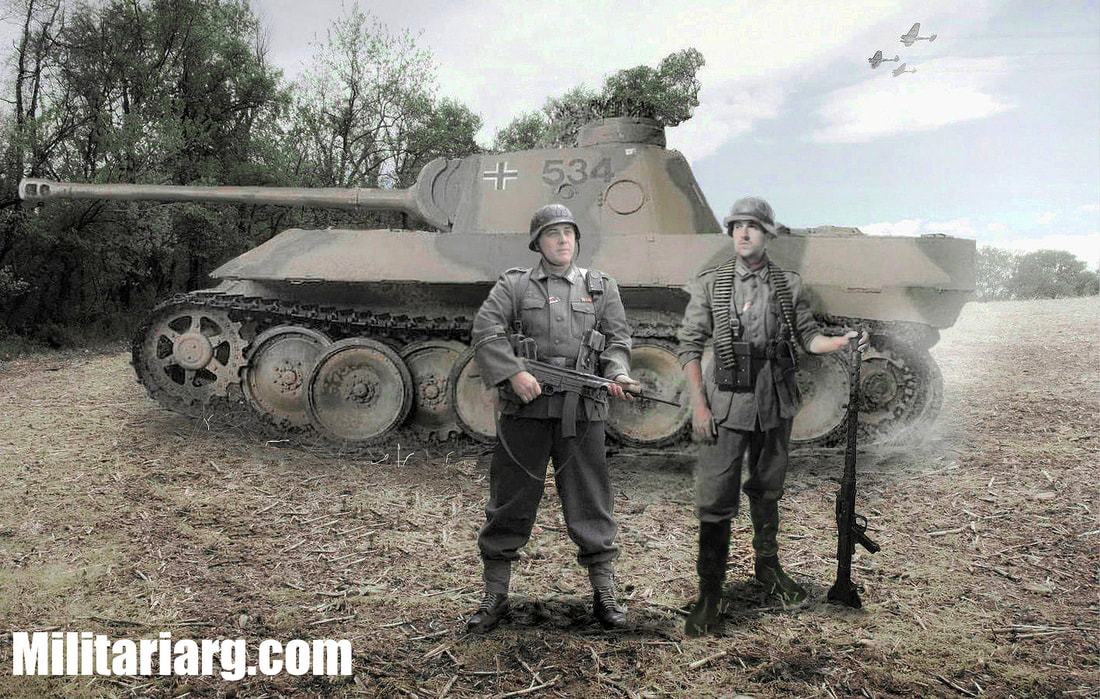
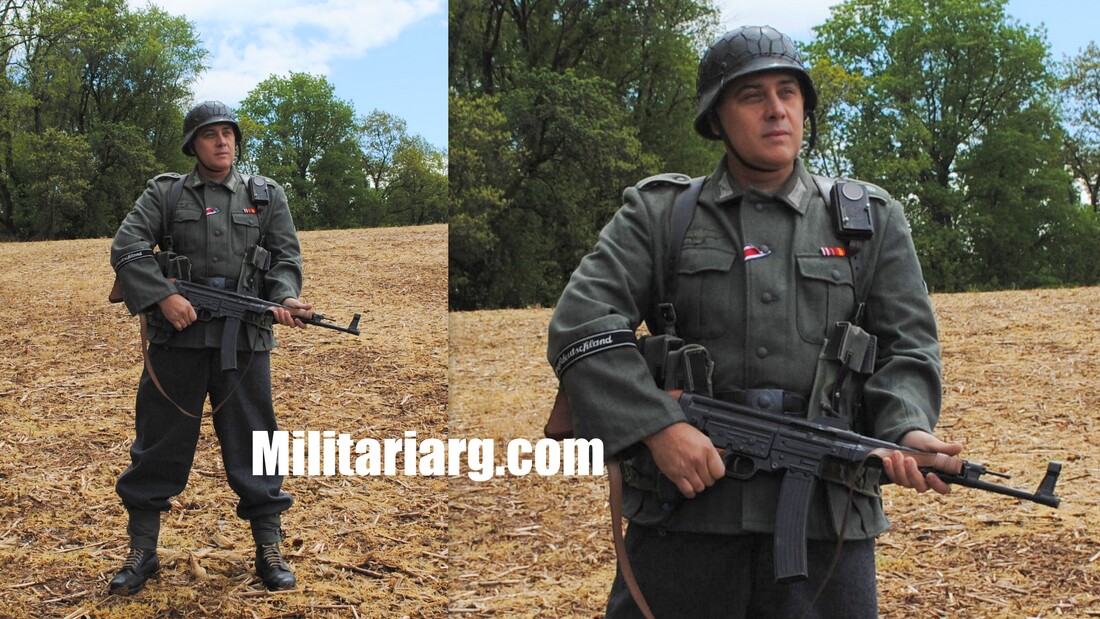
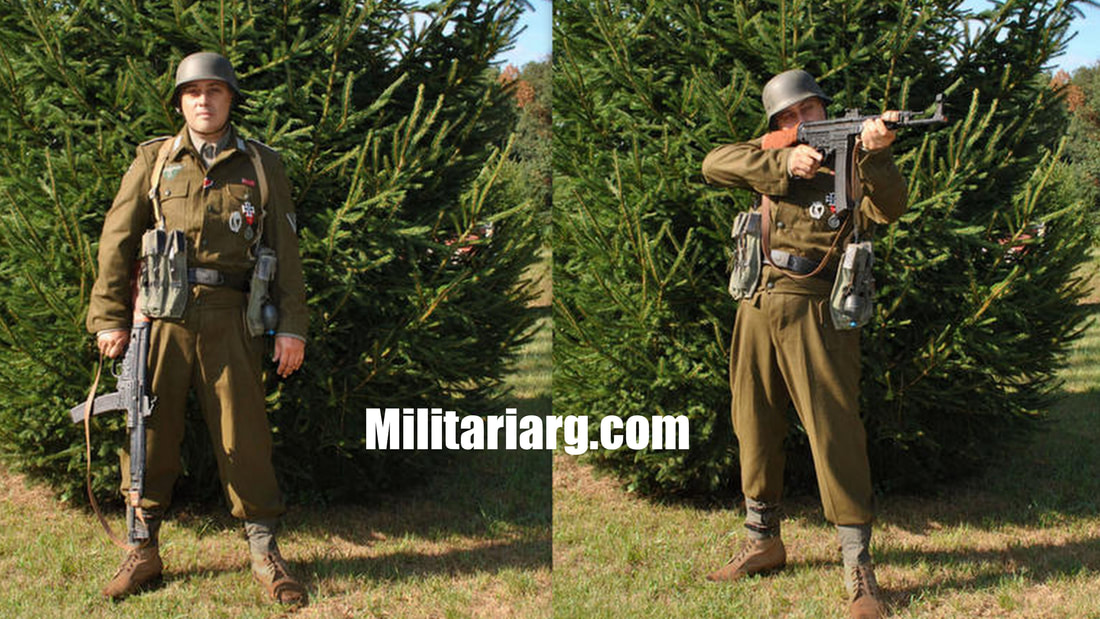
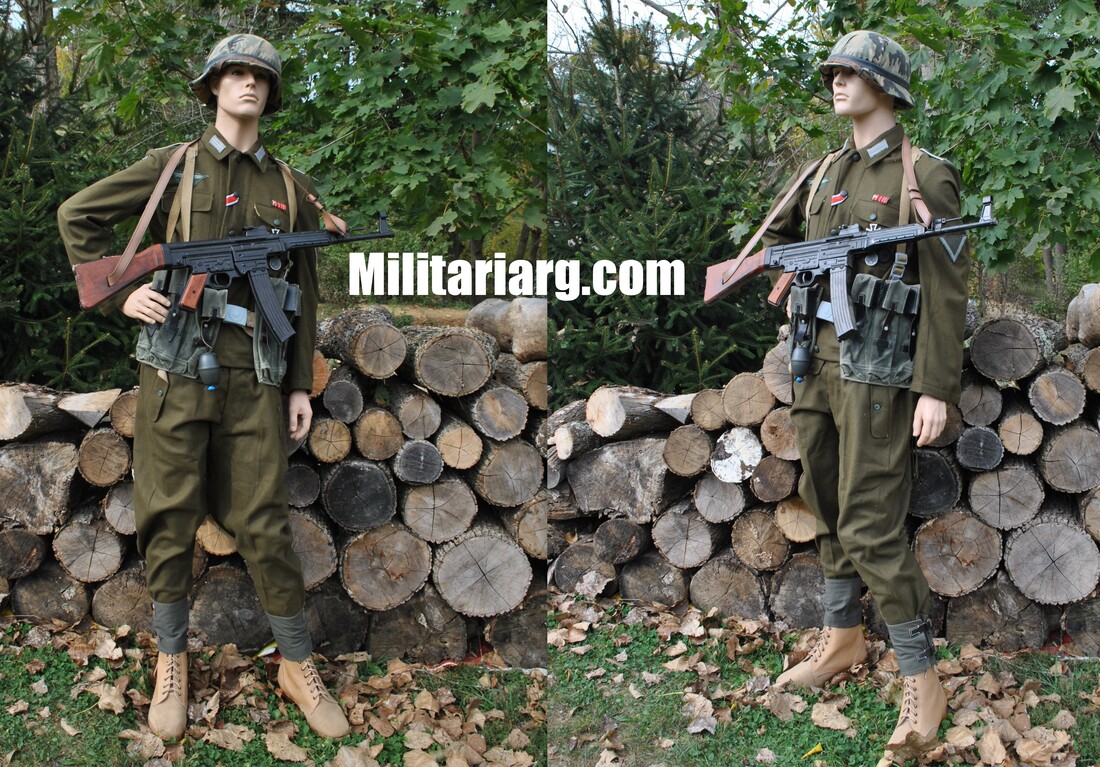
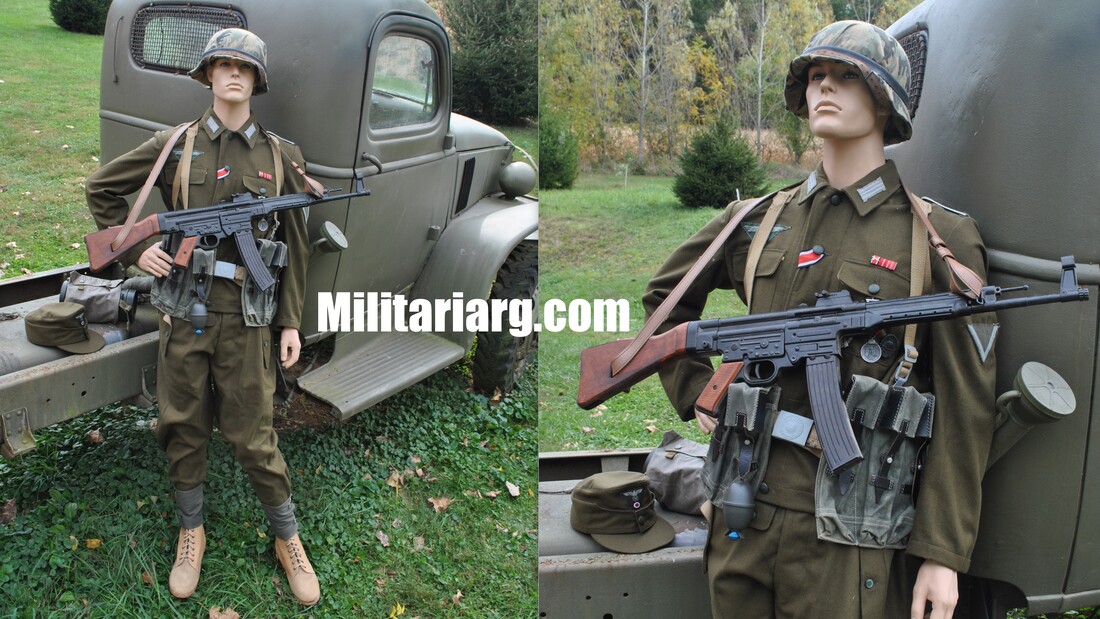
M40 German helmet with chicken wire; Heer German M40 tunic jacket and Gefreiter rank, M36 trousers (Steingrau color) STg-44 and canvas ammo pouches. Pocket flashlight.Wehrmacht leafther webbing. Ankle boots and gaiters.
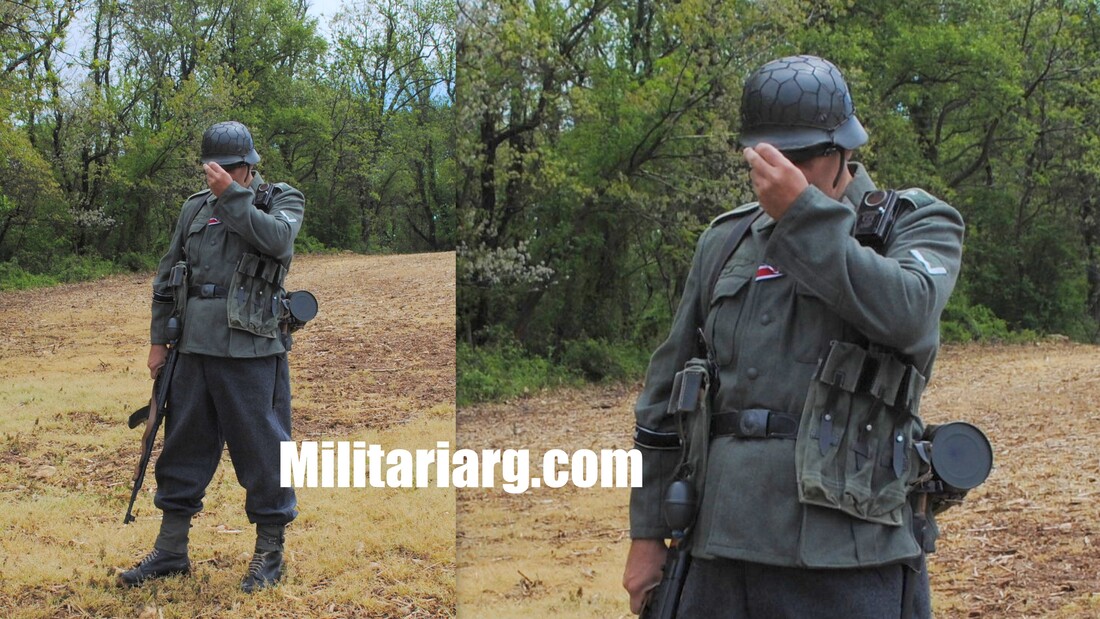
Ankle Boots (1941-1943): Due to the expense of production and material shortages, the issuance of the tall jackboots was restricted to combat units in 1940 and phased out for new recruits in 1941. Ankle-height lace-up boots (Schnürschuhe) were increasingly issued instead.
Gaiters: The ankle boots were worn with canvas gaiters (Gamaschen) to cover the space between the boot top and the bottom of the trousers, providing protection from mud and debris.
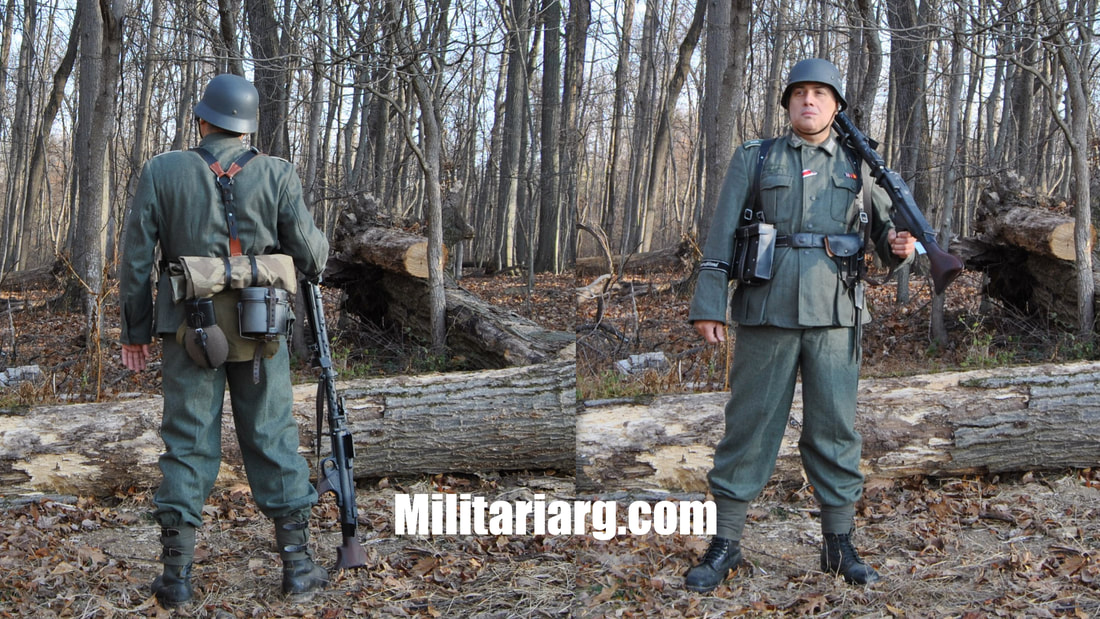
M40 German helmet tunic and trousers, marching boots. The tall marching boots (jackboots or
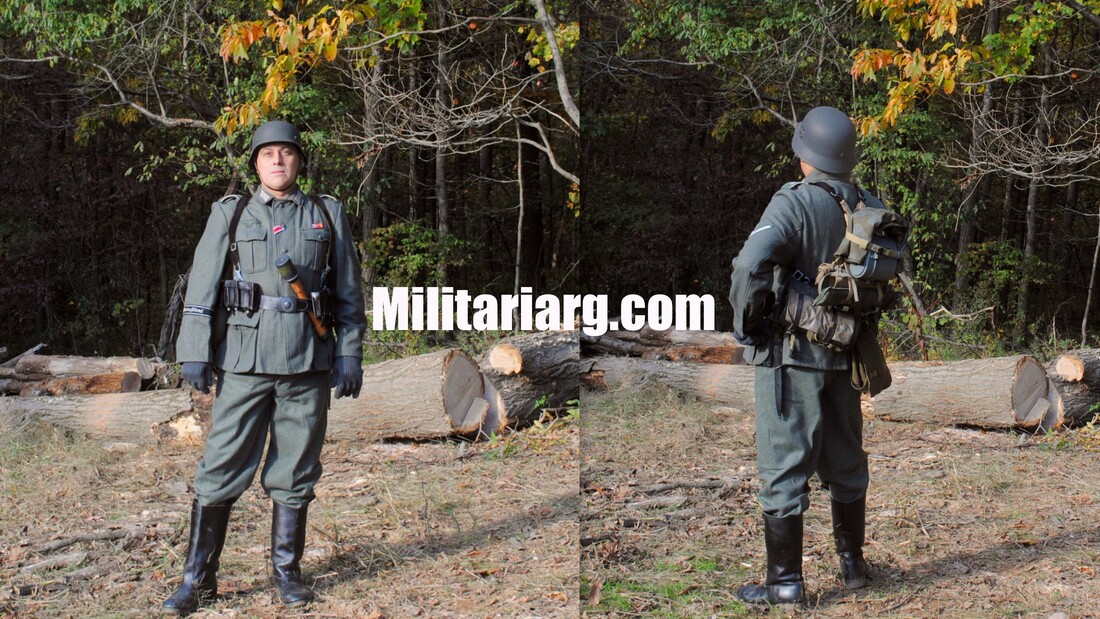
Marschstiefel) were standard issue and worn with the M40 uniform.
The Wehrmacht reduced the height of new-production jackboots slightly to save leather.
1942 (Transition Begins): The use of ankle-height lace-up boots (Schnürschuhe) combined with gaiters (Gamaschen) started to increase significantly as an economy measure, particularly for new recruits and support units.
1943 (Official Phase-Out): This is the key year. The production and issuance of the tall jackboots largely ceased. The ankle boot and gaiter combination officially became the new standard issue for all personnel.
1942 (Transition Begins): The use of ankle-height lace-up boots (Schnürschuhe) combined with gaiters (Gamaschen) started to increase significantly as an economy measure, particularly for new recruits and support units.
1943 (Official Phase-Out): This is the key year. The production and issuance of the tall jackboots largely ceased. The ankle boot and gaiter combination officially became the new standard issue for all personnel.
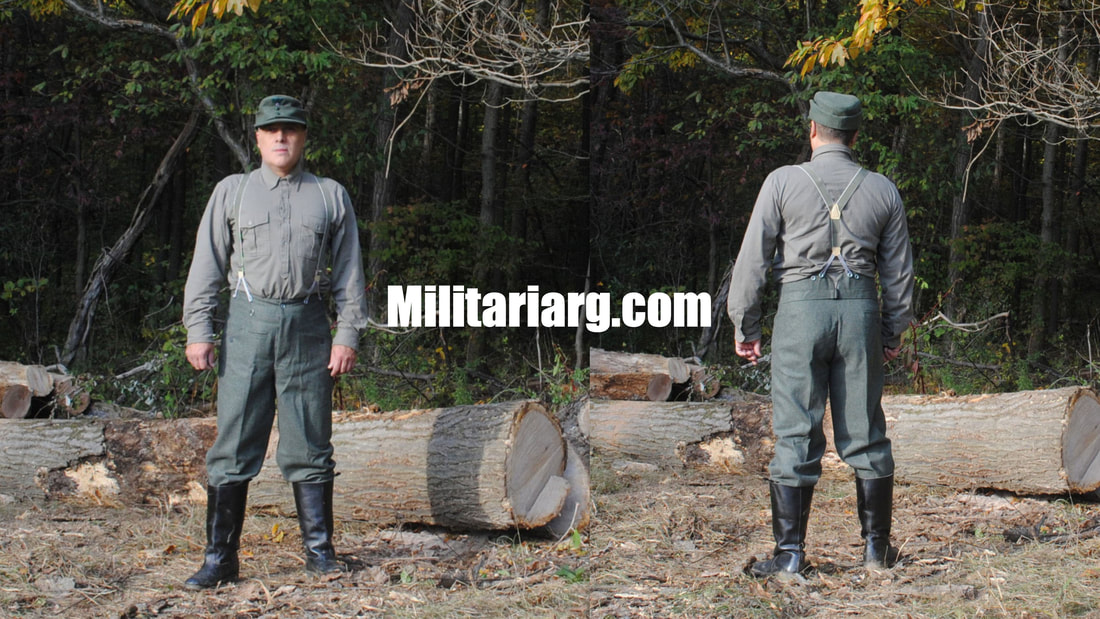
M43 German cap, M40 trousers and M37 suspenders.
The M43 German Cap (Einheitsfeldmütze or "standard field cap") was introduced in June 1943 and became the standard issue field cap for all ranks of the Wehrmacht and SS for the remainder of World War II. Its design was based on the traditional Bergmütze (mountain cap) of the Gebirgsjäger mountain troops and the tropical Afrika Korps cap.
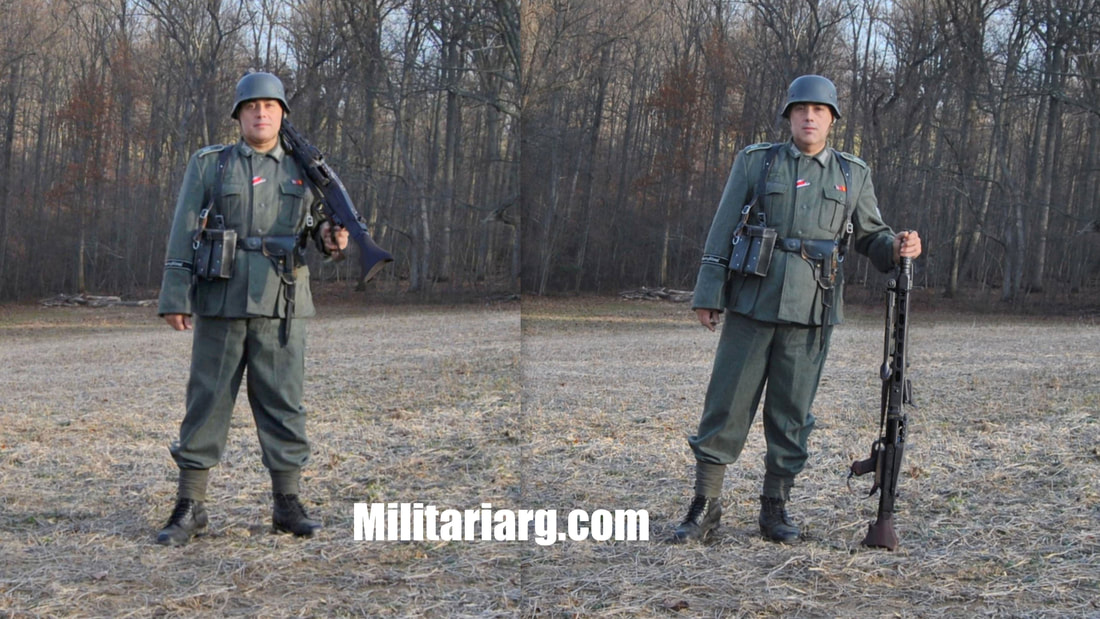
M40 German jacket and trousers. M40 helmet. Jack or marching boots. Splinter zeltbahn pole set.
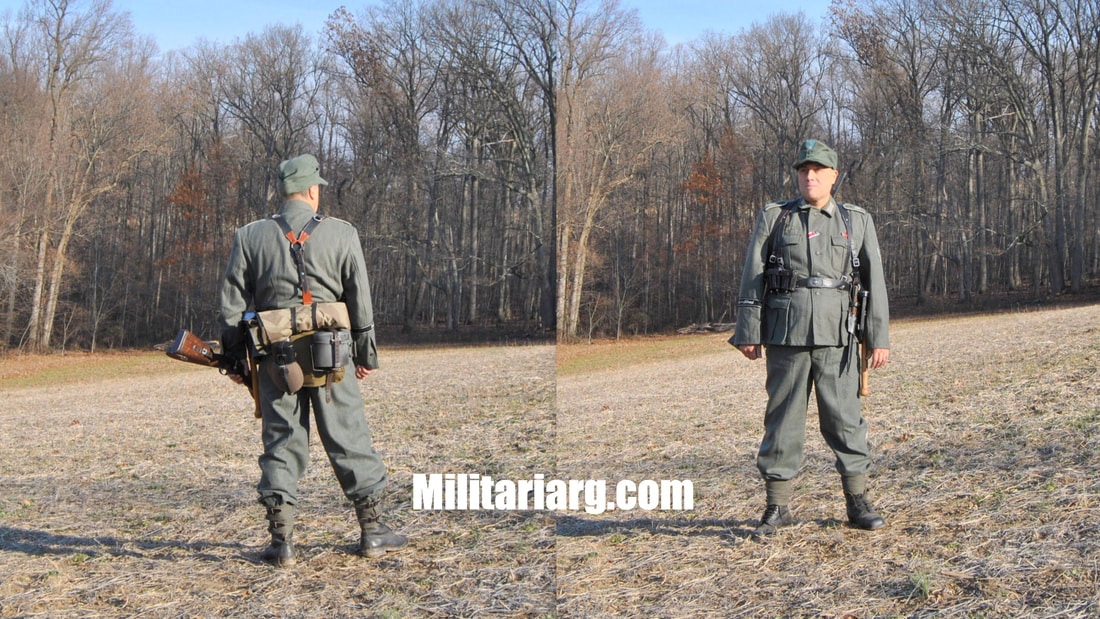
The M40 was introduced in March 1940. It maintained the same iconic, flared shape as its predecessor, the M35, but simplified the manufacturing process:
The M35 had separate ventilation grommets (holes with a rolled-in separate metal insert) that were a two-piece design requiring extra time to install. The M40 eliminated this separate piece; the ventilation hole was simply stamped directly into the helmet shell during the pressing process.
This single change significantly sped up production time and reduced manufacturing costs, which was essential as the war expanded after the German invasion of Poland.
Like the M35, the M40 was issued in an "apple green" or field-grey smooth paint finish, but as the war progressed, rougher, darker grey, and eventually camouflage paint schemes became common field modifications.
The M40 was introduced in March 1940. It maintained the same iconic, flared shape as its predecessor, the M35, but simplified the manufacturing process:
The M35 had separate ventilation grommets (holes with a rolled-in separate metal insert) that were a two-piece design requiring extra time to install. The M40 eliminated this separate piece; the ventilation hole was simply stamped directly into the helmet shell during the pressing process.
This single change significantly sped up production time and reduced manufacturing costs, which was essential as the war expanded after the German invasion of Poland.
Like the M35, the M40 was issued in an "apple green" or field-grey smooth paint finish, but as the war progressed, rougher, darker grey, and eventually camouflage paint schemes became common field modifications.
M43 field cap, M39 Y-straps suspenders, M40 tunic and trousers.
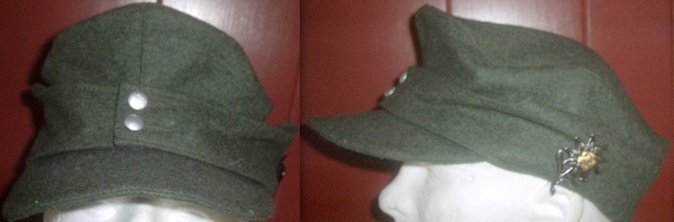
M43 field cap
Stalingrad 1942
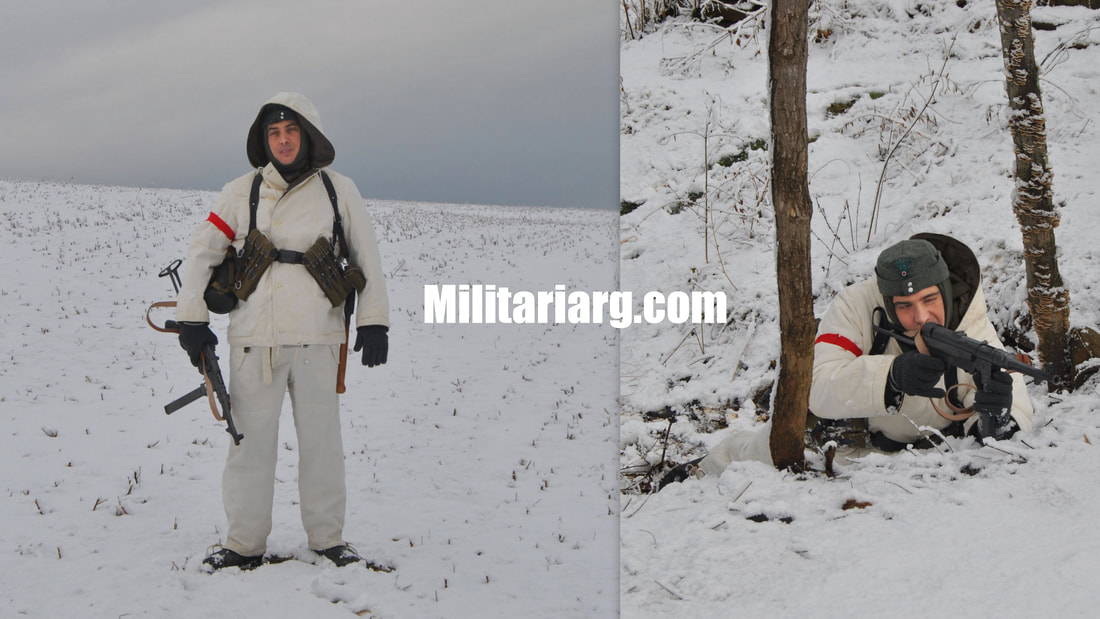
Reversible german winter gray white parka and trousers.
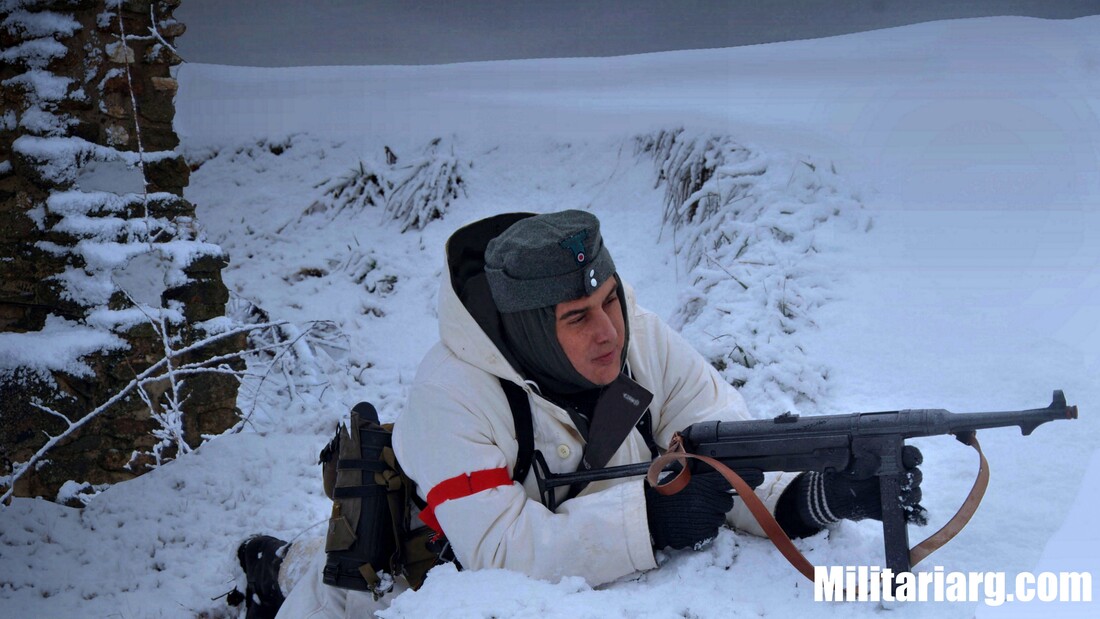
German soldiers of the 6th Army fighting in the Battle of Stalingrad during late 1942 and early 1943 wore a variety of standard issue uniforms, often supplemented by inadequate captured winter clothing (like the Valenki felt boots), and faced severe issues with a lack of proper arctic gear.
The standard issue Wehrmacht wool gloves were simple, grey, five-finger knitted gloves issued to all soldiers for general use in autumn and milder winter conditions. The gloves were made of 100% wool, typically in a field-grey or German-grey color. Designed as a general-purpose, lightweight glove, suitable for basic warmth and dexterity. They were not intended for extreme cold weather conditions like those encountered on the Eastern Front, where supplemental gear or captured equipment became necessary.
The gloves were typically issued in different sizes, denoted by white rings (sometimes 1, 2, or 3 rings) stamped on the inside of the cuff for easy identification.
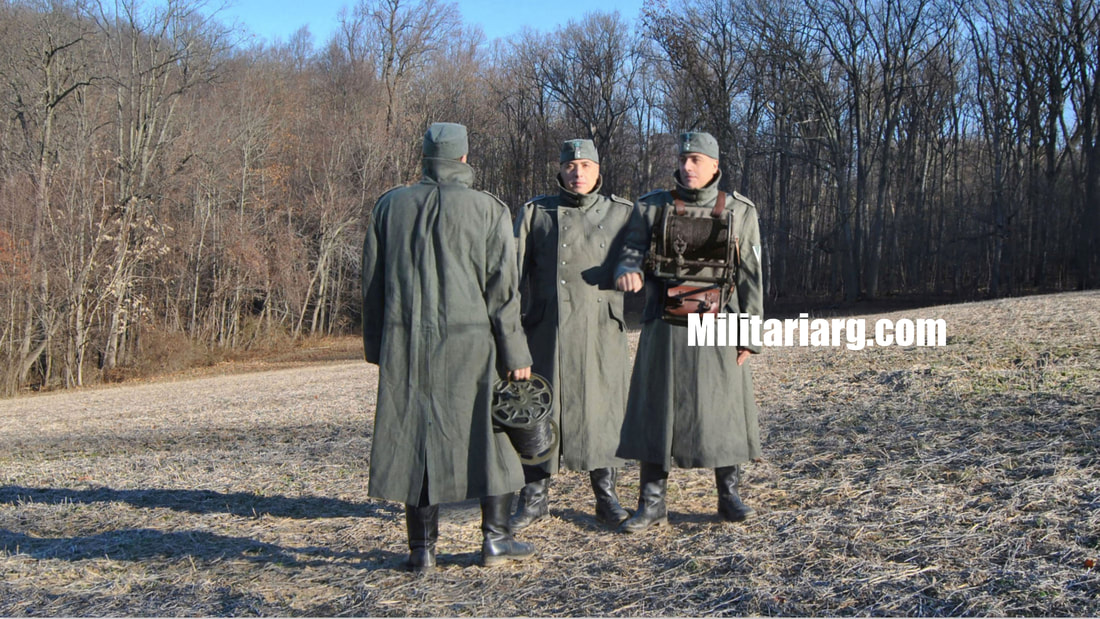
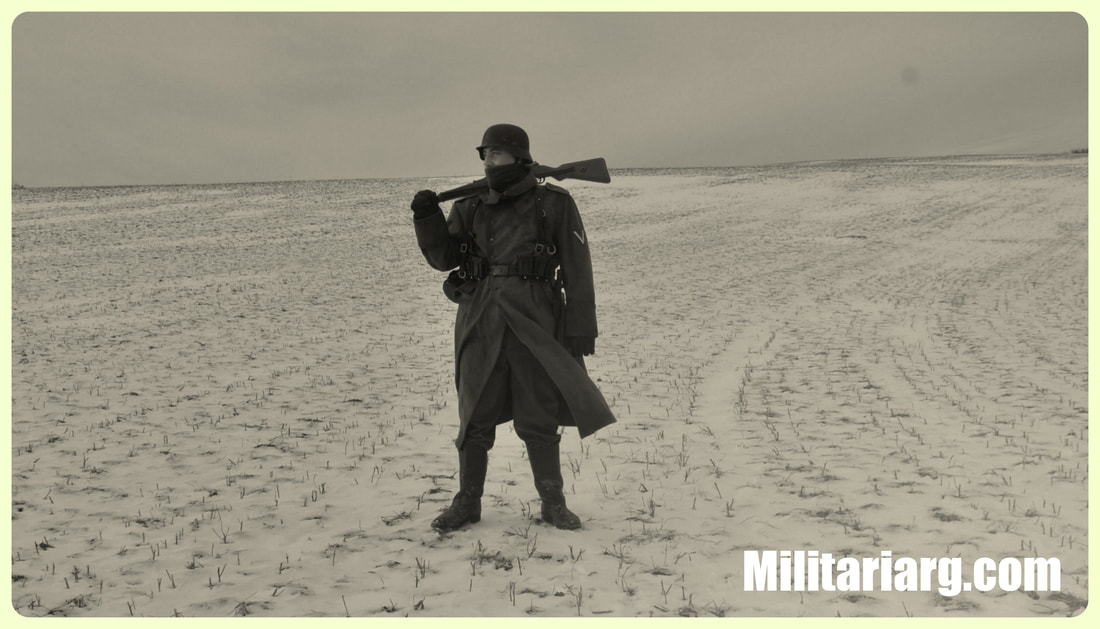
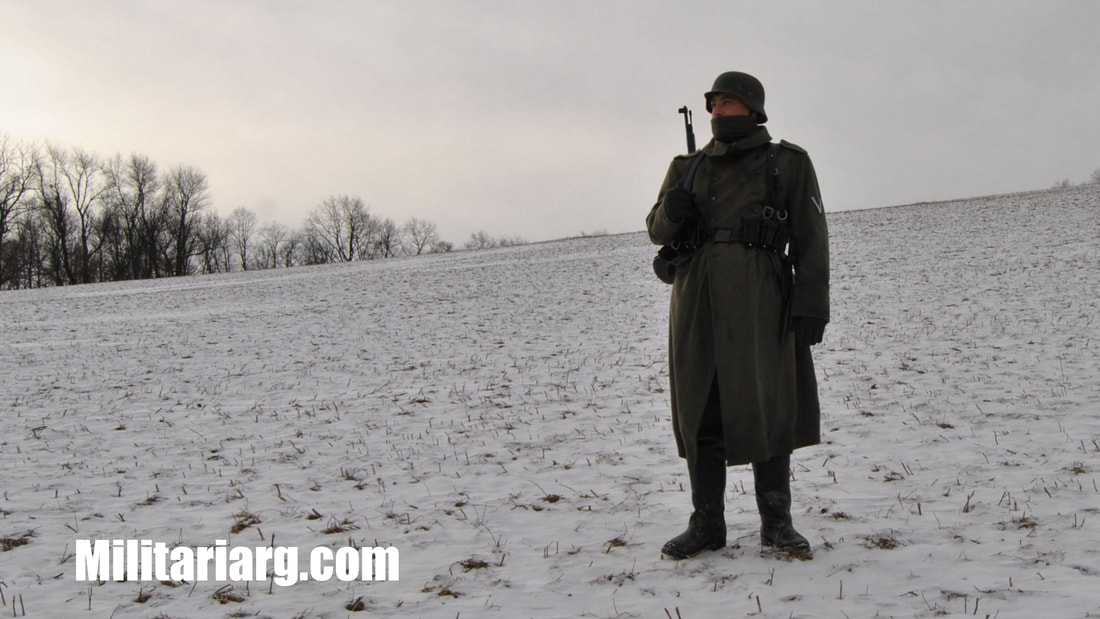
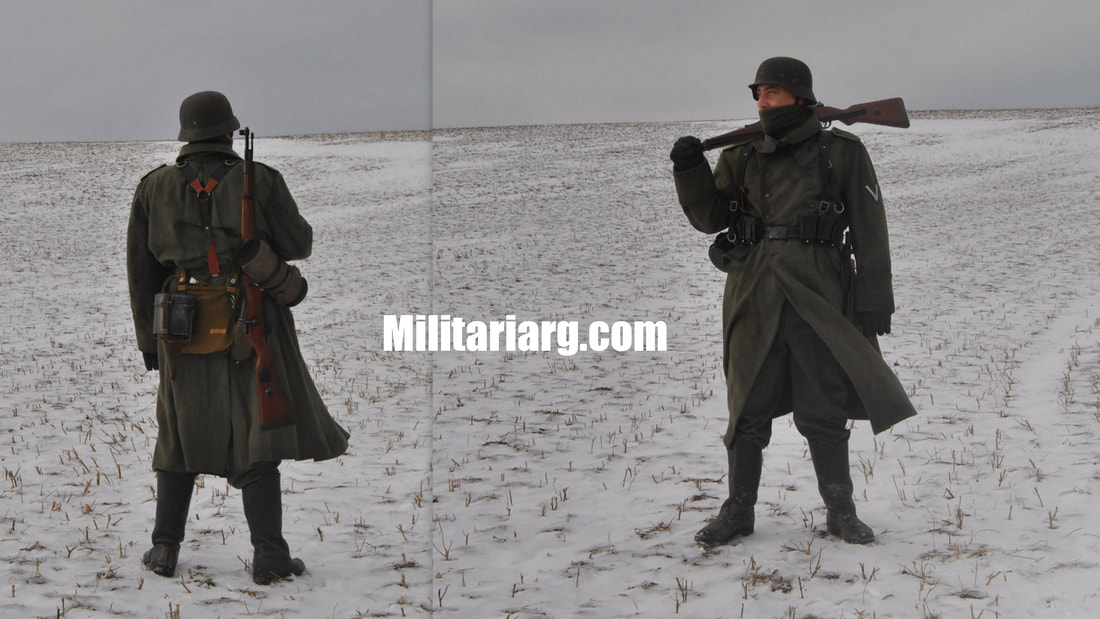
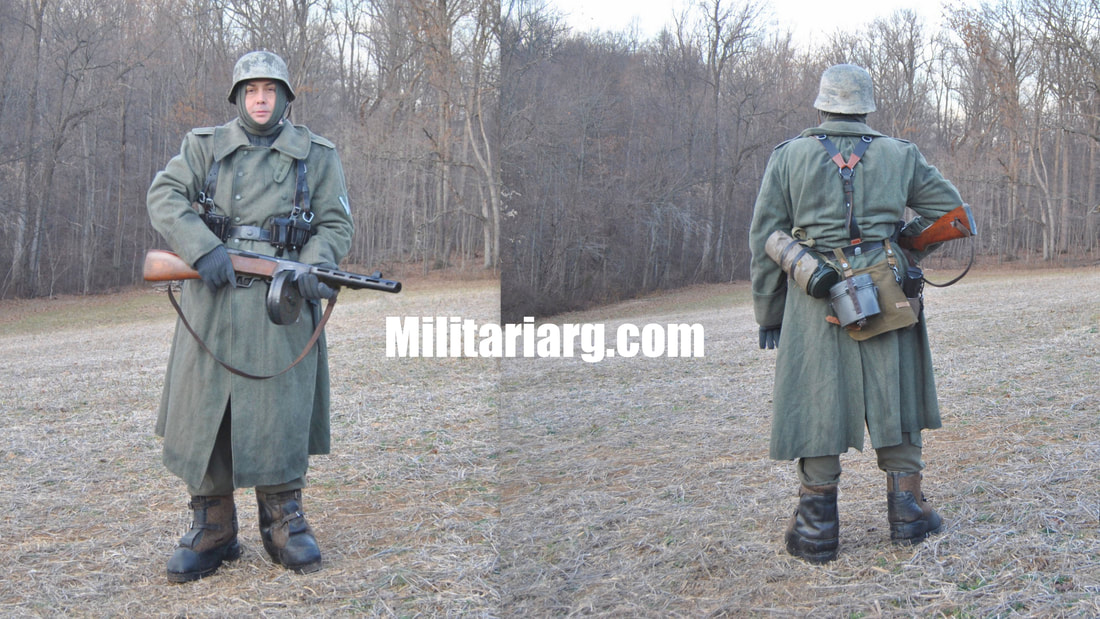
M42 German Heer field cap and M42 greatcoat. The M42 greatcoat (officially Mantel 42 or Mantel neuer Art - new style) was a simplified version of the German Wehrmacht greatcoat, introduced in 1942 as further cost and material-saving measures were implemented during World War II
M35 German Helmet. Gewehr Kar K98 rifle, M42 greatcoat and marching boots.
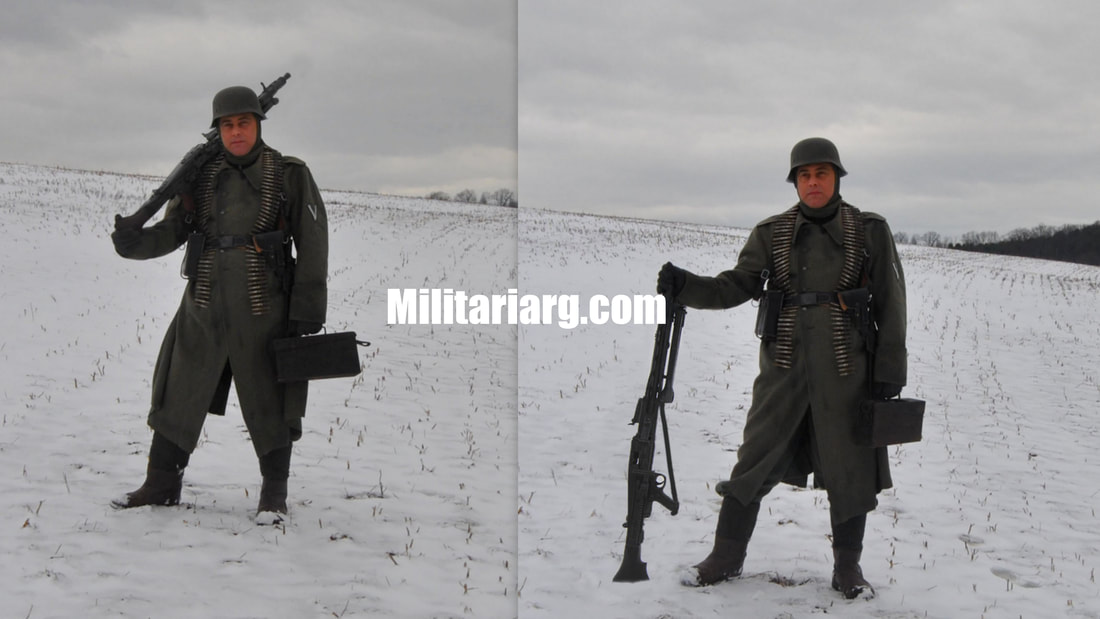
Replica PPSh-41 Soviet machine gun (Captured).
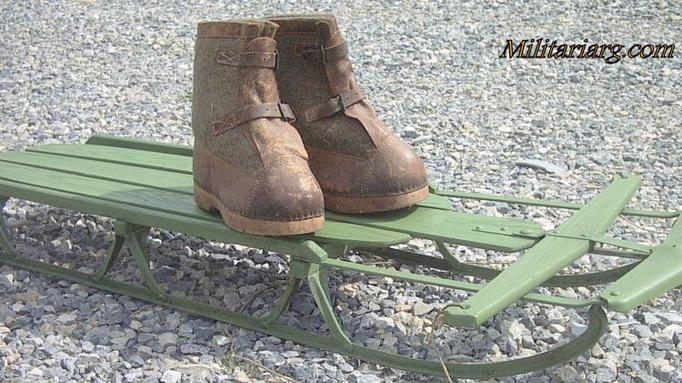
German felt & leather winter "Wachstiefel" overboots.
World War II German Wehrmacht winter overboots or sentry boots (Wachstiefel), which were used primarily on the Eastern Front. These boots were designed as an extreme cold weather solution after the Wehrmacht experienced massive frostbite casualties during the first Russian winter (1941-1942). They were made to be worn in static positions, such as sentry duty, where soldiers were not moving enough to generate body heat and their standard leather marching boots offered no insulation.
They are constructed from thick, insulating felted wool uppers combined with a sturdy leather foot section. The sole is made of thick wood, which acted as an insulator against the frozen ground, unlike the metal hobnails of standard boots which conducted cold. They secure with adjustable leather straps and buckles.
These overboots were crucial equipment for survival in temperatures far below freezing in the Soviet Union.
Variations:
Army (Heer) versions typically used black leather, while those issued to the Air Force (Luftwaffe) often used brown leather, as seen in the image.
World War II German Wehrmacht winter overboots or sentry boots (Wachstiefel), which were used primarily on the Eastern Front. These boots were designed as an extreme cold weather solution after the Wehrmacht experienced massive frostbite casualties during the first Russian winter (1941-1942). They were made to be worn in static positions, such as sentry duty, where soldiers were not moving enough to generate body heat and their standard leather marching boots offered no insulation.
They are constructed from thick, insulating felted wool uppers combined with a sturdy leather foot section. The sole is made of thick wood, which acted as an insulator against the frozen ground, unlike the metal hobnails of standard boots which conducted cold. They secure with adjustable leather straps and buckles.
These overboots were crucial equipment for survival in temperatures far below freezing in the Soviet Union.
Variations:
Army (Heer) versions typically used black leather, while those issued to the Air Force (Luftwaffe) often used brown leather, as seen in the image.
Wehrmacht Splinter (Splittertarnmuster) Camo
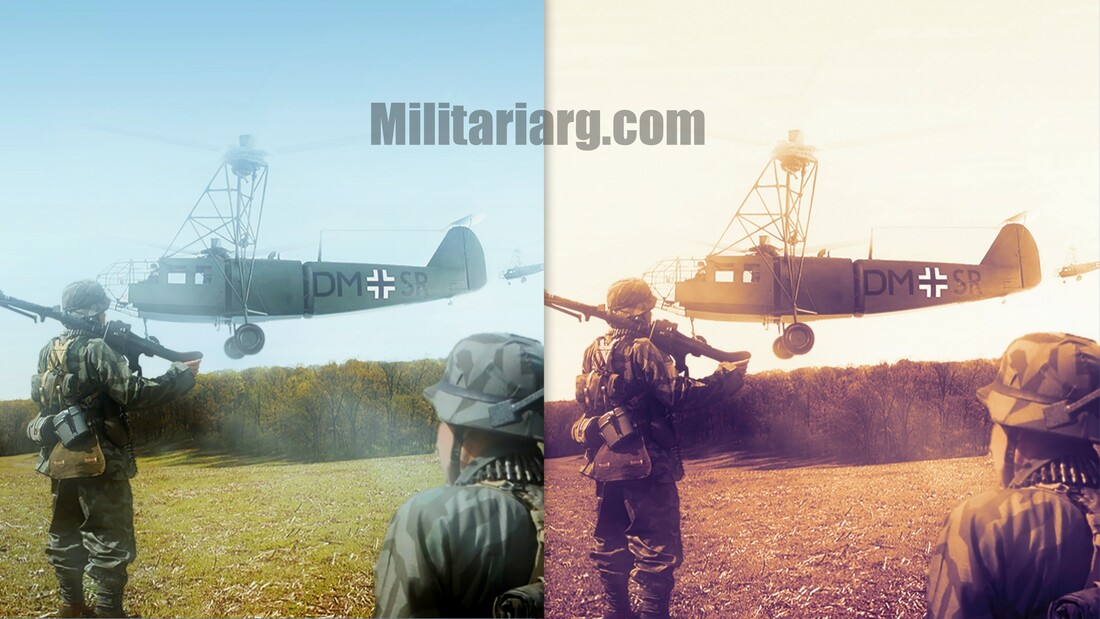
Helicopter Focke Achgelis Fa 225 "The Wehrmacht's Chopper".
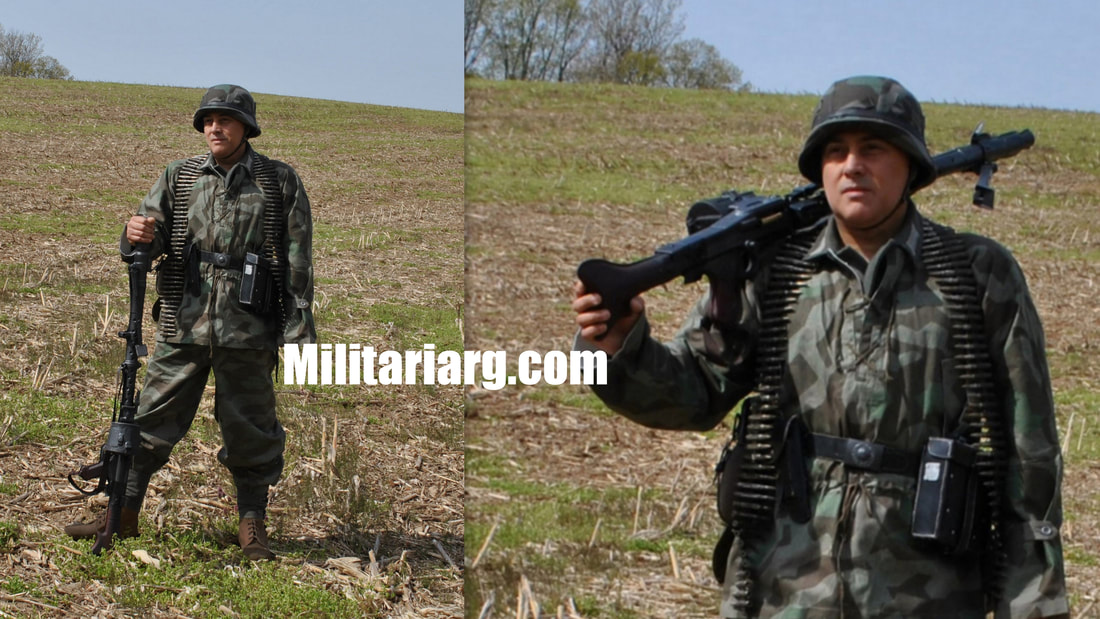
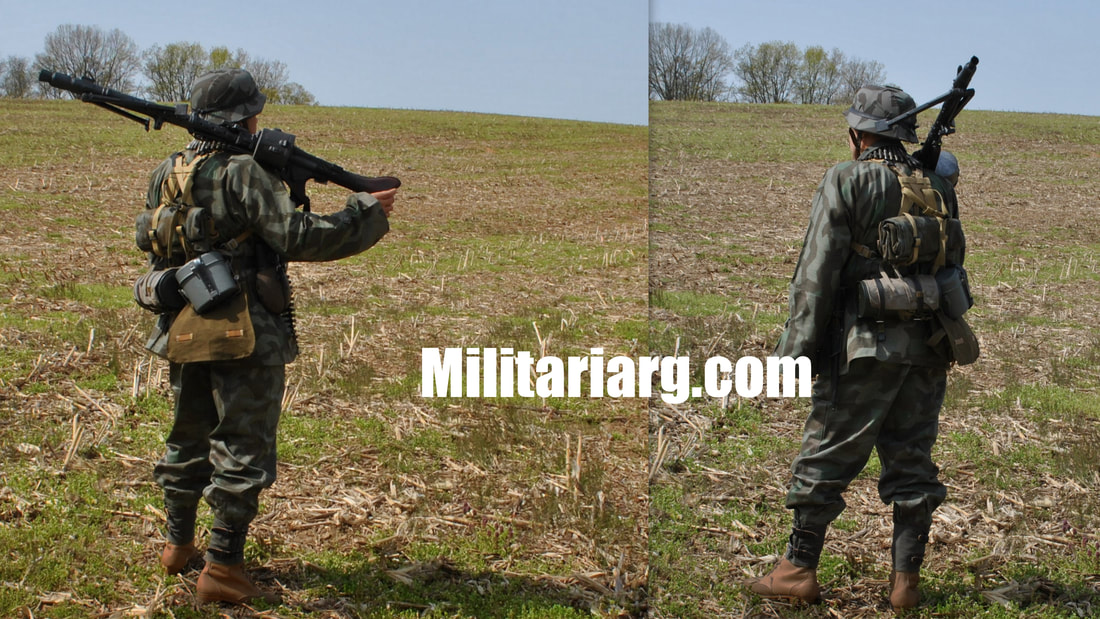
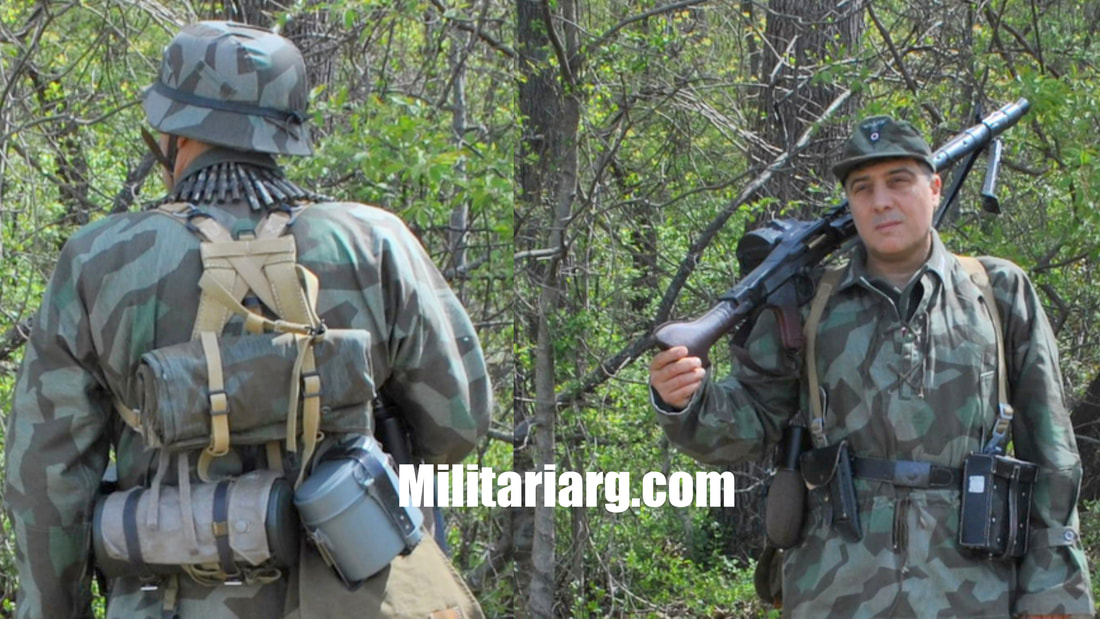
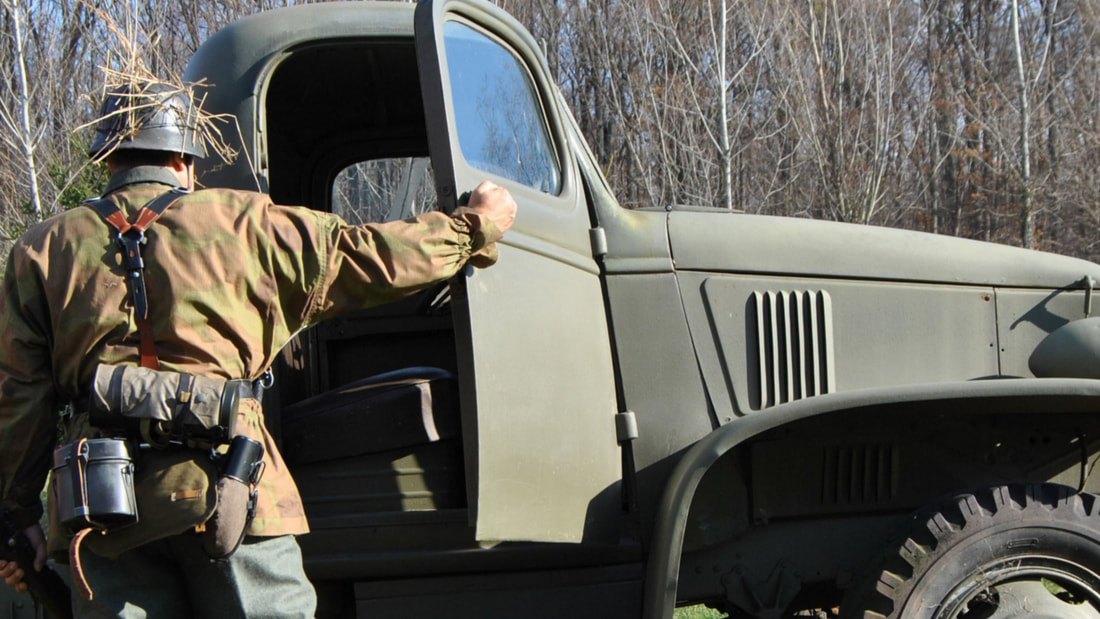
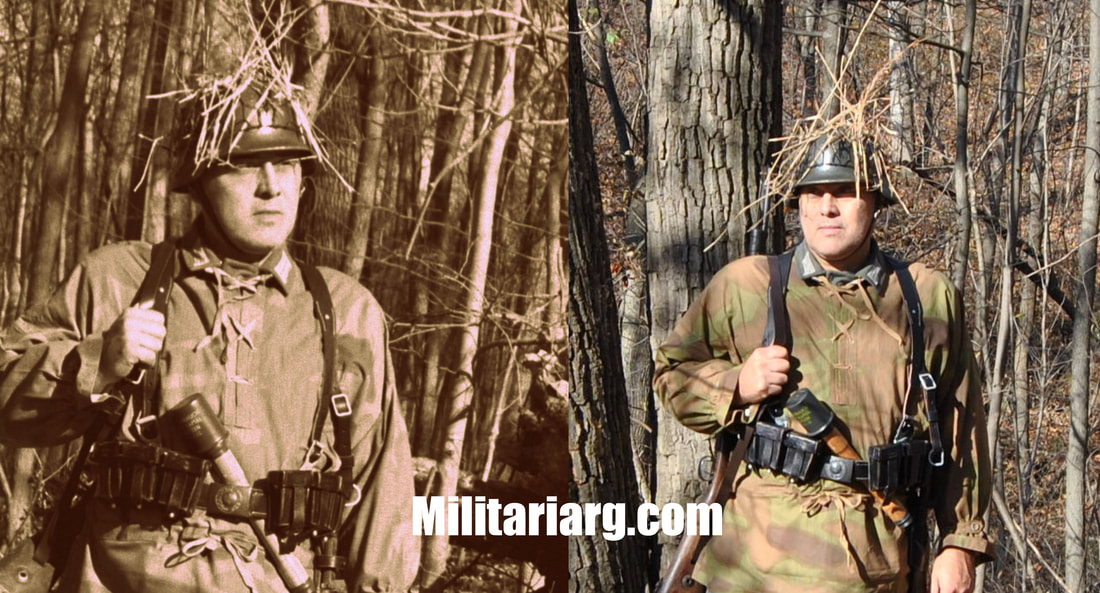
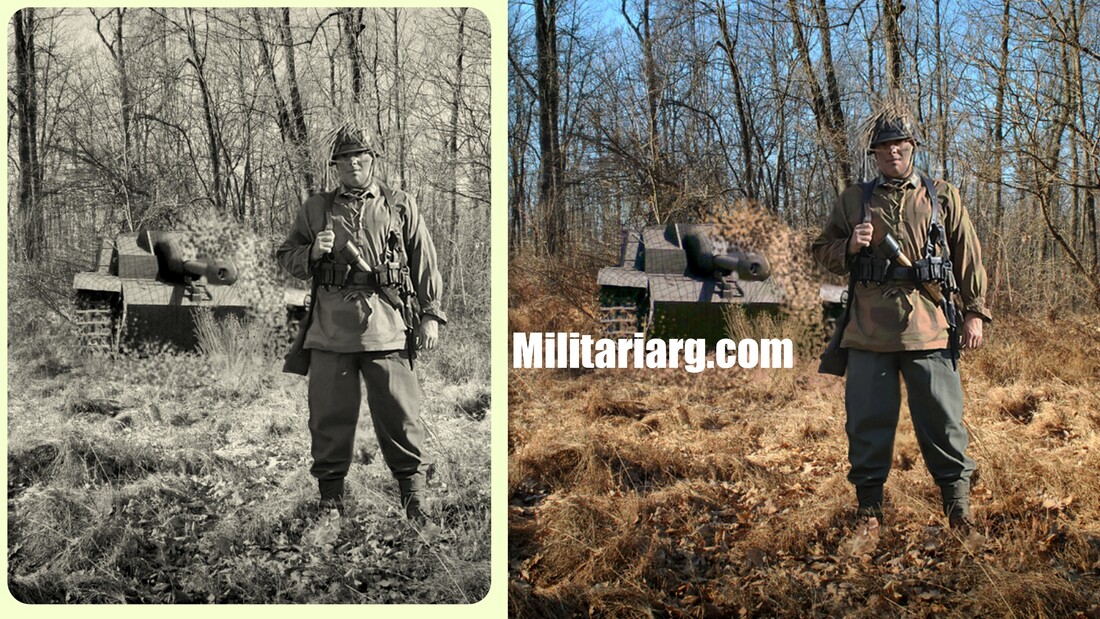
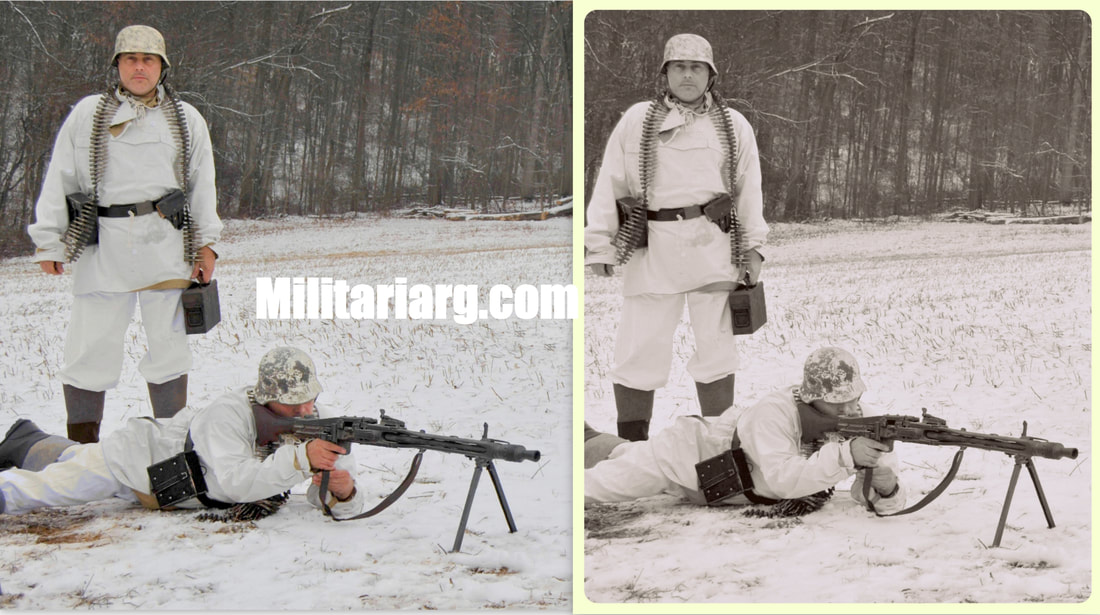
Splinter smock blouse and trousers; Heer belt and buckle; MG 34/42 leather tool pouch; M42 German helmet with splinter camo cover. German low boots "Schnurschuh and canvas gaiters. Movie prop Mg-34. M-31 canvas A-Frame for carrying personal equipment.
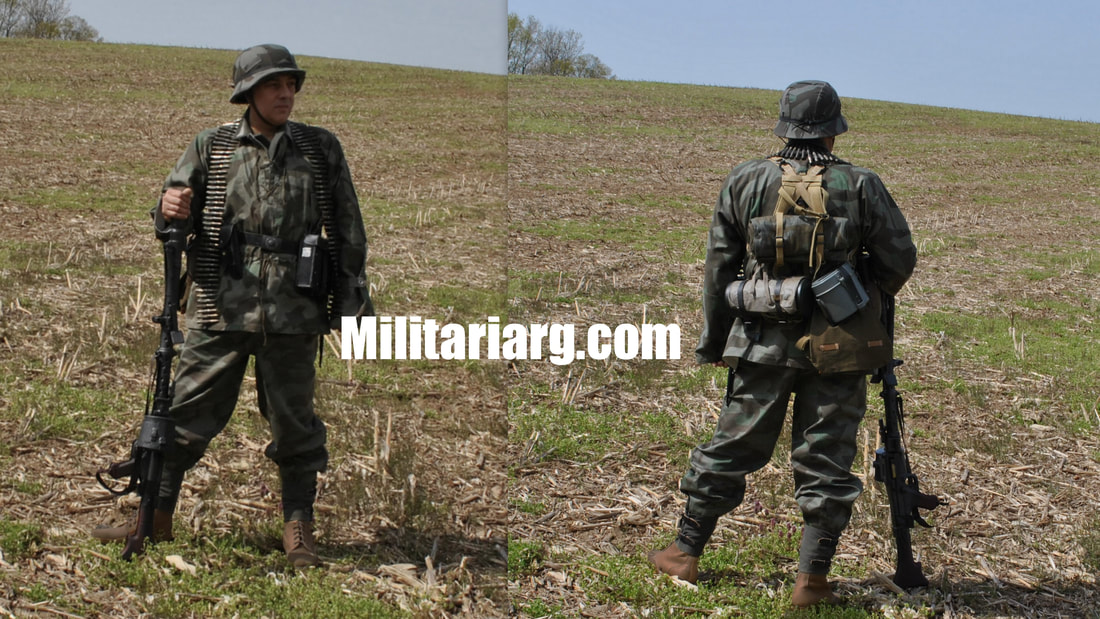
The pattern was officially called Splittertarnmuster ("splinter camouflage pattern"), and is known to collectors as "Splinter A". It featured a geometric design of jagged green and brown shapes on a field-grey or tan background, overlaid with thin, vertical "rain" streaks to further disrupt the soldier's silhouette.
The Heer was one of the first armies to issue camouflage to its troops in large numbers.
The smocks were typically made of lightweight cotton or cotton duck material, which was durable and could be worn year-round.
Pullover Style: The smock was a simple pullover design with a lace-up or drawstring neck opening.
It featured vertical slits with flaps on the chest area, allowing the wearer to access the pockets of the tunic underneath.
Drawstrings or adjustable straps were typically present at the waist and cuffs for a secure fit.
Reversible (Some Models): While many Heer smocks were one-sided, other winter versions were reversible to a white pattern for snow camouflage.
Pullover Style: The smock was a simple pullover design with a lace-up or drawstring neck opening.
It featured vertical slits with flaps on the chest area, allowing the wearer to access the pockets of the tunic underneath.
Drawstrings or adjustable straps were typically present at the waist and cuffs for a secure fit.
Reversible (Some Models): While many Heer smocks were one-sided, other winter versions were reversible to a white pattern for snow camouflage.
The splinter smock was issued to regular infantry units, not just elite forces, seeing extensive action across all European and Eastern fronts.It provided crucial additional camouflage, helping soldiers blend into wooded and mixed environments more effectively than the solid field-grey uniform alone.
Panzergrenadier
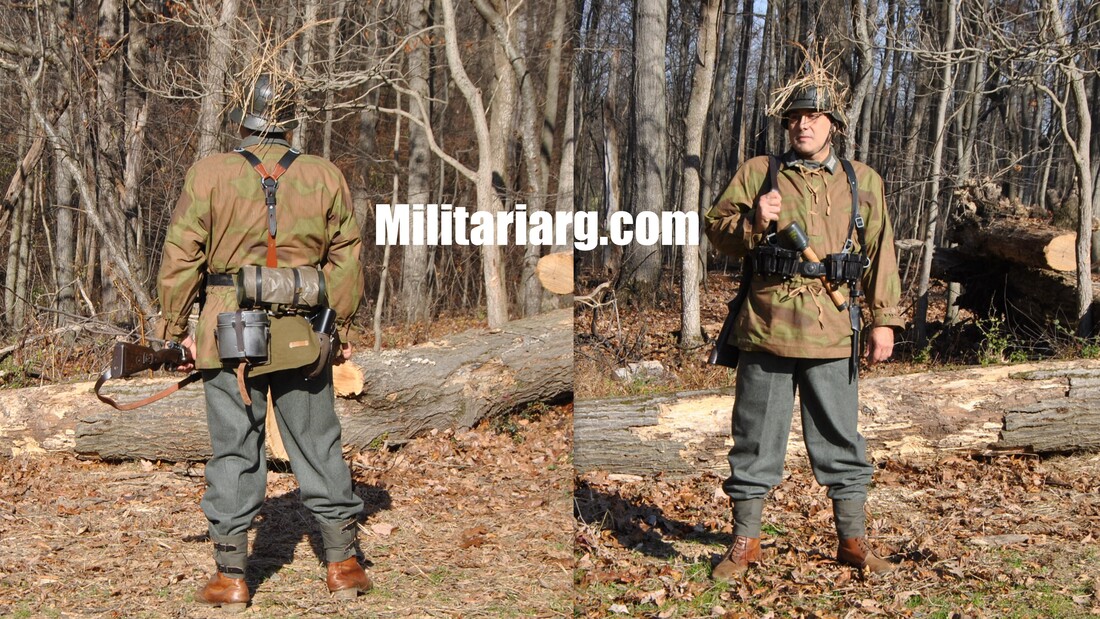
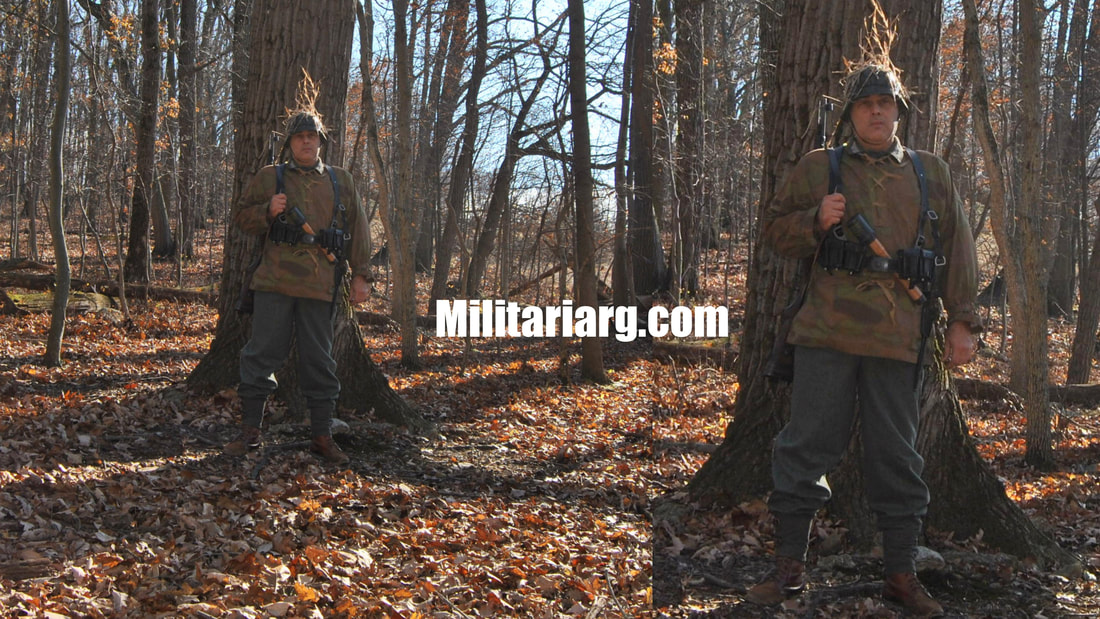
Tan & Water Anorak Camo. This is the same type of smock, but in Sumpftarnmuster or Marsh Camouflage.
The Sumpftarnmuster ("marsh camouflage pattern"), sometimes called "Tan and Water," was a German World War II camouflage design derived from the earlier "splinter" pattern.
The Sumpftarnmuster was an evolution of the Splittertarnmuster 31 (Splinter Pattern 31).
The pattern was first issued to Wehrmacht and Luftwaffe ground units around late 1942 or 1943.
The design modified the original hard-edged geometric shapes of the splinter pattern by blurring the edges and altering the This gave it a softer, more diffuse appearance better suited for blending into marshlands, forests, and temperate European environments.
The pattern was first issued to Wehrmacht and Luftwaffe ground units around late 1942 or 1943.
The design modified the original hard-edged geometric shapes of the splinter pattern by blurring the edges and altering the This gave it a softer, more diffuse appearance better suited for blending into marshlands, forests, and temperate European environments.
Two main variations were produced:
Sumpftarnmuster 43: Featured distinct green and brown shapes with a tan background.
Sumpftarnmuster 44: Introduced later in 1944, this version was even more blurred, nearly removing all geometric shapes entirely.
Sumpftarnmuster 43: Featured distinct green and brown shapes with a tan background.
Sumpftarnmuster 44: Introduced later in 1944, this version was even more blurred, nearly removing all geometric shapes entirely.
The Sumpftarnmuster was applied to various garments, primarily in the form of smocks, helmet covers, and winter uniform items.
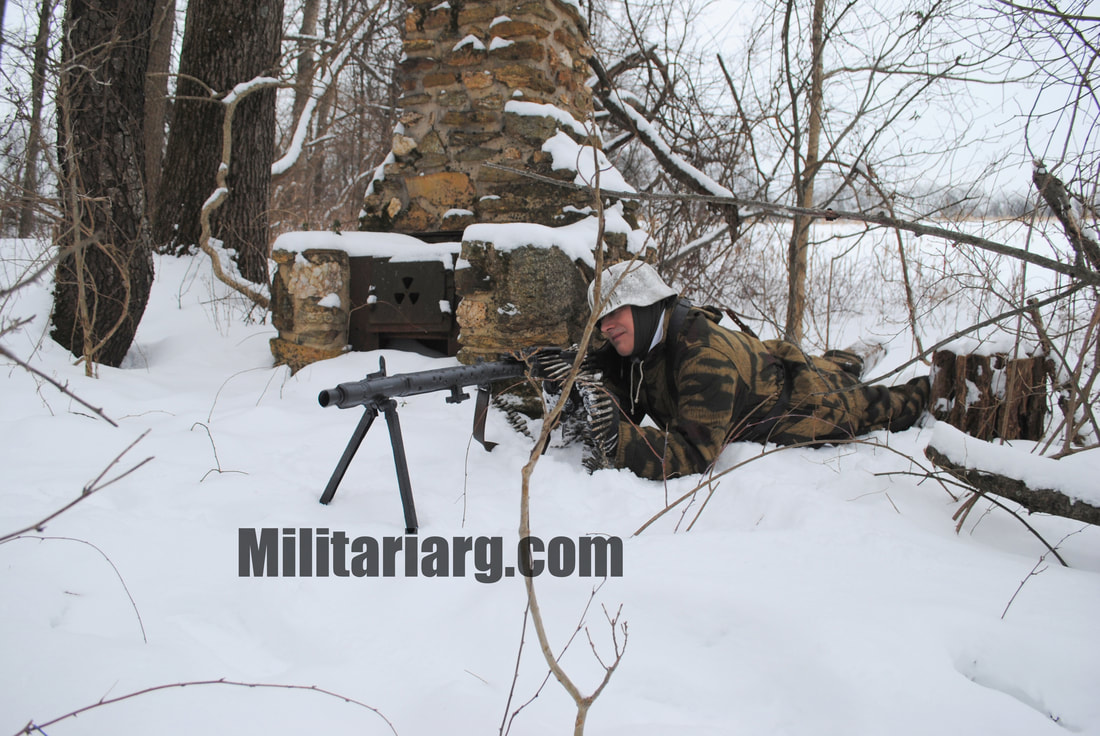
MG-34 (Star Wars - Movie Prop Replica).
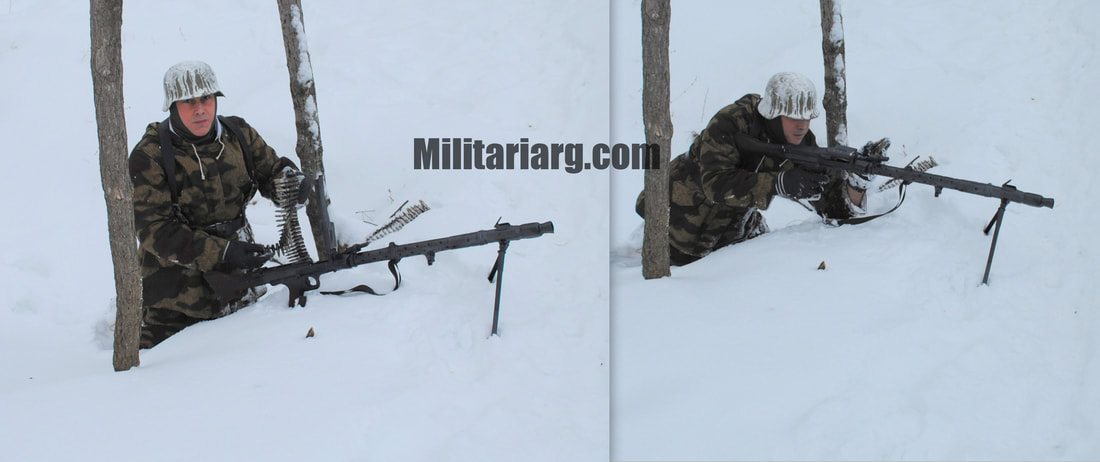
German reversible parka snow / tan and water "Sumpftarnmuster" pattern.
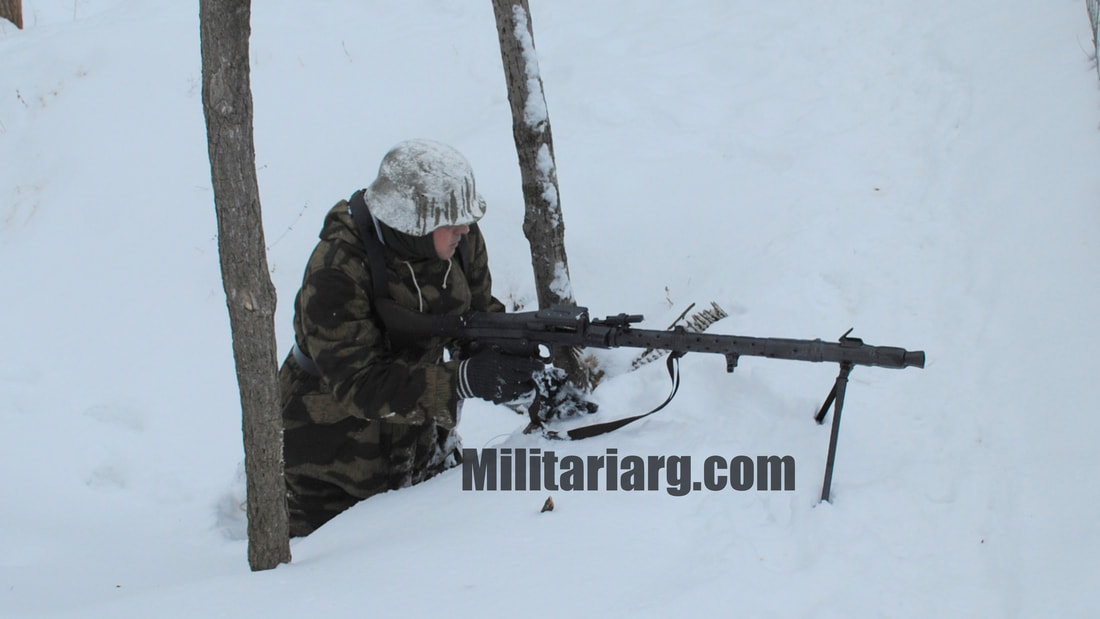
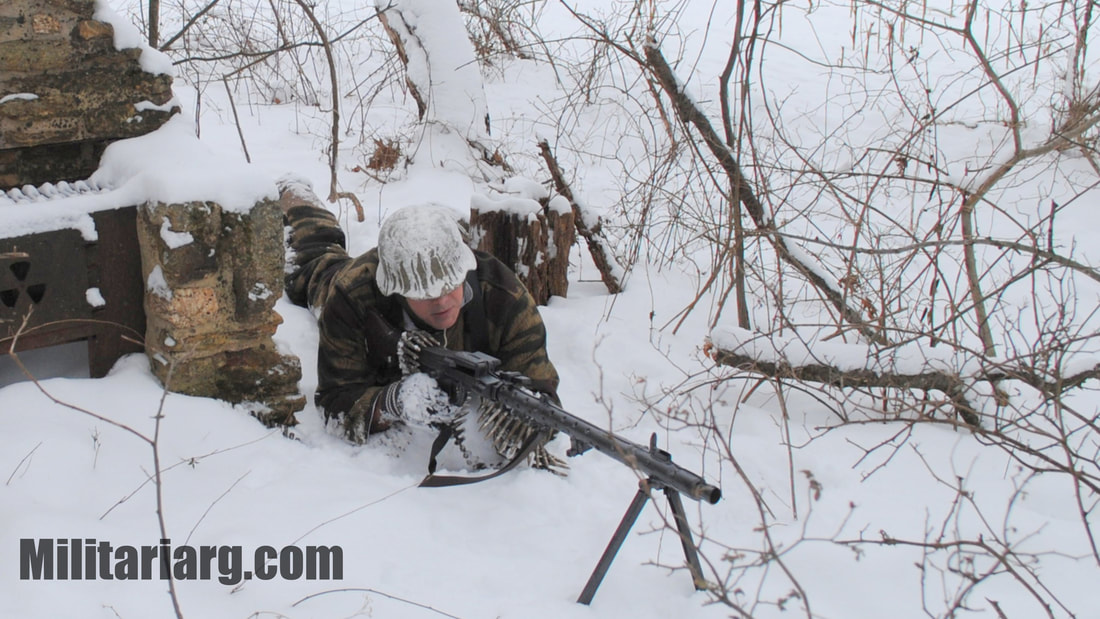
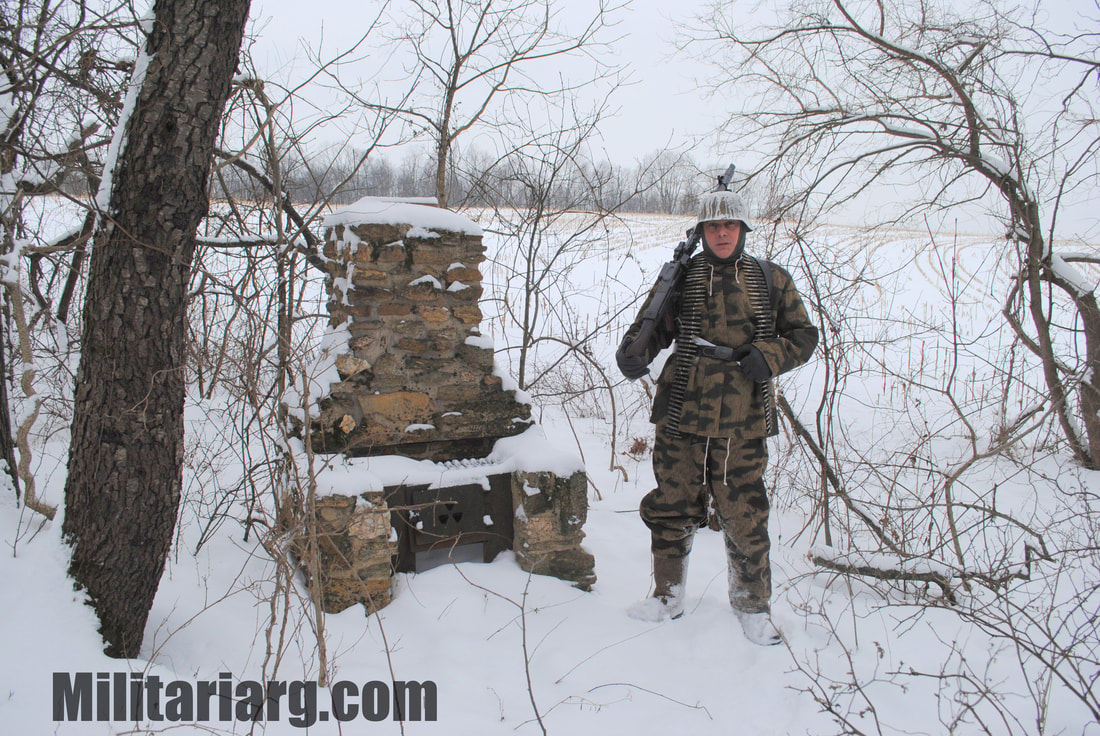
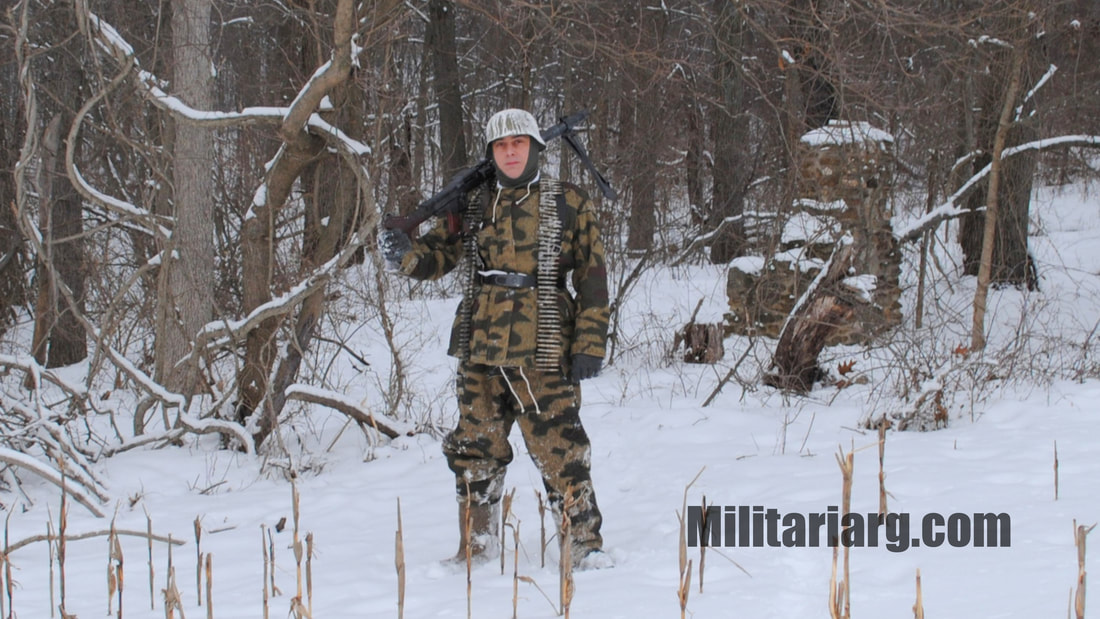
M44 Sumpftarn Pattern Reversible Snow Parka and Trousers.
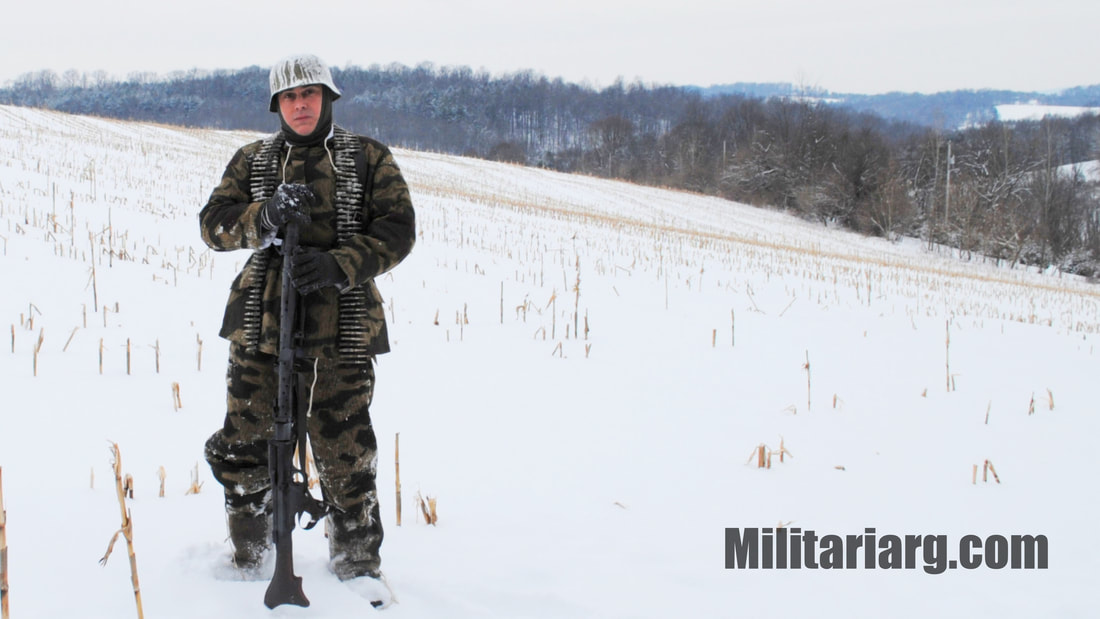
Reversible tan & water sumpftarn splinter snow camo
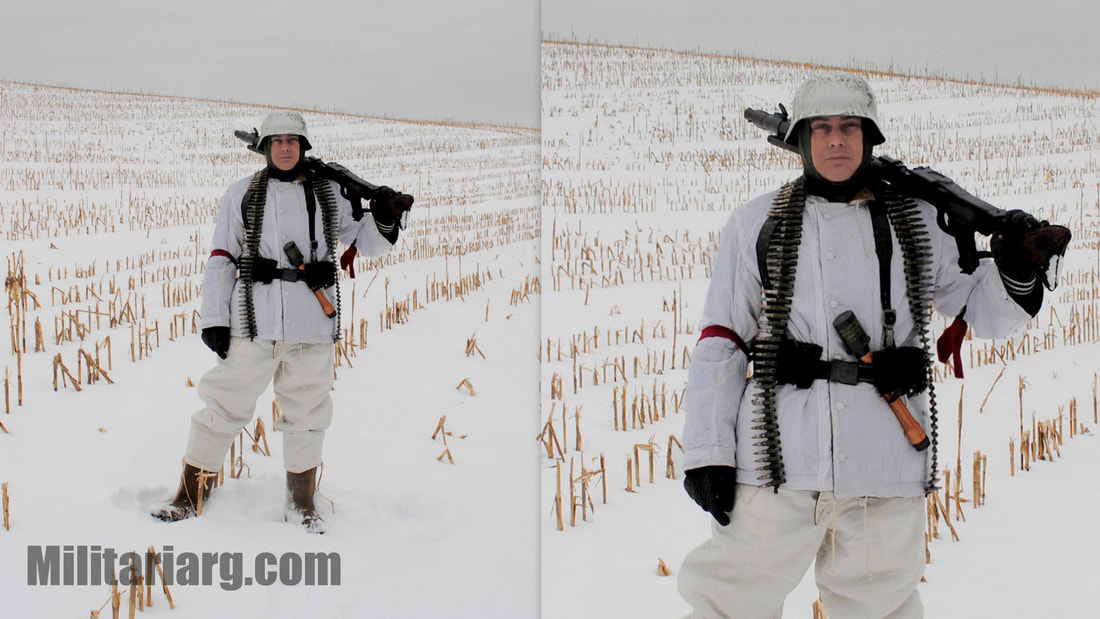
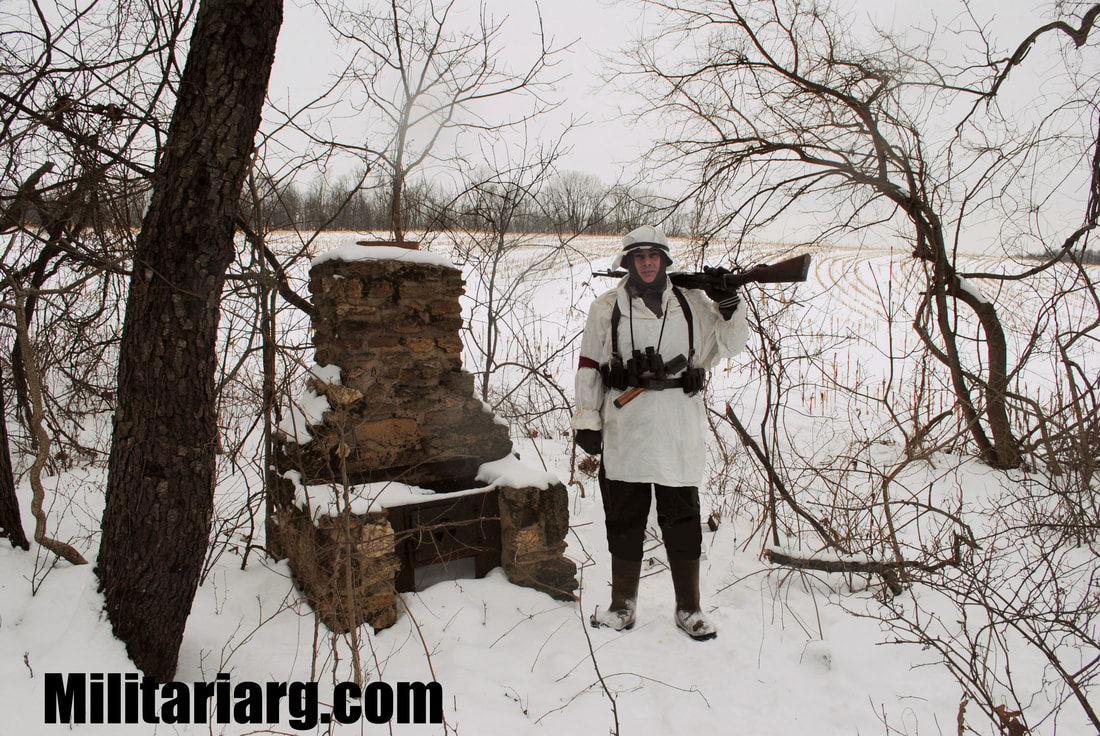
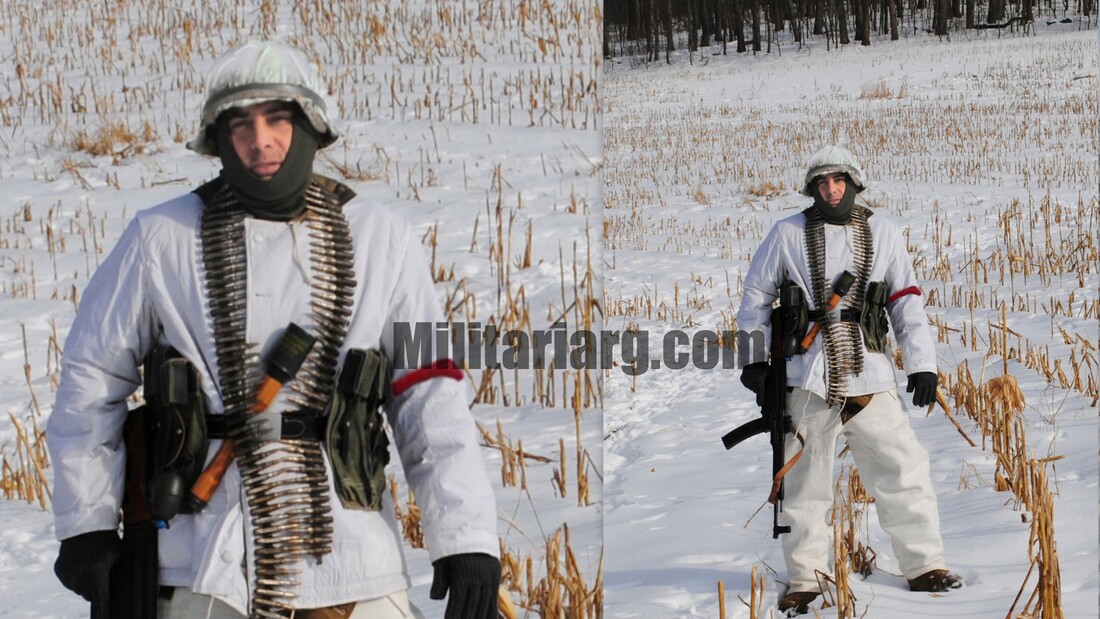
On the Eastern Front, particularly during winter operations in snow-covered areas, German soldiers occasionally wore colored armbands (including red, but also sometimes yellow or white) over their white winter camouflage uniforms.
The primary purpose was to provide a contrasting splash of color so German soldiers could easily identify friend from foe.
Preventing Friendly Fire: Since both German and Soviet troops wore white winter clothing, a simple system of colored bands was used to distinguish the sides in the field.
These were improvised and temporary field measures. The specific color (red was common) often changed daily or between units to prevent the Soviets from copying the identification method and infiltrating German lines.
The primary purpose was to provide a contrasting splash of color so German soldiers could easily identify friend from foe.
Preventing Friendly Fire: Since both German and Soviet troops wore white winter clothing, a simple system of colored bands was used to distinguish the sides in the field.
These were improvised and temporary field measures. The specific color (red was common) often changed daily or between units to prevent the Soviets from copying the identification method and infiltrating German lines.
Eastern Front winter camo
MG-42, German winter felt & leather boots, reversible mountain anorak.
The Wehrmacht issued specialized winter footwear known as Filzstiefel (felt boots), which functioned as insulating boots or overboots designed to be worn in extreme cold conditions on the Eastern Front, often over or instead of the standard leather marching boots.
The need for these boots became brutally clear after the first devastating winter in Russia (1941-1942), where standard leather jackboots with hobnailed soles offered no insulation and conducted cold, leading to widespread frostbite and casualties. The Filzstiefel were designed as a direct response to this crisis, inspired by the effective Soviet Valenki felt boots.
They typically featured a thick, grey felted wool upper section for maximum insulation, with the lower foot area reinforced with leather. Some later war models used thick wooden soles to further insulate the foot from the frozen ground.
The primary goal was insulation. Hobnails were found to be problematic in the extreme cold because the metal would transfer cold into the boot, so felt boots generally had pegged and glued leather or rubber soles without hobnails.
The Wehrmacht issued specialized winter footwear known as Filzstiefel (felt boots), which functioned as insulating boots or overboots designed to be worn in extreme cold conditions on the Eastern Front, often over or instead of the standard leather marching boots.
The need for these boots became brutally clear after the first devastating winter in Russia (1941-1942), where standard leather jackboots with hobnailed soles offered no insulation and conducted cold, leading to widespread frostbite and casualties. The Filzstiefel were designed as a direct response to this crisis, inspired by the effective Soviet Valenki felt boots.
They typically featured a thick, grey felted wool upper section for maximum insulation, with the lower foot area reinforced with leather. Some later war models used thick wooden soles to further insulate the foot from the frozen ground.
The primary goal was insulation. Hobnails were found to be problematic in the extreme cold because the metal would transfer cold into the boot, so felt boots generally had pegged and glued leather or rubber soles without hobnails.
Model 1944 Uniform (Feldgrau 44).
The Model 1944 (M44) Uniform (Feldgrau 44) was the final standardized field uniform introduced by the German Wehrmacht in late 1944, designed to cut down on material and production costs as the war situation deteriorated.
This uniform represented a radical departure from traditional German uniform design, primarily taking inspiration from the British Army's Battle Dress and the related U.S. "Ike" jacket.
Jacket Cut: The most significant change was the tunic (Feldbluse) being shortened to waist length, deleting the long skirt associated with previous models (M36, M40, M42, M43).
Pockets: The tunic had only two patch pockets on the chest, which were not pleated and had simple straight flaps. The lower skirt pockets were removed entirely.
Color: The uniform was produced in a new, distinct shade of fabric officially designated "Feldgrau 44," which was a drab olive-brown or greenish-brown color, noticeably different from the more gray-green shade of earlier uniforms.
Waistband: A wide waistband (approx. 12 cm deep) was integrated into the bottom of the tunic.
Collar: The uniform featured a collar that could be worn either open or closed, with the necktie being eliminated.
Insignia: Traditional German insignia were still applied: the national emblem (breast eagle) above the right chest pocket, Litzen (collar tabs) on the collar, and slip-on shoulder boards.
Trousers: The accompanying trousers were also redesigned, based on the Gebirgsjäger (mountain troops) model. They featured tapered ankles designed to be worn with short ankle boots and Gamaschen (gaiters), officially eliminating the tall jackboots for new issues.
The M44 uniform was issued primarily to new replacement troops, Volkssturm militia, and other late-war units, as it was never produced in sufficient quantities to completely refit the entire German Army.
Pockets: The tunic had only two patch pockets on the chest, which were not pleated and had simple straight flaps. The lower skirt pockets were removed entirely.
Color: The uniform was produced in a new, distinct shade of fabric officially designated "Feldgrau 44," which was a drab olive-brown or greenish-brown color, noticeably different from the more gray-green shade of earlier uniforms.
Waistband: A wide waistband (approx. 12 cm deep) was integrated into the bottom of the tunic.
Collar: The uniform featured a collar that could be worn either open or closed, with the necktie being eliminated.
Insignia: Traditional German insignia were still applied: the national emblem (breast eagle) above the right chest pocket, Litzen (collar tabs) on the collar, and slip-on shoulder boards.
Trousers: The accompanying trousers were also redesigned, based on the Gebirgsjäger (mountain troops) model. They featured tapered ankles designed to be worn with short ankle boots and Gamaschen (gaiters), officially eliminating the tall jackboots for new issues.
The M44 uniform was issued primarily to new replacement troops, Volkssturm militia, and other late-war units, as it was never produced in sufficient quantities to completely refit the entire German Army.
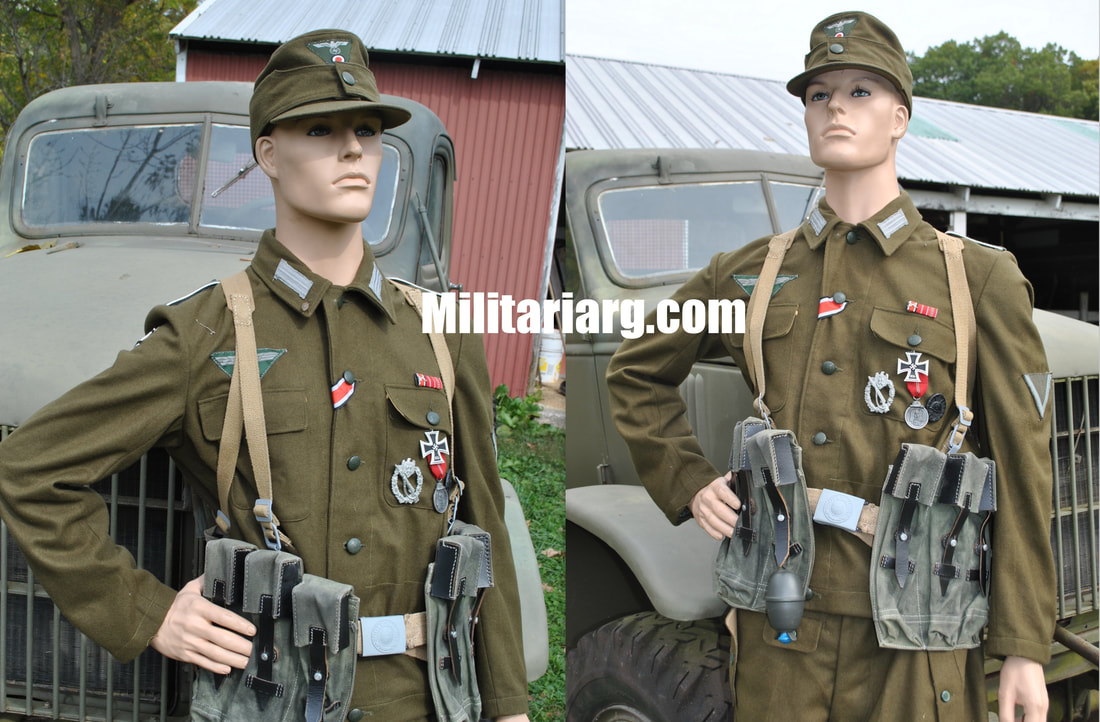
late War M44 Feldgrau Uniform (Gefreiter/ lance Corporal): Heer (Army) infantry assault silver badge; Wound badge in black for combat action. 2nd class iron cross and ribbon bar. Eastern Front medal and ribbon bar. Romanian campaign ribbon bar. M44 pouches, m39 'egg" grenade replica.
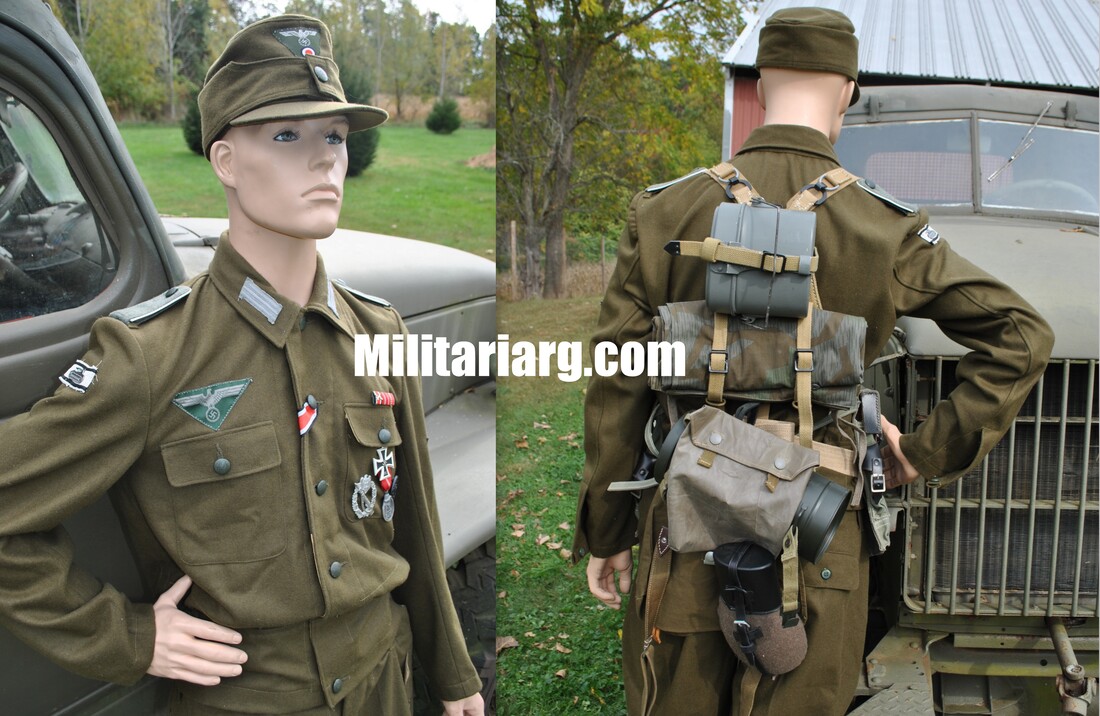
Rubberized gas mask bag.
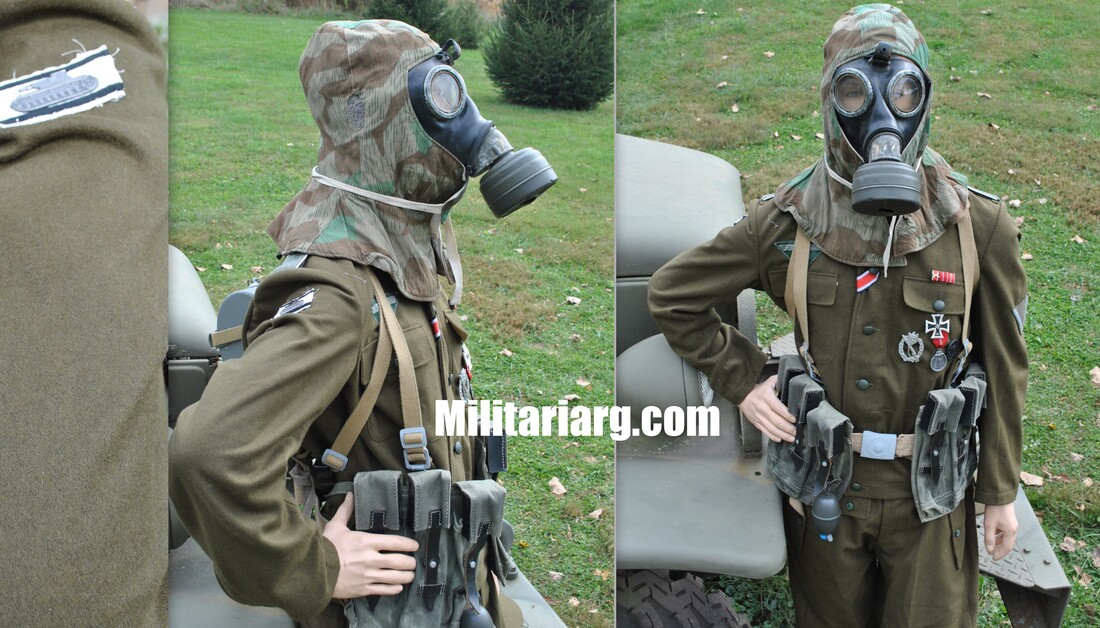
Wehrmacht GM38 gasmask, winter hood splinter camo and tank destruction badge.
Wehrmacht Late War German M45 "Leibermuster Six-Color Camouflage Pattern"
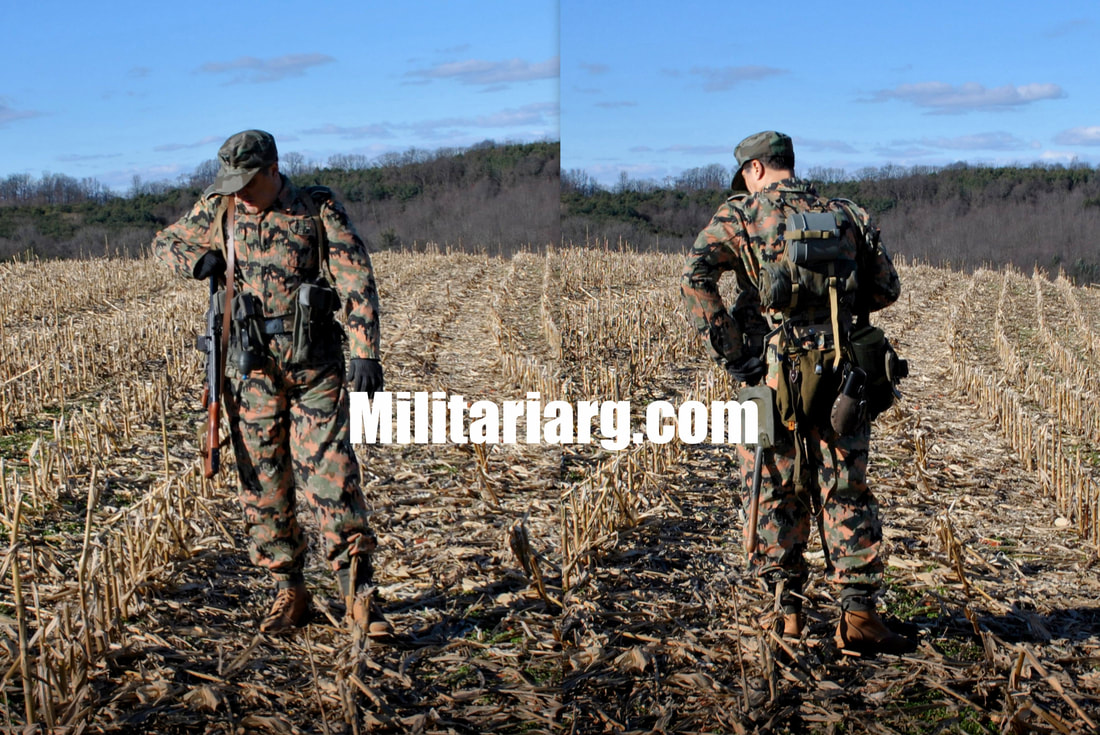
M45 German HBT (Cotton - Herringbone - Twill) cloth uniform Leibermuster pattern, feldblouse jacket and trousers. M37 field cap splinter camo with trapazoid M43 eagle-bevo. M43 low "Ankle" boots.
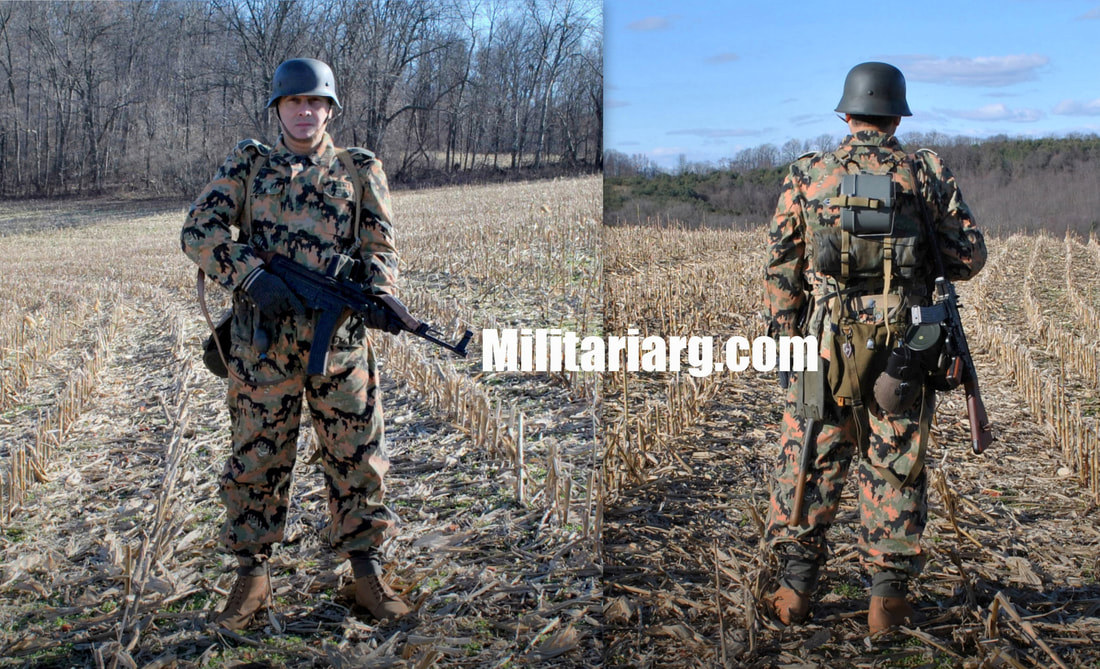
The Leibermuster (meaning "Leiber pattern", was the final and most technologically advanced German camouflage pattern developed during World War II, intended to replace all other patterns across the Wehrmacht and Waffen-SS.
Canvas A-frame with mess kitt (Post War) and Zeltbahn shelter poncho. M31 gasmask canister, M42 water canteen, m31 bread bag. M42 helmet.
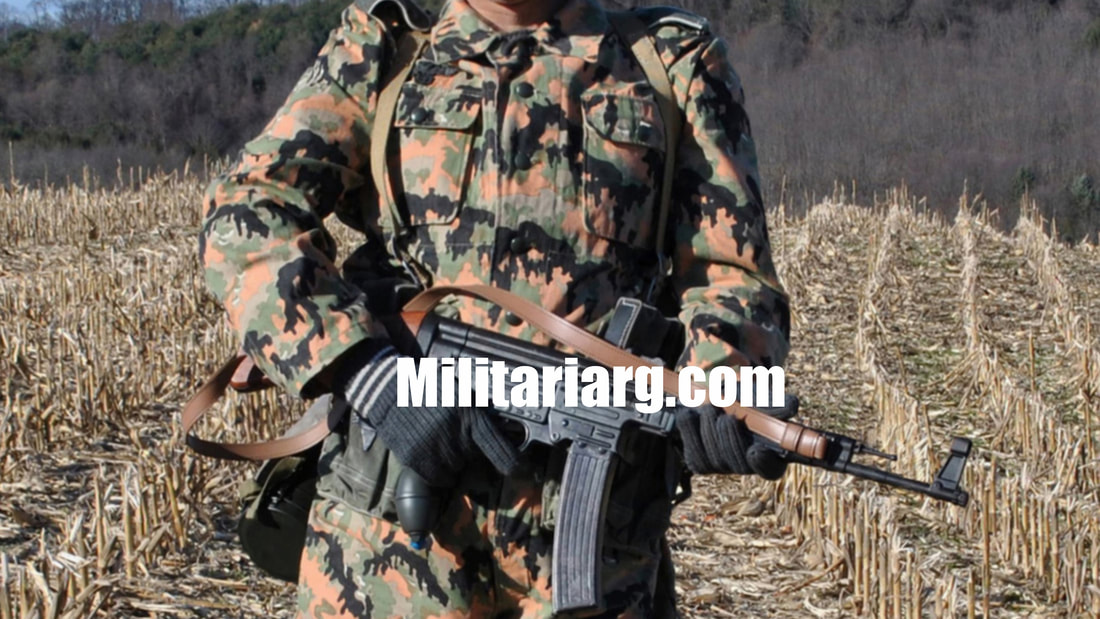
The Model 1942 (M42) German helmet was the final and most widely produced version of the iconic Stahlhelm during World War II, introduced as a cost and labor-saving measure due to the expanding war effort.
Design and Production Details
Raw Edge: The most distinguishing feature of the M42 helmet was the elimination of the rolled-over (crimped) rim found on the earlier M35 and M40 models. This left a sharp, flared, or "raw" edge which saved a production step and reduced labor costs.
Ventilation Holes: Like its direct predecessor, the M40, the M42 featured ventilation holes that were simply punched or stamped directly into the helmet shell, rather than using the separate, inserted grommets of the M35.
The Model 1942 (M42) German helmet was the final and most widely produced version of the iconic Stahlhelm during World War II, introduced as a cost and labor-saving measure due to the expanding war effort.
Design and Production Details
Raw Edge: The most distinguishing feature of the M42 helmet was the elimination of the rolled-over (crimped) rim found on the earlier M35 and M40 models. This left a sharp, flared, or "raw" edge which saved a production step and reduced labor costs.
Ventilation Holes: Like its direct predecessor, the M40, the M42 featured ventilation holes that were simply punched or stamped directly into the helmet shell, rather than using the separate, inserted grommets of the M35.
The M45 Leibermuster camo entered production in the final months of WW2. It only appears in photos being used by the troops that surrendered to the Czech partisans and in one photo of a POW in a concentration camp that could be in Northern Italy.
The original uniforms remained in the hands of the Czechs and also the Soviets. This late East Front camo was the post-war origin of the Swiss Alpenflage and many others. Although not a preferred camo for WW2 reenactors, this camo existed and saw action in WW2 despite the scarce photographic material. It was the first camo for all branches, although its photographic documentation links it to the Heer, more exactly to the 100th Jäger Division hence the idea to recreate this.
Introduced in early 1945, the pattern saw extremely limited issue to combat units in the final months of the war, primarily to troops stationed in Czechoslovakia.
Design: It was a multi-color pattern (six colors, including black, brown, green, and red on a pale background) featuring bold, irregular, overlapping shapes. This design aimed to provide effective concealment across various environments, from wooded to open terrain.
Infrared Technology: A revolutionary aspect was its use of carbon-laced dyes (the red in the pattern), intended to counter nascent Allied infrared night vision technology, making it the first known camouflage pattern designed with this defense in mind.
Wartime Use: Due to the late stage of the war, very few authentic examples were produced or used in the field. Original wartime photographs showing its use are rare and usually depict Wehrmacht soldiers.
Post-War Influence: The Leibermuster had a significant influence on post-war camouflage design. The Swiss Army's "Alpenflage" pattern (used until the 1990s) and even some elements of later NATO and Czech patterns were based on it.
The original uniforms remained in the hands of the Czechs and also the Soviets. This late East Front camo was the post-war origin of the Swiss Alpenflage and many others. Although not a preferred camo for WW2 reenactors, this camo existed and saw action in WW2 despite the scarce photographic material. It was the first camo for all branches, although its photographic documentation links it to the Heer, more exactly to the 100th Jäger Division hence the idea to recreate this.
Introduced in early 1945, the pattern saw extremely limited issue to combat units in the final months of the war, primarily to troops stationed in Czechoslovakia.
Design: It was a multi-color pattern (six colors, including black, brown, green, and red on a pale background) featuring bold, irregular, overlapping shapes. This design aimed to provide effective concealment across various environments, from wooded to open terrain.
Infrared Technology: A revolutionary aspect was its use of carbon-laced dyes (the red in the pattern), intended to counter nascent Allied infrared night vision technology, making it the first known camouflage pattern designed with this defense in mind.
Wartime Use: Due to the late stage of the war, very few authentic examples were produced or used in the field. Original wartime photographs showing its use are rare and usually depict Wehrmacht soldiers.
Post-War Influence: The Leibermuster had a significant influence on post-war camouflage design. The Swiss Army's "Alpenflage" pattern (used until the 1990s) and even some elements of later NATO and Czech patterns were based on it.