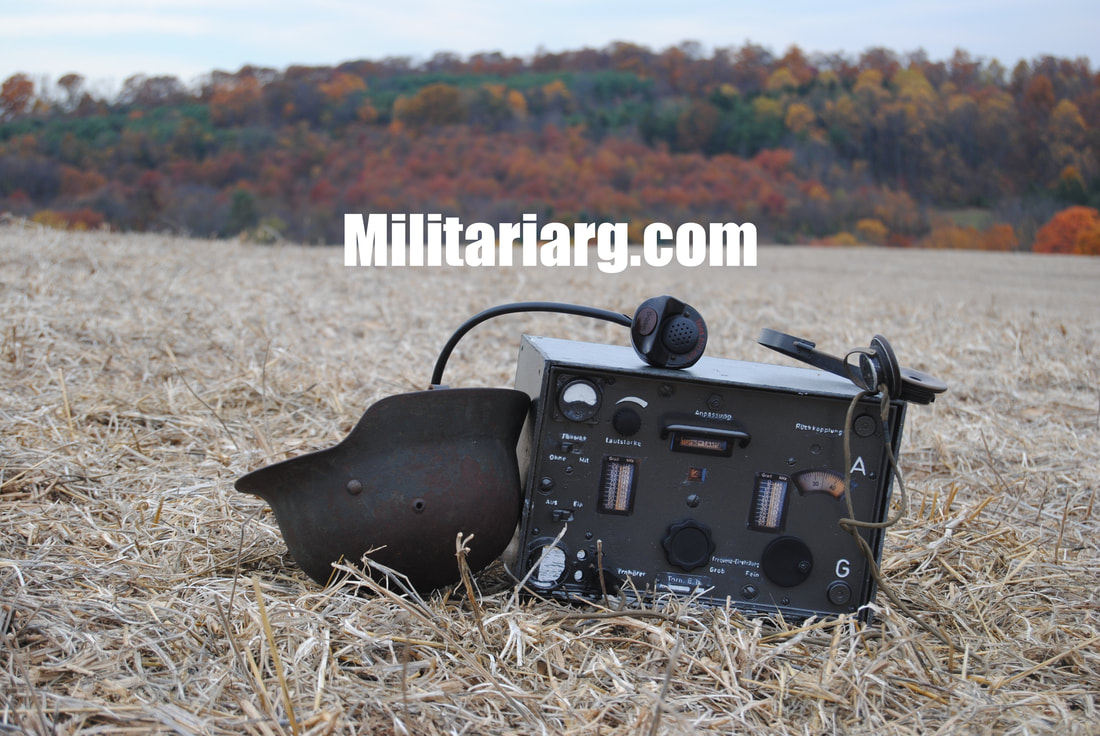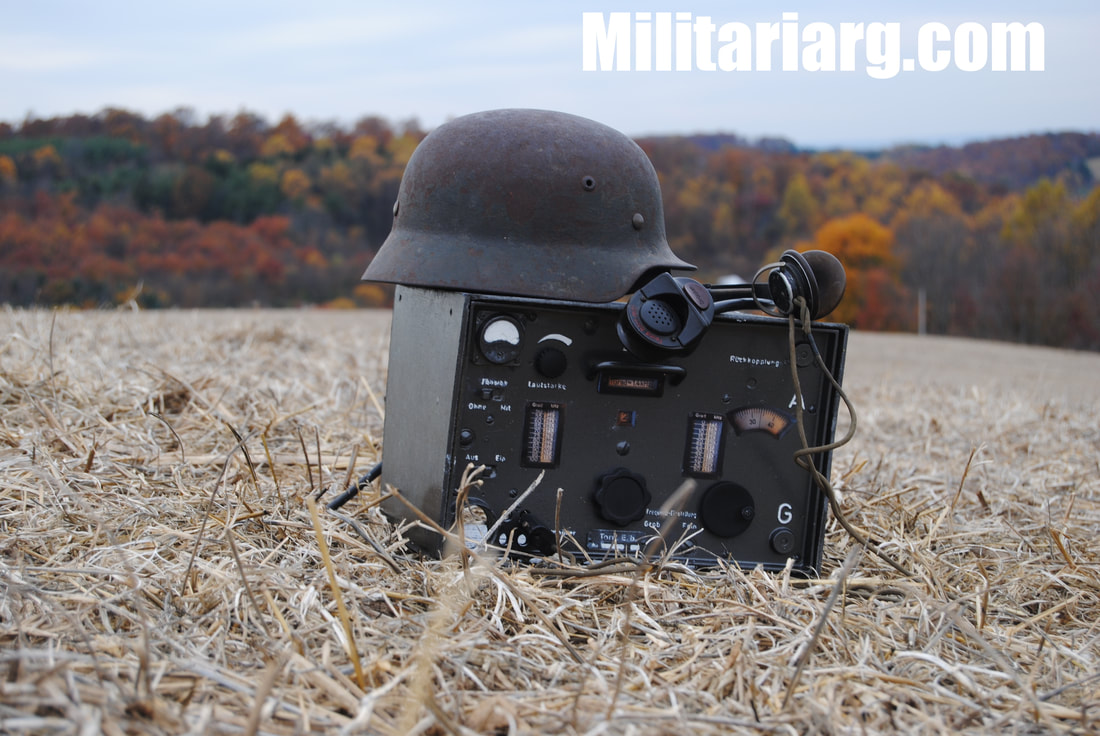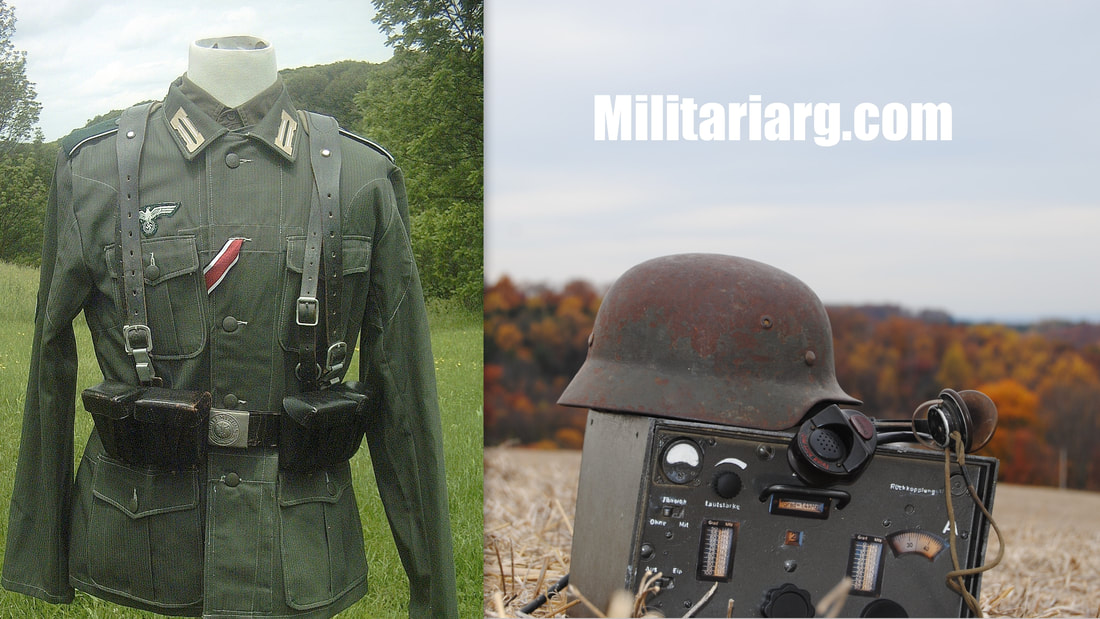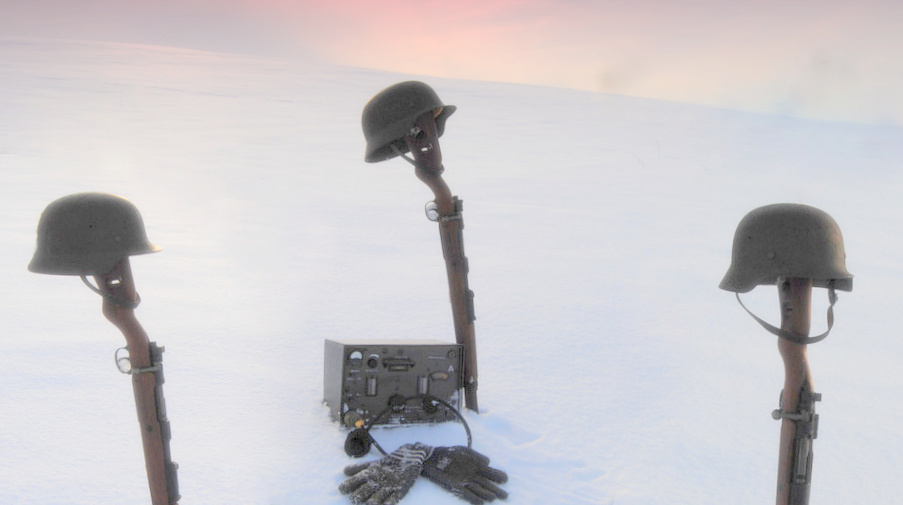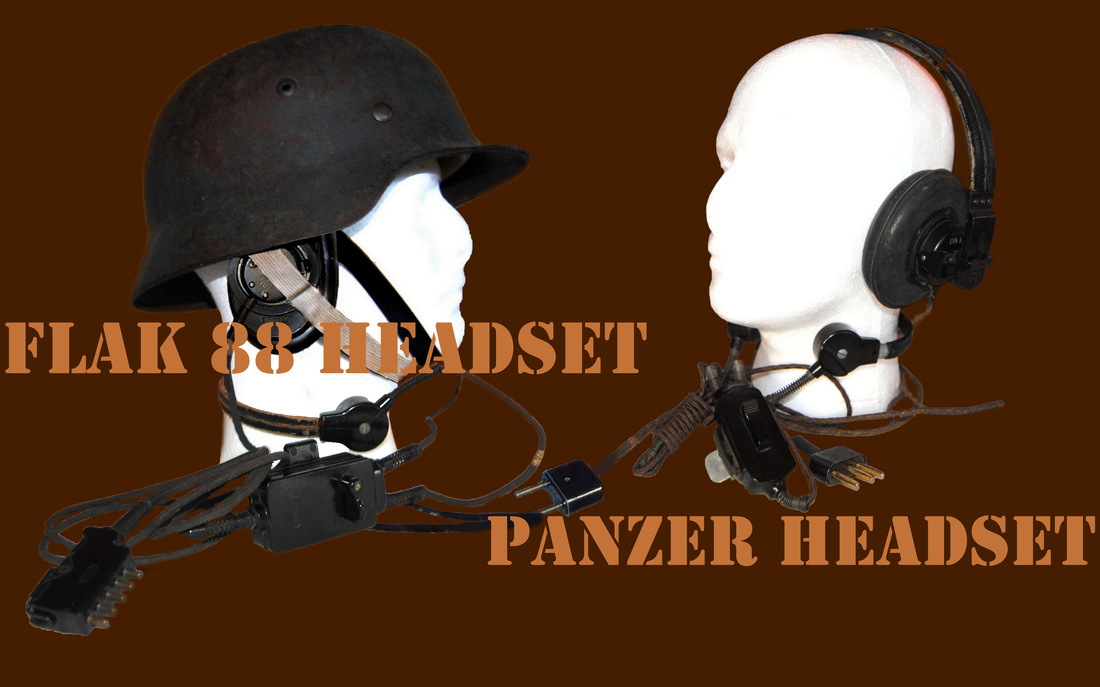
Flak 88 Crew (Luftwaffe) Single earphone (L38116) with Throat Mic marked L38114; switch box marked 38133; Five pin electrical plug dated 1943.
Panzer DFH.b Headset (2000 OHM), with KMF.b throat mic
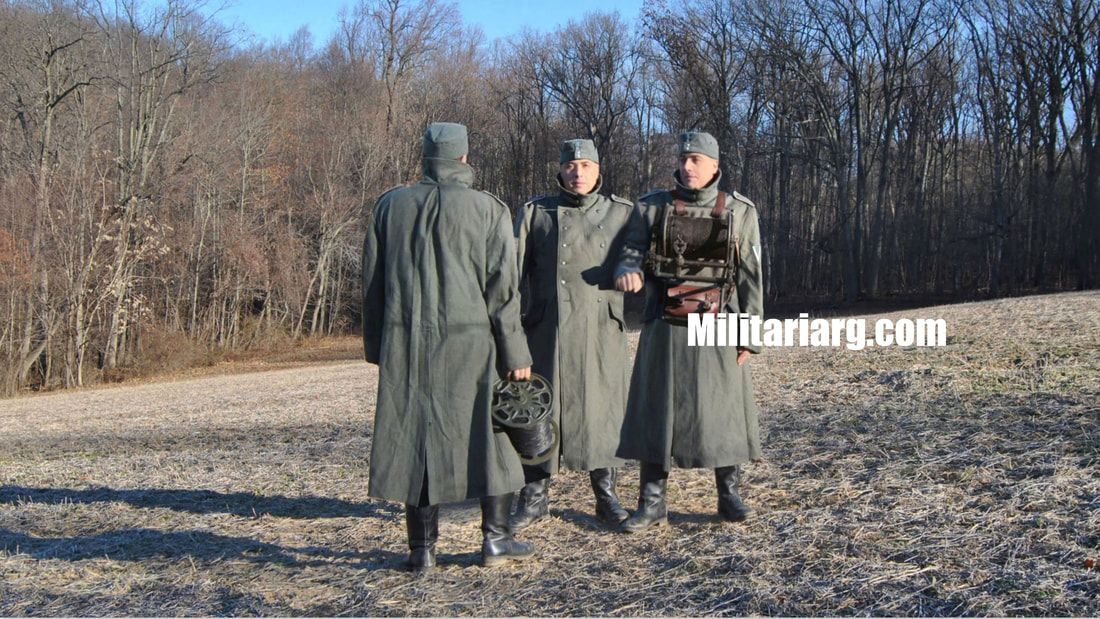
The German Wehrmacht utilized a diverse range of signal equipment and radios during World War II, collectively known as Nachrichtenmittel (communications equipment). This gear was crucial for maintaining command and control in their mobile warfare doctrine (Blitzkrieg).
The equipment was largely categorized into portable, vehicle-mounted, and fixed station systems, many given the generic prefix FuG for Funkgerät ("radio device").
Common Wehrmacht Radio Types
Infantry and Field Units Man-pack and field radios (Tornister-Fu, or "Torn.Fu." series, and the smaller Feldfunksprecher, or "Feldfu." series) were a backbone of infantry communication.
Torn.Fu.b/c/f: These were medium-to-high frequency (HF) transceivers used at the regimental and battalion levels. They typically offered a range of several kilometers using voice (AM) or Morse code (CW) and were usually not intended to be used while moving.
Torn.Fu.d2: A very common VHF (Very High Frequency) set used by infantry, offering a range of about 3 km with voice, and could be split between two soldiers (one carrying the receiver/transmitter, the other the battery/power supply) to be used on the move.
Feldfu. (a1, b, c, d, f, h): A series of smaller, lower-power VHF transceivers, often called "walkie-talkies" (though larger than modern versions), used for short-range communication within companies and platoons.
Armored Vehicle Communications
Communication in tanks and armored vehicles was primarily handled by a dedicated system.
FuG 5: This was the standard tank-to-tank transceiver, operating in the high-HF/low-VHF band (27–33.3 MHz). It was present in almost all German tanks and other vehicles, providing 125 channels for inter-platoon and company-level communication. It typically had a range of 2–3 km via voice.
Ukw.E.e Receiver: This ultra-short wave receiver was a component of the complete FuG 5 system, installed in many vehicles from Panzers to armored cars.
FuG 8/11: More powerful, medium-wave transceivers used in command tanks and command posts for longer-range communication back to regimental headquarters, using longer antennas.
Other Specialized Equipment
The Wehrmacht also employed highly specialized equipment:
Lichtsprechgerät 80/80: A unique system that used modulated light beams (both visible and infrared) for secure, line-of-sight communication over distances up to 5 km, as it could not be intercepted by traditional radio means.
FF33 (Feldfernsprecher 33): The standard, robust field telephone used for wired communications, often working in conjunction with radio nets when wire lines could be laid.
German radio technology was considered highly advanced for its time, though some Allied forces (like the US) moved to superior FM (frequency modulation) for their field radios, while the Germans primarily used AM (amplitude modulation).
The equipment was largely categorized into portable, vehicle-mounted, and fixed station systems, many given the generic prefix FuG for Funkgerät ("radio device").
Common Wehrmacht Radio Types
Infantry and Field Units Man-pack and field radios (Tornister-Fu, or "Torn.Fu." series, and the smaller Feldfunksprecher, or "Feldfu." series) were a backbone of infantry communication.
Torn.Fu.b/c/f: These were medium-to-high frequency (HF) transceivers used at the regimental and battalion levels. They typically offered a range of several kilometers using voice (AM) or Morse code (CW) and were usually not intended to be used while moving.
Torn.Fu.d2: A very common VHF (Very High Frequency) set used by infantry, offering a range of about 3 km with voice, and could be split between two soldiers (one carrying the receiver/transmitter, the other the battery/power supply) to be used on the move.
Feldfu. (a1, b, c, d, f, h): A series of smaller, lower-power VHF transceivers, often called "walkie-talkies" (though larger than modern versions), used for short-range communication within companies and platoons.
Armored Vehicle Communications
Communication in tanks and armored vehicles was primarily handled by a dedicated system.
FuG 5: This was the standard tank-to-tank transceiver, operating in the high-HF/low-VHF band (27–33.3 MHz). It was present in almost all German tanks and other vehicles, providing 125 channels for inter-platoon and company-level communication. It typically had a range of 2–3 km via voice.
Ukw.E.e Receiver: This ultra-short wave receiver was a component of the complete FuG 5 system, installed in many vehicles from Panzers to armored cars.
FuG 8/11: More powerful, medium-wave transceivers used in command tanks and command posts for longer-range communication back to regimental headquarters, using longer antennas.
Other Specialized Equipment
The Wehrmacht also employed highly specialized equipment:
Lichtsprechgerät 80/80: A unique system that used modulated light beams (both visible and infrared) for secure, line-of-sight communication over distances up to 5 km, as it could not be intercepted by traditional radio means.
FF33 (Feldfernsprecher 33): The standard, robust field telephone used for wired communications, often working in conjunction with radio nets when wire lines could be laid.
German radio technology was considered highly advanced for its time, though some Allied forces (like the US) moved to superior FM (frequency modulation) for their field radios, while the Germans primarily used AM (amplitude modulation).
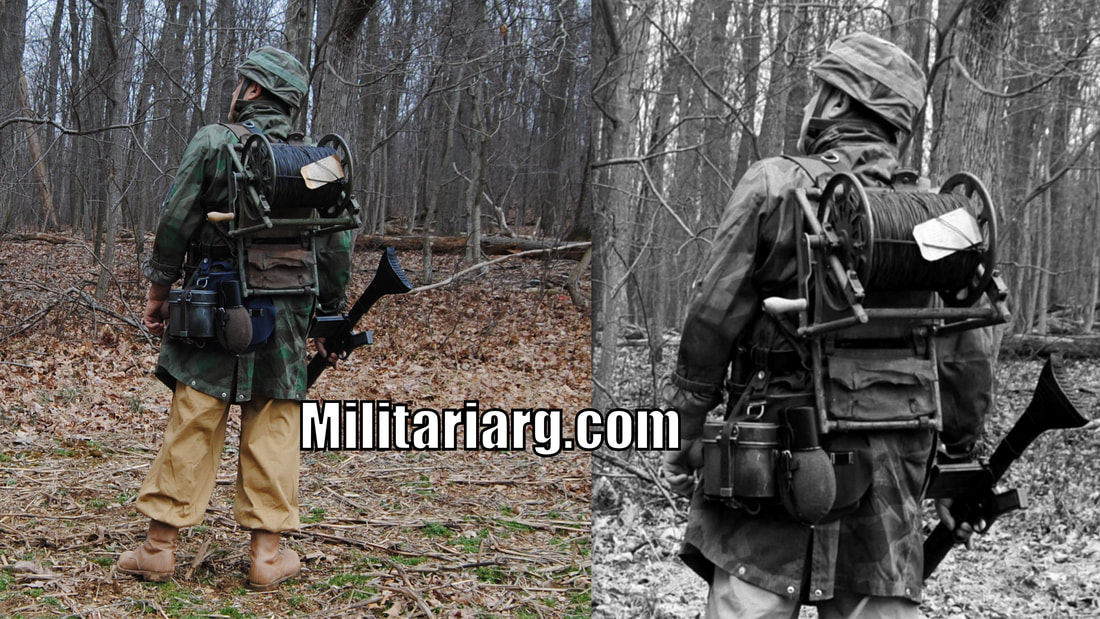
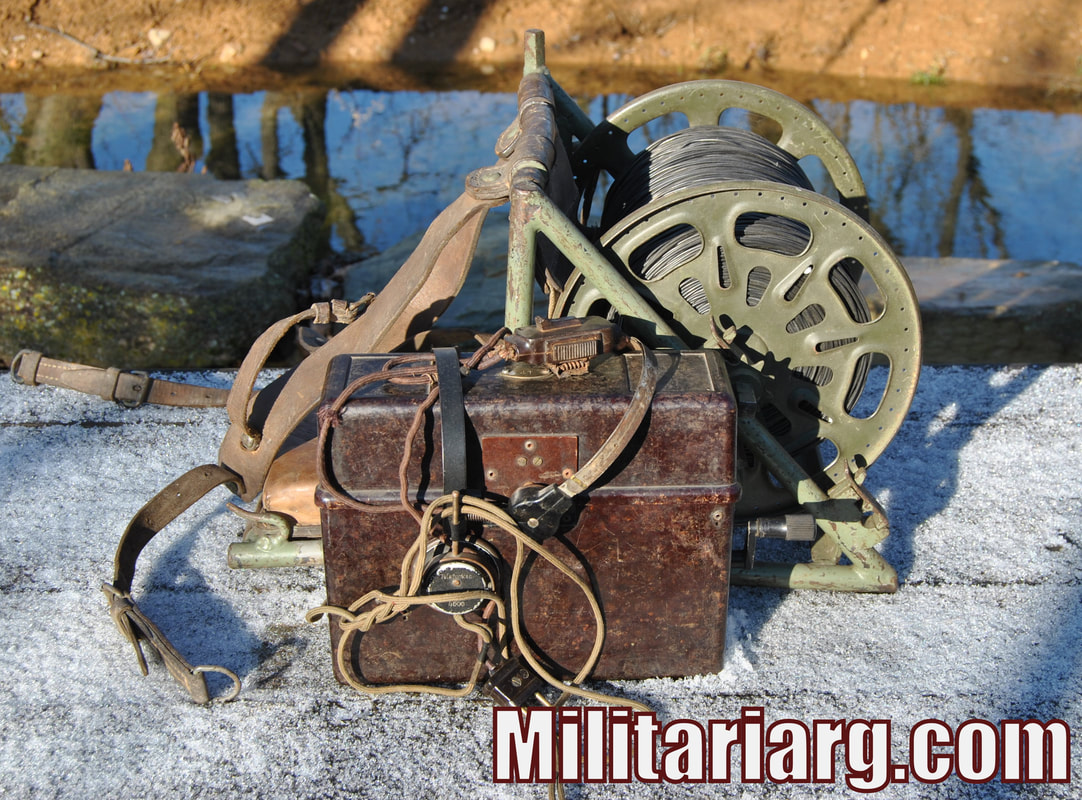
WW2 stalingrad reenactment. Feld kabel funk Kabeltrommel.
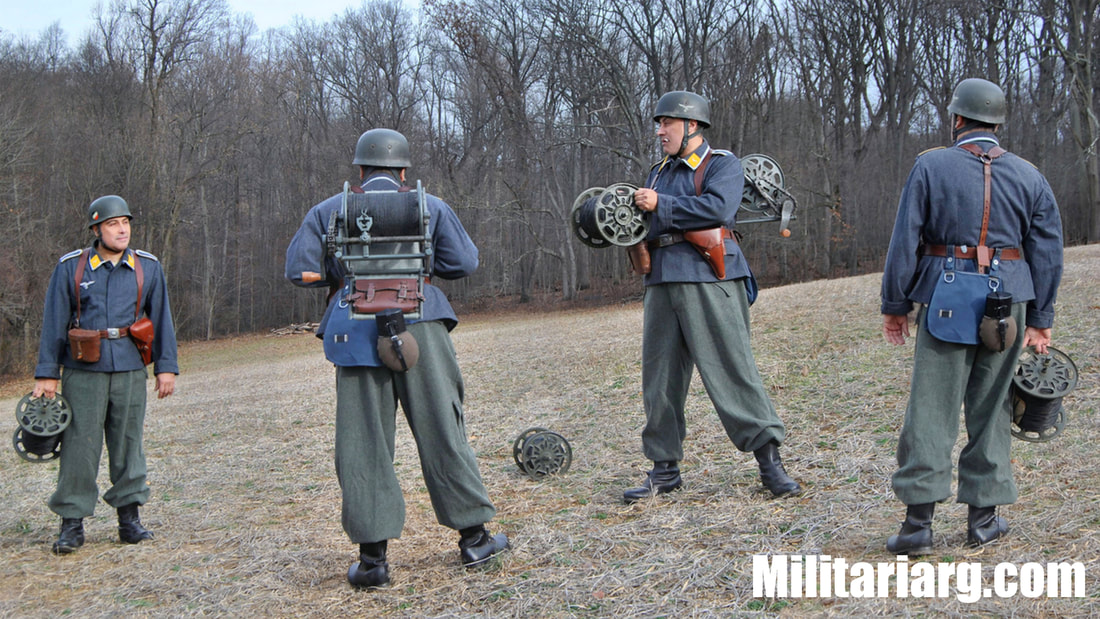
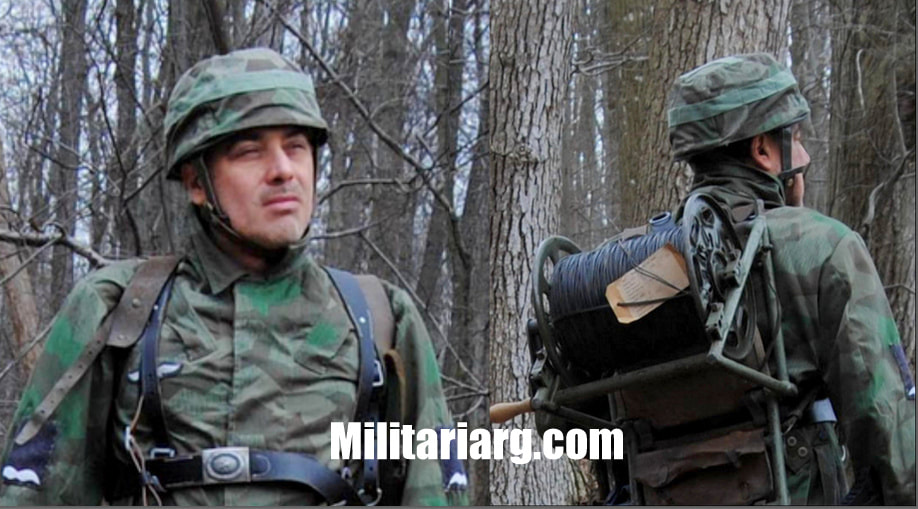
WW2 Fallschirmjager pioneer signal reenactment impression.
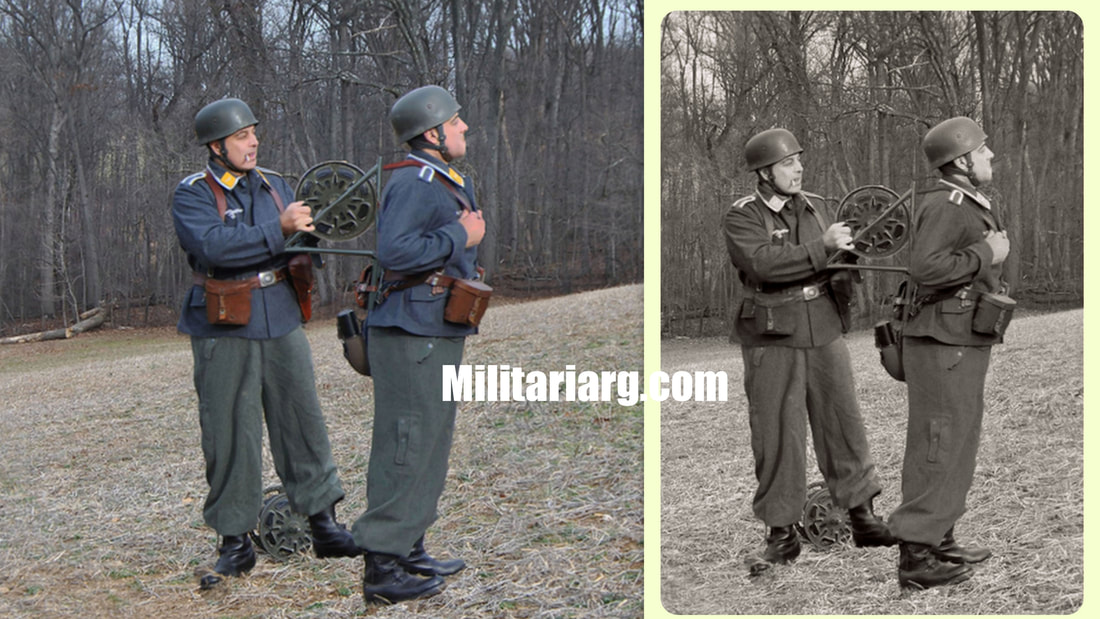
German signal troops (Nachrichtentruppen) used specialized equipment to carry and deploy wire. It typically involved the Rückentrage (Back Carrier).
The Kabeltrommel (cable reel) was a metal spool containing roughly 500 to 800 meters of heavy field telephone wire.
To carry this "backpack-style," signalmen used a lightweight tubular steel or aluminum frame known as the Rückentrage für Kabeltrommel (Back Carrier for Cable Reel). It featured leather or canvas shoulder straps and a central axle where the reel could spin freely.
A soldier (the Kabeltrupp) would walk forward, and the wire would unspool from the reel on his back. A second soldier often followed with a Gabelstange (forked pole) to guide the wire into ditches or up into trees.
The Kabeltrommel (cable reel) was a metal spool containing roughly 500 to 800 meters of heavy field telephone wire.
To carry this "backpack-style," signalmen used a lightweight tubular steel or aluminum frame known as the Rückentrage für Kabeltrommel (Back Carrier for Cable Reel). It featured leather or canvas shoulder straps and a central axle where the reel could spin freely.
A soldier (the Kabeltrupp) would walk forward, and the wire would unspool from the reel on his back. A second soldier often followed with a Gabelstange (forked pole) to guide the wire into ditches or up into trees.
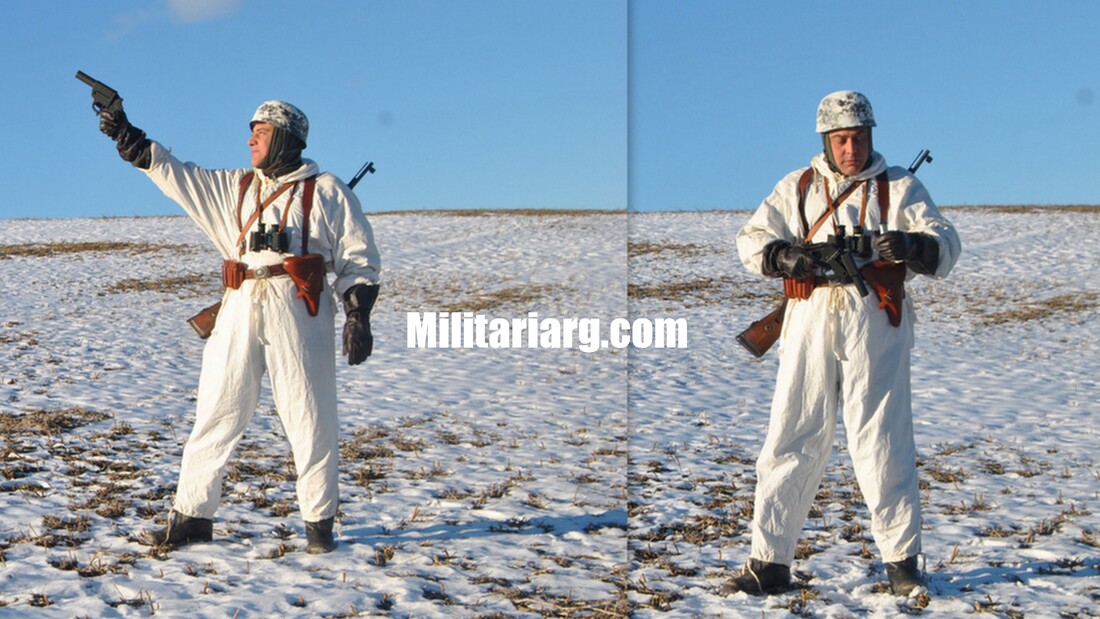
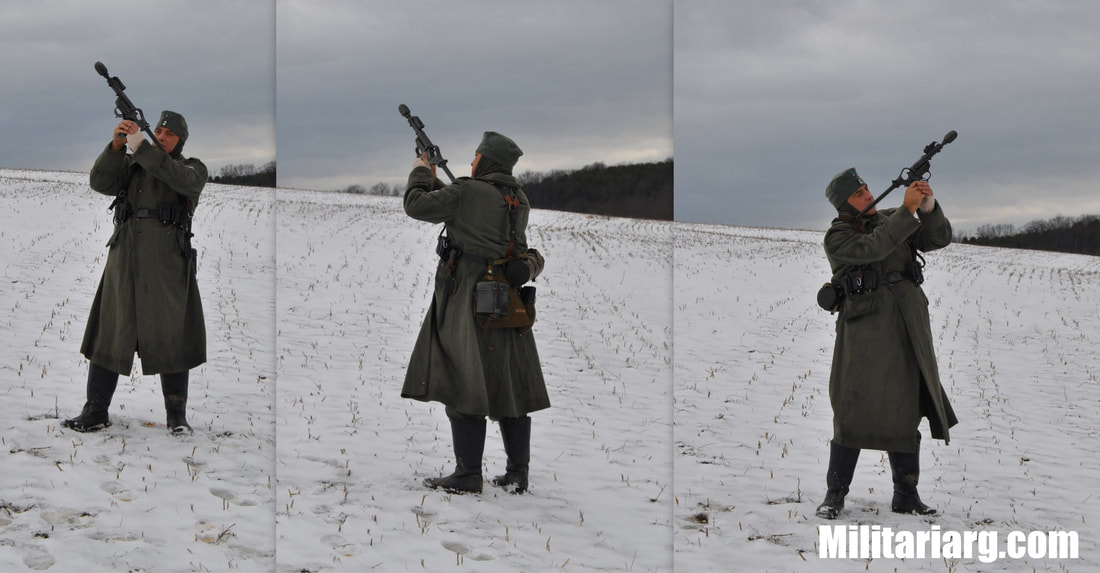
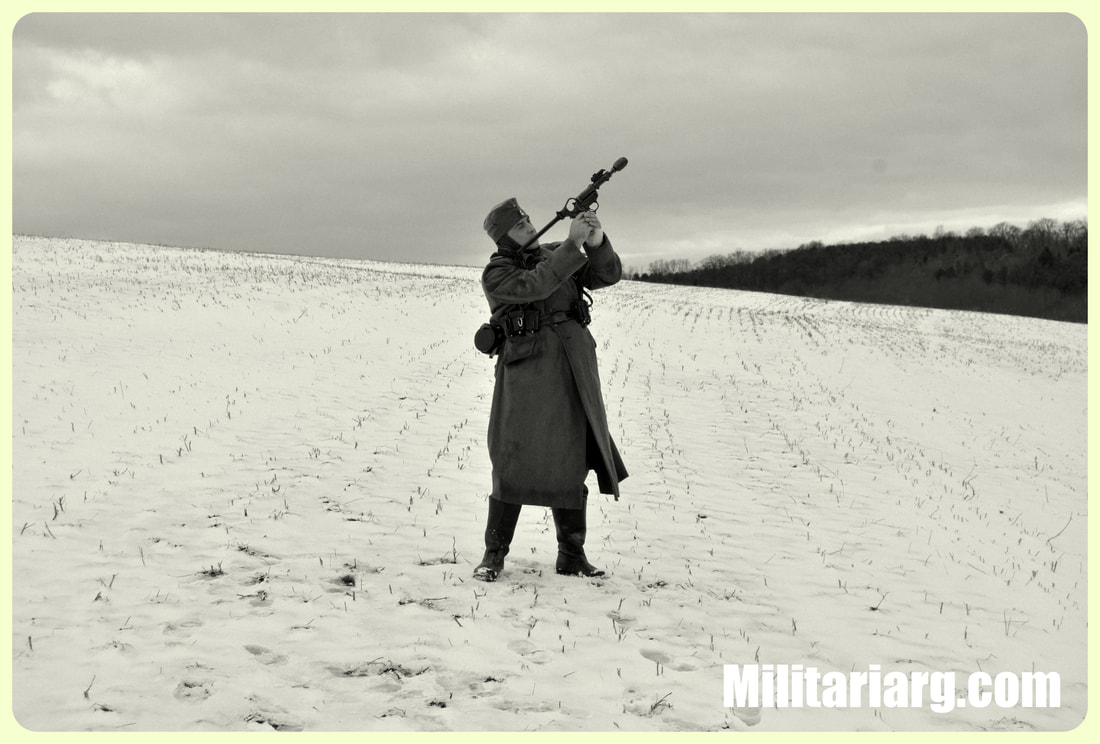
Single-shot Flare Gun Signal Pistol.
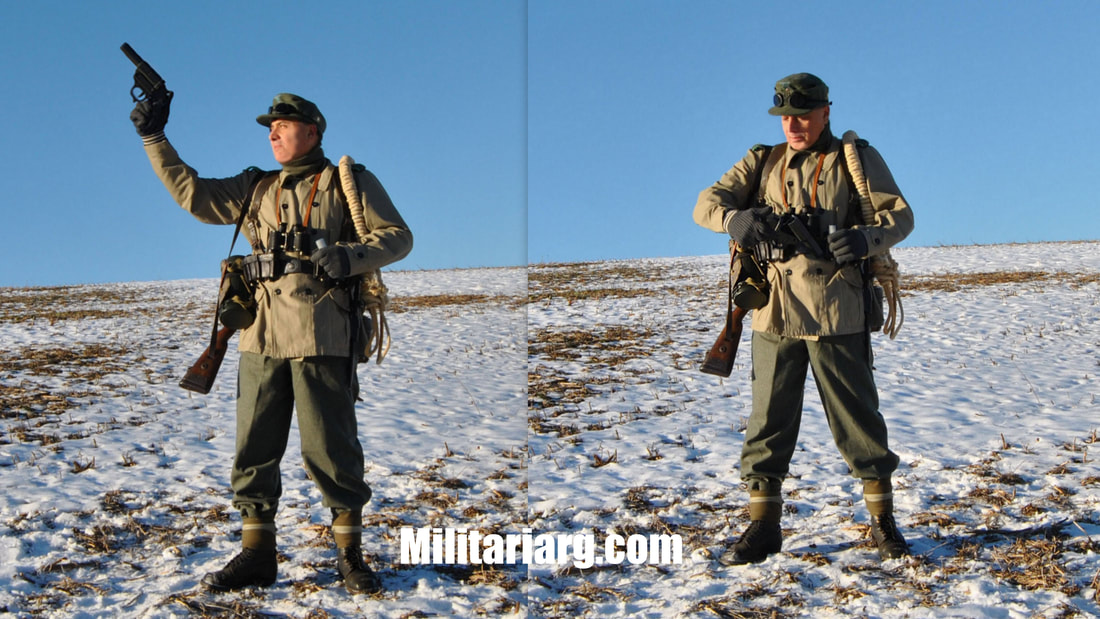
Sturmpistole Flare Gun
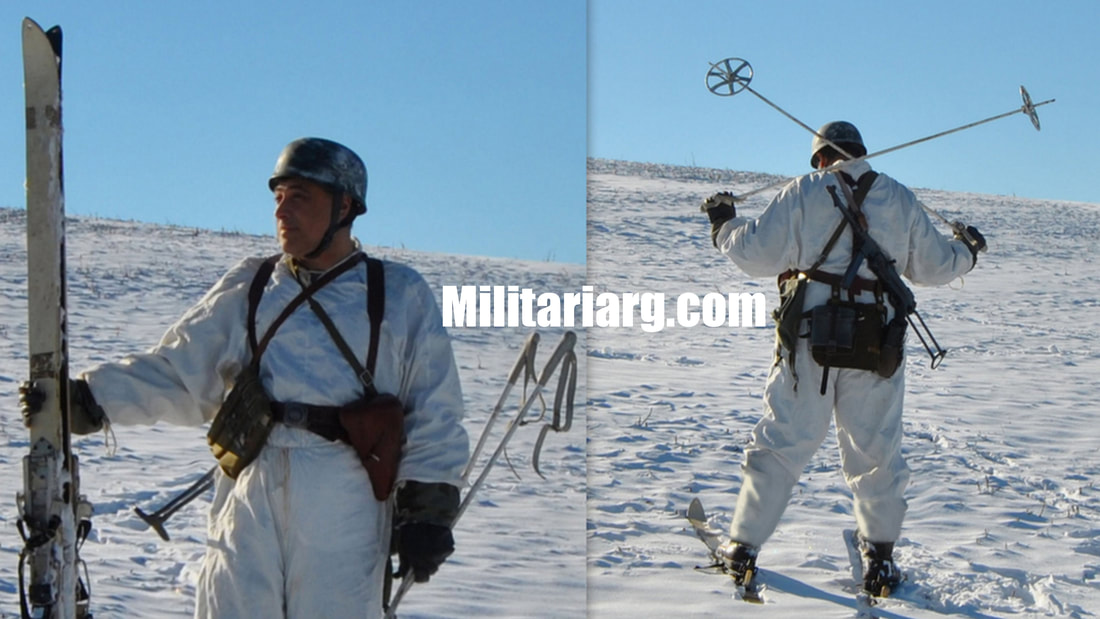
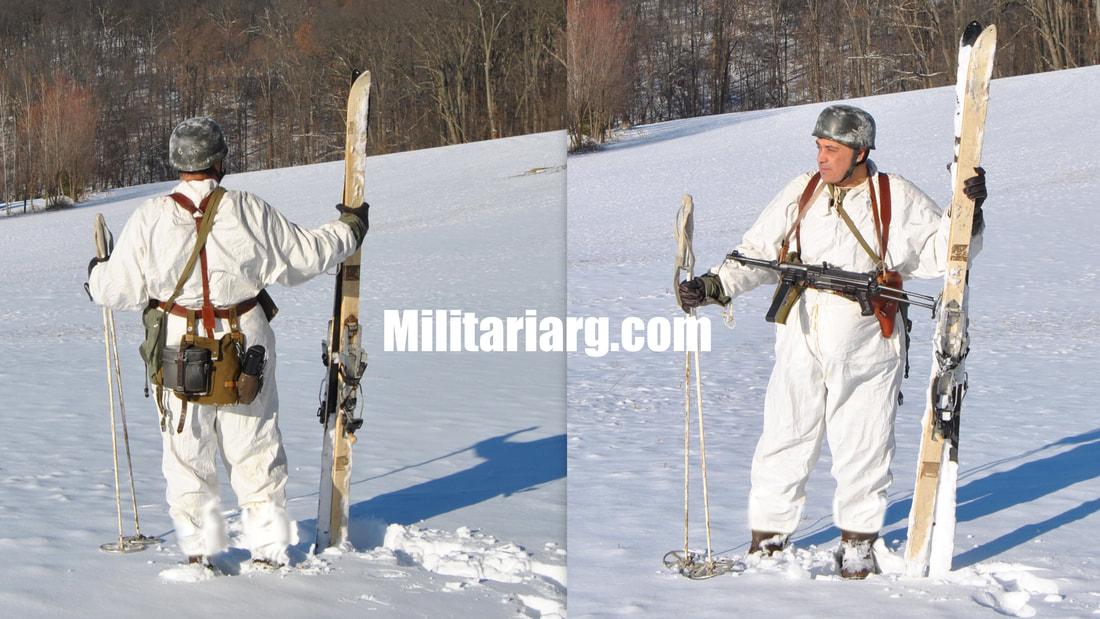
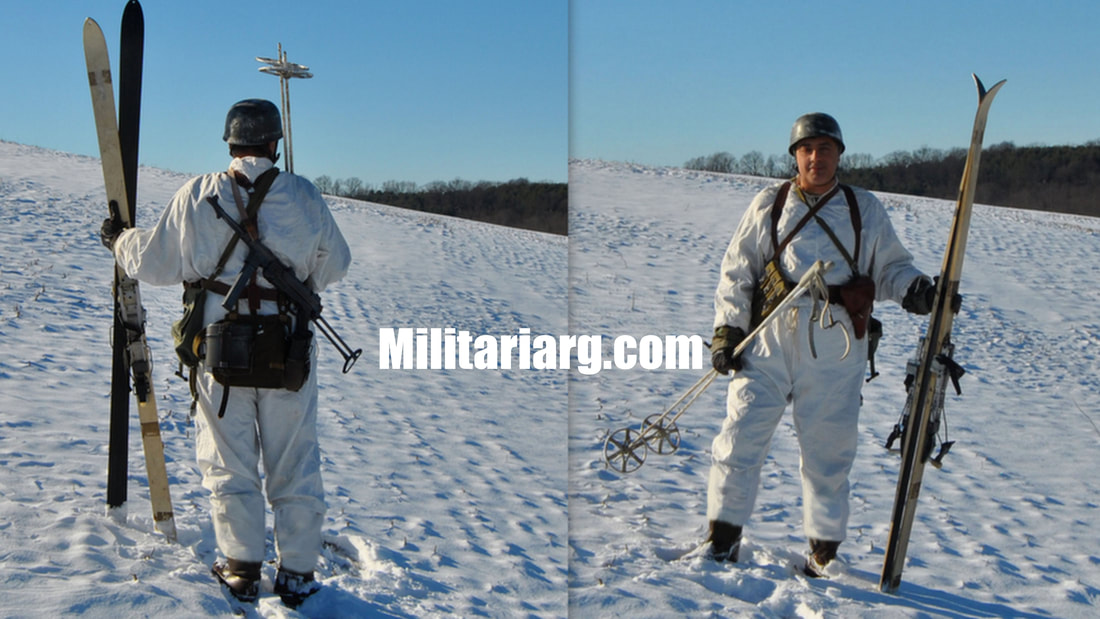
Fallschirmjager skiers (Radio operators extending phones lines on skis).
Late War. Field Telephone- OB Fernsprechen 43, dated 1944.
The FF33 was the single standard field telephone used by the German military (Wehrmacht) from 1933 until the end of the war. It was robustly built in a black Bakelite case and remained essentially unchanged throughout its service life.
The term "OB Fernsprechen" (OrtsBatterie Fernsprechen) refers to the standard mode of operation for the primary German World War II field telephone, the Feldfernsprecher 33 (FF33).
The FF33 was the single standard field telephone used by the German military (Wehrmacht) from 1933 until the end of the war. It was robustly built in a black Bakelite case and remained essentially unchanged throughout its service life.
The term "OB Fernsprechen" (OrtsBatterie Fernsprechen) refers to the standard mode of operation for the primary German World War II field telephone, the Feldfernsprecher 33 (FF33).
Fernsprechtornister FF-33 "Pony" Tornister.
On the right, the Fernsprechertornister (Signal, Radio, Telephone backpack). On the left a regular M39 Tornister backpack.
The "The FF-33 field telephone with the "Pony tornister" and its faithful companion the "Kabletrommel". They were the "inseparable pair" of the German signal corps. The FF-33 (Feldfernsprecher 33) provided the "voice," but it was useless without the Kabeltrommel providing the "line."
The Fernsprechtornister FF-33 "Pony" was a specialized backpack used by German Army (Wehrmacht) signals personnel (Nachrichtentruppen) to carry and operate the standard FF33 field telephone and associated equipment. It was nicknamed "Pony" due to its construction, which often used cowhide (pony fur) covering in the early war period.
The Fernsprechtornister (Signal Backpack) sometimes nicknamed the "Pony" due to its cowhide cover. While larger than a standard infantry pack, it was designed to house the FF-33 field telephone, batteries, tools, and smaller handheld cable spools rather than the large heavy reels.
By 1943, there were three primary models (1, 2, and 3), each with different internal partitions for specific signal equipment like testing devices or switchboards.
Torn Fu D2 Replica
Portable VHF 2 Way. Torn Fu D2 Repro.
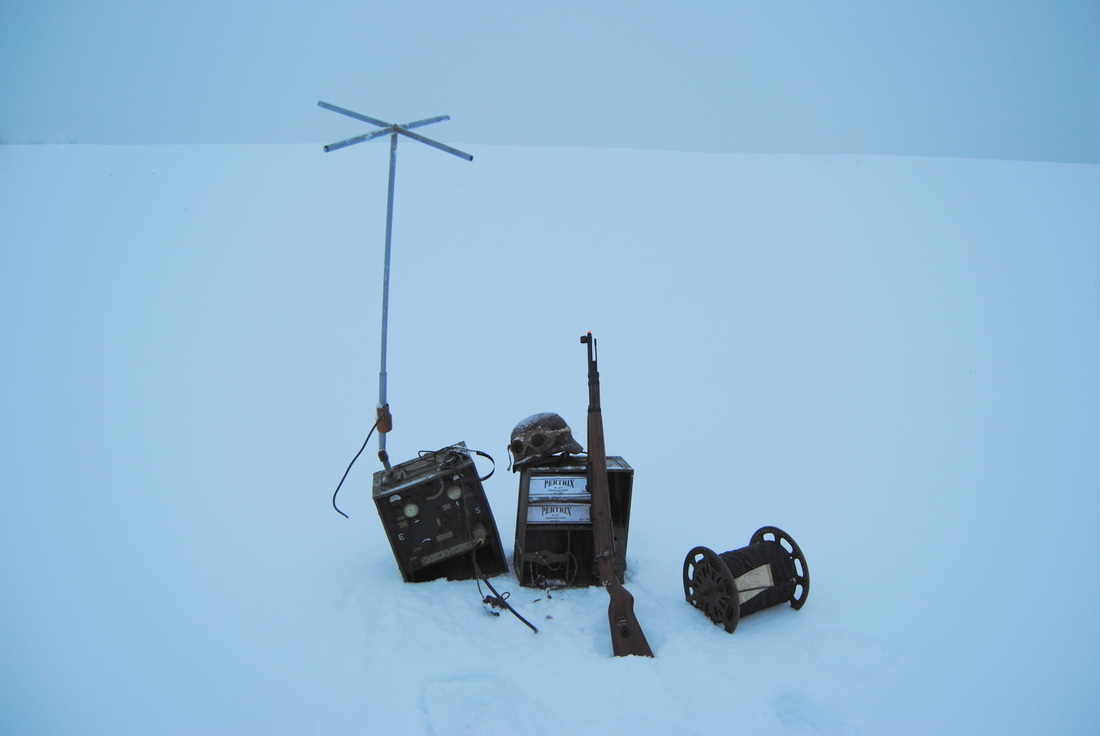
Torn. Fu. d2 (Tornister Funkgerät d2, or "knapsack radio device d2") was the standard, portable very-high-frequency (VHF) radio transceiver used by the German infantry, paratroopers, and artillery observers during World War II. Introduced in 1936, it was designed for voice communication at the battalion level and below.
Frequency Range: 33.8 to 38.0 MHz (VHF low band).
Modes: Capable of voice (AM - Amplitude Modulation) and continuous wave (CW - Morse code) transmission and reception.
Range: Approximately 4 km (2.5 miles) for voice communication and up to 10 km (6 miles) for Morse code (CW).
Power Output: Around 1 watt for CW and 0.4 watts for voice transmission.
Power Source: The unit required two battery packs: a 2-volt storage cell for the filaments and two 90-volt anode batteries for the plate voltage.
Transportation: The complete set was typically divided into two packs to be carried by two different soldiers. One carried the transceiver unit, while the other carried the battery pack and accessories (headphones, microphone, Morse key, antenna parts).
Antenna: A 6-foot vertical rod antenna was standard, but a remote wire antenna could also be used.
The Torn. Fu. d2 was a common and crucial piece of equipment for establishing voice radio nets within infantry units. Its reliability and range in the VHF band were comparable to later Allied designs like the U.S. SCR-300 "walkie-talkie" backpack radio. It could also be hooked up to a standard field telephone line to act as a radio relay station.
Frequency Range: 33.8 to 38.0 MHz (VHF low band).
Modes: Capable of voice (AM - Amplitude Modulation) and continuous wave (CW - Morse code) transmission and reception.
Range: Approximately 4 km (2.5 miles) for voice communication and up to 10 km (6 miles) for Morse code (CW).
Power Output: Around 1 watt for CW and 0.4 watts for voice transmission.
Power Source: The unit required two battery packs: a 2-volt storage cell for the filaments and two 90-volt anode batteries for the plate voltage.
Transportation: The complete set was typically divided into two packs to be carried by two different soldiers. One carried the transceiver unit, while the other carried the battery pack and accessories (headphones, microphone, Morse key, antenna parts).
Antenna: A 6-foot vertical rod antenna was standard, but a remote wire antenna could also be used.
The Torn. Fu. d2 was a common and crucial piece of equipment for establishing voice radio nets within infantry units. Its reliability and range in the VHF band were comparable to later Allied designs like the U.S. SCR-300 "walkie-talkie" backpack radio. It could also be hooked up to a standard field telephone line to act as a radio relay station.
Torn Eb Replica
Nicknamed "Berta" by some soldiers, the Torn. E.b. was in general use with the German Signal Corps, but also at higher army staffs, police, and traffic control authorities. Its robust construction and ease of repair in the field contributed to its widespread use until the end of the war.
The Torn. E. b. (Tornister Empfänger b, or "knapsack receiver model b") was a widely produced and highly effective German radio receiver used extensively by the Wehrmacht during World War II.
It was introduced around 1935/36 and remained a staple of German signals operations throughout the war.
Torn Eb Replica.
Role: It was designed primarily as a high-frequency (HF) receiver for field use, often paired with various portable transmitters to create complete radio stations.
Frequency Range: The receiver covered a wide spectrum, from 100 kHz to approximately 7 MHz (6970 kHz) across eight switchable bands, allowing it to pick up both long-range military signals and broadcast radio stations.
Design: The set was split into two separate, clip-able metal cases: one housed the receiver itself, and the other contained the batteries and accessories. This design made it more manageable for a single soldier to carry on his back, giving it its "Tornister" (backpack) name.
Technology: It was a robust, direct-amplification receiver using four identical RV2 P800 pentode vacuum tubes, a practical choice that simplified maintenance and required carrying only one type of spare tube.
Operation: The receiver was used for both voice (AM) and Morse code (CW) reception, featuring a Tonsieb (audio filter) for improved CW clarity.
Role: It was designed primarily as a high-frequency (HF) receiver for field use, often paired with various portable transmitters to create complete radio stations.
Frequency Range: The receiver covered a wide spectrum, from 100 kHz to approximately 7 MHz (6970 kHz) across eight switchable bands, allowing it to pick up both long-range military signals and broadcast radio stations.
Design: The set was split into two separate, clip-able metal cases: one housed the receiver itself, and the other contained the batteries and accessories. This design made it more manageable for a single soldier to carry on his back, giving it its "Tornister" (backpack) name.
Technology: It was a robust, direct-amplification receiver using four identical RV2 P800 pentode vacuum tubes, a practical choice that simplified maintenance and required carrying only one type of spare tube.
Operation: The receiver was used for both voice (AM) and Morse code (CW) reception, featuring a Tonsieb (audio filter) for improved CW clarity.
Relic Radios
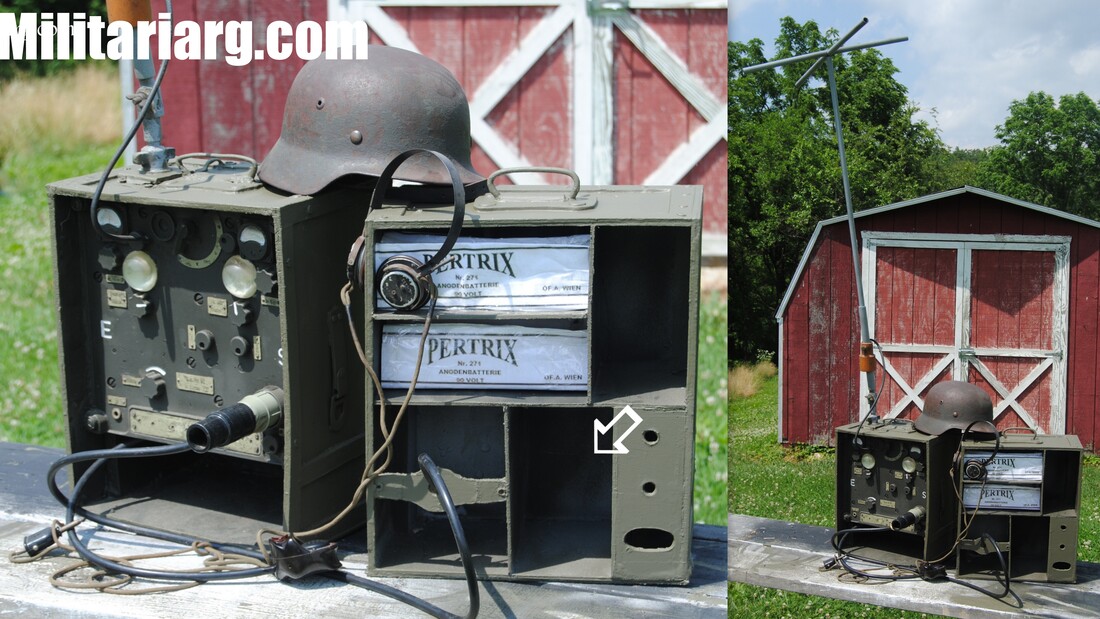
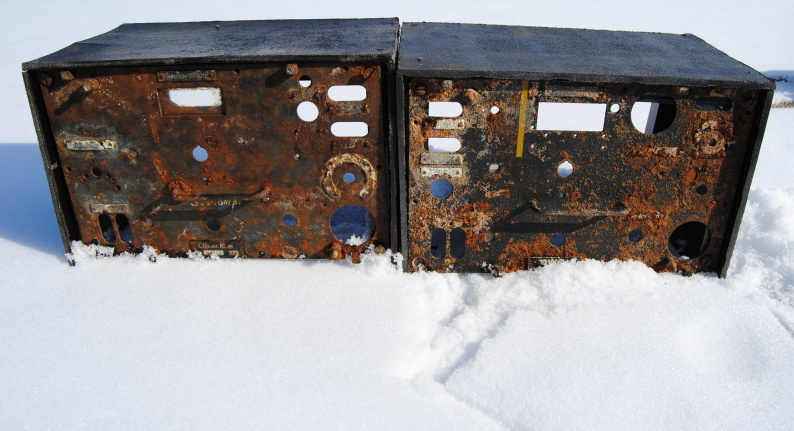
German Fu 5 Panzer Radio Set Panels 10 WS c and UKWE e (Relic).
The Fu 5 radio set was the standard German Army VHF (very high frequency) transceiver used for internal communication between tanks within platoons and companies during World War II.
The Fu 5 system was typically composed of two main units: a transmitter and a receiver, powered by an associated transformer unit (Umformer E.U.a2 or E.U.a4) drawing power from the vehicle's 12-volt battery.
Component description:
Transmitter 10 W.S.c (10 Watt Sender c).
Receiver Ukw.E.e (Ultra short wave receiver e).
Frequency Range 27.0 to 33.3 MHz (27,000 to 33,300 kHz).
Power Output 10 Watts.
Range Approximately 2-3 km for voice (AM), up to 3-4 km for Morse code (CW).
Channels 125 radio channels with 50 kHz spacing.
Antenna Usually used with a two-meter rod antenna.
Usage in German Armored Vehicles
The Fu 5 was a near-universal fitment in non-command versions of German tanks and other armored vehicles. Command tanks (Befehlspanzer) typically had an additional receiver (FuG 2) installed to monitor a second frequency, allowing the commander to communicate with both his own unit and the regimental command simultaneously.
Vehicles commonly equipped with the Fu 5 included:
Panzer II, III, IV, V (Panther), and VI (Tiger)
StuG III and IV
Flakpanzer IV variants (Wirbelwind, Kugelblitz)
Various half-tracks and tank destroyers
The Fu 5 radio set was the standard German Army VHF (very high frequency) transceiver used for internal communication between tanks within platoons and companies during World War II.
The Fu 5 system was typically composed of two main units: a transmitter and a receiver, powered by an associated transformer unit (Umformer E.U.a2 or E.U.a4) drawing power from the vehicle's 12-volt battery.
Component description:
Transmitter 10 W.S.c (10 Watt Sender c).
Receiver Ukw.E.e (Ultra short wave receiver e).
Frequency Range 27.0 to 33.3 MHz (27,000 to 33,300 kHz).
Power Output 10 Watts.
Range Approximately 2-3 km for voice (AM), up to 3-4 km for Morse code (CW).
Channels 125 radio channels with 50 kHz spacing.
Antenna Usually used with a two-meter rod antenna.
Usage in German Armored Vehicles
The Fu 5 was a near-universal fitment in non-command versions of German tanks and other armored vehicles. Command tanks (Befehlspanzer) typically had an additional receiver (FuG 2) installed to monitor a second frequency, allowing the commander to communicate with both his own unit and the regimental command simultaneously.
Vehicles commonly equipped with the Fu 5 included:
Panzer II, III, IV, V (Panther), and VI (Tiger)
StuG III and IV
Flakpanzer IV variants (Wirbelwind, Kugelblitz)
Various half-tracks and tank destroyers
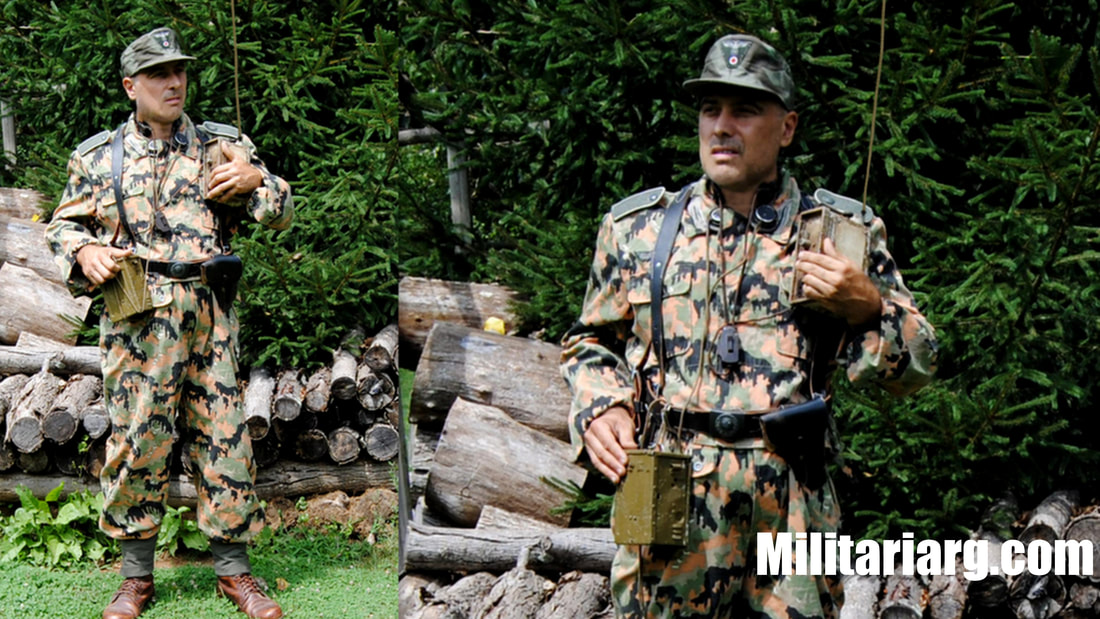
Kleinfunksprecher D Dorette KlFuSpr.d Small Dora
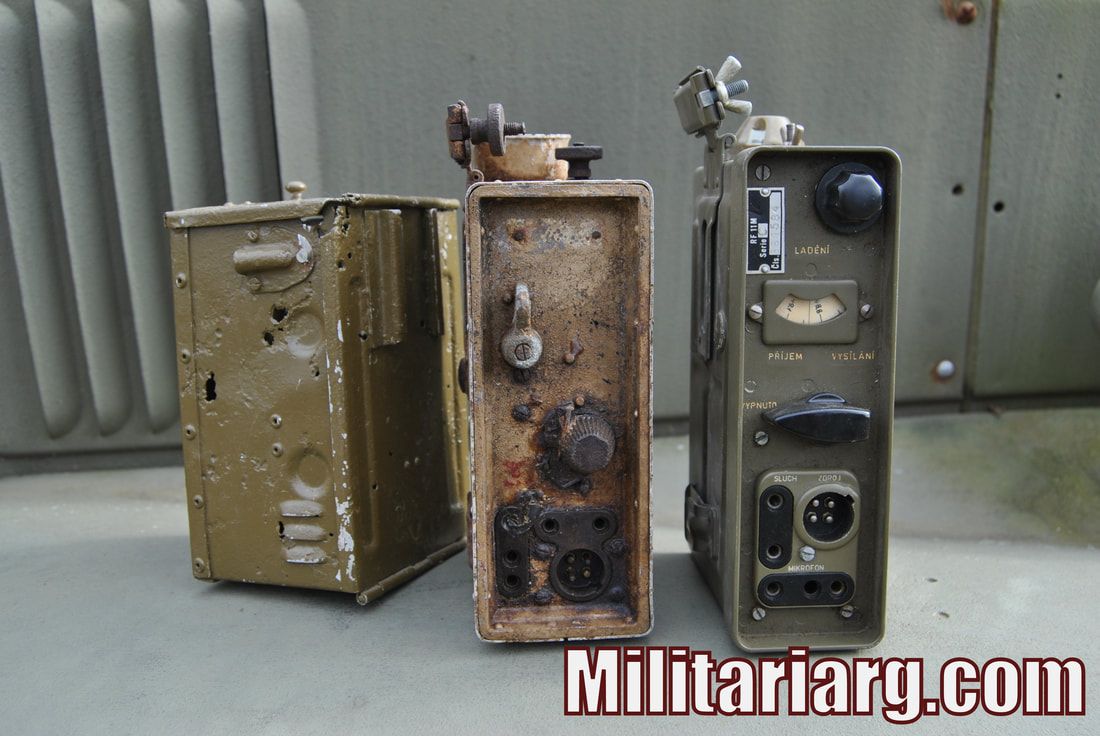
KlFuSpr.d "Dorette" Radio Walkie Talkie with Battery Box. On the right, the RF-11 Czech Post War Version.
The KlFuSpr.d "Dorette" (Kleinfunksprecher d, or "small radio speaker model d") was a very small, late-war German military radio transceiver, essentially a "walkie-talkie" designed for tactical voice communication at the squad or platoon level.
Introduction: The "Dorette" was developed by Philips and entered service very late in the war, around October 1944.
Size and Portability: It was the smallest and lightest portable radio set produced by the Germans during WWII, light enough to be carried attached to a soldier's standard "Y-straps" or on a belt.
Frequency Range: It operated in the VHF (Very High Frequency) range from 32 to 38 MHz for voice (AM) communication.
Range: The effective range was approximately 2 to 4 km (about 1.2 to 2.5 miles), depending on terrain and weather conditions.
Interoperability: Its frequency range was specifically chosen to overlap with the standard infantry Torn. Fu. d2 set and the Fu 5 tank radio set, allowing infantry to coordinate directly with supporting armor.
Power: It ran on a 1.4-volt filament battery and a 150-volt anode battery, which provided approximately 25 hours of operation (assuming 20% transmit, 80% receive time).
Accessories: The complete set included a separate battery box (often carried on a belt), headphones, a throat microphone (Kehlkopfmikrofon), and a collapsible band antenna.
Due to its late-war introduction and production interruptions from Allied bombing, most surviving examples come from unissued stocks found at the end of the war, though it was issued and used in the final months of combat.
The KlFuSpr.d "Dorette" (Kleinfunksprecher d, or "small radio speaker model d") was a very small, late-war German military radio transceiver, essentially a "walkie-talkie" designed for tactical voice communication at the squad or platoon level.
Introduction: The "Dorette" was developed by Philips and entered service very late in the war, around October 1944.
Size and Portability: It was the smallest and lightest portable radio set produced by the Germans during WWII, light enough to be carried attached to a soldier's standard "Y-straps" or on a belt.
Frequency Range: It operated in the VHF (Very High Frequency) range from 32 to 38 MHz for voice (AM) communication.
Range: The effective range was approximately 2 to 4 km (about 1.2 to 2.5 miles), depending on terrain and weather conditions.
Interoperability: Its frequency range was specifically chosen to overlap with the standard infantry Torn. Fu. d2 set and the Fu 5 tank radio set, allowing infantry to coordinate directly with supporting armor.
Power: It ran on a 1.4-volt filament battery and a 150-volt anode battery, which provided approximately 25 hours of operation (assuming 20% transmit, 80% receive time).
Accessories: The complete set included a separate battery box (often carried on a belt), headphones, a throat microphone (Kehlkopfmikrofon), and a collapsible band antenna.
Due to its late-war introduction and production interruptions from Allied bombing, most surviving examples come from unissued stocks found at the end of the war, though it was issued and used in the final months of combat.
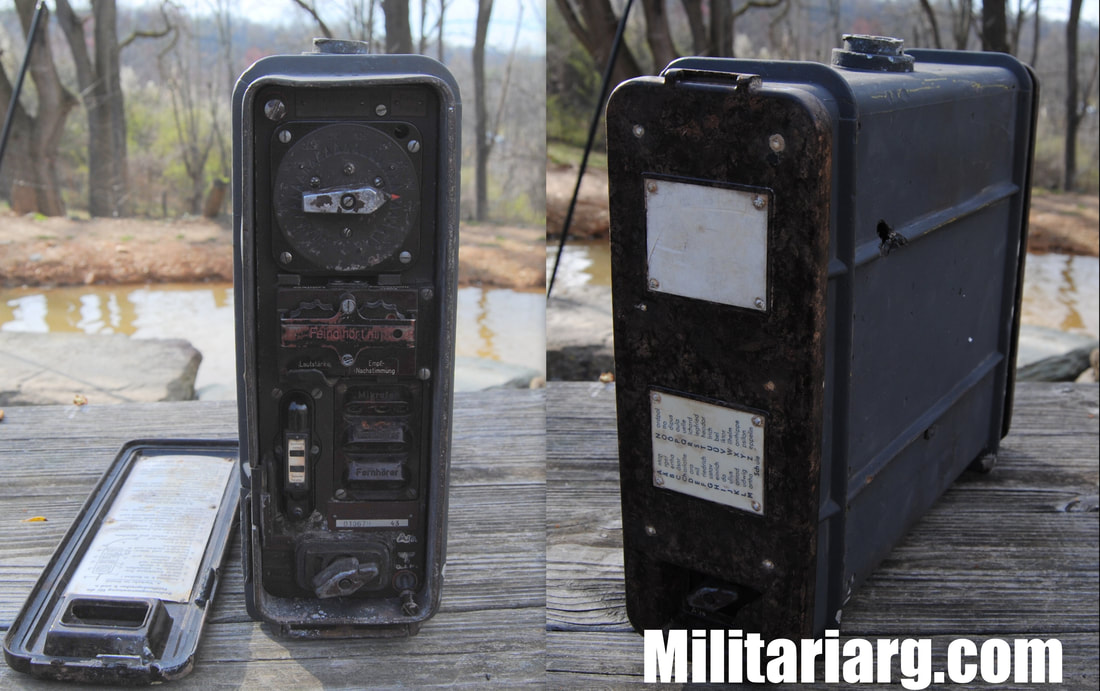
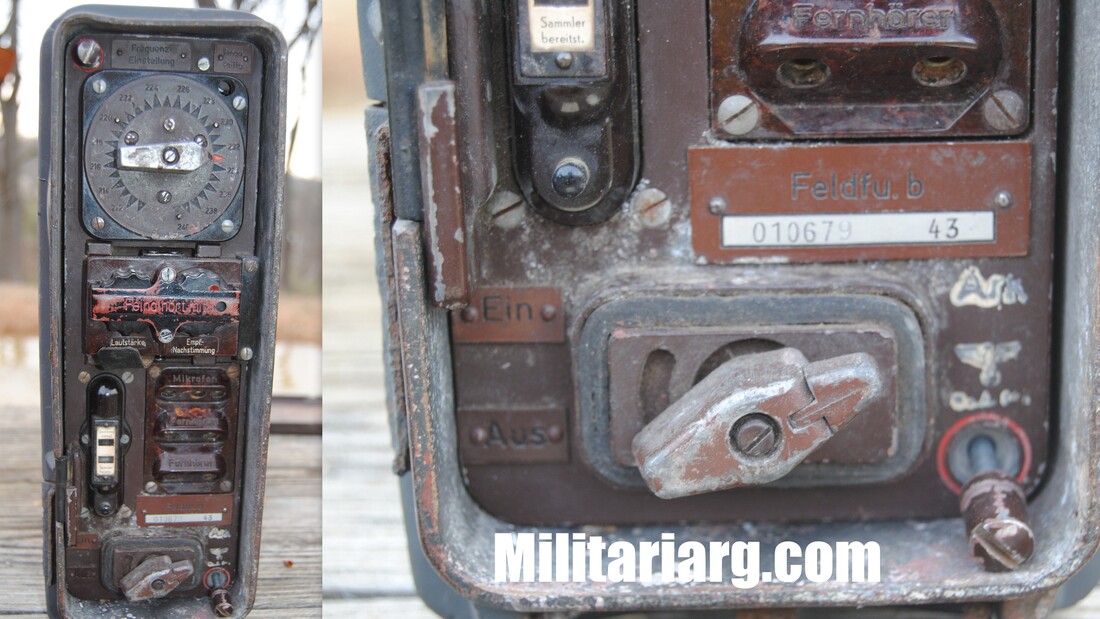
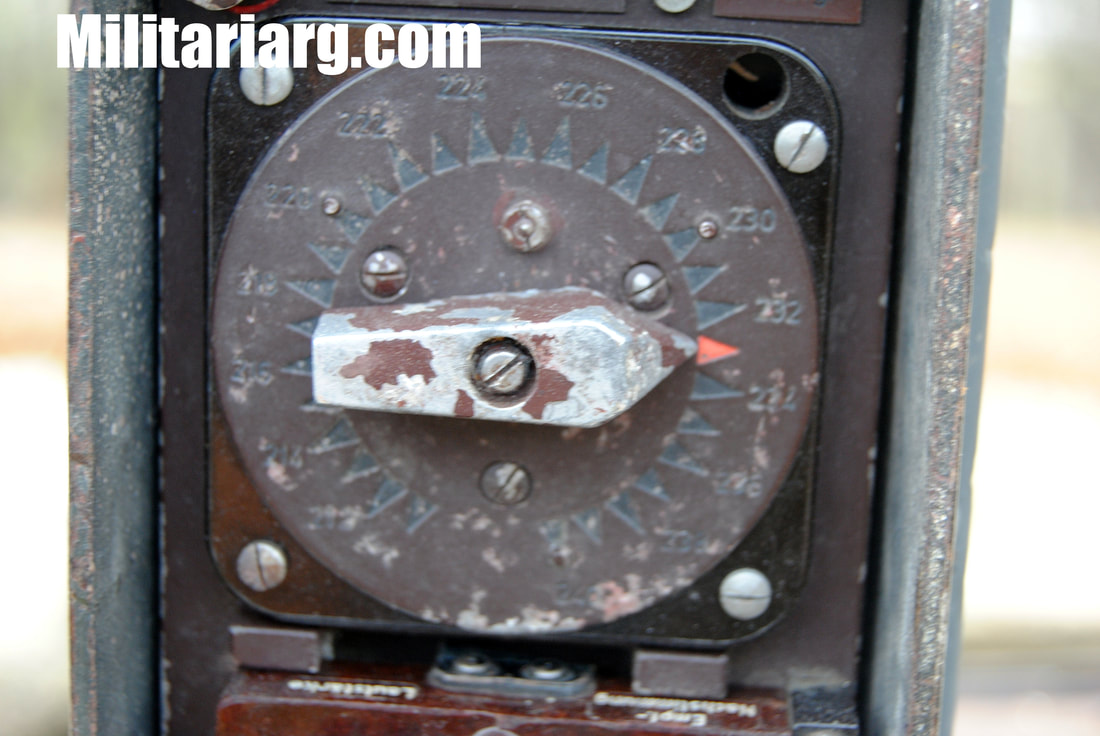
Feld Fu B (Infantry) Radio
The Feldfunksprecher b (Feldfu. b) was a German portable VHF (very high frequency) radio transceiver, often referred to as a "walkie-talkie" at the time, used for tactical, short-range communication between small combat groups and by motorcycle troops in the early to mid-war period.
Role: Designed for communication at the company and platoon levels within infantry units.
Frequency Range: Operated in the VHF range of 90 MHz to 110 MHz.
Modes: Capable of both voice (AM - Amplitude Modulation) and Morse code (CW - Continuous Wave) transmission and reception.
Power Output: Had a low power output of approximately 0.15 watts (150 mW).
Range: The effective range was relatively short, about 1.5 km (around 1 mile) and required a relatively direct line of sight.
Design: The radio unit was housed in a lightweight, durable Bakelite case and was designed to be carried on a soldier's back with a specific support strap system. It was a self-contained unit, unlike some of the larger Tornister radios which split the load between two soldiers.
Accessories: It was used with a flexible rod antenna and included connections for headphones, a microphone, and a remote control unit which allowed the operator to adjust volume and tuning without removing the radio from their back.
Variants
Feldfu. b1: A slightly modified version used by Pioneer (combat engineer) units.
Feldfu. b2: A simplified, lower-power version used by Panzergrenadier (mechanized infantry) units later in the war.
The Feldfu. b was one of several radios in the Feldfunksprecher series, which provided short-range voice communication that complemented the wired field telephone network.
Role: Designed for communication at the company and platoon levels within infantry units.
Frequency Range: Operated in the VHF range of 90 MHz to 110 MHz.
Modes: Capable of both voice (AM - Amplitude Modulation) and Morse code (CW - Continuous Wave) transmission and reception.
Power Output: Had a low power output of approximately 0.15 watts (150 mW).
Range: The effective range was relatively short, about 1.5 km (around 1 mile) and required a relatively direct line of sight.
Design: The radio unit was housed in a lightweight, durable Bakelite case and was designed to be carried on a soldier's back with a specific support strap system. It was a self-contained unit, unlike some of the larger Tornister radios which split the load between two soldiers.
Accessories: It was used with a flexible rod antenna and included connections for headphones, a microphone, and a remote control unit which allowed the operator to adjust volume and tuning without removing the radio from their back.
Variants
Feldfu. b1: A slightly modified version used by Pioneer (combat engineer) units.
Feldfu. b2: A simplified, lower-power version used by Panzergrenadier (mechanized infantry) units later in the war.
The Feldfu. b was one of several radios in the Feldfunksprecher series, which provided short-range voice communication that complemented the wired field telephone network.
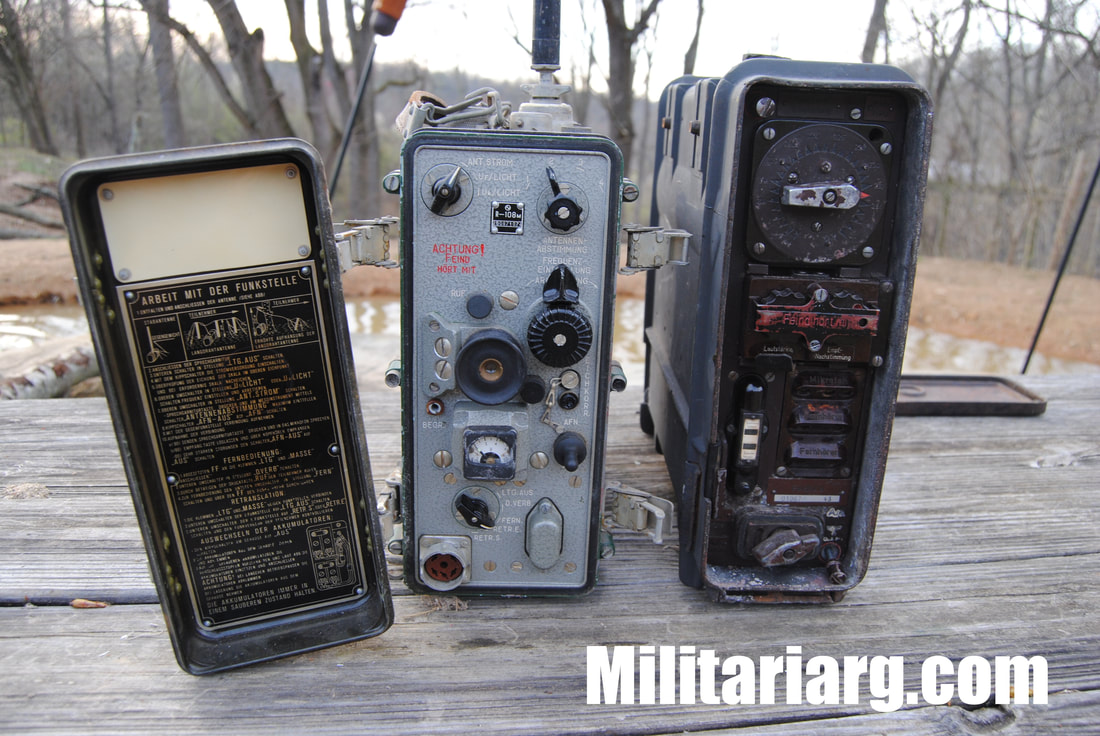
WW2 Feld Fu B Radio and post War Soviet R-108
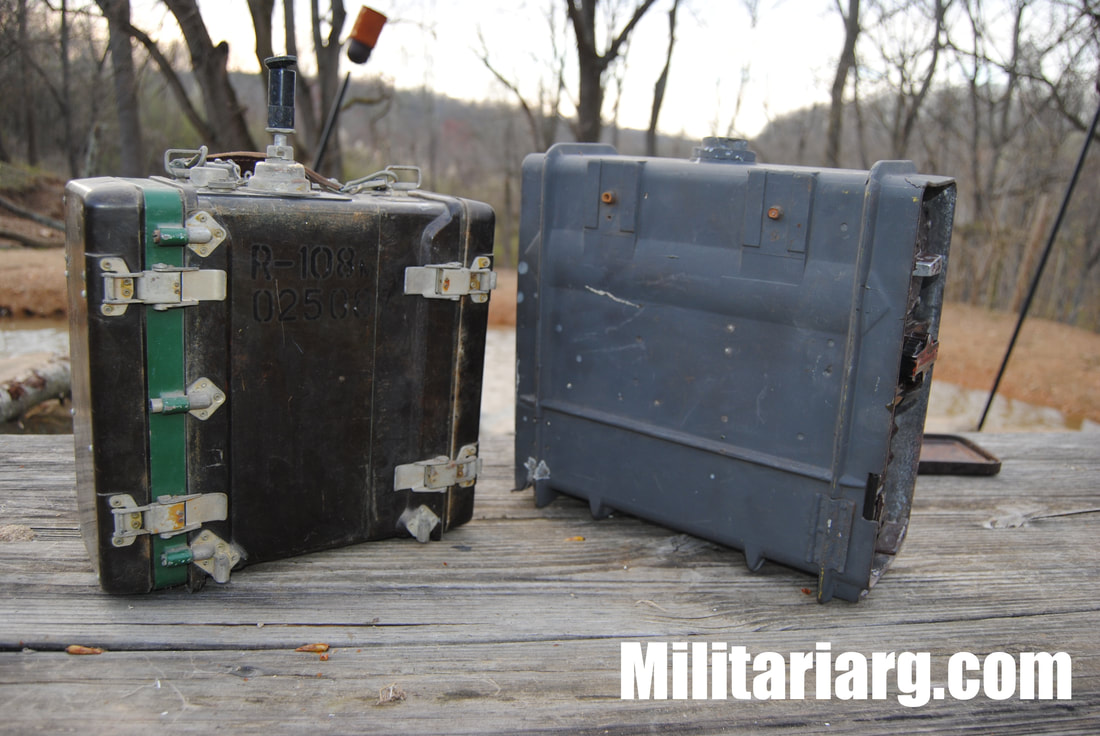
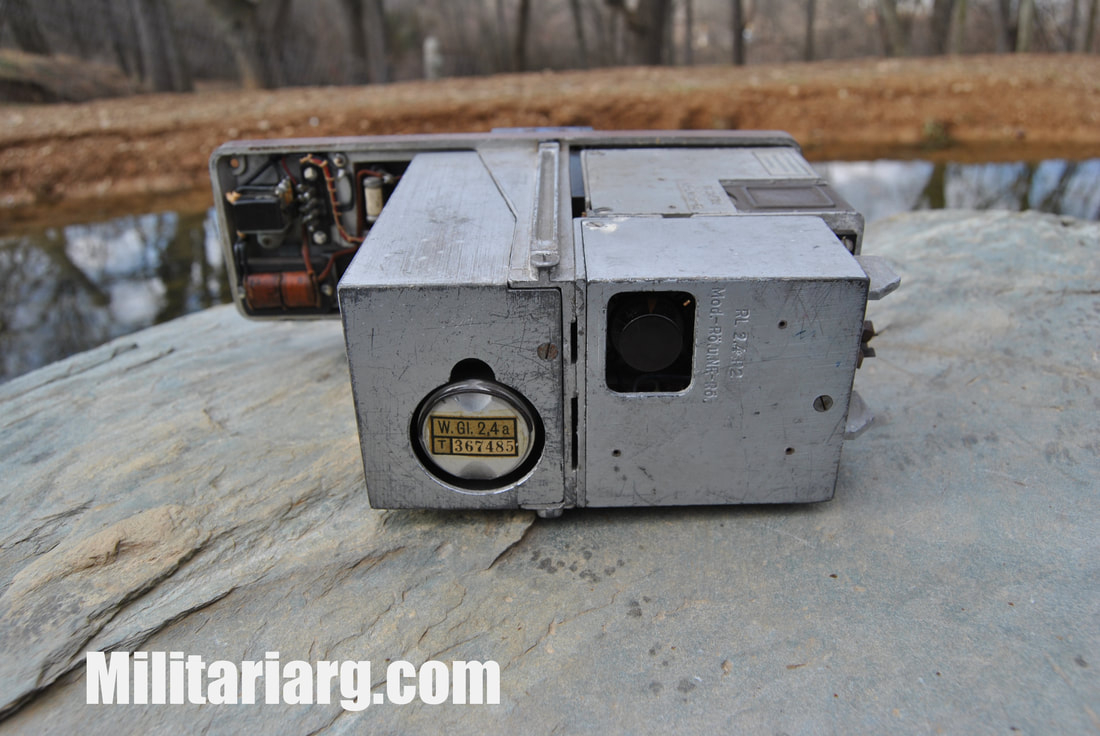
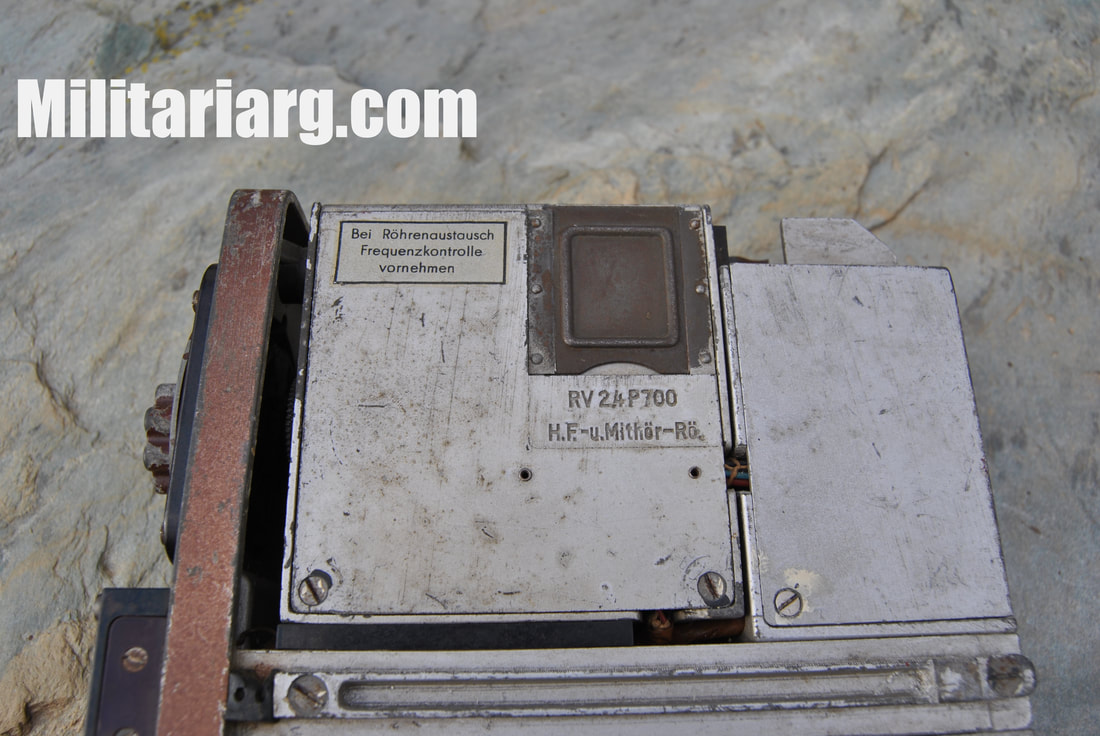
Feld.Fu.F Panzergrenadier Transceiver Radio Funkgerät.
Replica and Restoration Project.
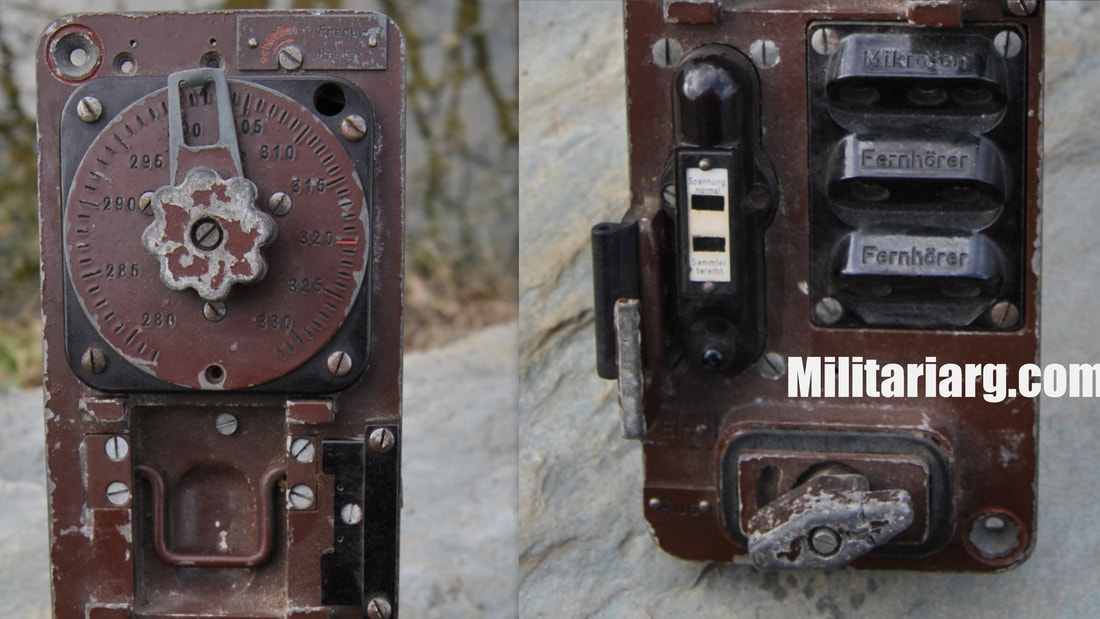
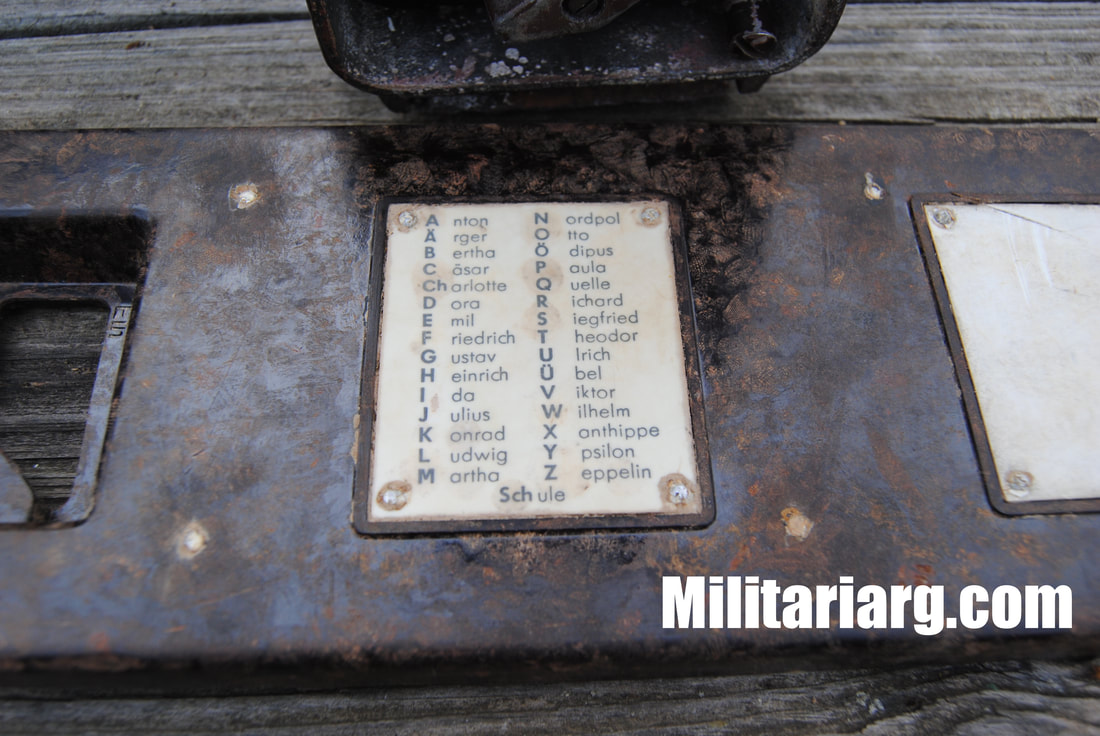
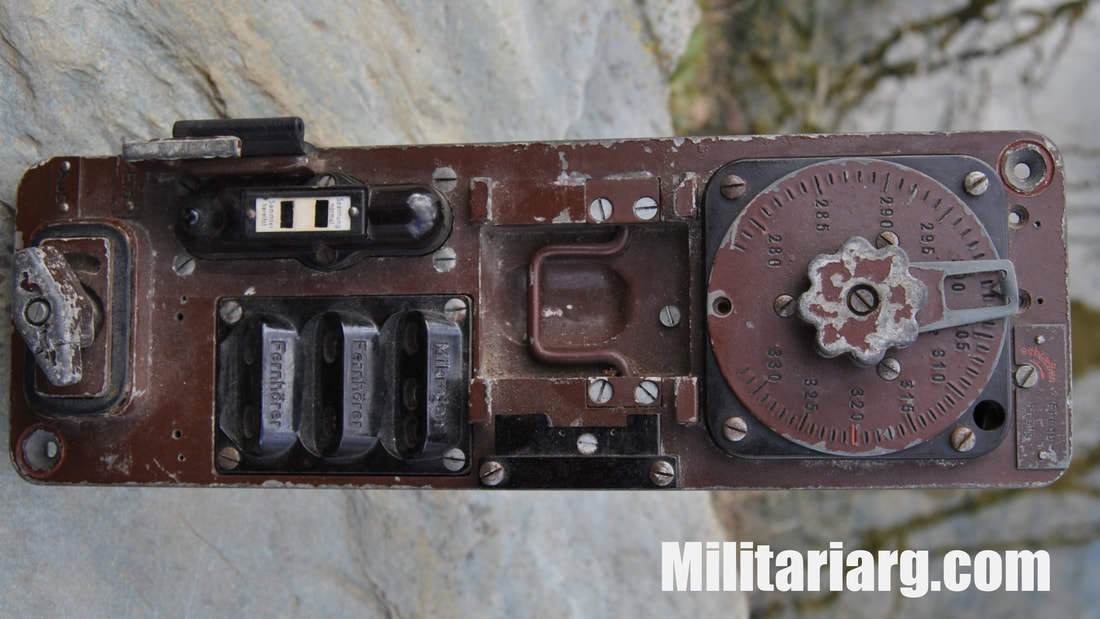
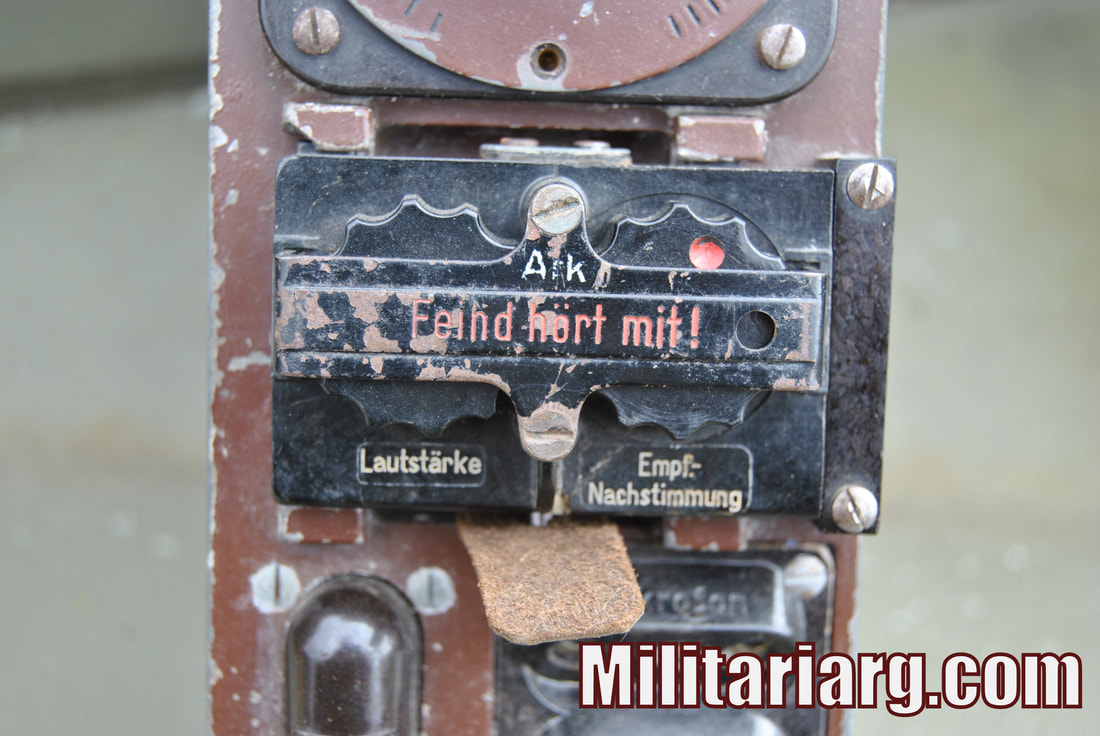
Feld Fu Radio Remote Control Feind Hort Mit!
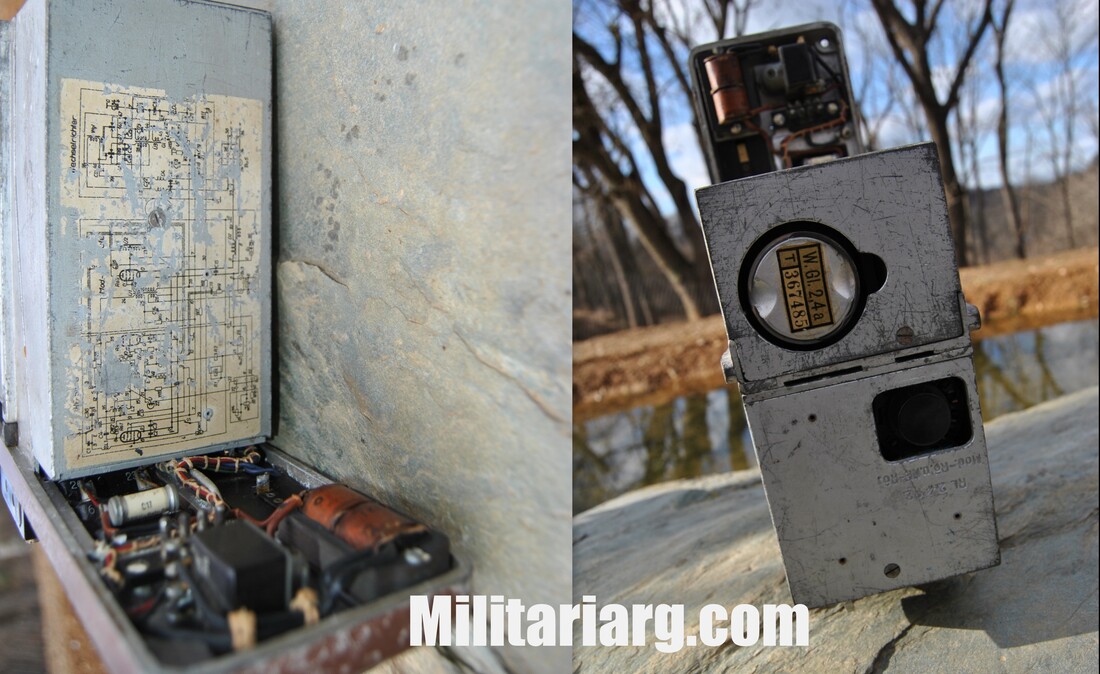
The Feldfunksprecher f (Feldfu.f) was another model in the series of portable German VHF ("walkie-talkie") radio transceivers, designed for tactical voice communication at the platoon and company level.
The Feldfu.f shared the same lightweight Bakelite case design as the b and c models, but operated on a different frequency range:
Role: Primarily used by Panzergrenadier (mechanized infantry) units.
Interoperability: Its specific frequency range was chosen to allow direct communication and interwork with the FuG 5 tank radios of the supporting armored units.
Frequency Range: Operated in the VHF range of 28 to 33.0 MHz (27.8 - 32.2 MHz according to some sources).
Modes: Capable of both voice (AM - Amplitude Modulation) and Morse code (CW) transmission and reception.
Power Output: Low power output of approximately 0.15 watts (150 mW).
Range: The effective range was about 1.5 km (around 1 mile) and required a relatively direct line of sight.
Antenna: Used a 1.20-meter long strip antenna.
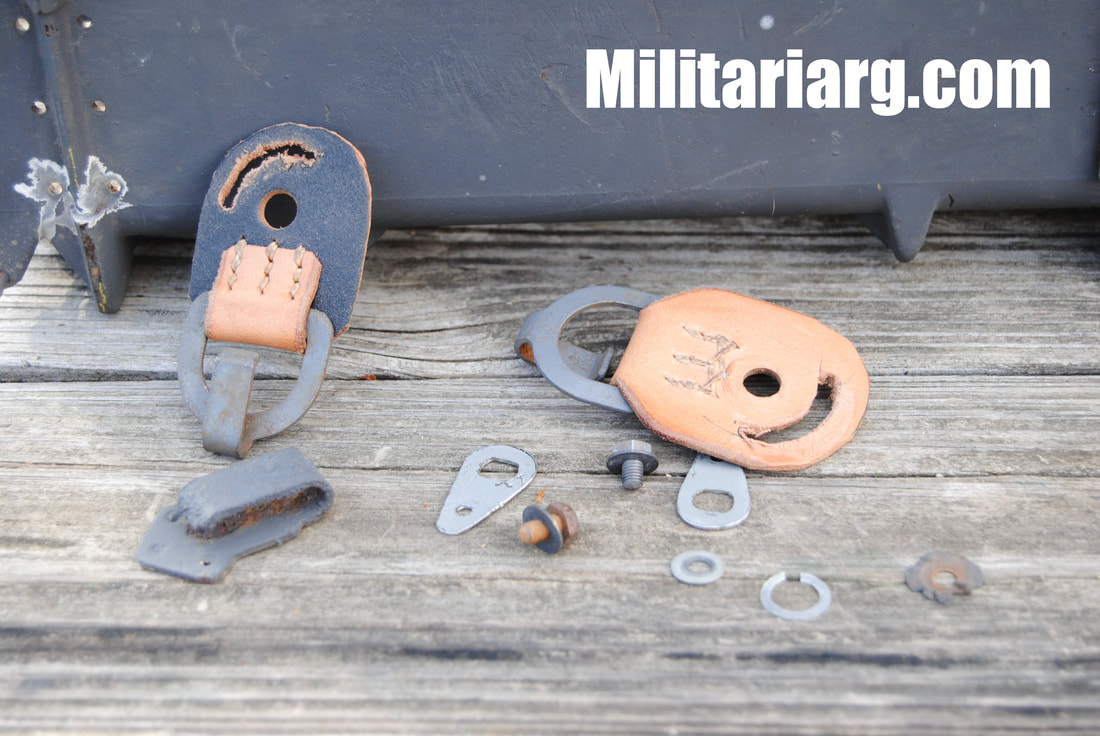
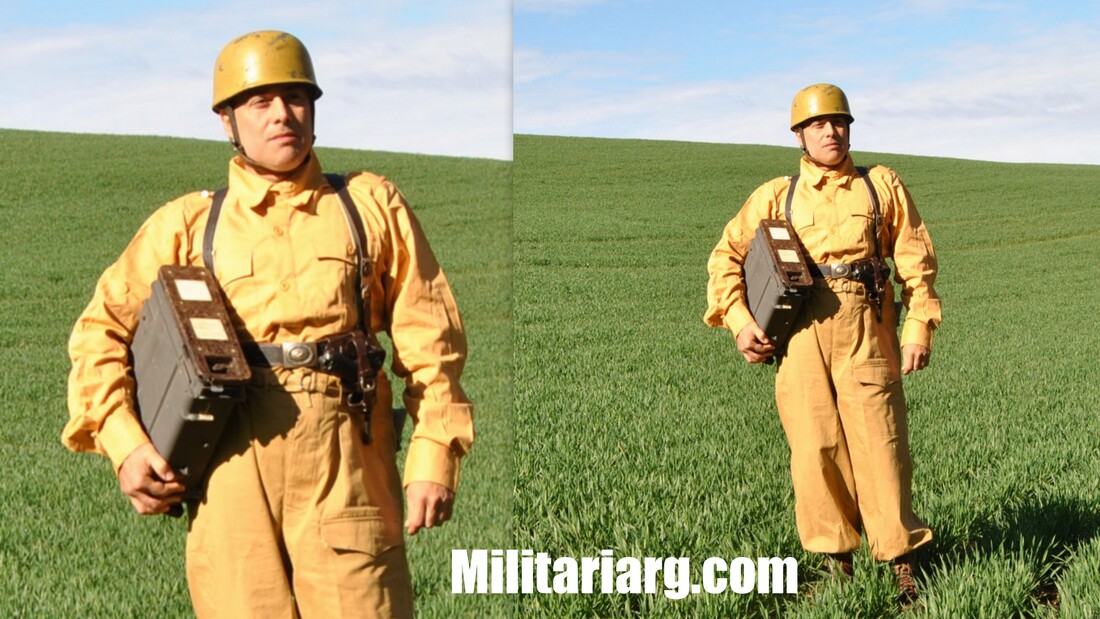
Portability: Like other Feldfunksprecher models, it was designed to be carried on the back with a specific support strap system (Rückenstütze) and used with a remote volume/tuning control clipped to the user's belt or chest.
The Feldfu.f provided a vital link between dismounted infantry and their supporting armor, crucial for close-quarters combined-arms operations.
The Feldfu.f shared the same lightweight Bakelite case design as the b and c models, but operated on a different frequency range:
Role: Primarily used by Panzergrenadier (mechanized infantry) units.
Interoperability: Its specific frequency range was chosen to allow direct communication and interwork with the FuG 5 tank radios of the supporting armored units.
Frequency Range: Operated in the VHF range of 28 to 33.0 MHz (27.8 - 32.2 MHz according to some sources).
Modes: Capable of both voice (AM - Amplitude Modulation) and Morse code (CW) transmission and reception.
Power Output: Low power output of approximately 0.15 watts (150 mW).
Range: The effective range was about 1.5 km (around 1 mile) and required a relatively direct line of sight.
Antenna: Used a 1.20-meter long strip antenna.
Portability: Like other Feldfunksprecher models, it was designed to be carried on the back with a specific support strap system (Rückenstütze) and used with a remote volume/tuning control clipped to the user's belt or chest.
The Feldfu.f provided a vital link between dismounted infantry and their supporting armor, crucial for close-quarters combined-arms operations.