Militariarg.com
  • Home
  • Army
  • Aviation
  • Navy
  • Uniforms and Badges
  • Arms and Weapons
  • Equipment
  • Vehicles
  • Operational and Organizational Structure, Security Forces, Transportation, Books, Models and More.
  • Argentine Confederation Era. 1829 - 1852.
  • From 1852 to 1910 (French fashion)
  • Bunker 1982: South Atlantic War Militaria
  • International Militaria
  • Argentina WWII Era (Neutral) Reenactment Impression
  • Links ~ Enlaces
Picture
1942. Portuguese Army with M40 helmets.

Picture
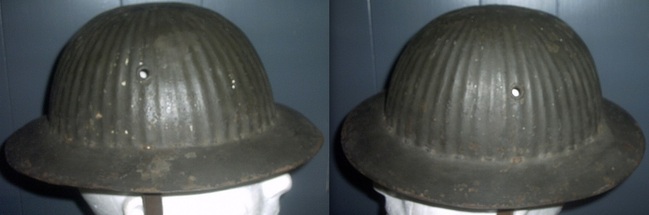
The Portuguese M16 helmet (Model 1916) was the standard headgear for the Portuguese Expeditionary Corps on the Western Front during World War I, widely considered by historians to be the worst helmet of the war due to its poor ballistic protection.
The M16 was a distinct design, not a copy of the British Mk I (Brodie) helmet. But the design was modeled after private-purchase helmets made by the British Mackintosh company ( Birmingham) for British officers. The British Army eventually banned this style due to its weak protection.
The helmets were largely manufactured in Great Britain and supplied to Portuguese troops as a stopgap measure until enough British Mk I helmets were available. Samples sent for evaluation revealed that the mild, lightweight steel used and a manufacturing defect in the design made the helmet dangerous. The helmet had a fluted/ribbed bowl, which had the effect of catching shrapnel fragments and directing them into the helmet rather than deflecting them.

The Portuguese M16 manufactured by Vickers (and others) was based on the "Mackintosh" design, this helmet is infamous for being arguably the lowest-quality steel helmet of WWI. The Irish M27 "Vickers" also manufactured by Vickers Ltd in London, but produced a decade later (1927) with much higher standards. Unlike the Portuguese version, the Irish M27 used high-quality manganese steel. It was a serious piece of combat armor, providing protection equal to the German M16 it was copying.

Picture
Picture
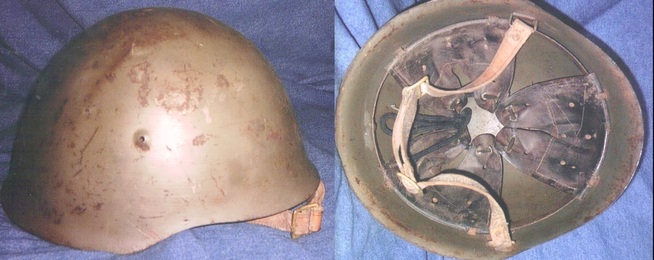
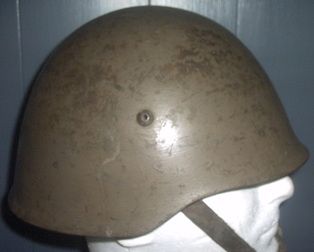
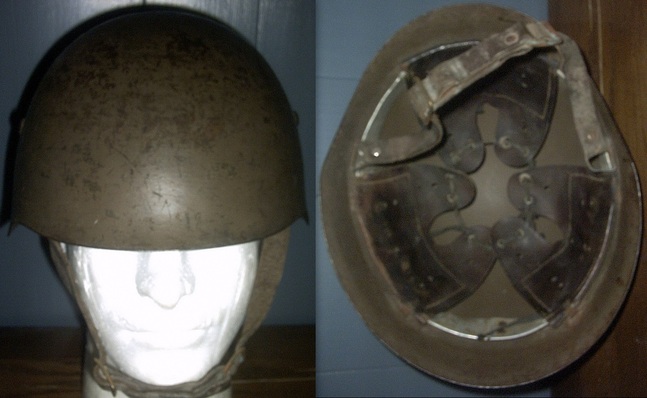
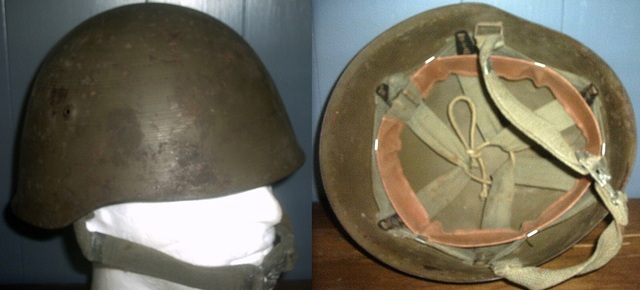
The Portuguese M40 helmet (officially Modelo 1940 or M/40) was the standard steel combat helmet of the Portuguese Armed Forces from the 1940s to the late 1960s. It had a unique, domestically designed shape that was allegedly inspired by Portuguese 15th-century headgear, manufactured by the Fábrica de Braço de Prata in Lisbon. 

The M40 has a deep, rounded bowl with a slightly flared brim all the way around, but no prominent visor. Its design is distinct and not based on standard German, British, or US designs of the era.
The shell was made of steel and finished in various shades of olive green or khaki-brown paint, which was often textured.
The original M40 liner system was based on a Swiss design, featuring a three-pad leather system attached to an aluminum band that was secured by internal rivets and bushings.It had bushed air vents on the sides, which also internally secured the chinstrap brackets. ​
Picture
The M40 replaced the poorly-rated WWI-era Portuguese M16 and M17 Brodie-style helmets. It was the primary helmet during WWII and the subsequent Portuguese Colonial War (1961–1974). Due to its robust construction, the M40 shell remained in service for decades. ​
Picture
/Portuguese Helmet M40/63 with M1 type liner. 
​The shell design was so successful that it was upgraded in 1963, creating the M40/63 variant, which replaced the Swiss-style leather liner with a modern U.S. M1-style cotton/webbing liner for better comfort and shock absorption. The M40/63 remained in limited use with ceremonial units and security agencies into the 2000s, making it one of the longest-serving helmet models in history.

Portugal was involved in World War I, remained neutral in World War II, fought extensive colonial wars, and was a founding member of NATO during the Cold War
World War I (1914-1918) 
​

Portugal initially maintained neutrality but became actively involved in the war, largely due to conflicts with Germany over colonial territories in Africa and Britain's request for the seizure of German ships in Portuguese ports. Portuguese troops fought in Europe on the Western Front alongside Allied forces, notably at the Battle of the Lys in 1918. Portugal's involvement solidified its alliance with Great Britain.

The Portuguese Army during World War I fought on two fronts: in Africa and on the Western Front in Europe. The troops in Europe were largely re-equipped by the British to simplify logistics, while colonial forces used a mix of domestic and older weapons.
 
Weapons

Rifles:
Mauser-Vergueiro m/1904: This domestically designed bolt-action rifle, chambered in the unique 6.5x58mm Vergueiro cartridge, was the standard infantry weapon of the Portuguese Army. It was primarily used by forces in the African colonies.
Lee-Enfield: To simplify logistics on the Western Front in France, the Portuguese Expeditionary Corps (CEP) was equipped with the British Lee-Enfield SMLE Mk III rifle and ammunition.
Other Rifles: In the African campaigns, older rifles like the Snider-Enfield and Westley-Richards were still in limited use by local colonial troops.
Pistols: The standard sidearm was the Luger P08 (Pistol m/908), chambered in 7.65mm Parabellum.
Machine Guns:
Madsen machine gun: Portugal utilized this weapon, the world's first true light machine gun, for colonial forces and early in the war.
Vickers machine gun: In France, the CEP was supplied with British Vickers heavy machine guns and Lewis guns to standardize equipment with the Allied forces. 

Artillery
Portugal's artillery was considered on par with its European counterparts during the war due to a pre-war modernization effort and Allied support during the conflict. 

Field Artillery: The Portuguese Expeditionary Corps in France was primarily equipped with the French 75mm field gun (Canon de 75 modèle 1897), known for its high rate of fire.
Medium Artillery: British Obus 11.4 cm T.R m/1917 (British QF 4.5-inch howitzer) were also provided to the Portuguese divisional artillery groups.
Heavy Artillery: A separate Portuguese Independent Heavy Artillery Corps (CAPI) operated under French command on the Western Front, utilizing British-supplied railway guns in 190mm, 240mm, and 320mm calibers for long-range bombardments.
Mortars: Light, medium, and heavy mortars, including the British Stokes 6-inch mortar, were used by the CEP.

World War II (1939-1945)
​
Under the dictatorship of António de Oliveira Salazar, Portugal maintained a policy of official neutrality throughout WWII. Salazar shrewdly balanced relations with both Allied and Axis powers because Portugal was a vital source of tungsten for both sides. The strategically important Azores islands were leased to the Allies in 1943, serving as a critical base for anti-submarine operations 
Picture
Portuguese colonial troops with Madsen M36 LMG.
Colonial Conflicts
​
Portugal engaged in a long and costly series of conflicts from 1961 to 1974, known as the Portuguese Colonial War, to maintain control over its African colonies . Fought in Angola, Mozambique, and Portuguese Guinea (now Guinea-Bissau). The wars placed immense strain on Portugal's economy and society. The refusal to grant independence was a primary cause of the 1974 Carnation Revolution, a military coup that overthrew the authoritarian regime and led to the rapid independence of all its African colonies

Overseas War or War of Liberation, was a prolonged armed conflict fought between Portugal and the emerging nationalist movements in its African colonies from 1961 to 1974. The war took place in Angola, Guinea-Bissau, and Mozambique and ended with the Carnation Revolution in Lisbon in April 1974, which overthrew the Portuguese dictatorship and led to the rapid independence of the colonies. 

Colonies and Nationalist Movements
The war involved simultaneous conflicts in three main African territories, each with its own specific dynamics and independence movements supported by various foreign powers during the Cold War: 

Angola: The conflict started here on February 4, 1961. Portugal fought against three rival nationalist groups that also often fought each other:

MPLA (Popular Movement for the Liberation of Angola), supported by the Soviet Union and Cuba.
FNLA (National Liberation Front of Angola), initially backed by the US and Zaire.
UNITA (National Union for the Total Independence of Angola), which received support from China and South Africa.

Portuguese Guinea (Guinea-Bissau): The war began in January 1963. The PAIGC (African Party for the Independence of Guinea and Cape Verde) was the primary movement, well-trained and led by Amílcar Cabral (assassinated in 1973). The PAIGC made significant territorial gains and effectively controlled much of the countryside by the early 1970s, making it the most successful of the movements militarily.

Mozambique: The war started here in September 1964. The main independence movement was FRELIMO (Mozambique Liberation Front), which received support from the Soviet Union and China. 

The war had profound consequences for both Portugal and its colonies:

Carnation Revolution: The long, costly, and increasingly unpopular war led to a military coup in Portugal on April 25, 1974. This nearly bloodless "Carnation Revolution" overthrew the long-standing Estado Novo dictatorship.

Decolonization: The new democratic government immediately sought to end the conflicts and granted independence to all of Portugal's African colonies in 1974-1975. This prompted a mass exodus of over a million Portuguese citizens and people of Portuguese descent (known as the retornados) from the newly independent nations back to Portugal.

Regional Instability: Following independence, both Angola and Mozambique descended into devastating civil wars, fueled by Cold War proxy conflicts between the former anti-colonial movements and their superpower backers. 

Cold War and NATO
Portugal was a key anti-communist ally during the Cold War due to its strategic geographic location and its authoritarian government's anti-Soviet stance. Portugal was a founding member of the North Atlantic Treaty Organization (NATO), signing the North Atlantic Treaty in Washington D.C. in April 1949. Portugal's Atlantic islands (Azores and Madeira) and mainland ports were crucial military bases for NATO operations and surveillance. The regime used its alignment with Western powers to gain political legitimacy and economic support, despite its non-democratic nature at the time.

 
Salazarism 


Salazarism was fundamentally a form of Portuguese Integral Nationalism, formalized as the Estado Novo ideology.
The Estado Novo was the authoritarian, right-wing political regime in Portugal that lasted from 1933 to 1974, with António de Oliveira Salazar serving as the de facto dictator and Prime Minister from 1932 to 1968. The regime rejected liberalism, democracy, communism, and socialism, advocating for a single-party government, the National Union, and concentrating power in the executive branch. 

While often linked to European fascism, Salazar actively distinguished his regime from Italian and German models, which he viewed as "pagan" and overly mobilizing. Salazar favored political apathy and de-politicization among the general population, relying on elite rule rather than mass rallies or forced indoctrination.

Salazarism (Portugal) and Francoism (Spain) were both long-lasting, right-wing, authoritarian regimes that dominated the Iberian Peninsula in the mid-20th century, sharing core ideologies but differing significantly in their paths to power and internal structures. Both regimes were built on conservative nationalism, corporatism, and traditional Catholic values, promoting a strong sense of national identity while rejecting liberalism, democracy, and communism.

Salazar promoted a strong sense of Portuguese national identity and historical destiny. He insisted that Portugal's overseas territories were integral "provinces" of a single, multi-continental nation, leading to protracted and costly colonial wars to resist decolonization. 

Based on Catholic social teachings, the state organized society into "corporations" of employers and workers to prevent class conflict and maintain social harmony, although these organizations were ultimately subordinate to state control. The regime emphasized traditional, conservative Catholic values as the foundation of society. The Catholic Church regained significant influence under Salazar's rule. 
​Political freedoms were severely curtailed. A powerful secret police force, the PIDE (Polícia Internacional e de Defesa do Estado), was used to suppress dissent, monitor the population, and imprison political opponents in brutal prison camps

Salazar, an economics professor by background, initially stabilized the chaotic Portuguese economy by focusing on fiscal conservatism, achieving budget surpluses and reducing national debt. However, this stability came at the cost of modernization, leaving Portugal with one of the lowest per capita incomes and highest illiteracy rates in Western Europe by the end of his rule. 

The Portuguese Army during World War II was equipped with a variety of primarily European-sourced weapons and a modest collection of armored vehicles, reflecting the nation's neutral but complex diplomatic position with both Allied and Axis powers.

Weapons

The standard infantry rifle was a German-made Mauser design, but other weapons were also used. 

Rifles: The primary service rifle was the Mauser m/937 7.9mm infantry rifle (a variant of the Karabiner 98k), along with the earlier Mauser-Vergueiro m/1904-39. Other models, including the British Lee-Enfield No. 1 Mk III*, were in limited use.
Pistols: A mix of pistols were in service, including the Luger P08, Walther P38, and locally-produced versions of the Savage M1907.
Submachine Guns: The Portuguese Army utilized the Austrian Steyr MP 34 (designated m/942), the British STEN Mk II, and the domestically produced FBP m/948.
Machine Guns: Light machine guns included the German MG 13 and the Danish Madsen M1936, while the German MG 34 and Breda mod. 37 (M/938) served as heavier machine guns. 

Artillery
The army used a mix of light and heavy artillery pieces, including some World War I vintage equipment. 

Field Artillery: Notable pieces included the French Canon de 75 modèle 1897 and the British Ordnance QF 25-pounder.
Mountain Artillery: The Obus de Montanha 7,5 cm/18 m/940 mountain gun was used.
Anti-aircraft: The 2 cm Flak 30/38 (m/943) and 4 cm Bofors (m/942) were among the anti-aircraft guns in use.

Tanks and vehicles
​
The Portuguese Army's armored force was limited and largely consisted of light vehicles and tankettes acquired before or early in the war. 
Tanks/Tankettes: The inventory included the British Carden Loyd tankette and a small number of Vickers 6-Ton light tanks. A few Valentine tanks were also acquired.
Armoured Vehicles: Armored cars included the British Humber Armoured Car (and its Canadian-built variant, the GMC Fox Armoured Car).
Transport Vehicles: Transport largely relied on standard military trucks, with US-made Dodge and GMC 6x6 trucks being widely used later on, likely as part of post-1944 Allied support.

Powered by Create your own unique website with customizable templates.