Militariarg.com
  • Home
  • Army
  • Aviation
  • Navy
  • Uniforms and Badges
  • Arms and Weapons
  • Equipment
  • Vehicles
  • Operational and Organizational Structure, Security Forces, Transportation, Books, Models and More.
  • Argentine Confederation Era. 1829 - 1852.
  • From 1852 to 1910 (French fashion)
  • Bunker 1982: South Atlantic War Militaria
  • International Militaria
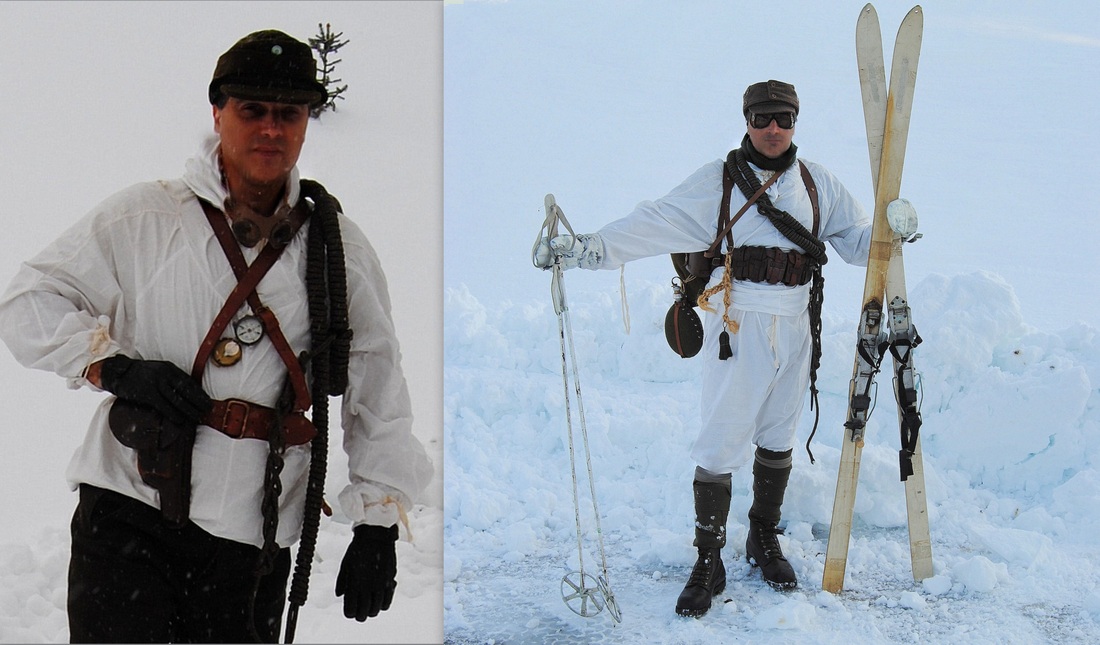
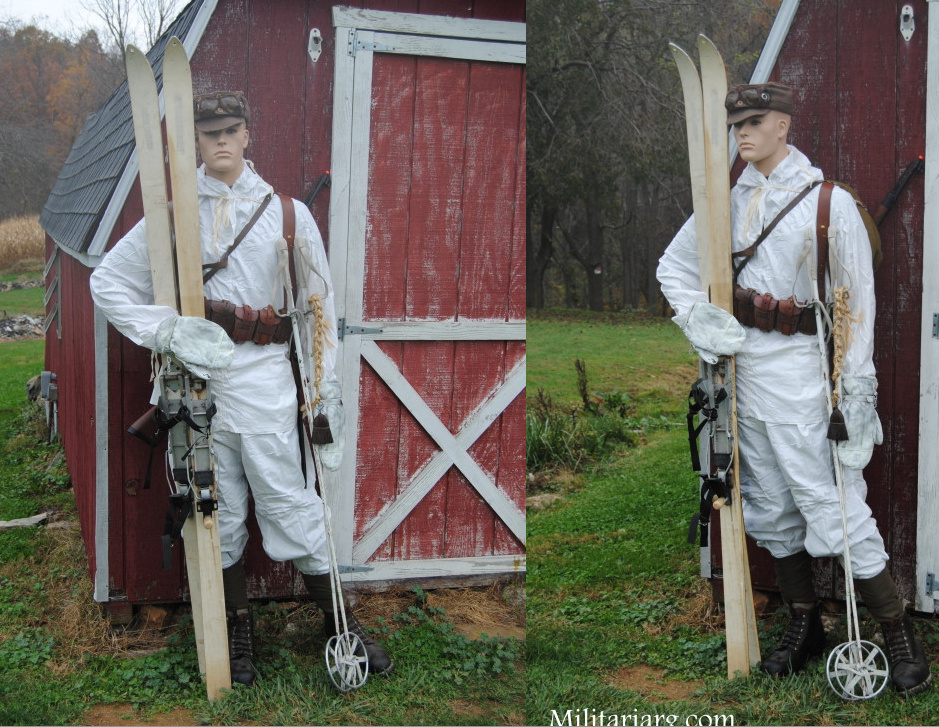
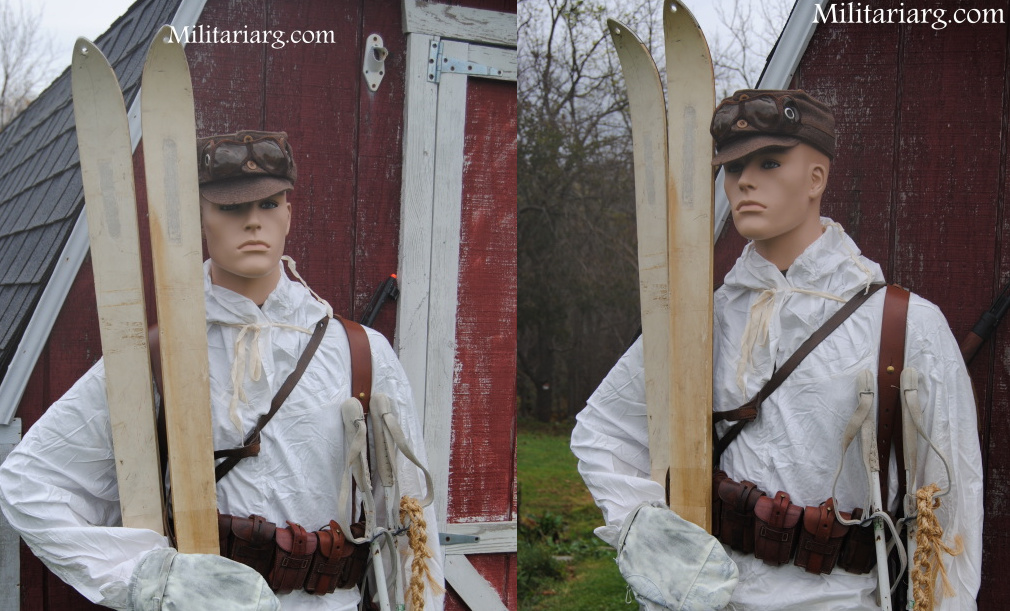
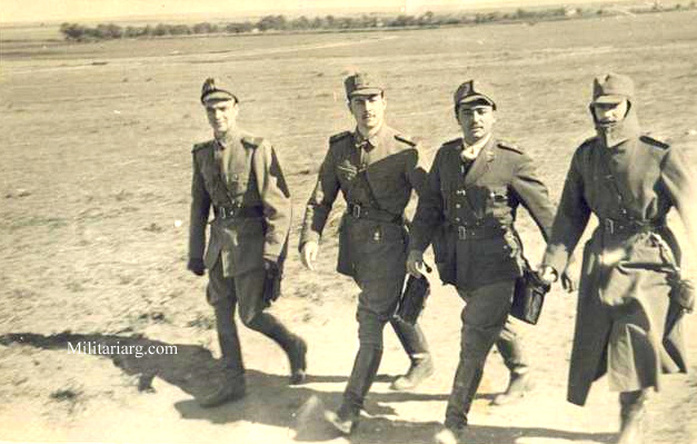
  • Argentina WWII Era (Neutral) Reenactment Impression
  • Links ~ Enlaces

Argentine Mountain Troops

Picture
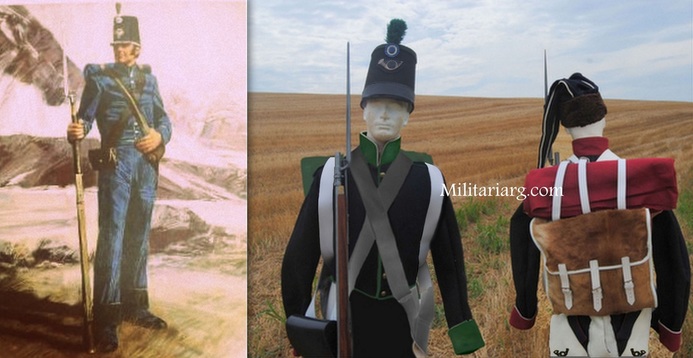
11th Line Infantry Regiment 1814 (Regimiento 11 de Infanteria General las Heras), Reproduction of the uniform and equipment.  

This corps was created by then Colonel San Martin based on the ex-auxiliary sent to Chile.  The uniform was proposed by its chief, Lieutenant Colonel las Heras.  This corps participated in the crossing of the Andes and was dissolved in Callao Peru.
The 11th Line Infantry Regiment (Regimiento 11 de Infantería de Línea) was a pivotal unit in the South American wars of independence, founded by José de San Martín during the organization of the Army of the Andes. 

The regiment was officially created on November 8, 1814, in El Plumerillo, Mendoza. It was formed using the veteran Argentine Auxiliary Division as its core. These troops had recently returned from Chile following the Patriot defeat at the Battle of Rancagua (October 1814), having executed a disciplined retreat across the Andes under then-Colonel Juan Gregorio de Las Heras. He was appointed its first chief, and the regiment eventually bore his name as a commemorative title. 
The unit is historically regarded as the "backbone" of San Martín's liberating force. 

The regiment crossed the mountains via the Uspallata Pass under Las Heras's command.It participated in major engagements that secured independence for the region: Battles of Chacabuco (1817), Cancha Rayada, and Maipú (1818).
It was the first unit to land during the Liberating Expedition of Peru at Paracas Bay (1820) and participated in the siege of Callao.

Dissolution: The original regiment was dissolved in Peru following the uprising and capture of Callao. 

The lineage is maintained by the current 11th Mountain Infantry Regiment "General Las Heras" (Regimiento de Infantería de Montaña 11), headquartered in Tupungato, Mendoza.
Picture
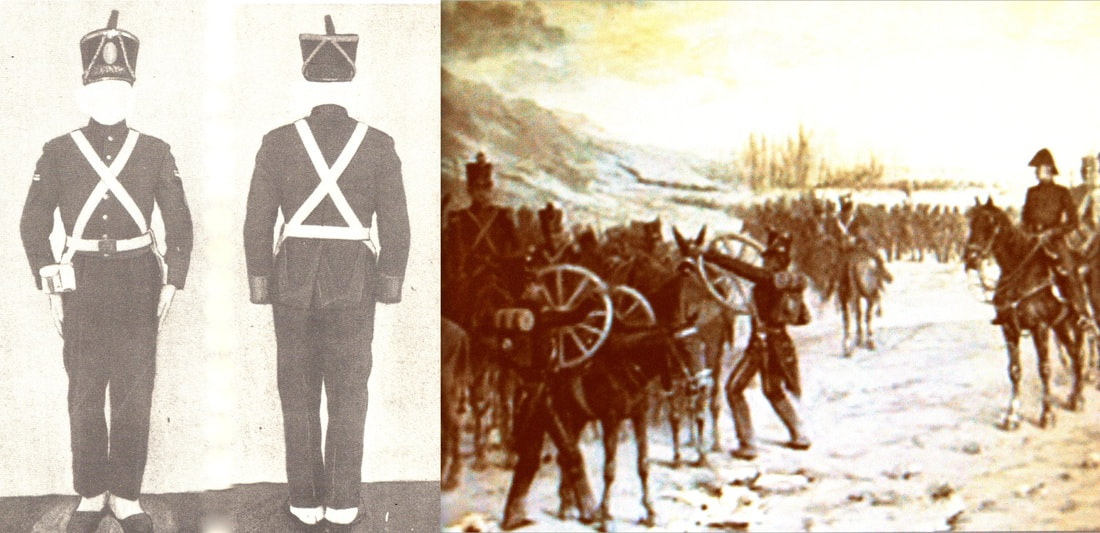
Left: Modern and official representation of the 11th Mountain Infantry Regiment, General Las Heras".
Picture
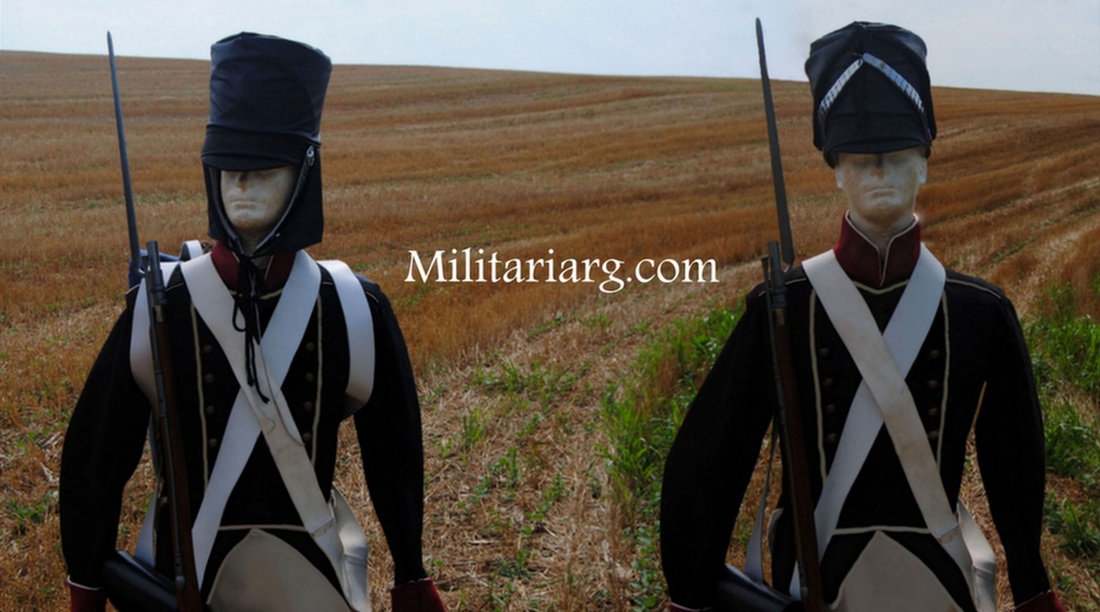
​French style, waterproof shako cotton canvas or waxed linen cover. To achieve the "waterproof" quality, the fabric was heavily coated with linseed oil, animal fats, or a mixture of wax and black paint. This treatment gave the covers their characteristic "glazed" or shiny black appearance They were designed to fit snugly over the shako and were often secured with drawstrings or straps, covering the main body, peak, and sometimes the side chin scales. This cover was in standard use in all armies of that time.​
Picture
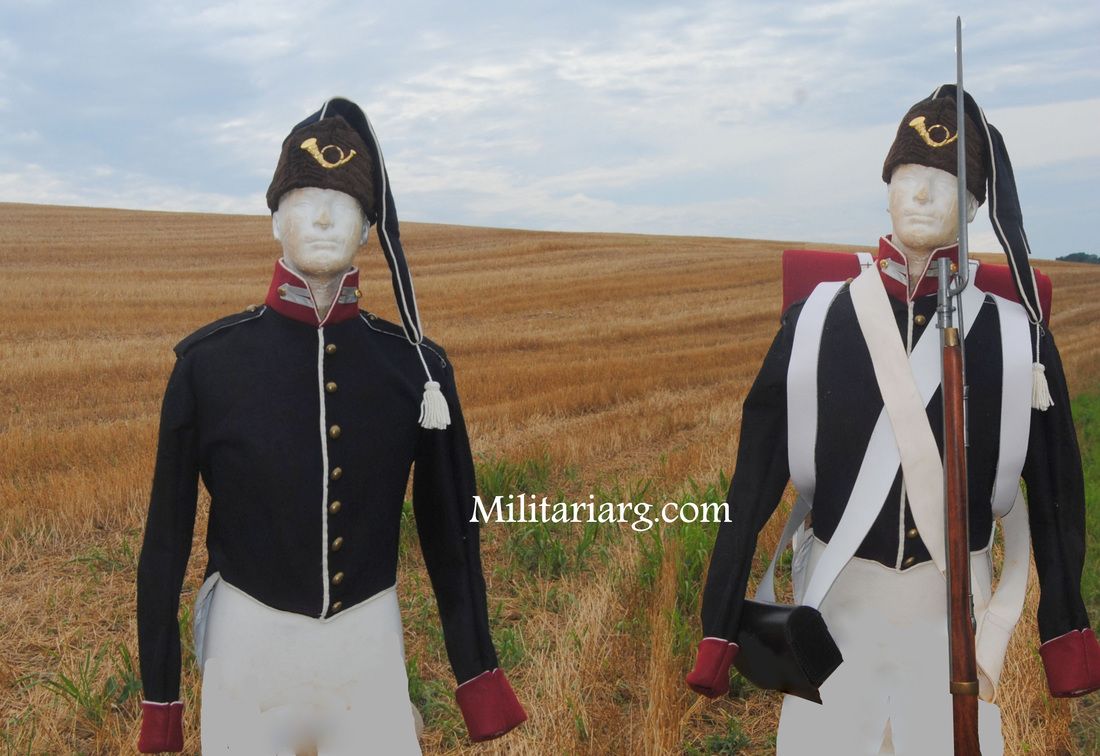
The shako on the left is a reproduction of the Cazadores de los Andes Chasseurs of the Andes (Light Infantry). The shako style is the British foot regiment light infantry.

The Chasseurs of the Andes (known in Spanish as Cazadores de los Andes) was a specialized light infantry unit within General José de San Martín’s Army of the Andes, organized between 1814 and 1817 to liberate Chile and Peru from Spanish rule. 

The battalion was formed in Mendoza, Argentina, as part of San Martín's modern military doctrine for the Army of the Andes. It integrated experienced Argentine soldiers with Chilean revolutionary forces who had fled to Mendoza after the Patriot defeat at the Battle of Rancagua in 1814.

As light infantry (chasseurs/cazadores), they were trained for high-speed maneuvers, skirmishing, and screening the main force. Their specialized training was essential for the rugged, high-altitude terrain of the Andes. The unit often operated in close coordination with the 11th Line Infantry Regiment led by Juan Gregorio de Las Heras, which also contained many veterans of the early Chilean campaigns. 

Crossing of the Andes (1817): The Chasseurs were critical during the crossing, serving as advance guards and scouting parties in the "snow-choked passes".

The battalion played a vital role in the Battle of Chacabuco (February 12, 1817), where San Martín’s strategy of dividing forces into two wings led to a decisive victory over the Spanish (American Royalist Army).

The tradition of the "Cazador" (Hunter/Chasseur) continues in the modern Argentine Army through the Mountain Cazadores (Cazadores de Montaña), who are elite rangers trained for high-altitude operations. Today the lineage of these light infantrymen is maintained today by specialized mountain units in the 8th Mountain Infantry Brigade, reflecting the same elite status and geographical specialization established by San Martín.
Picture
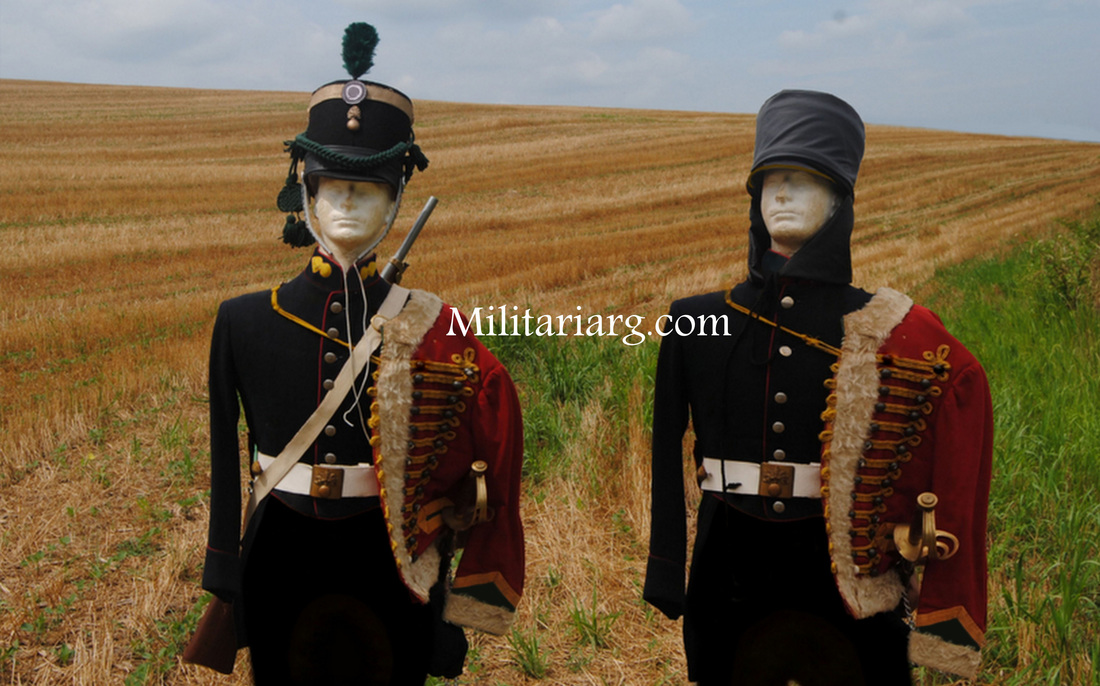
Crossing of the Andes (1817) - Hranaderos a caballo (Horse Grenadiers). The San Martin's era uniform was based on that of Napoleon's Light Horse Artillery, to which elements of the Hussars were incorporated, for example the dolman and standard riding pants "Charivari" that seems to have disappeared from memory. 

The 1903 Resurrection.

The original regiment was dissolved in 1826. When President Julio Argentino Roca reinstated it in 1903, he decreed they would wear the "historic uniform". However, this "historic" version was a stylized, idealized recreation of San Martín’s original designs rather than a carbon copy of what soldiers actually wore in the mud and snow of the Andes.
​
The modern uniform of the Regiment of Mounted Grenadiers (Granaderos a Caballo) is intentionally designed to preserve the "historic" 1812 appearance, but it differs from the actual combat gear of the early 19th century due to its 1903 restoration as a ceremonial unit and subsequent shifts in materials. The uniform we see today is actually the 1824–1826 version, designed specifically when the regiment was reorganized to serve as the personal guard of Bernardino Rivadavia, the first president of Argentina. The modern burgundy/red plume is a direct legacy of the 1824 "Presidents Guard" look. ​The original San Martin grenadier corps wore green feathers and laces.

Recommended Books

Picture
11th Infantry Battalion 1816. According to two interpretations by two publishers

#232 "The Armies of Bolivar and San Martin: Series Men-at-Arms. Osprey UK

"Soldados de Plomo". Las Guerras Napoleonicas. RBA. Barcelona Spain. El Ocaso del Imperio. La America Española (1810 - 1924). Pag 11.
Picture
The reconstruction of the uniform of the 11th Regiment that these two advertisements have made, is really very good and the closest thing historically. The modern reconstructions that states have made to recreate historic uniforms are based on practicality and convenience rather than refinement. These publications recreate very well the cut of the designs of the uniforms of the time, and reflect very much the state of them in the campaign
In Osprey's publication, the Regiment of Grenadiers on horseback of San Martín is also recreated with the dolman and the charivari riding breeches.

Next to St. Martin in the drawing, there is an 1816 mountain hunter with the British 1800 - 1816 Line - Infantry Rifles (Fuileros) "Stovepipe type" "Morrion" (Shako). It was a tall, cylindrical cap made of stiffened felt with a leather peak. Unlike the brass plates worn by line infantry, the Rifles wore a bronzed (blackened) bugle horn badge. The shako was entirely black, including the badge, to maintain the "camouflage" effect. 
These shako were brought from the United Kingdom along with other uniforms (including French) and armaments to the independence forces. The Cazadores de los Andes wore a uniform directly inspired by the British 95th Rifles, including the iconic Stovepipe Shako and the bugle horn badge.

Cazadores: Literally "hunters," this is the traditional Spanish military term for Light Infantry or Chasseurs. They were historically specialized units trained for rapid movement and skirmishing.


During the 1820s, Bernardino Rivadavia (then Minister of Government in Buenos Aires) prioritized local administrative and economic reforms, such as creating the Discount Bank. He was reluctant to provide further funding for San Martín's Peruvian Expedition, viewing it as a drain on Buenos Aires' resources. This lack of support forced San Martín to rely almost entirely on the Chilean government and private merchants for supplies.
San Martín's relationship with Lord Cochrane and the British was defined by a desperate search for funds that eventually led to a total collapse of their partnership. 

The Cochrane Conflict
Lord Thomas Cochrane was hired by the Chilean government to lead the navy. Far from helping San Martín with uniforms, Cochrane frequently clashed with him over pay for his crews. The dispute peaked in September 1821 when Cochrane seized the government’s treasury at Ancón to pay his men, leading to an "irreparable" breach.

Uniforms and Arms.
For the Army of the Andes, San Martín was famously resourceful. Rather than receiving them from a foreign fleet, he established a factory in Cuyo to produce fabric for uniforms and revitalized local mining to melt metal for cannons.

British Volunteers
While there was no formal "British Legion" under his command, a Company of Light Infantry (British residents of Mendoza) and a regiment of British soldiers did serve in the Army of the Andes.


Both General José de San Martín and Simón Bolívar faced immense logistical challenges, but San Martín’s difficulties were compounded by a total lack of institutional support from his home government in the final years of his campaign.

San Martín’s Logistical Isolation

By 1821, Bernardino Rivadavia and the government in Buenos Aires had essentially cut off financial and military support for San Martín, focusing instead on internal reforms.

Chilean Financial Strain.
San Martín became almost entirely dependent on the Chilean government under Bernardo O'Higgins, which was also nearly bankrupt.

Cochrane’s "Mercenary" Demands
Lord Cochrane’s fleet was a private enterprise. Unlike a state-run navy, Cochrane frequently threatened to abandon the mission if his crews weren't paid immediately in cash, which led him to eventually seize the army's treasury.

San Martín lacked the men and resources for a final push into the Peruvian highlands, where the Spanish army was still four times his strength.
Picture
Reconstruction of the uniform of the 11th Infantry Regiment during the crossing of the Andes, using AI technology. The uniform was the standard general infantry uniform model 1810, they wore a blue-sleeved cap with white pipin stitching, and fur skin sides.
​The 11th Line Infantry Regiment (Regimiento 11 de Infantería de Línea), which crossed the Andes with José de San Martín, was officially formed on November 8, 1814, in El Plumerillo, Mendoza.. 


Picture
Picture
Colonel Pedro José Díaz (1801–1860) was a prominent Argentine military figure from Mendoza who indeed joined the Army of the Andes at the young age of 15. 

His father, an administrator for the local treasury in Mendoza, presented him to General José de San Martín as a volunteer. Legend holds that San Martín, impressed by the boy's determination, accepted him into the service, where he participated in the historic crossing of the Andes in 1817. 


​Military Career Highlights


Army of the Andes: Joined as a teenager and served in the campaign to liberate Chile.

War of Brazil: Later fought in the conflict against the Empire of Brazil (1825–1828).

Civil Wars: He was a notable figure in Argentina's internal conflicts, primarily aligned with the Unitarian Party.

Later Life: Despite his Unitarian leanings, he fought in the Battle of Caseros (1852) within the ranks of Juan Manuel de Rosas before eventually being recognized as a veteran of the independence wars. 
​


Today, his remains are interred in a historic sepulcher in Buenos Aires, recognized by the Argentine Government as a monument to his service.


Picture
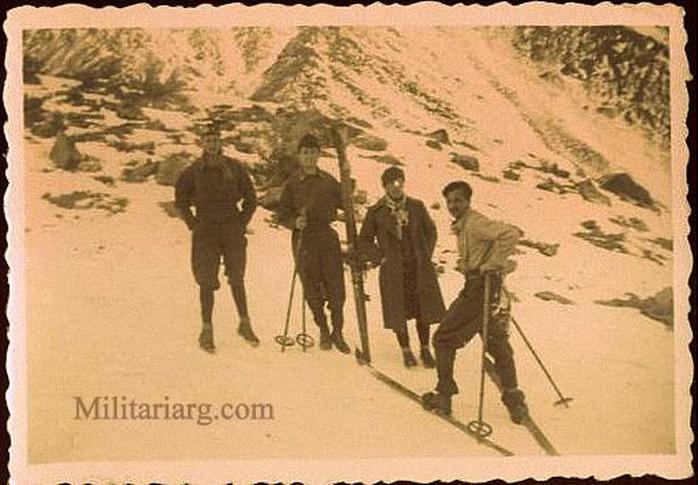
To get to the origins of the Argentine mountain troops , we must return to the South American wars for independence.  More precisely, to the group of Chasseurs of the Andes founded by General San Martin for possibly the largest military operation and logistical maneuvering on the South American continent.  An entire army crossed the Andes mountains in the style Napoleon at Saint Bernard (Alps), hence the name "Army of the Andes".  Specifically, this body of "Hunters of the Andes" (Chasseurs of the Andes) was wearing a uniform inspired in part by the British Light Companies of the Napoleonic Wars.  In the early 1940s the Argentine Army began in earnest to modernize and update the doctrine of the mountain.

During the 20th century, mountaineering and combat tactics were in full swing, mainly due to operations in the heights tested by the Alpini and Gebirgsjager in WWI and large logistic operations for the transfer of modern armies.  Mountaineering became an elite specialty like paratrooping in later WWII operations.


Argentina, a country with a long Andean stretch, decides to send officers and military attaches to mountain countries like Italy and Germany whose geography determines a way of life at high altitude. They received technical training and logistics development in the field of mountaineering, Military and sport ski skills were also learned after having been in the field during the Great War.


Picture
Prior to Perón’s mission to Europe in the late 1930s, Argentine mountain doctrine was characterized by a transition from 19th-century "mass crossing" tactics to a modernizing, German-influenced professional framework.
 Operations focused on large-scale logistics and moving entire armies across passes to achieve strategic surprise on the other side.Soldiers were not yet specialized "mountaineers" but rather regular infantry and "Hunters of the Andes" (Cazadores) who adapted to the terrain during specific campaigns. 

The formalization of mountain warfare as a distinct technical discipline began in 1923, influenced by European lessons from World War I. The Argentine Army designated its first specialized mountain units in 1923: RI 16 (Mendoza) and RI 20 (Jujuy).

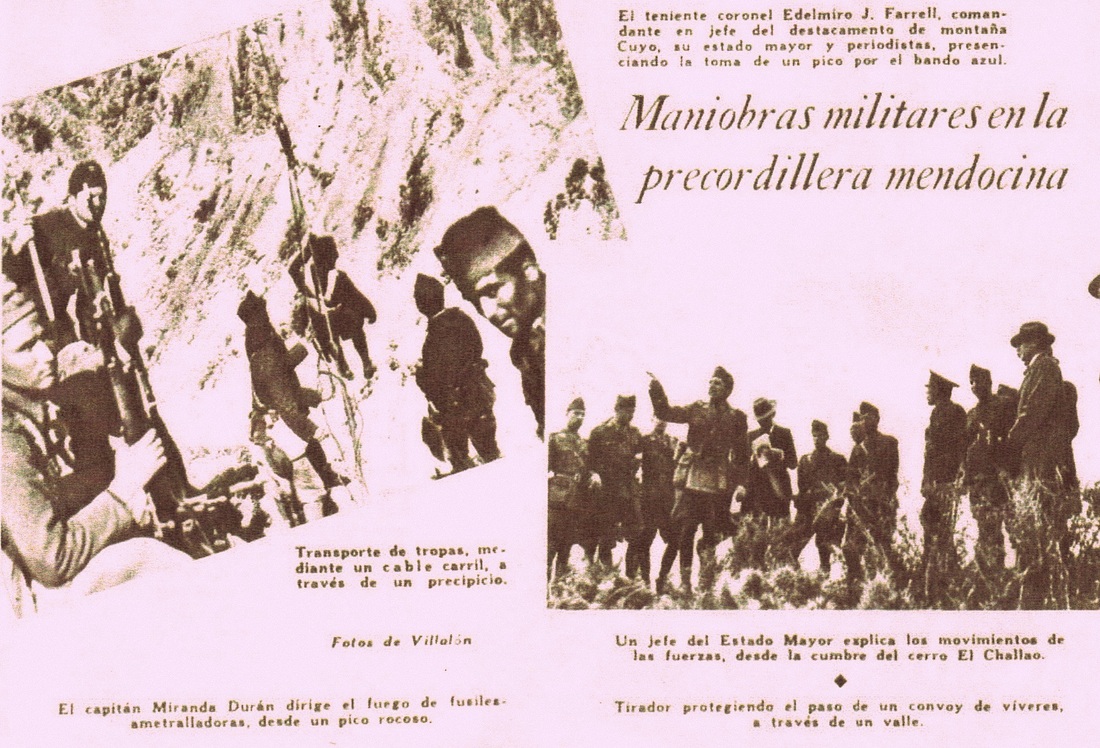
Under Major Edelmiro Farrell (who later became president), the first official skiing and winter survival courses were established in 1928 at the Escuela Militar de Montaña. Despite these steps, the army lacked "mountain intelligence" specialized knowledge in high-altitude technical climbing, specialized light weaponry, and alpine-specific logistics. The mountain doctrine was largely reactive, shaped by a 5,300-kilometer border that fostered an atmosphere of "armed peace" and intense military competition

Geopolitical Context: The Border Disputes
The primary driver of military planning was a series of volatile territorial disagreements: 

The Boundary Treaty of 1881 defined the border along the highest peaks of the Andes. However, in Patagonia, the highest peaks and the continental divide (watershed) did not always align, leading to conflicting claims over approximately 1 million square kilometers of land.

Puna de Atacama. A high-altitude desert dispute in the north was only settled in 1899 through U.S. arbitration, which awarded 85% of the territory to Argentina.The issue was largely settled in 1899 via an arbitration led by U.S. Minister William Buchanan, which defined the border in that rugged, high-altitude region using the "Buchanan Line.

Patagonian Ice Field & Beagle Channel. These remote southern regions remained ambiguous, with the Beagle conflict eventually bringing the two nations to the brink of war decades later in 1978. 

The Naval Arms Race (1890–1902). Because the mountain passes were often impassable for large armies, the two nations initially focused their "arms race" on the sea to control the straits and coastline: 

Tit-for-Tat Acquisitions. When Chile ordered the battleship Capitán Prat in 1887, Argentina responded by ordering two of its own. This cycle continued until Argentina eventually pulled ahead with its Garibaldi-class cruisers.

The Pacts of May (1902). Facing bankruptcy from military spending, both nations signed the Pacts of May. This landmark agreement was the world’s first arms control treaty, forcing both countries to sell off warships under construction and recognize "spheres of influence" (Chile in the Pacific, Argentina in the Atlantic). 

Defensive Deterrence. Both armies maintained small, static frontier garrisons intended to "hold" disputed passes rather than conduct offensive alpine maneuvers.
While Chile was often considered the "Prussia of South America" due to its earlier German training, neither side had mastered the specialized "light infantry" mountain tactics (skiing, technical climbing, high-altitude logistics) that Perón later brought from the Italian Alpini and German Gebirgsjäger.
Strategic Isolation. Large-scale movements were deemed nearly impossible; doctrine assumed that any conflict would be "split" into isolated skirmishes at specific mountain passes.

The "Alpinist" Generation of Officers

Picture
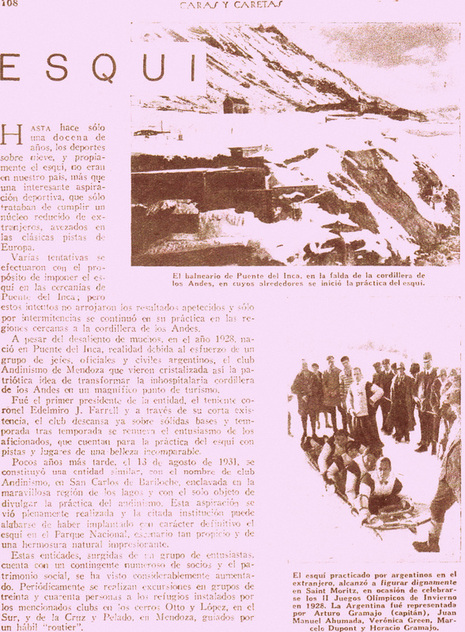
Photo 1933. Caras y Caretas.

The Argentine military during this era (the 1920s through the early 1940s) viewed the Italian Alpini as the global standard for mountain warfare.
​
These officers imported everything from mountain artillery tactics to specialized gear, such as the distinctive mountain troop climbing equipment used in the Andes.
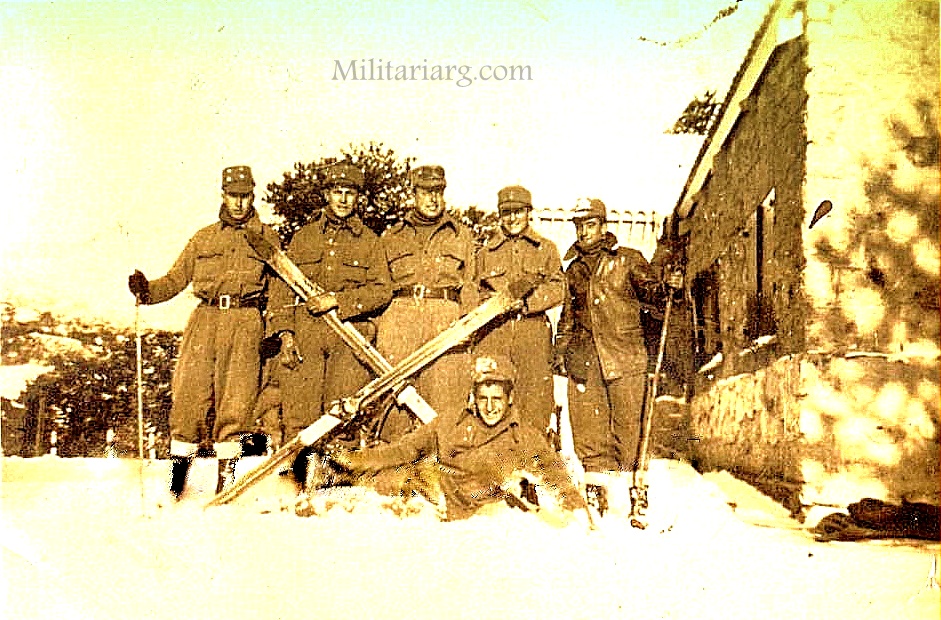
Like Italy, Argentina adapted the standard infantry uniform to mountain conditions until the doctrine of the specialty evolved. Mountain troops included infantry, artillery, skiers, and high climbers. To adapt the army to operate in such harsh climates, civilian sports equipment and even clothing were incorporated or militarized.
Many mountain instructors were civilians. The army had to send its officers to Europe as observers of the new mountain techniques that had evolved markedly in WW1, especially in Italy and Germany.

These mountainous regions were not very popular with Army officers, who preferred the status, glamour and amenities that the units around the big city provided. At the beginning, the mountain destinations, or those far to the south of Patagonia, were considered by the officers as punishment destinations. To be direct, the officers of that time preferred to vacation in the mountains, practicing skiing, but not to stay and live there. All this changed with events in the last decade of the interwar period.
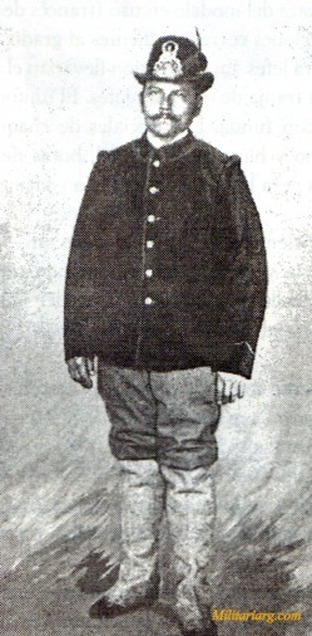
Right: Photo from 1901 which shows a uniform of the Chasseurs of the Andes.  The uniform is a copy of the Italian Alpini from the same time period.  Photo from the book Los cuerpos militares en la Historia Argentina 1550-1950 by Julio Mario Luqui-Lagleyze. 
Picture
Picture
Edelmiro Farrell and several other high-ranking Argentine officers were also sent to Italy. Farrell served in an Italian Alpine regiment between 1924 and 1926. He trained as a staff officer at the Italian Alpine military school of Aosta. Upon returning to Argentina, he was instrumental in founding the country's own mountain infantry regiments. Farrell later became President (1944–1946) and appointed Perón as his Vice President and Minister of War. 
​
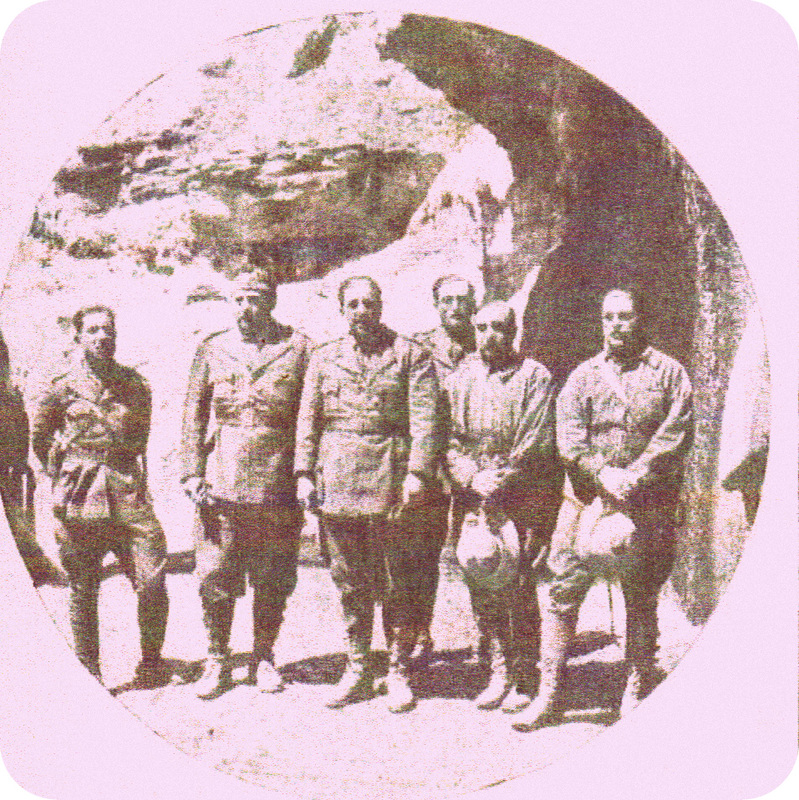
Edelmiro Farrell, was stationed as a staff officer at the Alpine military school Aosta and who later in Argentina created mountain troops on the basis of infantry regiments. These officers imported everything from mountain artillery tactics to specialized gear, such as the distinctive mountain troop uniforms and climbing equipment used in the Andes.
Picture
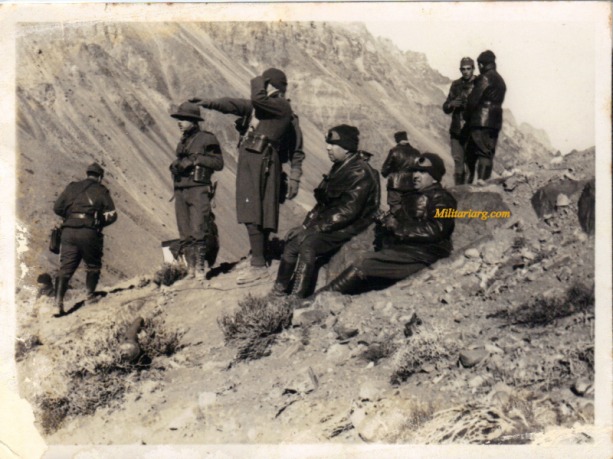
In 1939, the Argentine War Ministry assigned Juan Domingo Perón to Italy to study mountain warfare techniques with the Alpini, the Italian Army's elite mountain infantry.  Perón was sent specifically to observe "alpine military method". He spent time with Alpini regiments in the Italian Alps, training in skiing and mountain maneuvers. 

Peron was  to Merano Tridentine Alpina Division for military exercises in schools and ski mountaineering and other Italian military units in other regions of the Alps. On his return to Argentina he was sent to the center for mountains instruction in Mendoza.While his service took him across the Alps, he also spent a semester at the University of Turin. Beyond military tactics, this stay allowed Perón to witness the rise of Fascism under Benito Mussolini firsthand. He was reportedly impressed by how Mussolini reorganized Italian society through a strong state and organized labor. 
Picture
Those "Great Maneuvers" (the Grandi Manovre) of 1939 were the climax of Italian military preparation before the war, and Perón arrived at the perfect time to observe them. 
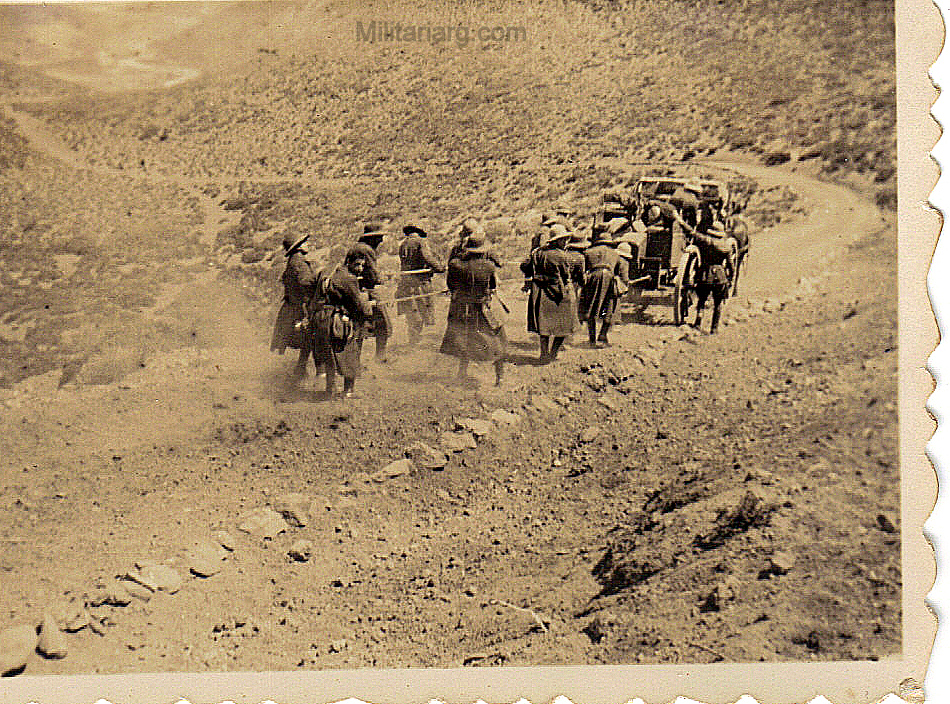
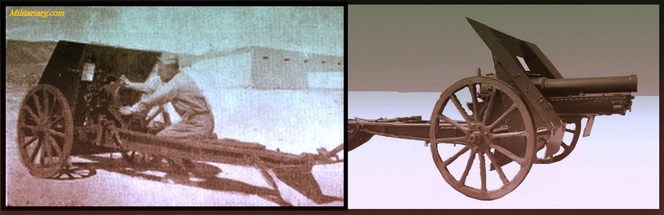
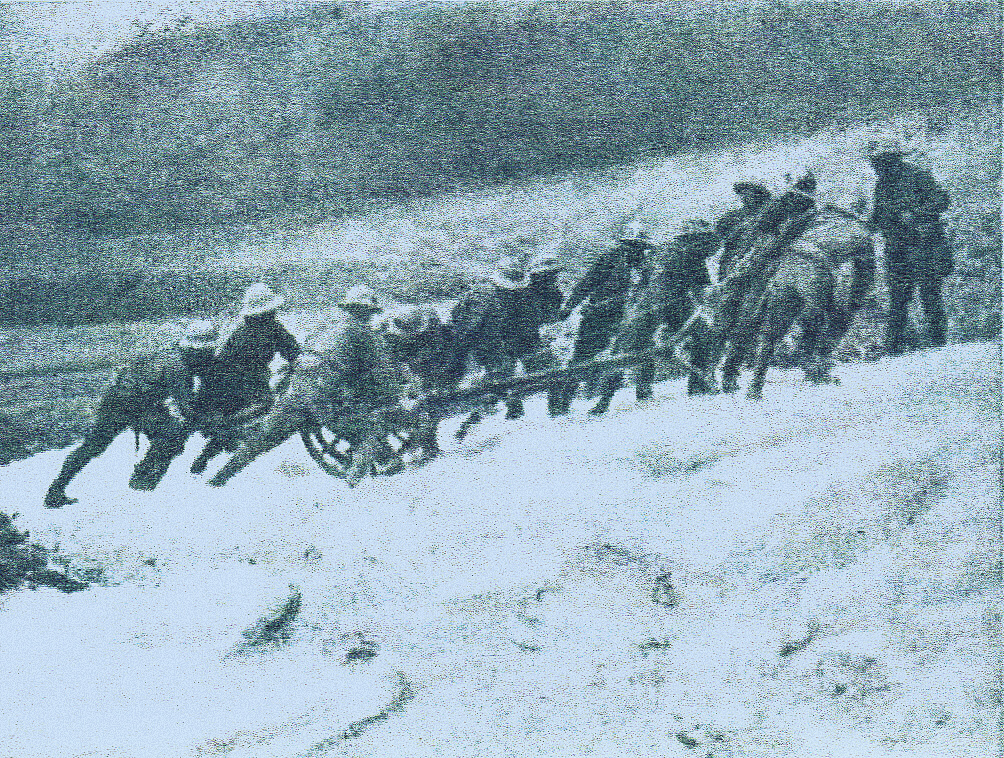
The Tridentina Division and other Alpini units were tested on their ability to move rapidly between the Adige and Piave river valleys. These were massive war games observed by King Victor Emmanuel III and Mussolini. A key focus of these exercises was the mobility of mountain guns (like the 75/13 model) *. 
Perón was reportedly fascinated by the logistical feat of moving heavy firepower through the Dolomite passes using only mules and human strength—a lesson he brought back to the Andes. 

*The Oto Melara Mod 56 105mm pack howitzer was developed specifically to replace in the postwar the aging Skoda Gebirg 75/13 (known in Italy as the Alpini Obice da 75/13). Both weapons were specifically designed as "pack howitzers," meaning they could be completely dismantled and transported on the backs of mules using specialized pack saddles.
Argentina's acquisition of the Oto Melara Mod 56 (M56) pack howitzer was a direct result of Plan Europa, a strategic military procurement program launched in the late 1960s.

Juan Domingo Perón’s assignment to Italy (1939–1941) was deeply connected to the 2nd Alpine Division "Tridentina", which at that time was one of the premier mountain warfare units of the Italian Army. He was sent by the Argentine War Ministry specifically to study the techniques of the Alpini, the Italian elite mountain troops.
He spent much of his time attached to units that formed part of the Tridentina Division, observing their maneuvers in the Alps.

He participated in high-altitude exercises, including skiing and climbing, which were central to the Tridentina’s operational doctrine. The training took place just as the division was preparing for World War II deployments.
The knowledge Perón gained from the Tridentina—such as the use of specialized mountain artillery and the organization of small, autonomous alpine units—was later used to modernize the Argentine Army's mountain regiments in the Andes. 


Picture
​ (1939–1941)
During Perón’s stay, the Tridentina was in a state of high mobilization:


Invasion of France (1940): The division took part in the Italian invasion of Southern France while Perón was an observer in the region.

Greek Front (1941): Shortly after Perón returned to Argentina, the division was deployed to the Greek-Albanian front.

This alpine division later became legendary for leading the retreat of the Italian Alpine Corps during the Battle of Nikolayevka on the Eastern Front in 1943, where it was the only division to remain combat-effective. 
The Tridentina suffered a tragic fate on the Eastern Front that is considered one of the most harrowing chapters in Italian military history. During the Soviet "Operation Little Saturn" (January 1943), the Italian front collapsed. The Tridentina, along with the Cuneense and Julia divisions, were forced into a 200-mile retreat on foot through sub-zero temperatures (-30°C to -40°C) while surrounded by the Red Army.

Perón often spoke of his time with the Alpini with great respect, and he maintained a lifelong admiration for the efficiency and discipline he witnessed within the Tridentina and other Italian mountain divisions
Picture
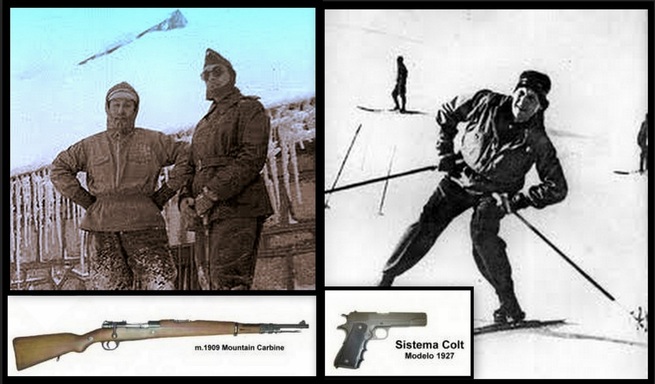
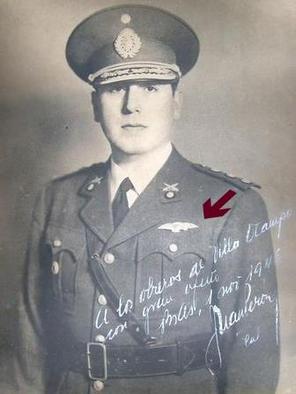
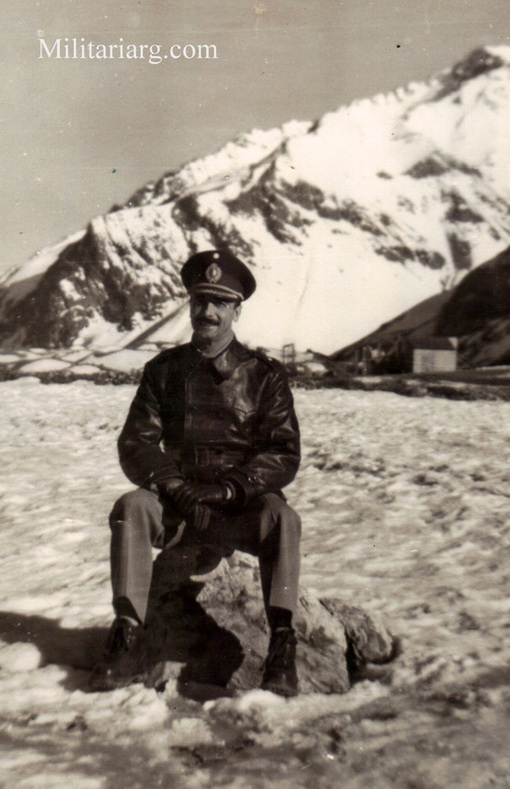
Lieutenant Colonel Juan Peron in the center for mountain instruction in Mendoza.
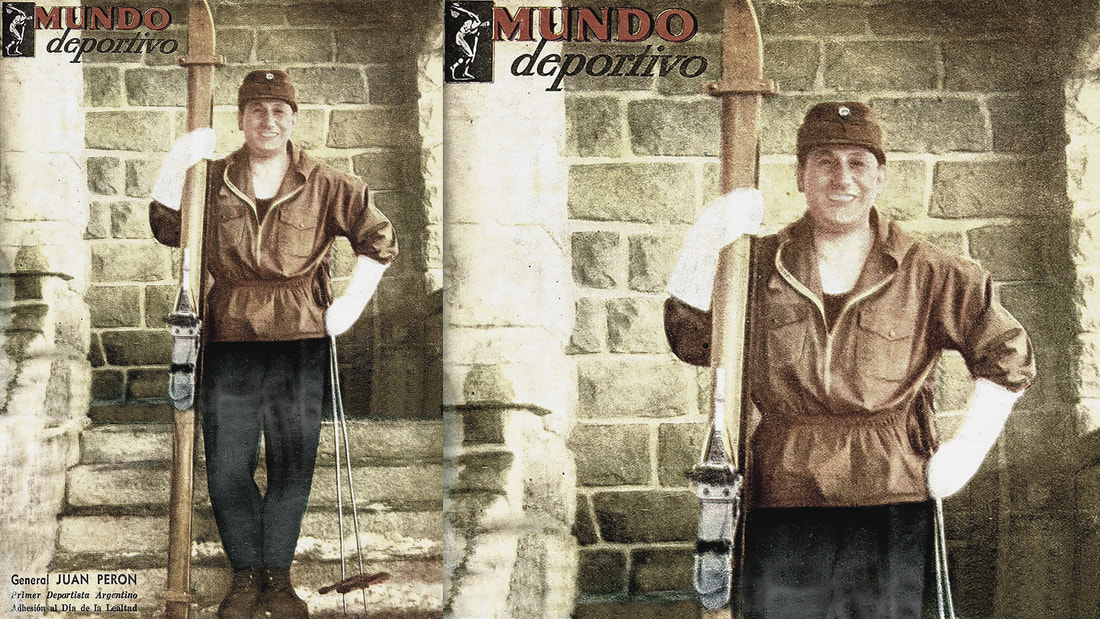
Upon returning to Argentina in 1941, Perón applied his Italian training by serving as a skiing instructor for the Argentine Army in Mendoza Province. At this time, Peron is often pictured in specialized mountain troop uniforms inspired by his time in the Alps, including the distinctive earthy-brown caps, ironically inspired by the Austro-Hungarian mountain model (the Bergmütze), rival to the Italian alpini cappello.
Picture
Lieutenant Colonel Juan Peron in the center for mountain instruction in Mendoza upon his return from the Italian Alps.  He is dressed in a dark khaki colored open jacket and an earthy brown cap (El "bergmütze andino"), specialty uniform for the mountain troops.
Picture
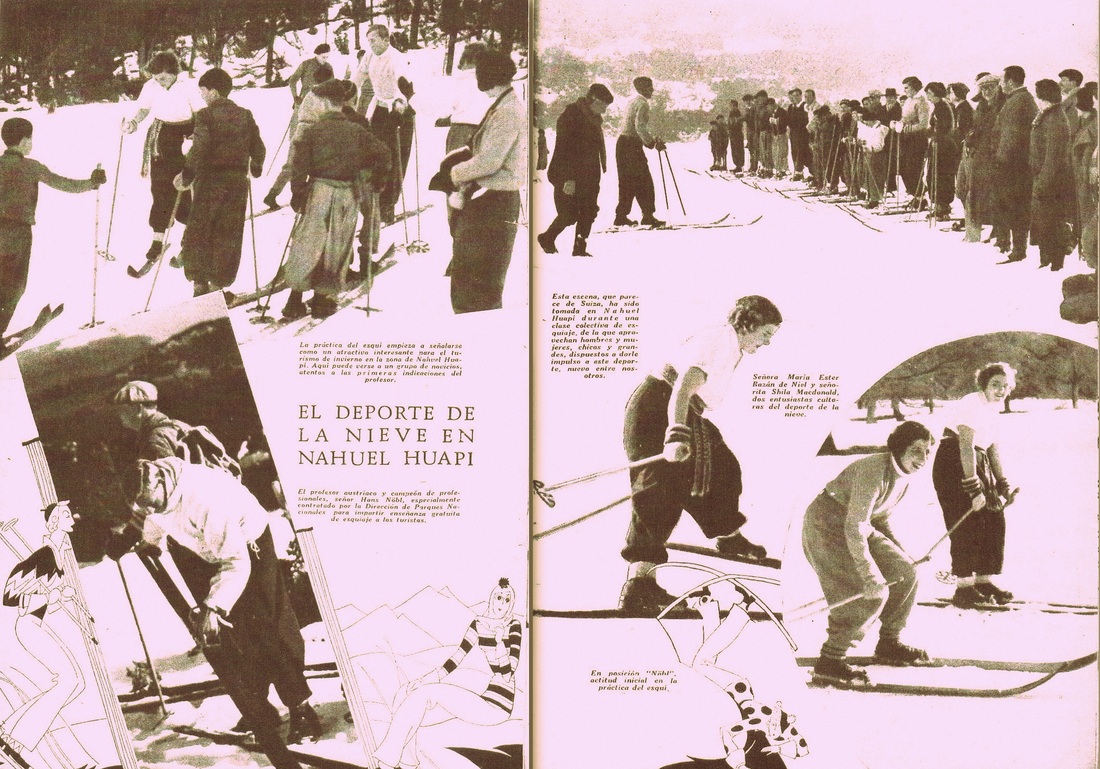
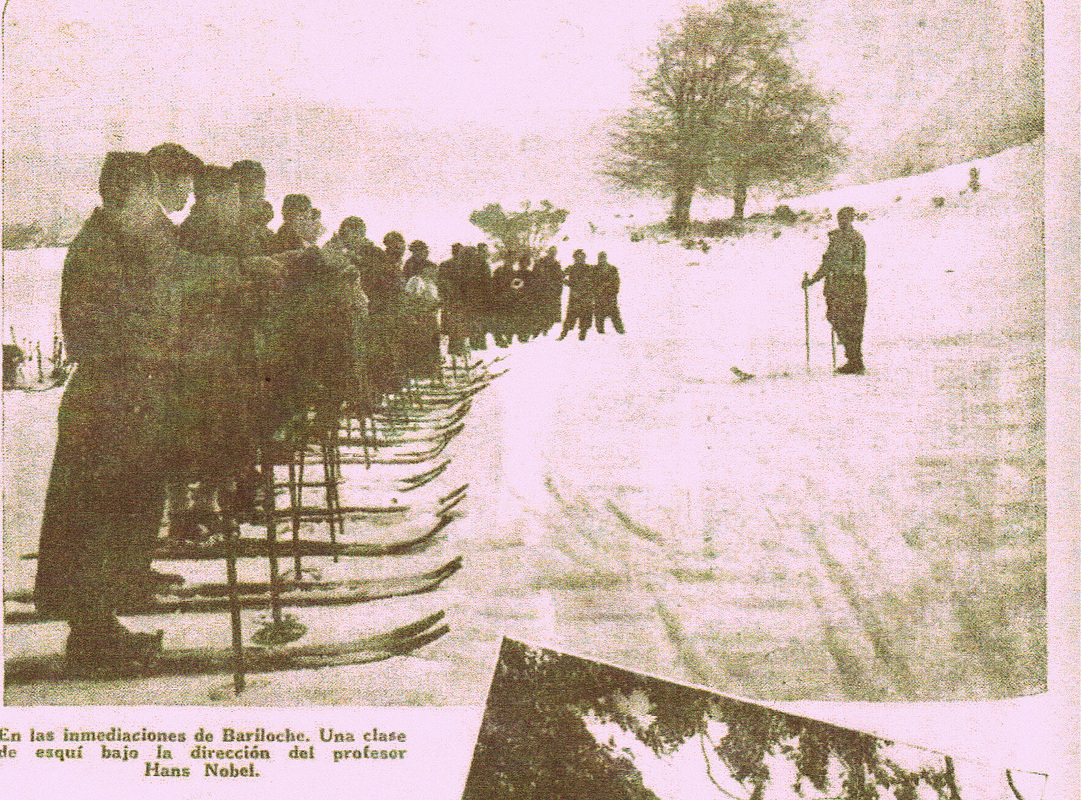
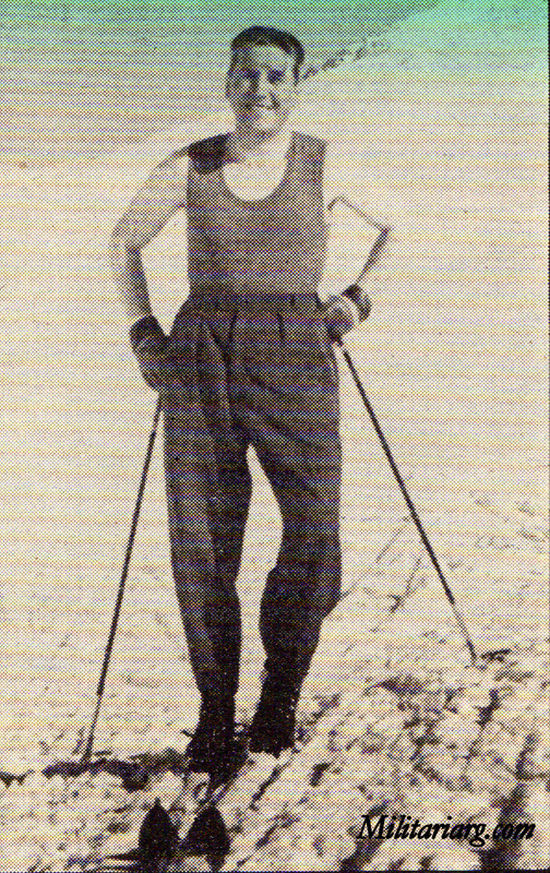
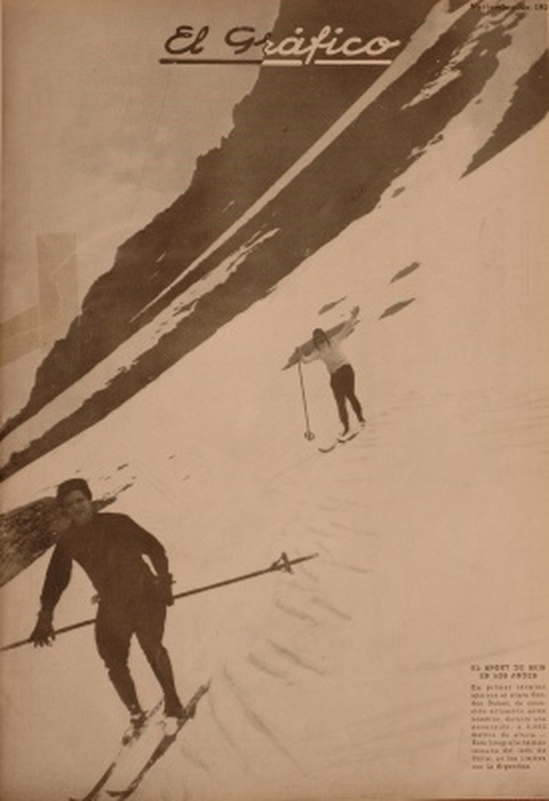
​ Hans Nobel was a prominent Norwegian skier in Argentina during the 1930s who served as a skiing instructor for Juan Domingo Perón. 
Nobel was an Argentine ski champion in 1936.Before Perón was sent to Italy to train with the Alpini, he received his initial skiing and mountain instruction from Nobel in the Bariloche region. This early training with a high-level instructor like Nobel provided Perón with the foundational skills that allowed him to excel in his later professional training with the Tridentina Division and subsequently serve as a mountain warfare instructor himself back in Argentina. 
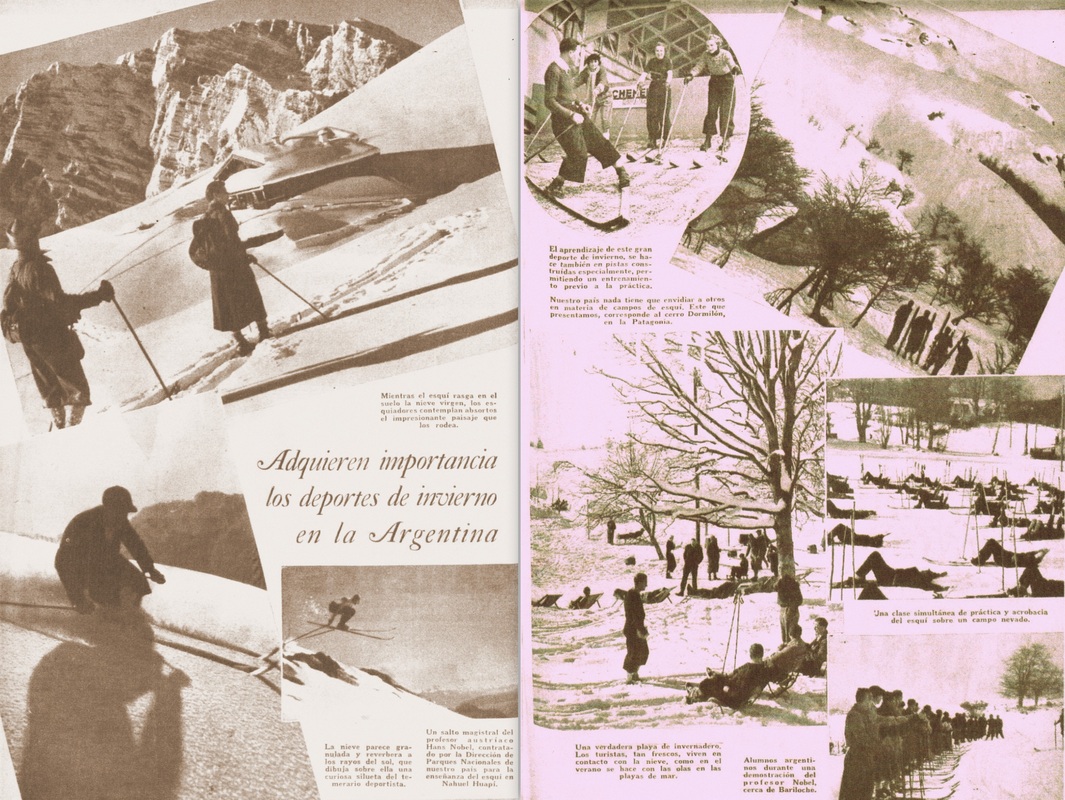
The presence of experts like Nobel was part of a broader effort by the Argentine military to adopt European (specifically Nordic and Alpine) mountain techniques). Photo Caras y Caretas 1930s.
Picture
Picture
Picture
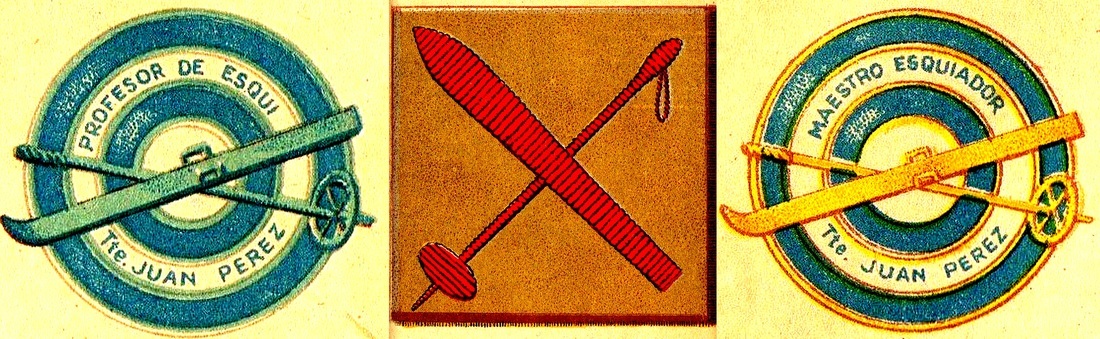
Master Skier. Skiers NCO's and troops. Profesor of Sky. Sky Instructor.

Picture
From Tomas Eloy Martinez (Peron's novel)

In 1942 and 1943, Peron wrote some articles for the Military Review about life on the mountain for an officer.  "The terrain, the soldier, the fighting patterns, the climate and untamed nature of the mountains; everything seems to speal to us in a different language.  The mountain is an atmosphere of surprise and the unexpected; in it, everything superfluous or apparent disappears and the most complete leader imposes himself.  There one must be, more than seem.  It is the true command school."
​
In another passage Peron writes, "The art of command is intuitive but it is perfected by exercising it.  The mountain has needs that go beyond normal commands.  Love the soldier and the comrade to be loved by them in return; know their needs and share their hardships, their fatigue, their sacrifices; win their esteem and their confidence with your example."     
 
Of the mountain soldier Peron write, "They must simultaneously combat with three enemies: the terrain, climate and their opponents, their missions are always the most difficult, its the most complicated tactical problems, its material means less potent and its action is fought over the initiative and genius command of all kinds to fulfill orders or rules of conduct ..."

Picture
Picture
Picture

Picture
Picture
Picture
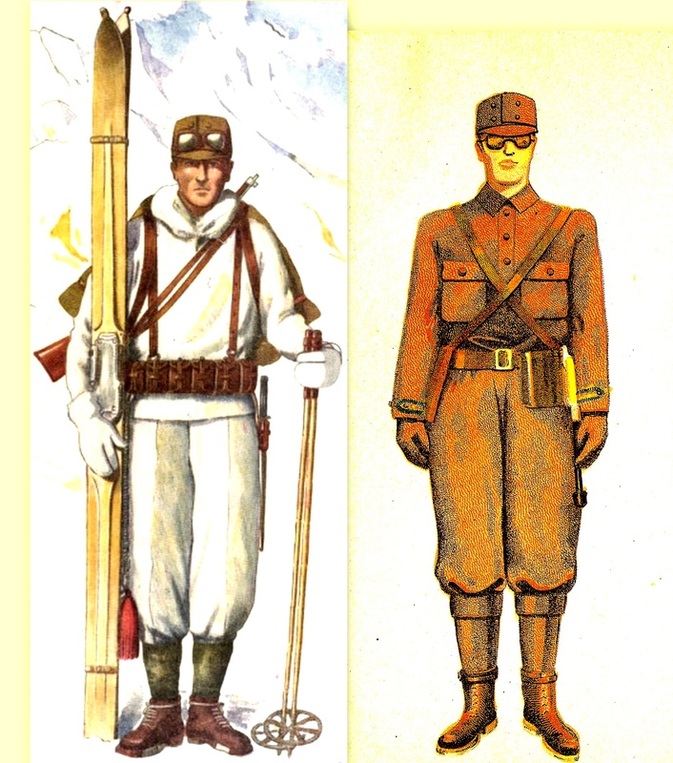
​Model 44 Uniform (R.R.M.44), Argentine skier with snow camo.  Painting by Argentine artist Marenco . Right: Mountain troops officer with model 46 uniform in earthy brown color.
Picture
Picture

Picture
Picture
Picture
Picture
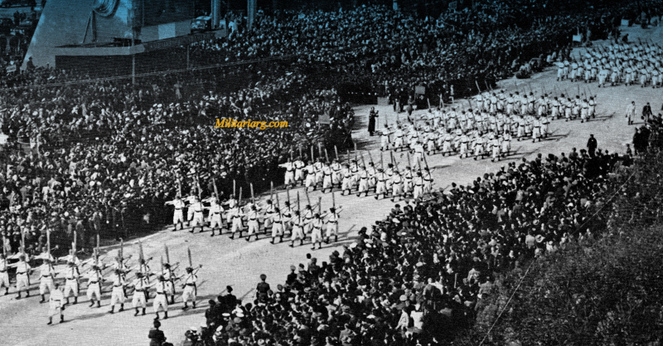
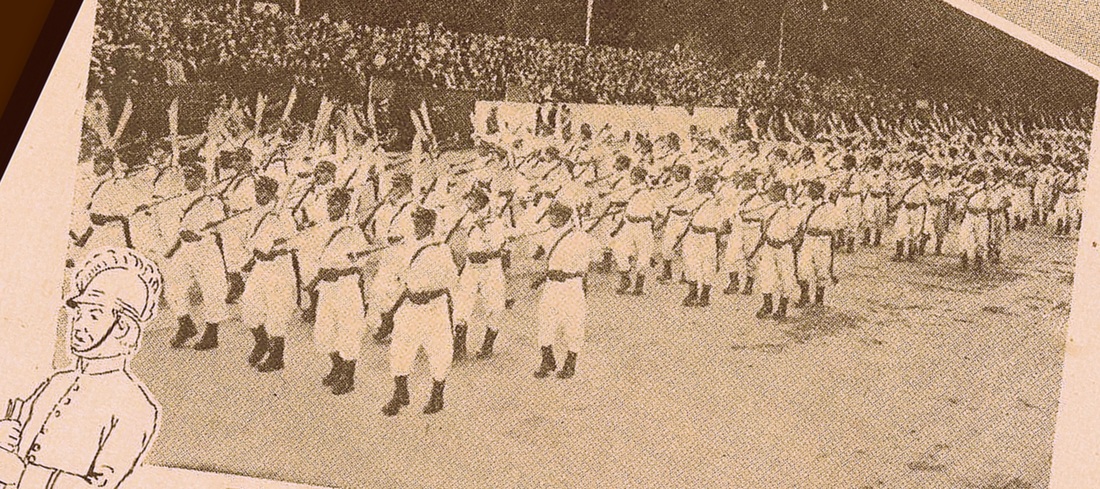
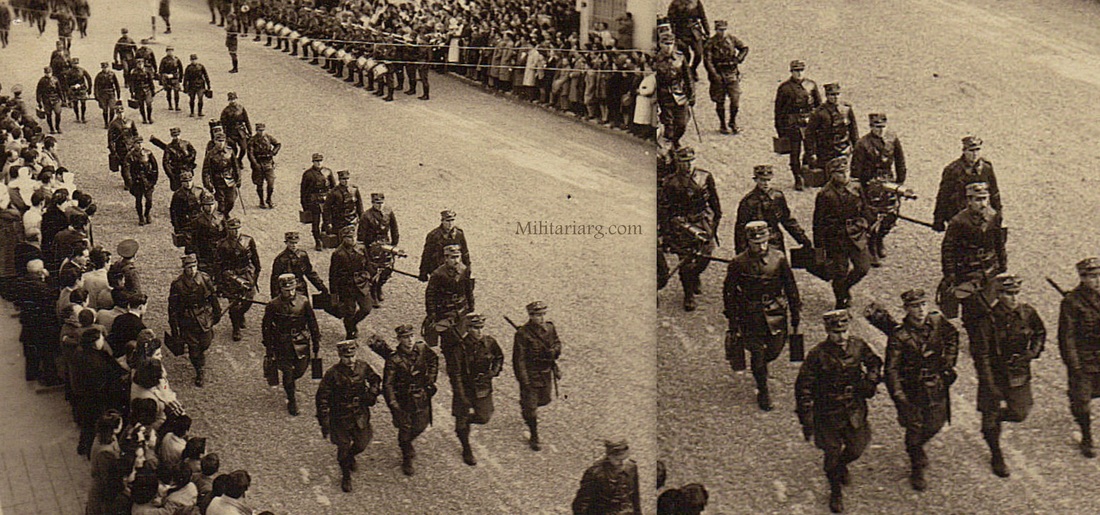
1947 parade.
Picture
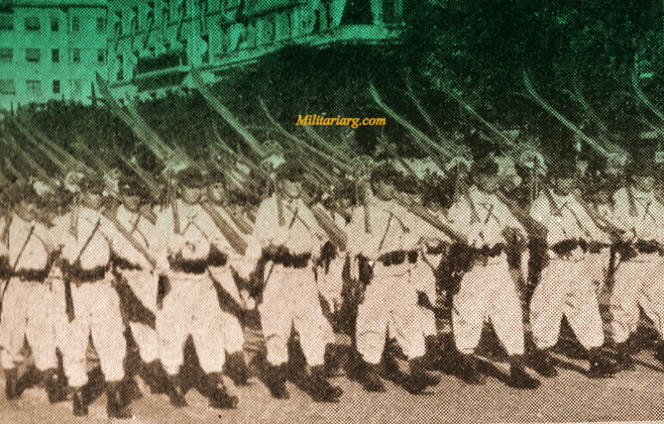
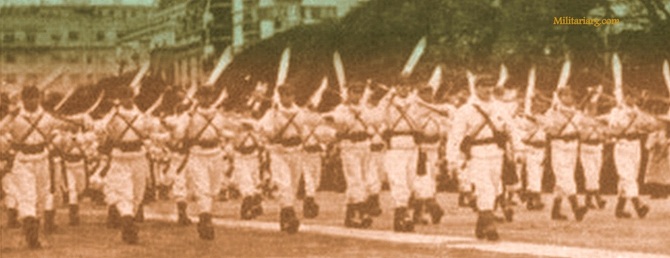
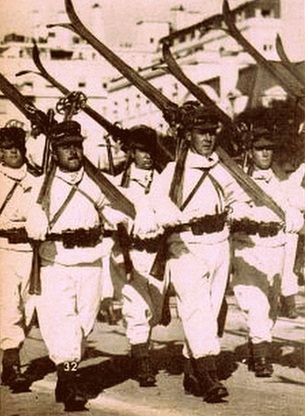
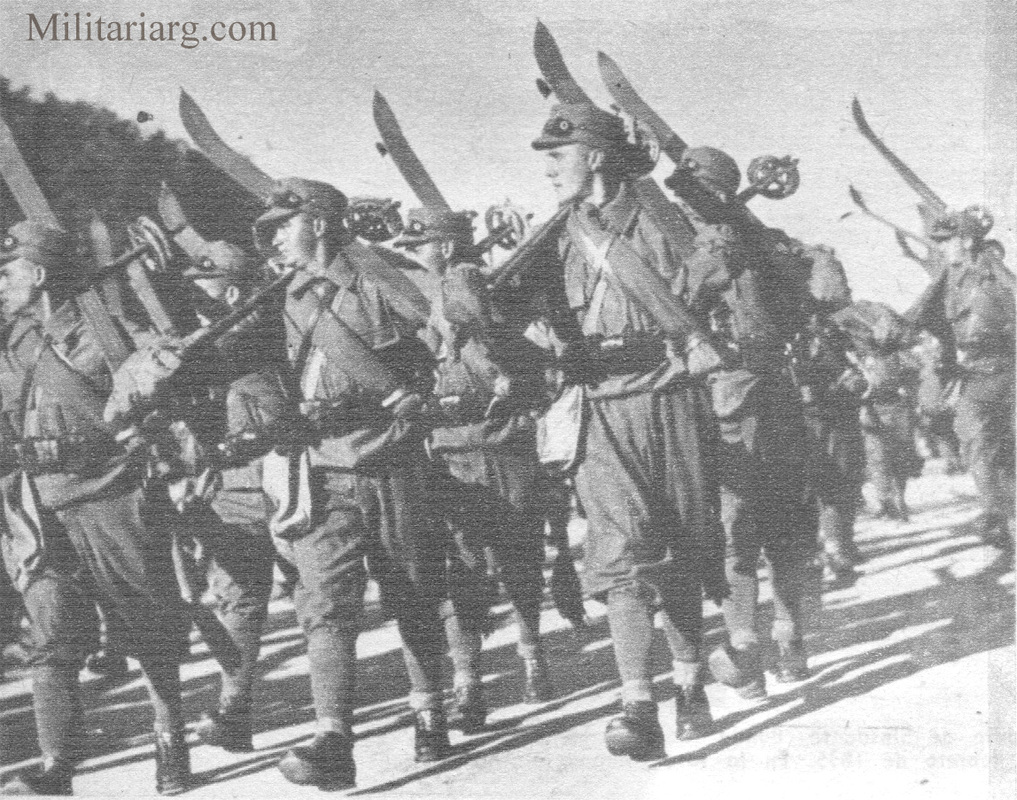
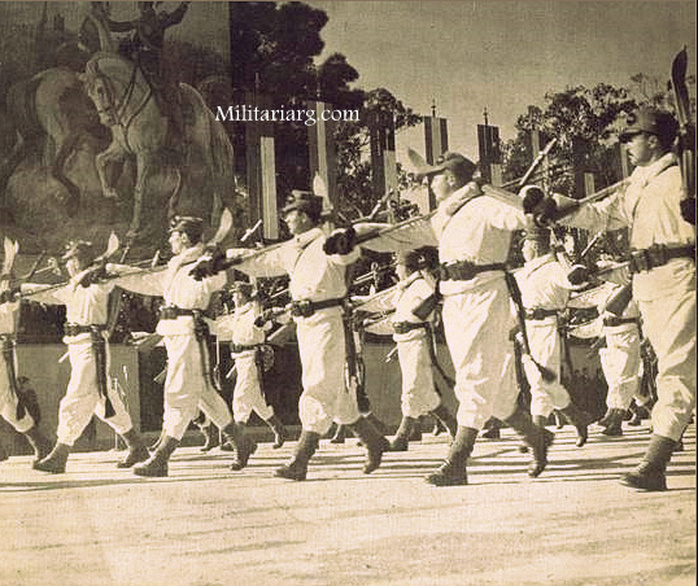
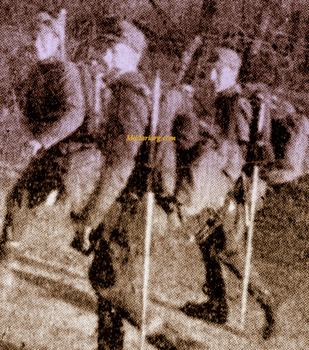
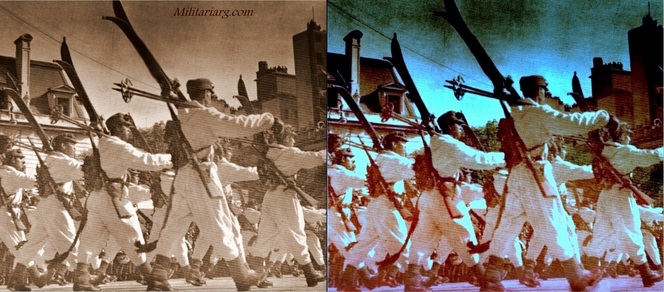
​Andinean skiers from the army mountain troops, marching in the city with snow camo. This photo is from 1950 showing a parade celebrating August 17, the Day of San Martin.  Photo publication from the time.
Picture
Picture
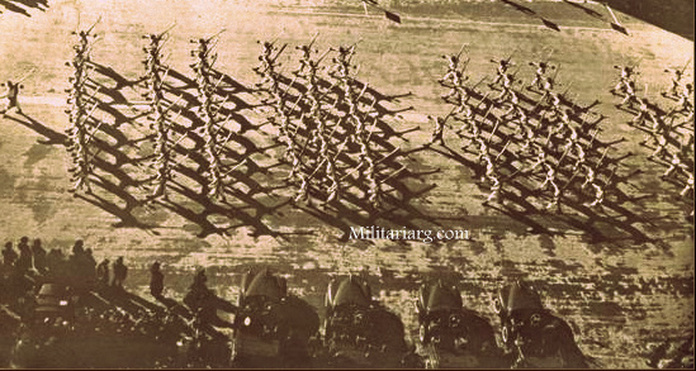
1955 parade. 
Picture

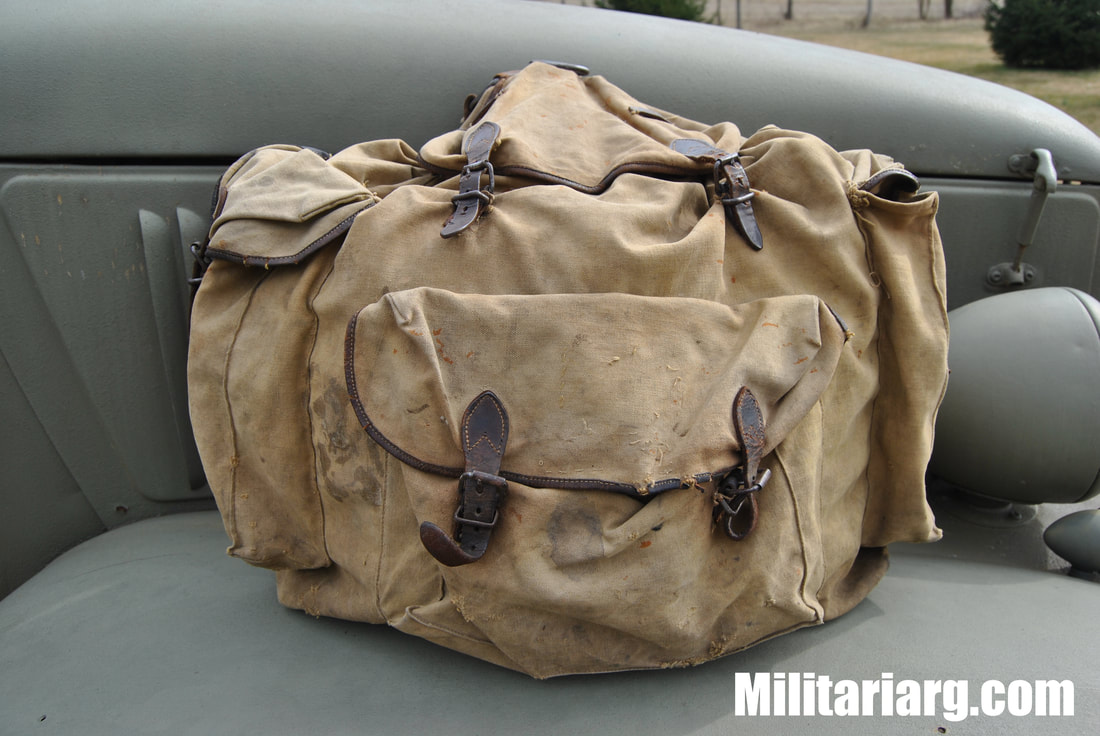
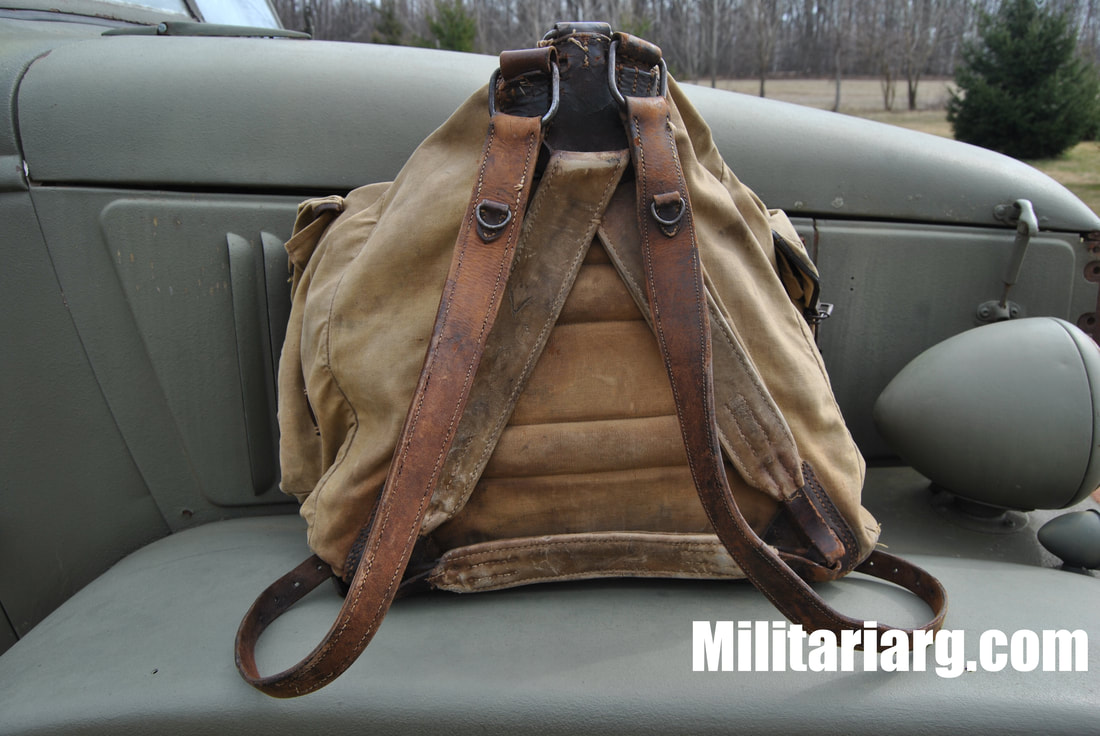
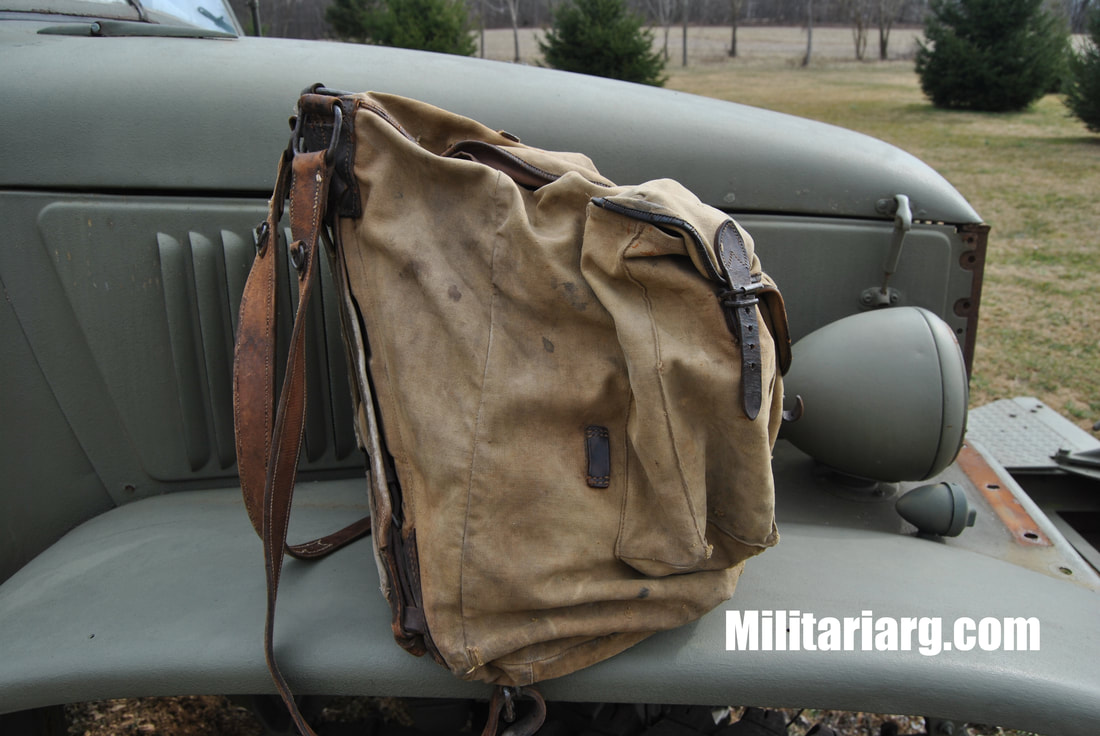
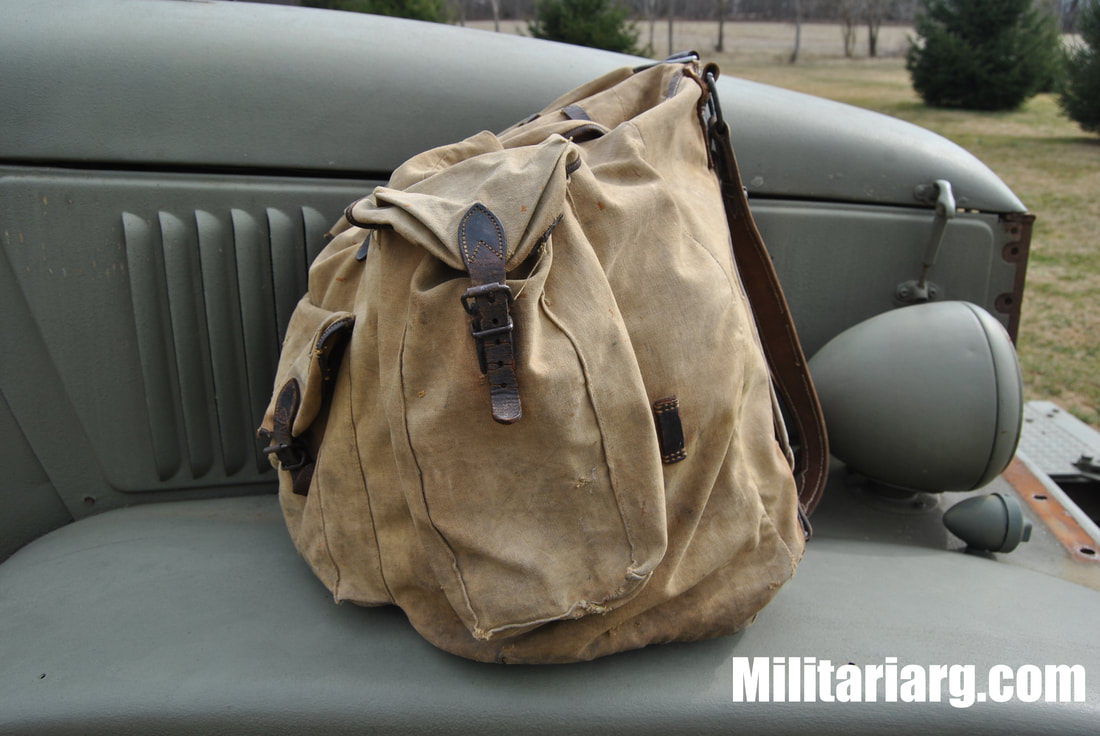
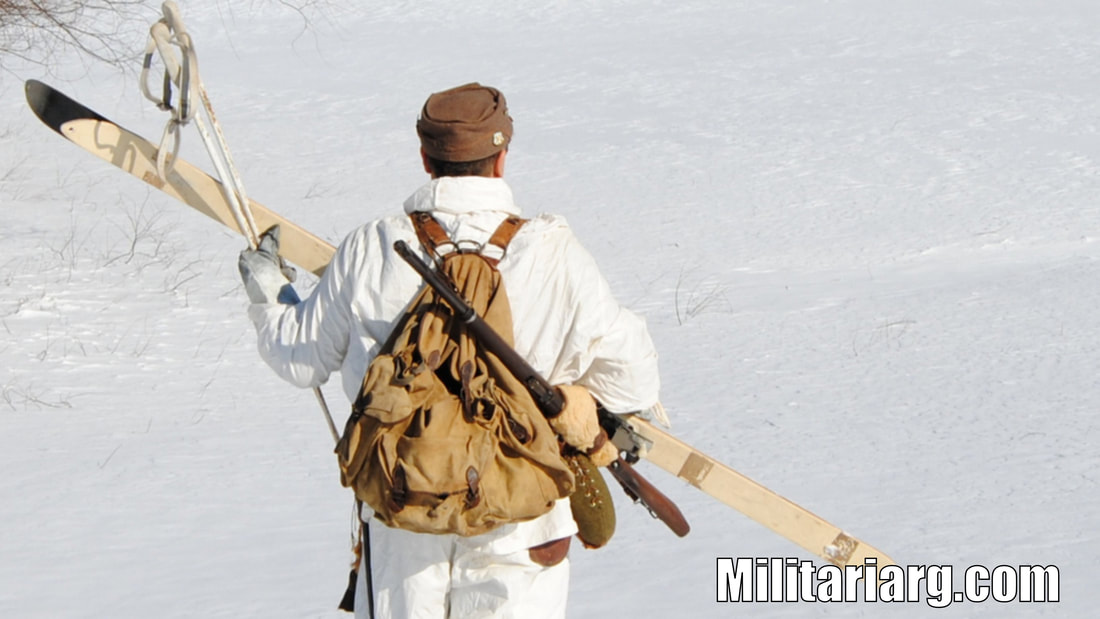
Argentine Army Mountain Backpack Rucksack.

Picture
Picture
Picture
Picture
Picture
Picture

Argentine Mountain Troops and Assorted photos about mountaineering in the Andes

Picture
Picture
Picture
Picture
Picture
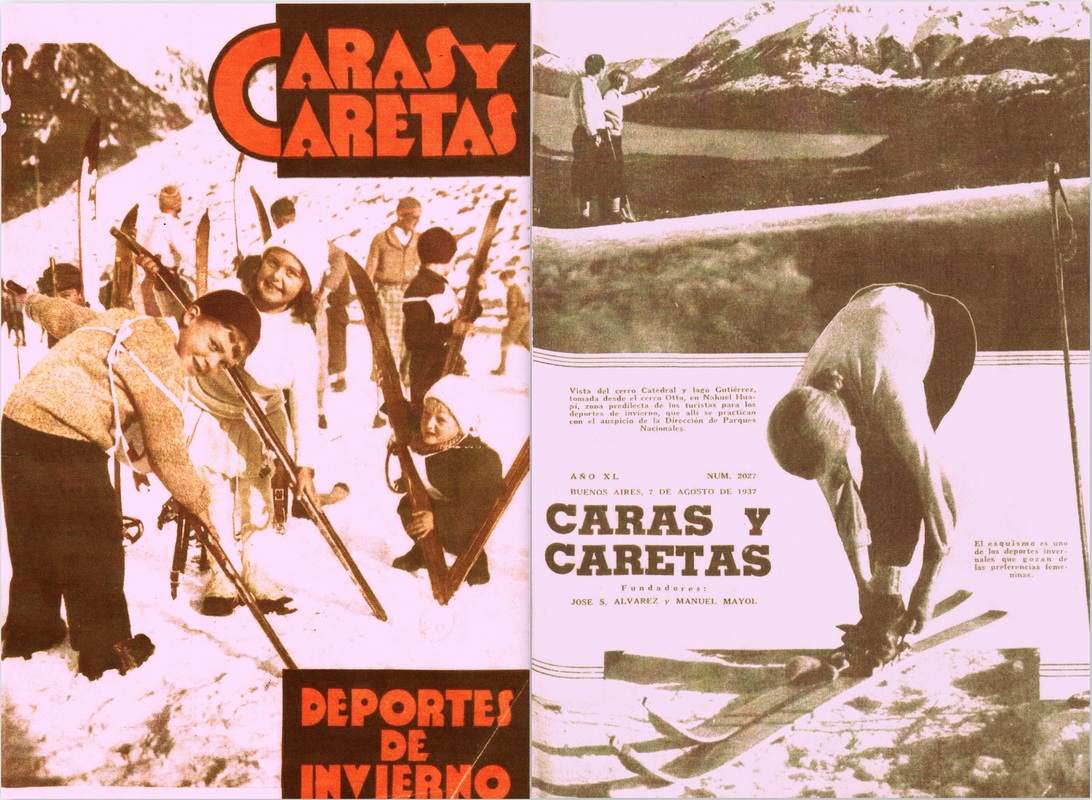
Caras y Caretas 1937.
Picture
16Th Mountain Infantry (1944)
Picture
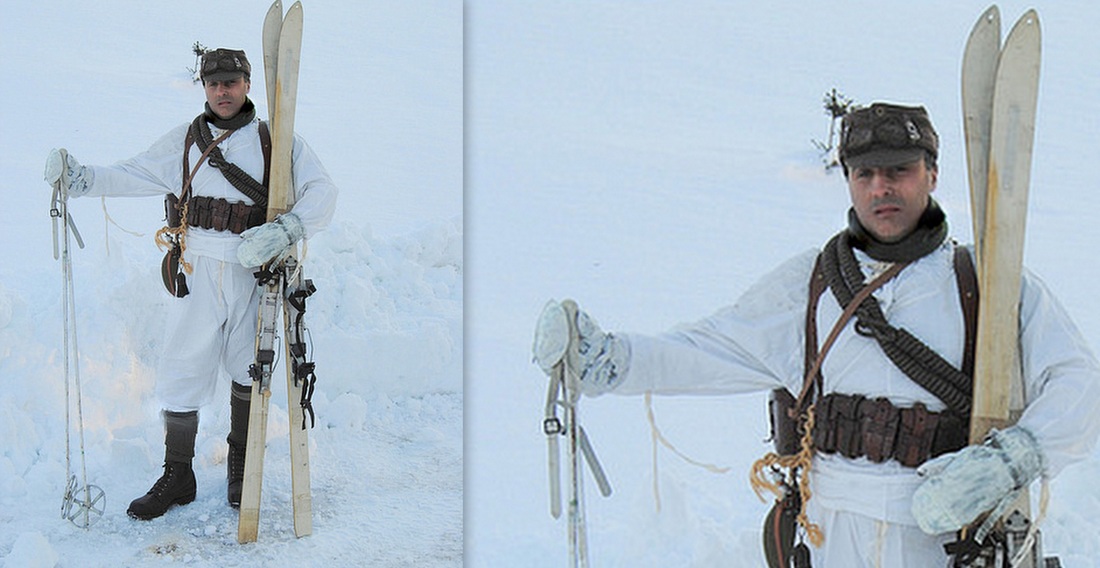
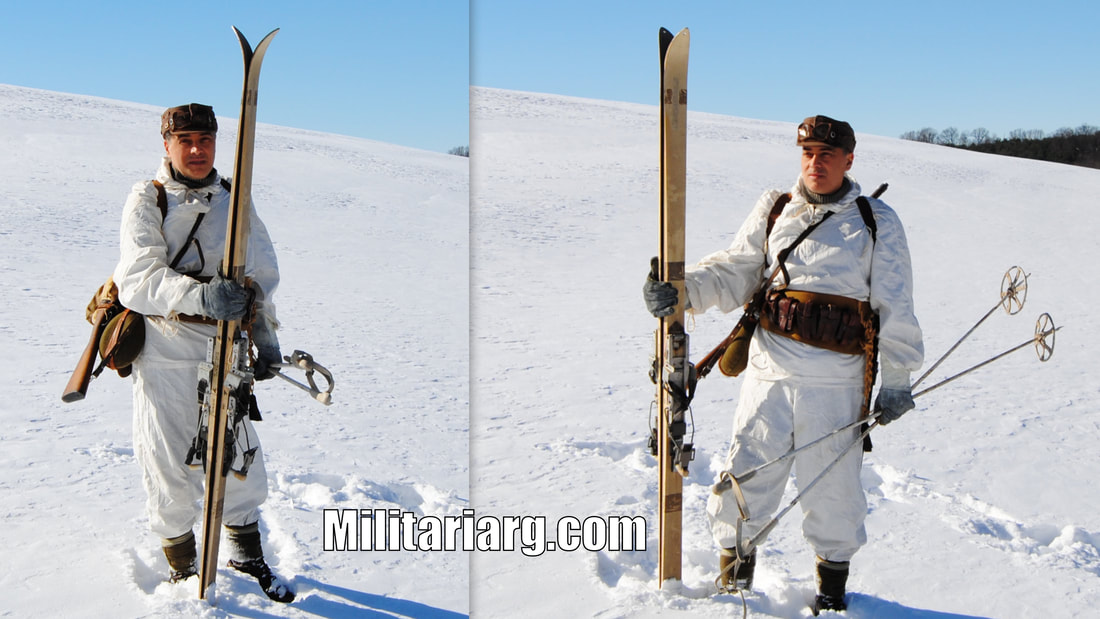
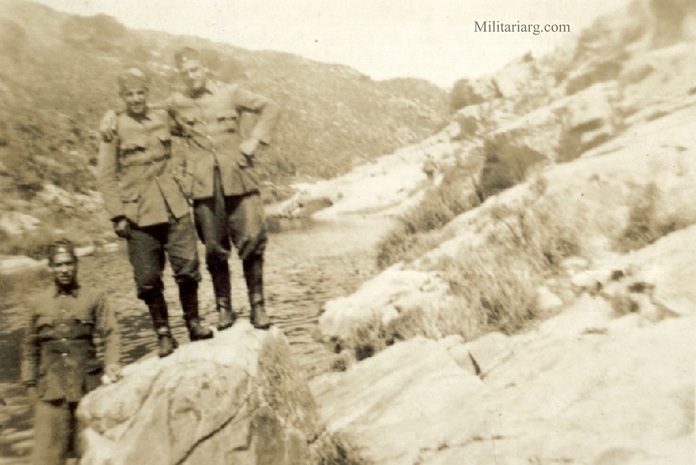
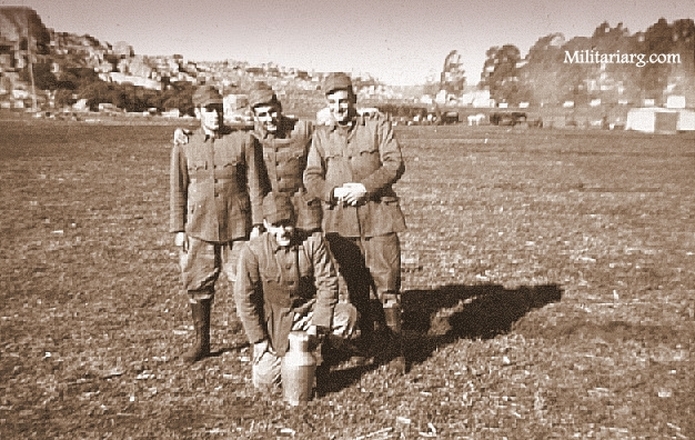
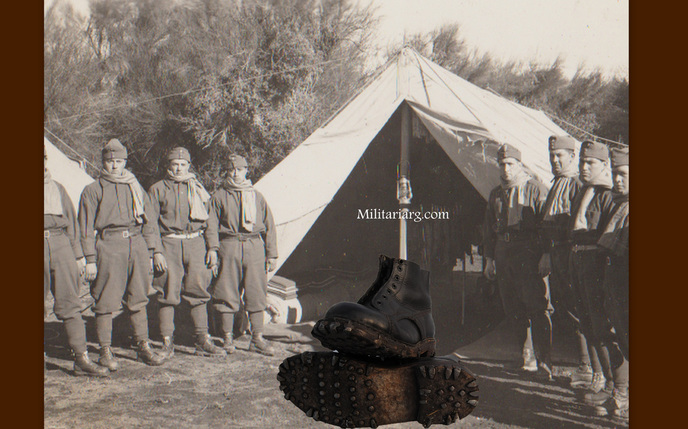
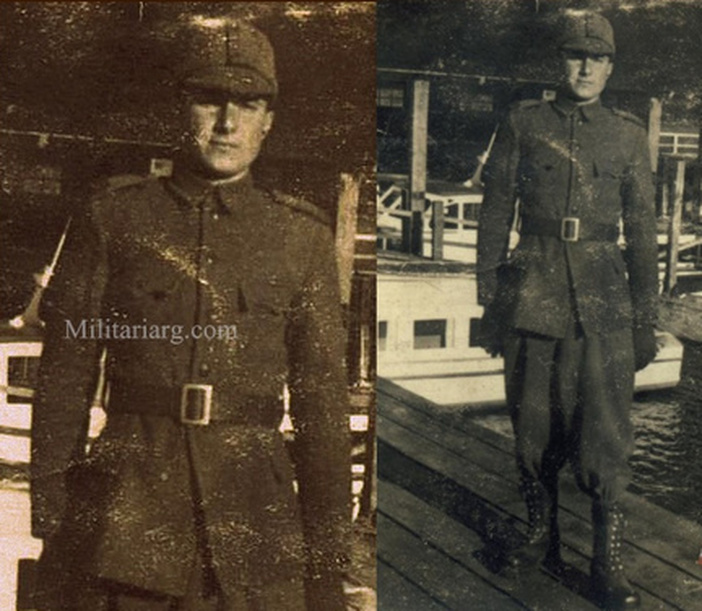
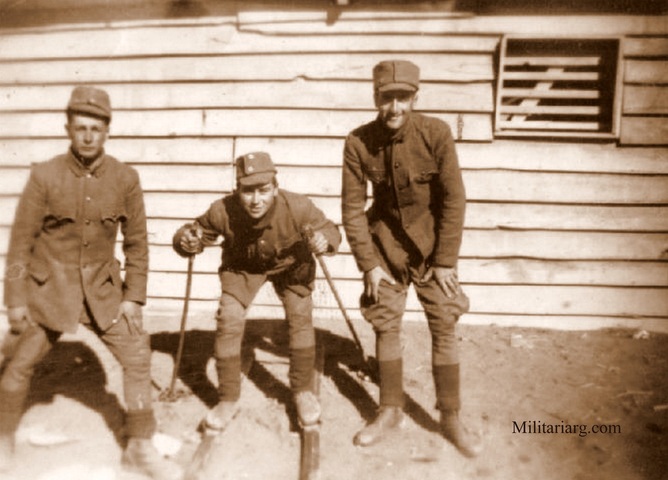
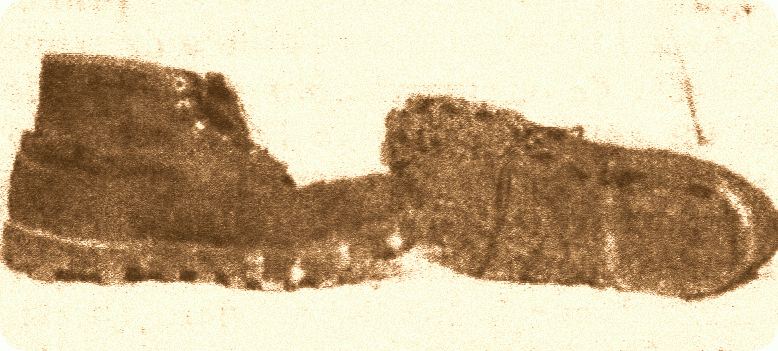
​These photos are from the early 1940s. The photo on the left is of the footwear of a mountain soldier in the Argentine army. The soldier wears the standard army leather leggings with short spiked mountain boots. The photo on the right is of an officer from the same era, and he wears the same type of boots but with canvas gaiters. The boots are of the German type.
Picture
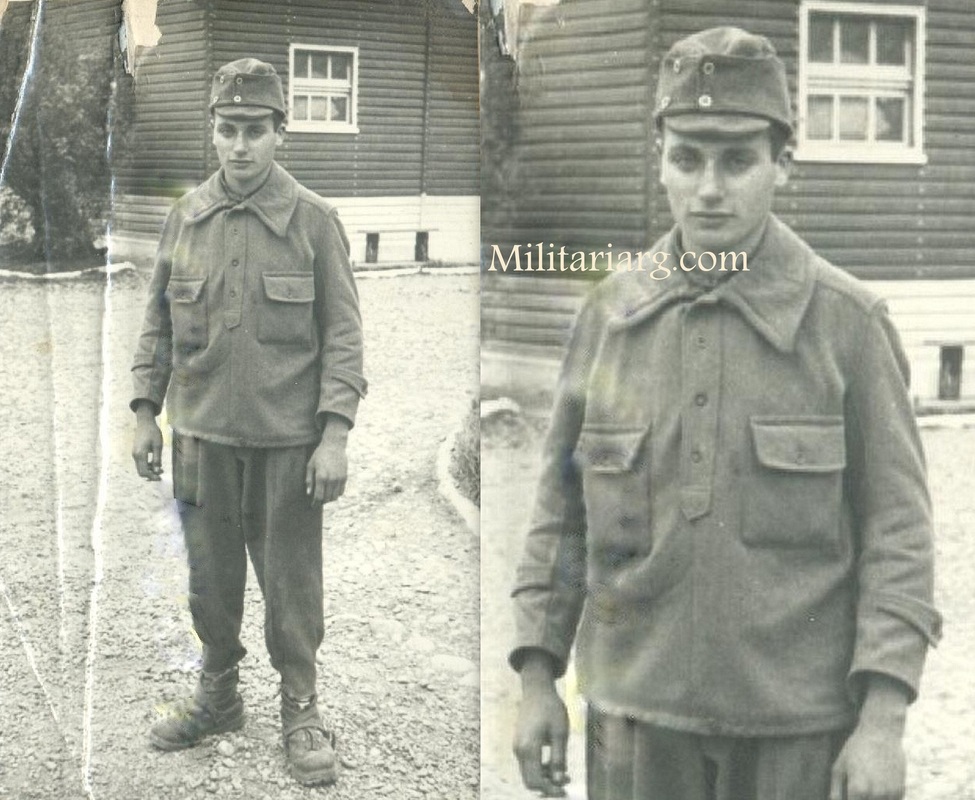
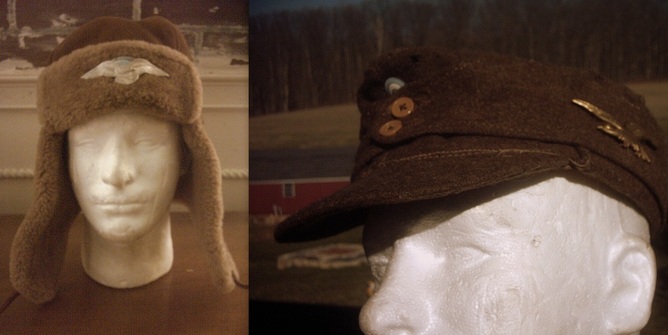
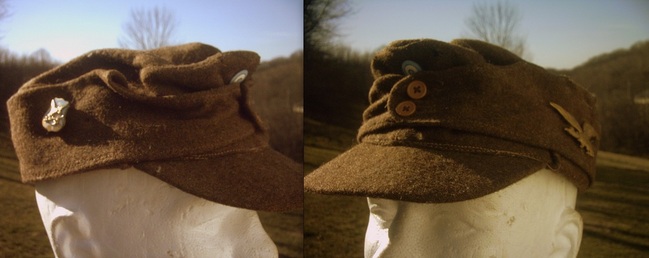
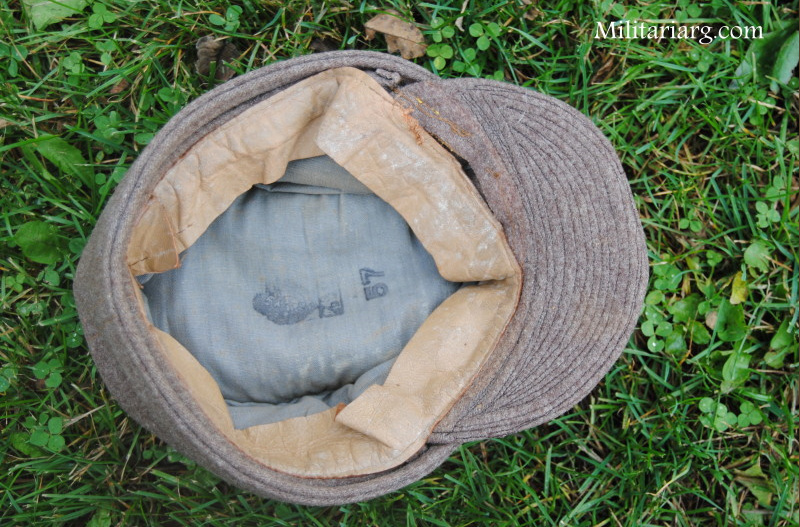
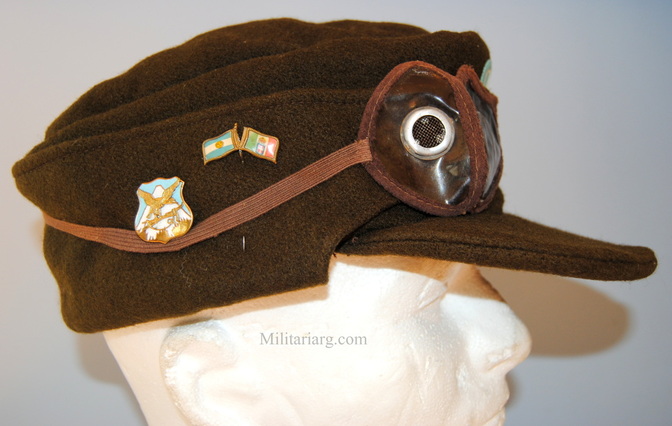
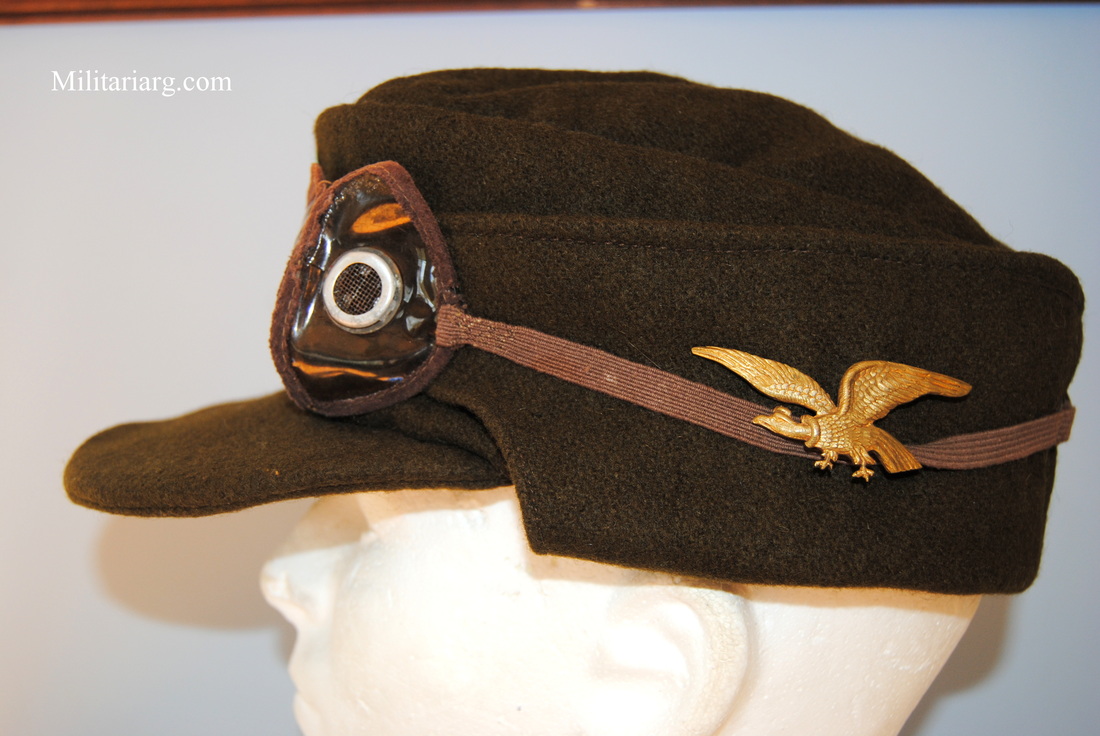
​What we see is not an M42 German cap, but the same model of the field cap of the Argentine army late 1930s earlies 40s ((Birrete Pasamontañas) , but with sides and fastened with hooks or buttons in front. In other words, this Argentine model predates the German M42.

This was a modification of the cap for cold areas. This garment could be considered the first mountain cap of the Argentine army. Towards the end of WW2, a field cap with a scope like the German Feldmutze appeared with two buttons on the front, and with the regulation of M46 an Argentine model similar to the German gebirgsjäger, but with four buttons on the front.

Except for the hiking boots and the cold eather version of the Army field cap (Officers and troops), the rest of the uniform in the photos. The uniform standard of the Argentine Army

Picture
Picture
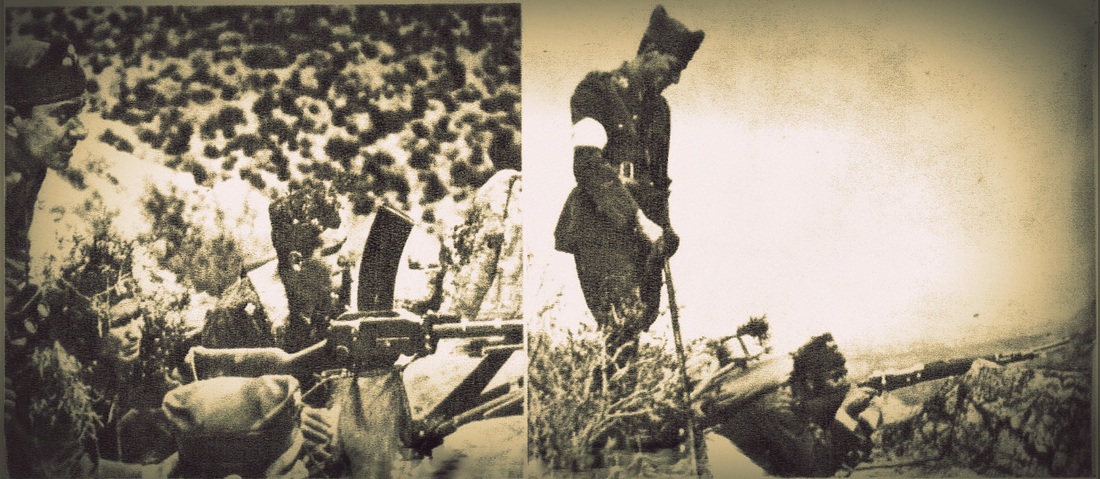
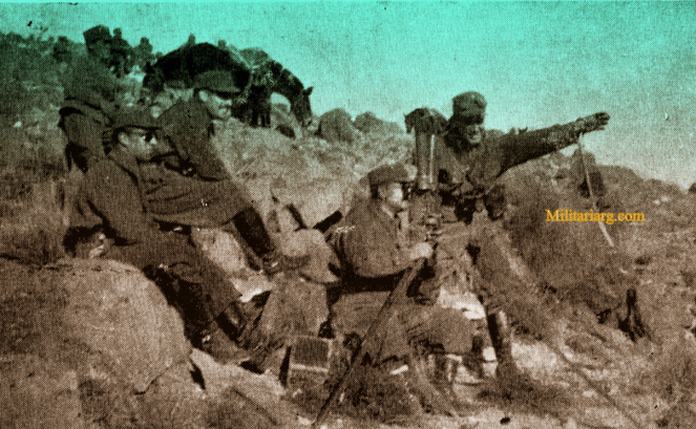
Mountain troops late 30s, earlies 40s, operating the heliograph, a device for transmitting messages by reflecting sunlight. .
Picture
Picture
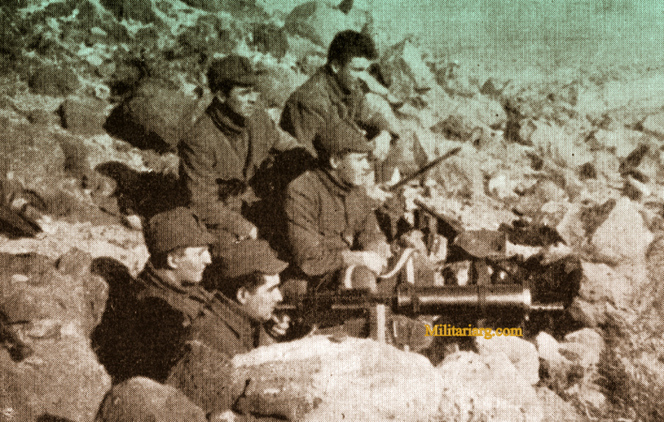
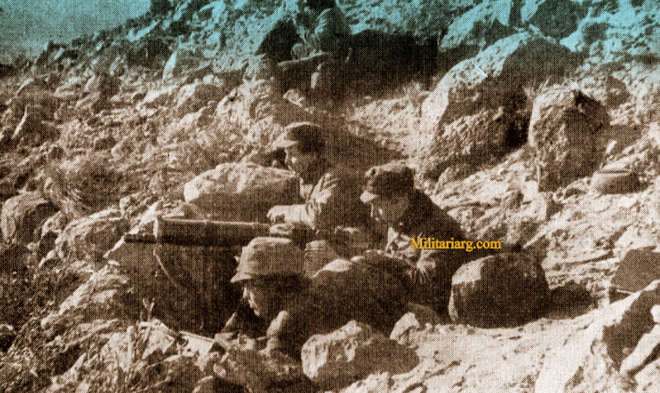
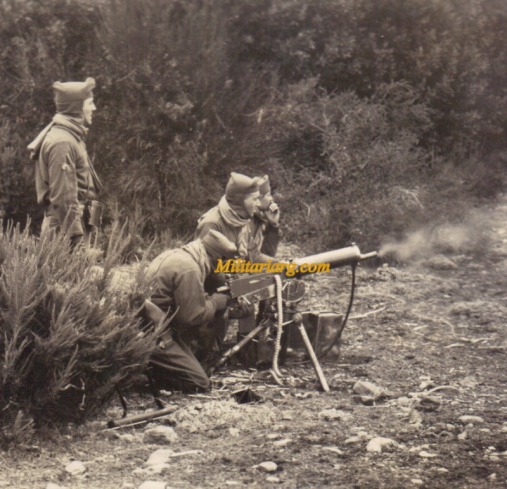
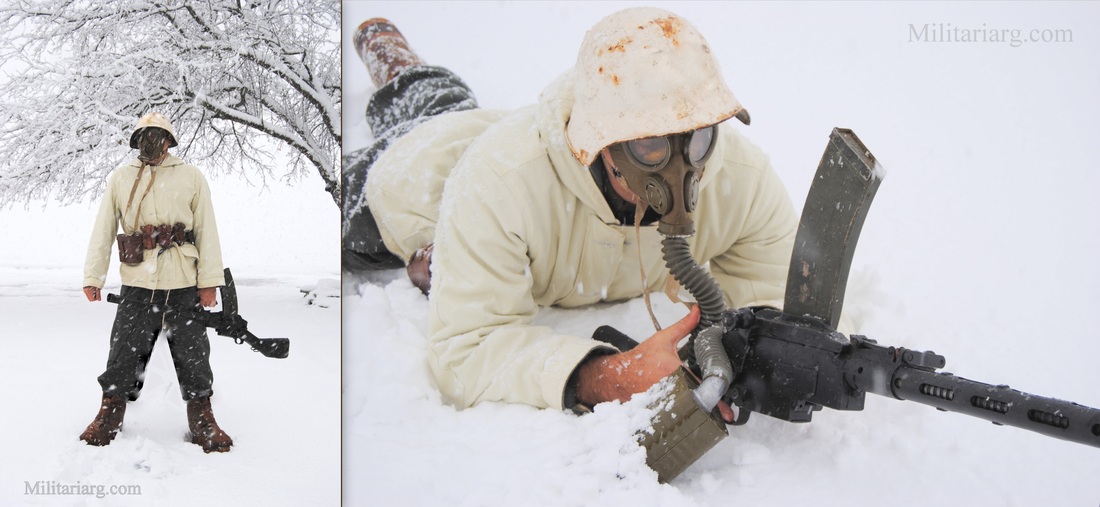
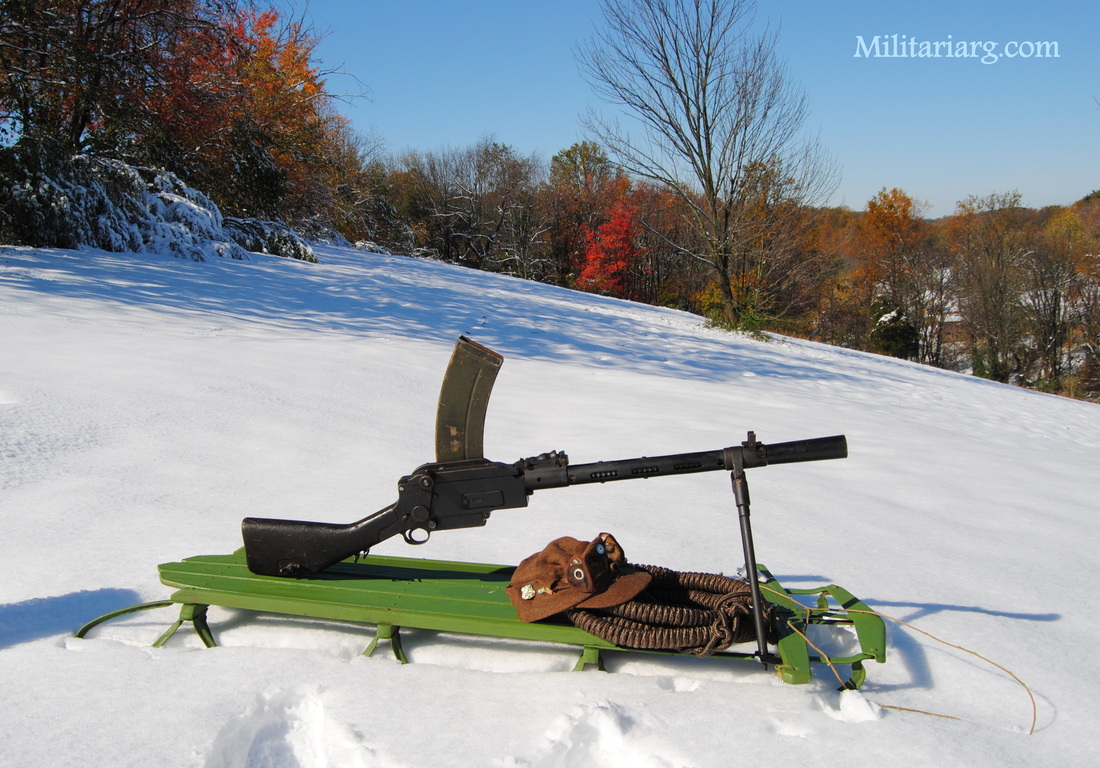
Colt 1928 HMG, a commercial export version of the water-cooled Browning M1917. I was designed to be transported by pack animals (both horses and mules) through the use of specialized pack saddles. 
Picture
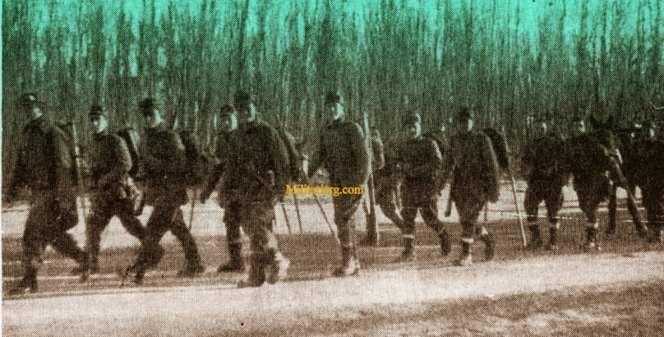
​In this photo you can see troops with high lace-up boots.
Picture
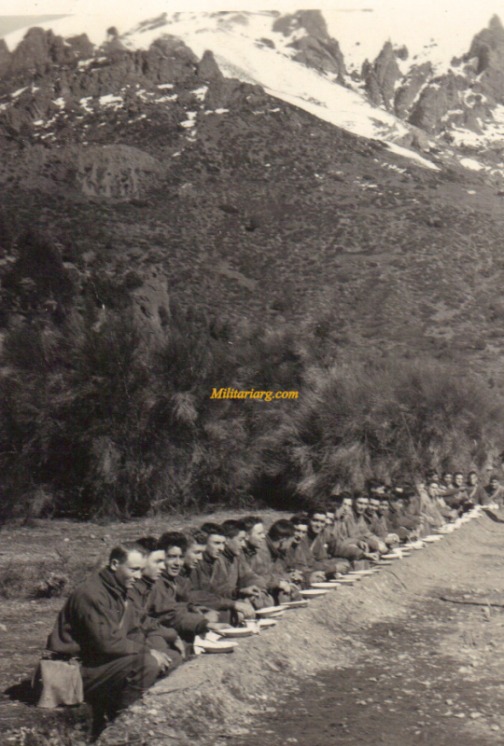
It is a temporary field dining room (Rancho), made by the troops.
Picture
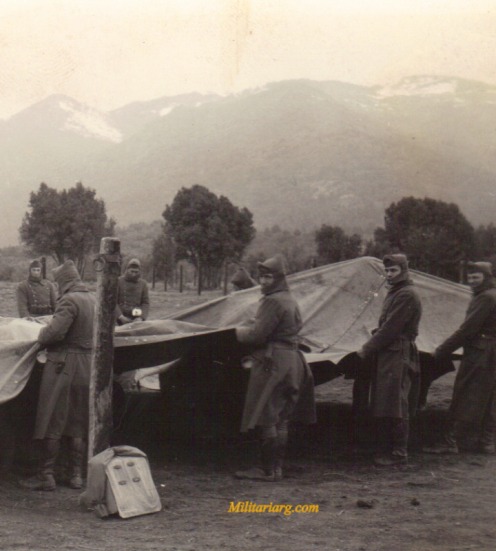
Army engineer soldiers in a mountainous zone.   ​

Picture

Picture

Picture
Picture
Picture
Picture
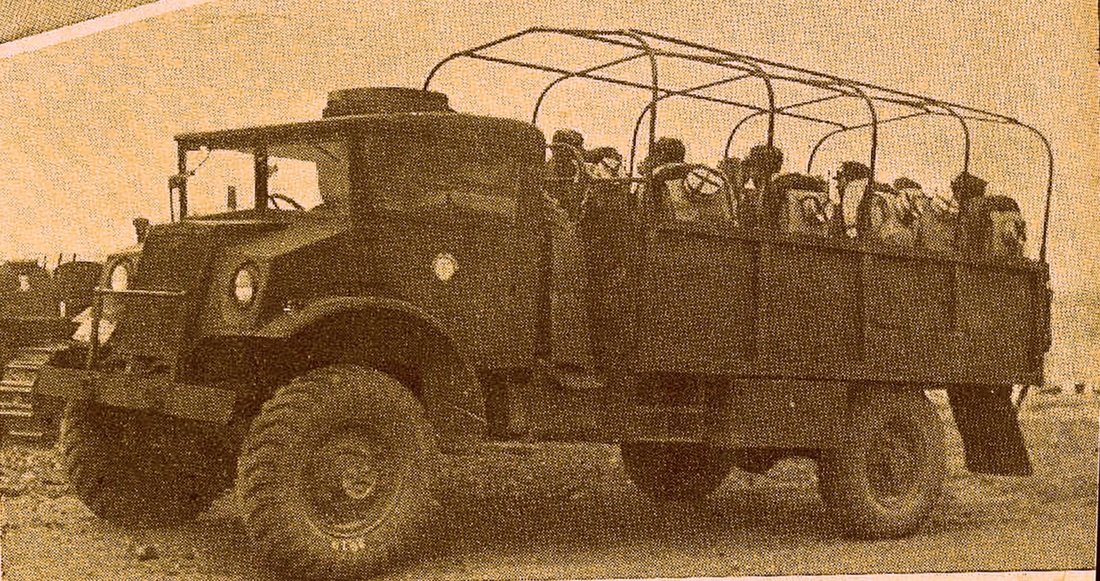
​In Argentina, soldiers and civilians gave the name "Guerrero" or "Guerrera" specifically to the CMP trucks built by Ford and Chevrolet in Canada. The name was inspired by their rugged, aggressive appearance and their proven track record in the front lines of WWII.
They were easily recognizable by their "Cab 13" design—a short, steep-angled front with a reverse-sloped windshield meant to reduce sun glint for pilots and allow for a larger engine in a smaller frame.
The most common models in Argentina were the Chevrolet C60 and Ford F60 (3-ton versions) and the C15/F15 (lighter utility versions).
Picture
Post-War Massive Purchase

Following the 1946 rise of Juan Domingo Perón, Argentina bought thousands of these vehicles from Allied surplus depots in Europe and North America. This move aimed to "mechanize" the army quickly, shifting it from horse-drawn logistics to a modern, motorized force. Alongside the GMC CCKW "Deuce and a Half," the Canadian Guerreros became the logistical backbone of the Argentine Army throughout the 1950s and 60s.

Because these trucks were designed for easy maintenance, they fostered a generation of skilled military mechanics in Argentina. When parts became scarce due to later embargos, Argentine workshops became famous for "re-programming" these trucks with local engines and transmissions to keep them running. 
When the Army began replacing the Guerreros with newer Mercedes-Benz trucks (like the L-312), many were sold at military auctions. They became a common sight in the Argentine countryside, used for hauling grain, towing fishing boats in places like Santa Teresita, or working in the Patagonian oil fields.
​
Collectors: Today, they are prized by restorers. You can still see "Guerreros" in Argentine military parades or historical reenactments, often painted in their original olive drab or federalist red. 
Picture
Picture
Picture
Picture

Picture

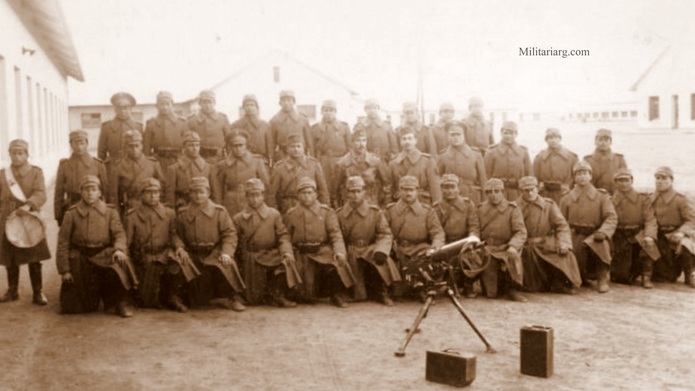
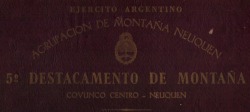
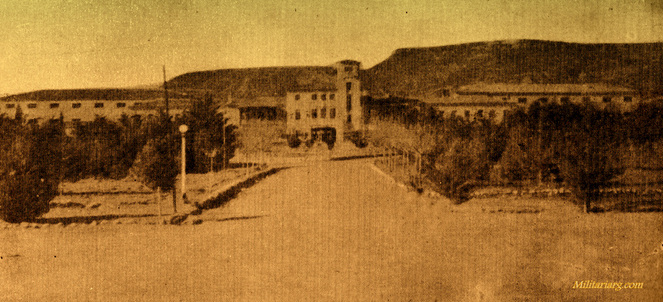
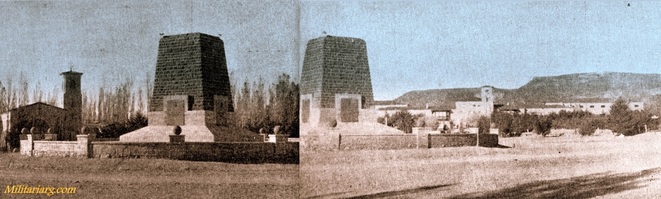
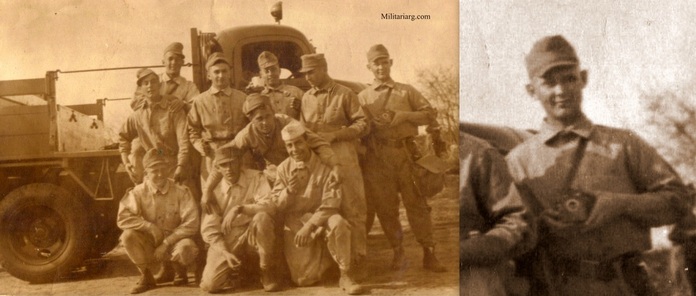
5th Mountain Detachment, (Covunco Centro Neuquen) 1955.
Picture
Picture
Picture
Picture
Picture
Picture
Picture
Picture
Picture
Picture
Picture
Picture
Picture
Picture
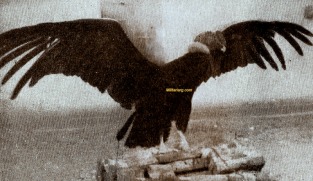
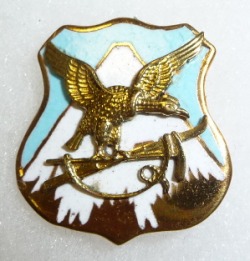
​ For a mountain soldier, the Condor represents the ability to survive and dominate the "Death Zone" where oxygen is thin. It symbolizes the "eyes of the army" looking down from the highest peaks.
Picture
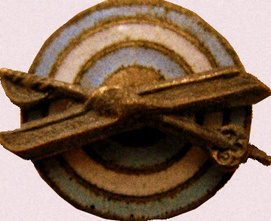
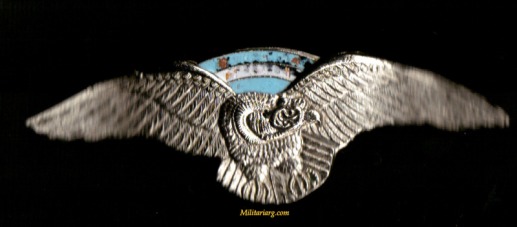
Andean Condor is the definitive symbol for both Argentine and Chilean mountain troops, and its cultural significance in the Andes mirrors exactly what the Eagle represents for the European Alpini and Gebirgsjäger.Just as the Eagle is the master of the Alps, the Condor is the largest flying bird in the world by combined measurement of weight and wingspan, capable of flying at altitudes exceeding 6,500 meters (21,300 feet).
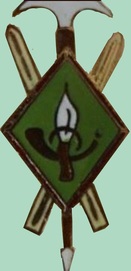
In the Argentine Army, the Condor badge" is the highest distinction awarded to mountain specialists, is the Andean equivalent of an Italian soldier earning his cappello alpino (the feathered hat).

Badges

Picture
Picture
Picture
The official badge for the Argentine Army's elite mountain combatants prominently features a
condor, the iconic bird of the Andes mountains. This insignia is known as the "Cóndor Plateado" (Silver Condor) or simply the Mountain Warfare Qualification Badge.
Picture
Picture
Above: The "Panzer-Style Influence", the standard black leather garment widely associated with the German military and later adopted by the Soviets, was the Lederfeldmantel or Ledermantel (leather greatcoat/trench coat), a private-purchase item for officers and a standard issue for specific personnel. A long, double-breasted black leather coat with a half-belt at the back and large lapel collars. In the mid-20th century, the Argentine Army—heavily influenced by German and European military aesthetics—adopted leather garments for specialized roles, including motorized and mountain troops.


Picture
Picture
Picture
Picture


Picture
Picture

Picture

Mule

Picture
Picture
Mule

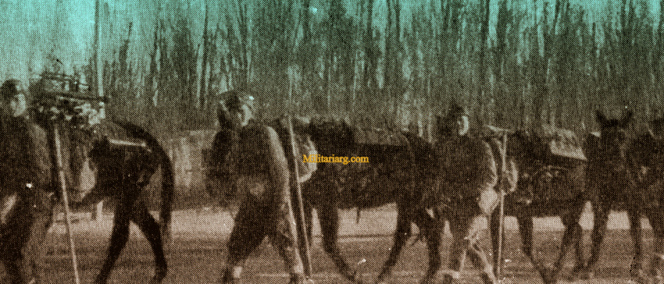
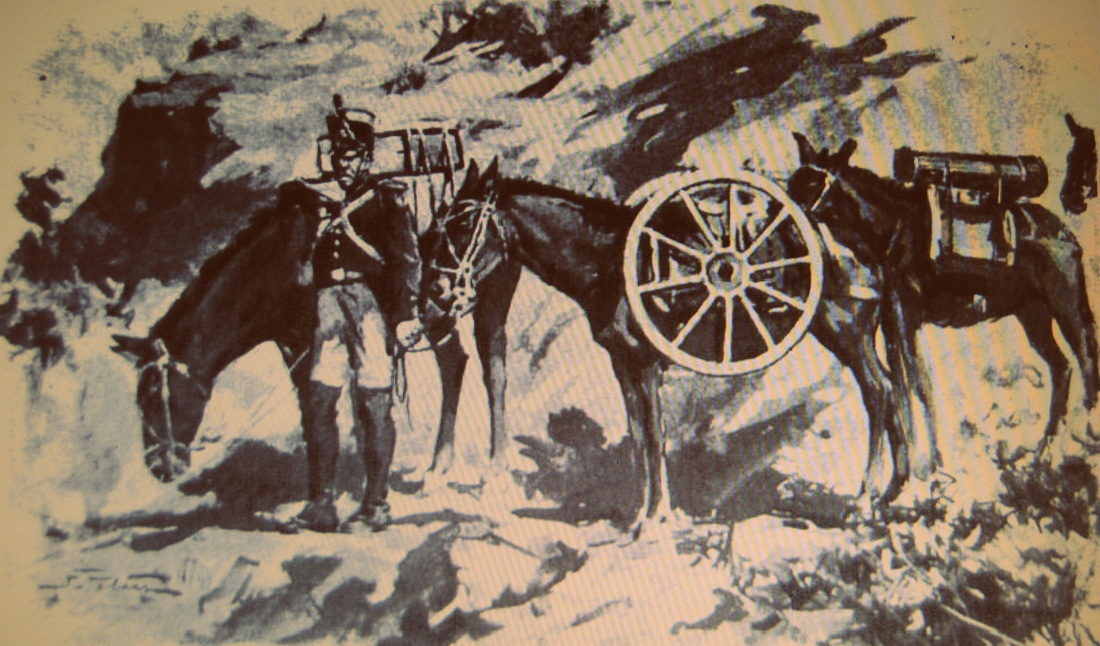
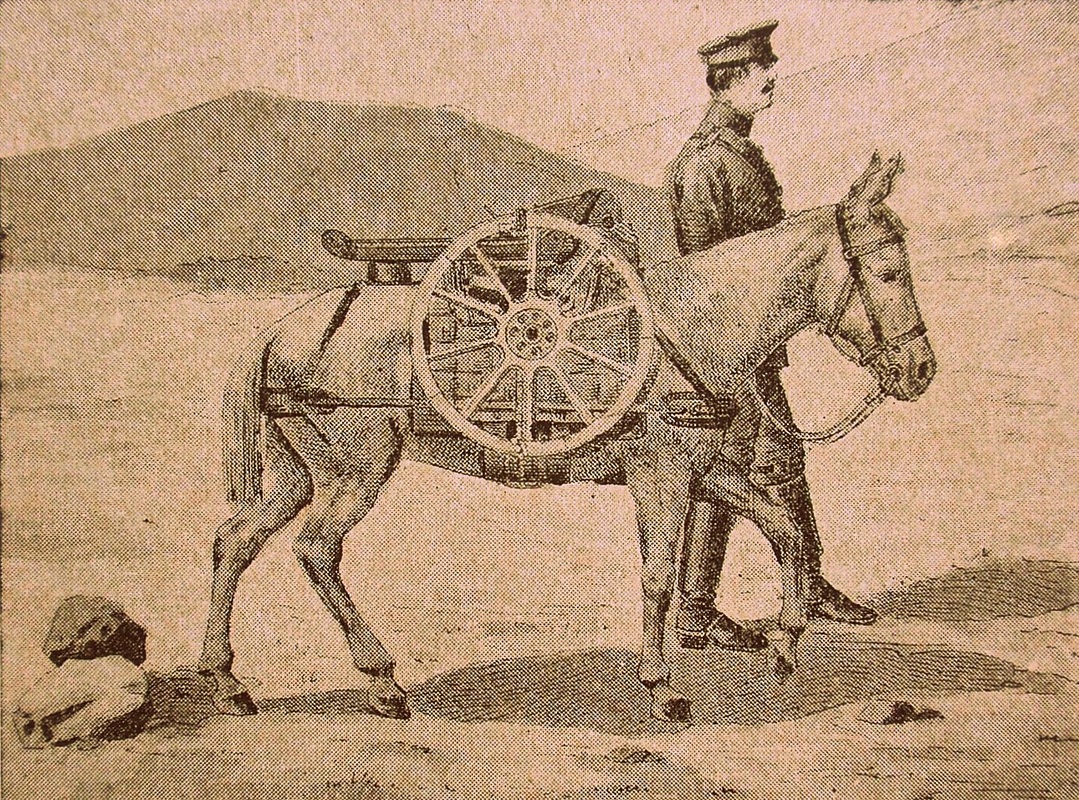
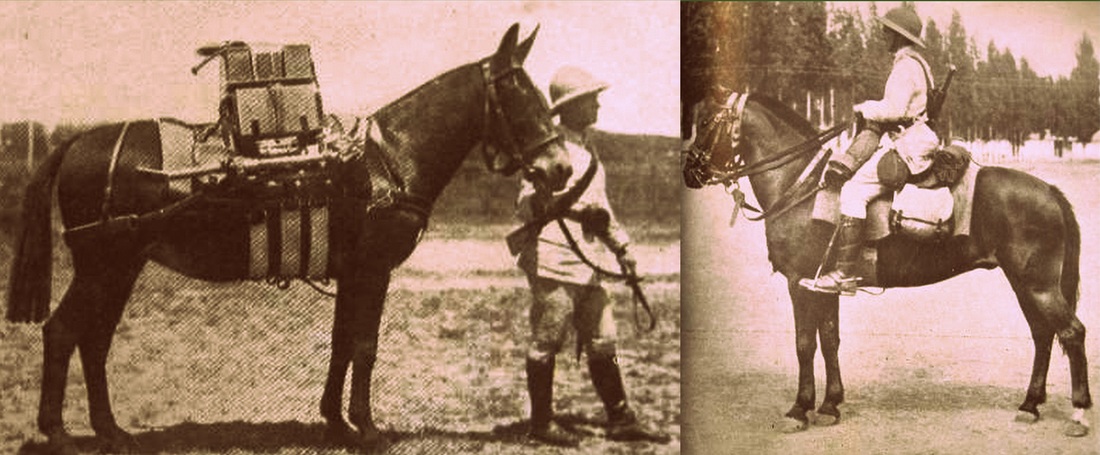
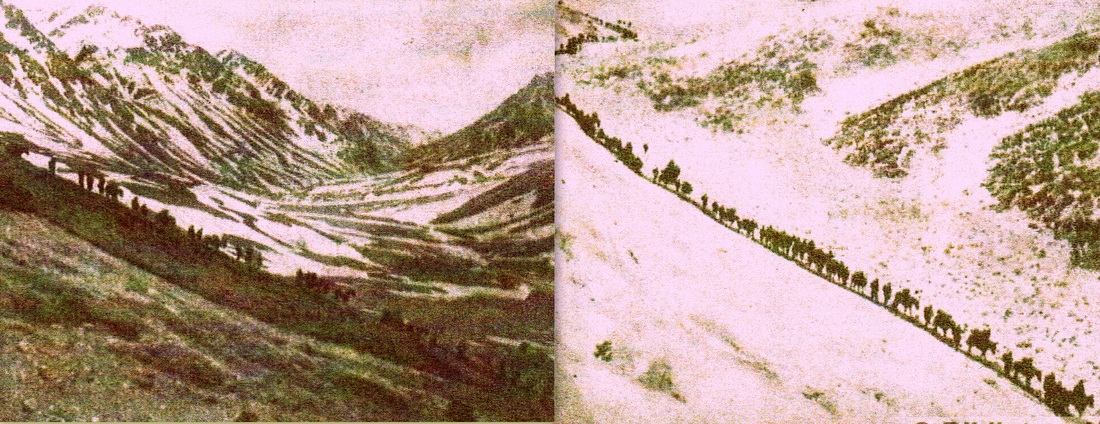
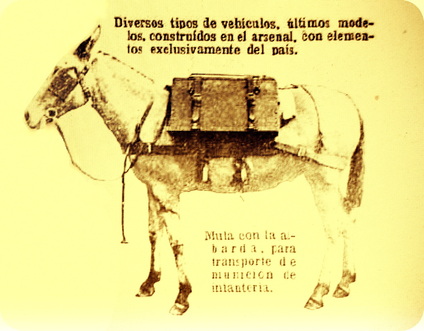
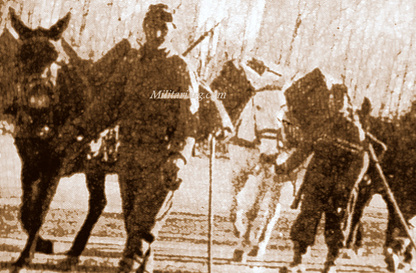
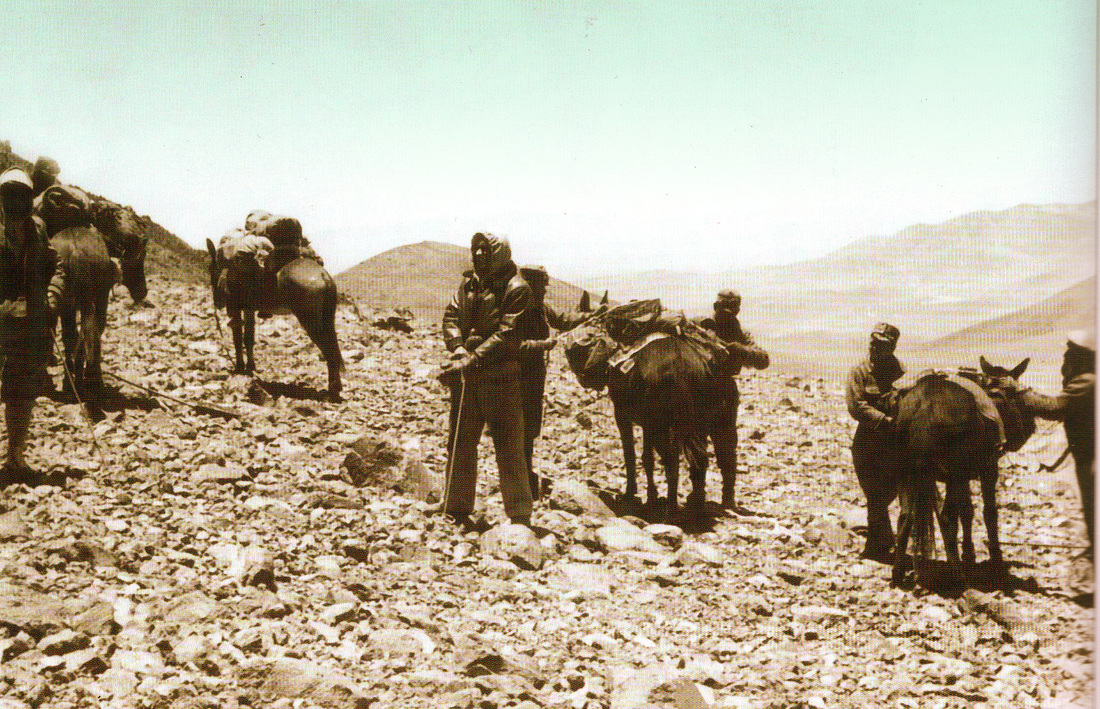
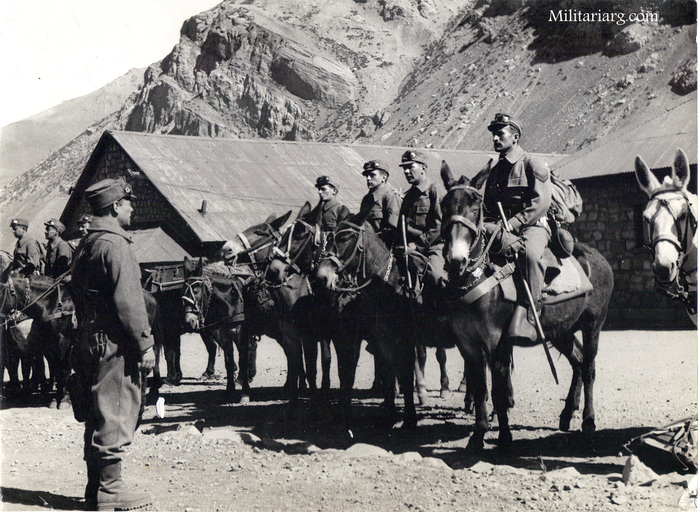
This sterile hybrid obtained by crossing a donkey and a mare combines the advantages of both species. From his mother inherits the size and strength from his father the structure of the legs and adaptability to the most harsh conditions. Combining the efforts of the mule in the fight of the Alpine cliffs and glaciers is a must as the leading role played by this animal on the mountain trails. It 'true that all the armies of Europeans were interested in the beast at least since 1700. Also used for towing, flat pieces of artillery shots in 4 or 8, the mule was, however, its value in the mountains. He could carry a load of 150 kg on narrow paths and steep, taking a step which differed little from that of humans.
Do not forget that the street "mule" was created in 1915 to bring weapons and supplies were in part based on these official instructions, "must have slope varies from 18 to 8%; exceptionally can reach the 30% rule, but not in place. The width varies from 1 to 2 meters, but in some places may also be of 0.80 m ". Amazing animals, the mules, which paths wide enough for just 80 cm! Thanks to them, the climbers wore the tops of their precious mountain howitzers of small to medium size, from 65 to 75 mm. Each piece was dismantled and transported on three or four mules.

http://blog.libero.it/grandeguerra1418/
Picture
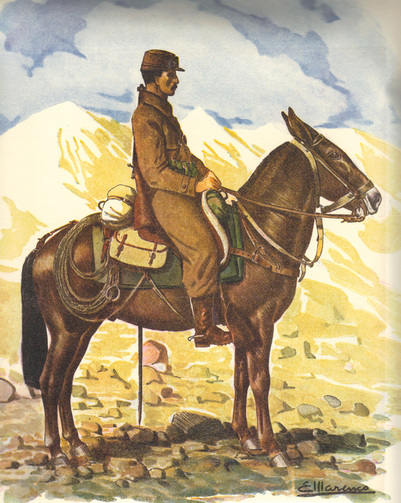
"Baqueano", Regional Mountain Explorer. Painting by Argentine artist Marenco.
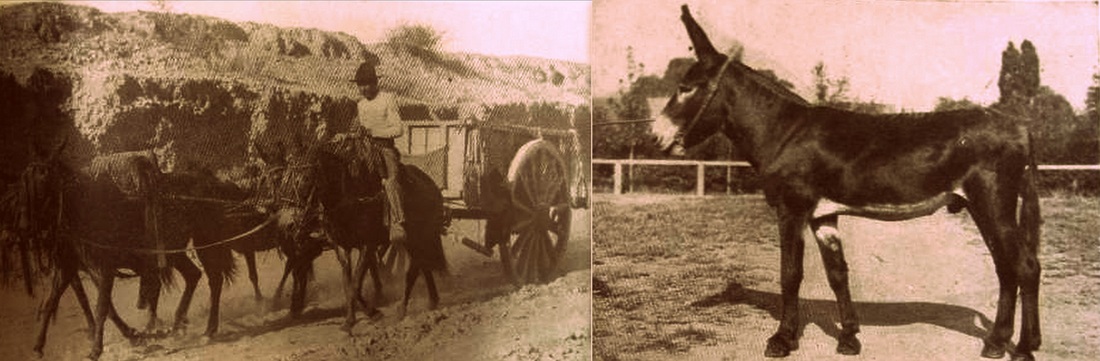
The mule is the undisputed protagonist of Andean military history. From the liberation of the continent in the 1810s to the modern border patrols of 2026, the "mountain engine" has remained a constant while empires and technologies have fallen away.

When José de San Martín organized the Army of the Andes, the mule was the strategic center of his planning.
San Martín gathered over 10,000 mules for the crossing. He understood that horses were too fragile for the narrow, rocky trails of the high passes (Los Patos and Uspallata).
Soldiers often rode mules during the march to preserve the horses for actual combat on the plains of Chile.
The conditions were so brutal that only about 4,000 mules survived the crossing. They carried everything: disassembled cannons, barrels of water, and the "charqui" (dried meat) that fed the troops.

The Professionalization (1930s–1940s)
During the era of Farrell and Perón, the use of the mule was scientific and systematic, influenced by the Italian Alpini tradition.

Influenced by European designs, the Argentine Army adopted sophisticated pack saddles (albardas) that allowed the M28 (Colt 1917) HMG and the Skoda 75/13 to be balanced across the animal’s spine.

The "Baqueano": The military formalized the role of the baqueano—the mountain guide who understood the psychology of the mule, ensuring the animal wouldn't "freeze" or panic during high-altitude storms.
Picture

Picture
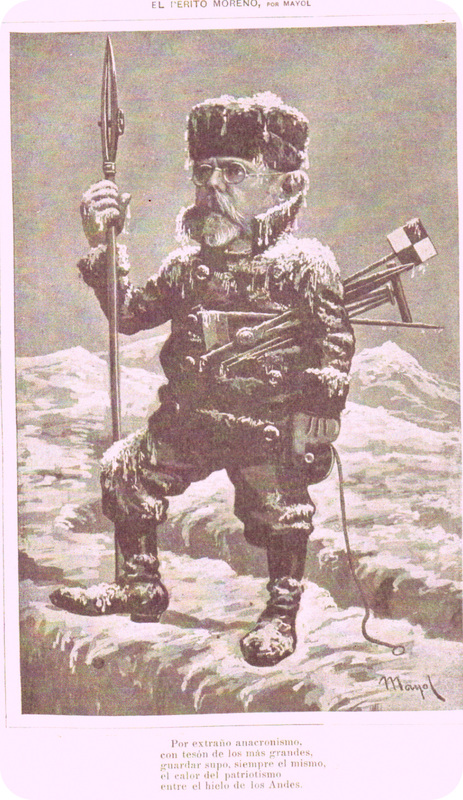
Caras y Caretas 1898.

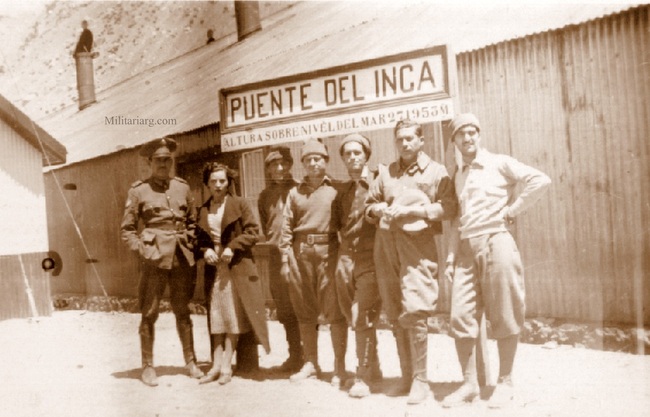
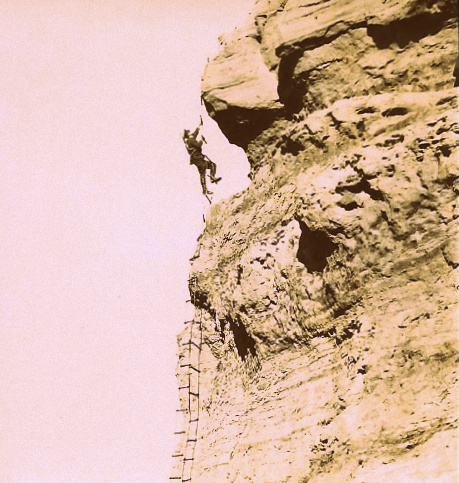
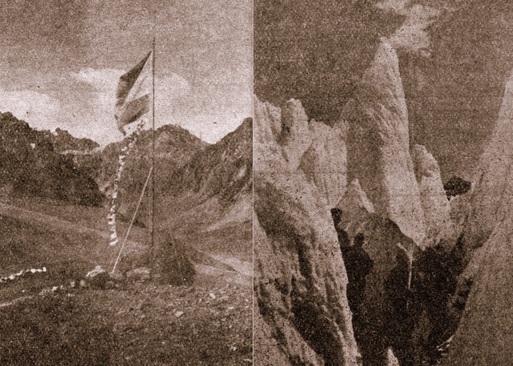
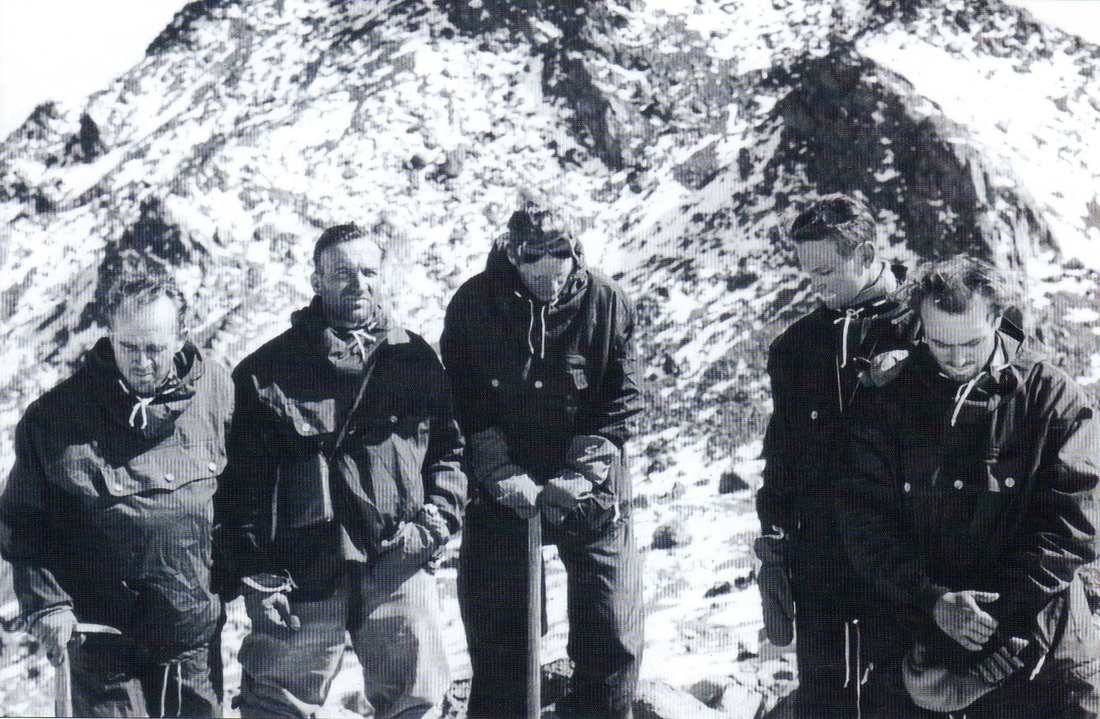
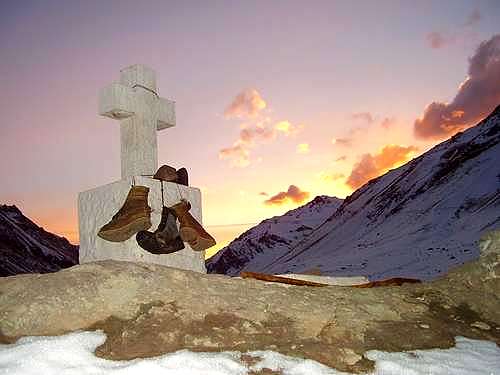
 We will be making reference to some Argentine, British, Swiss, French and German expeditions (among other countries) to the peaks of the Andes.  Many ended in human losses whose remains were laid to rest in the andean cementary Paso del Inca.
Picture

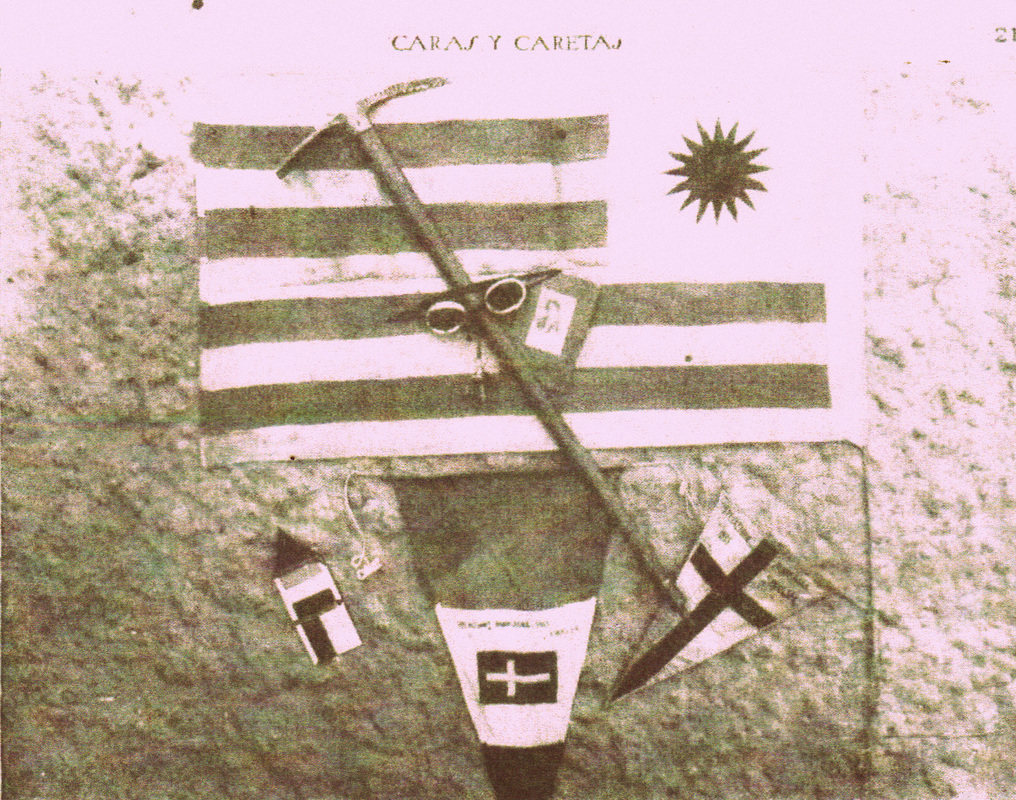
1936. Hans Georg Link Expedition.

Picture
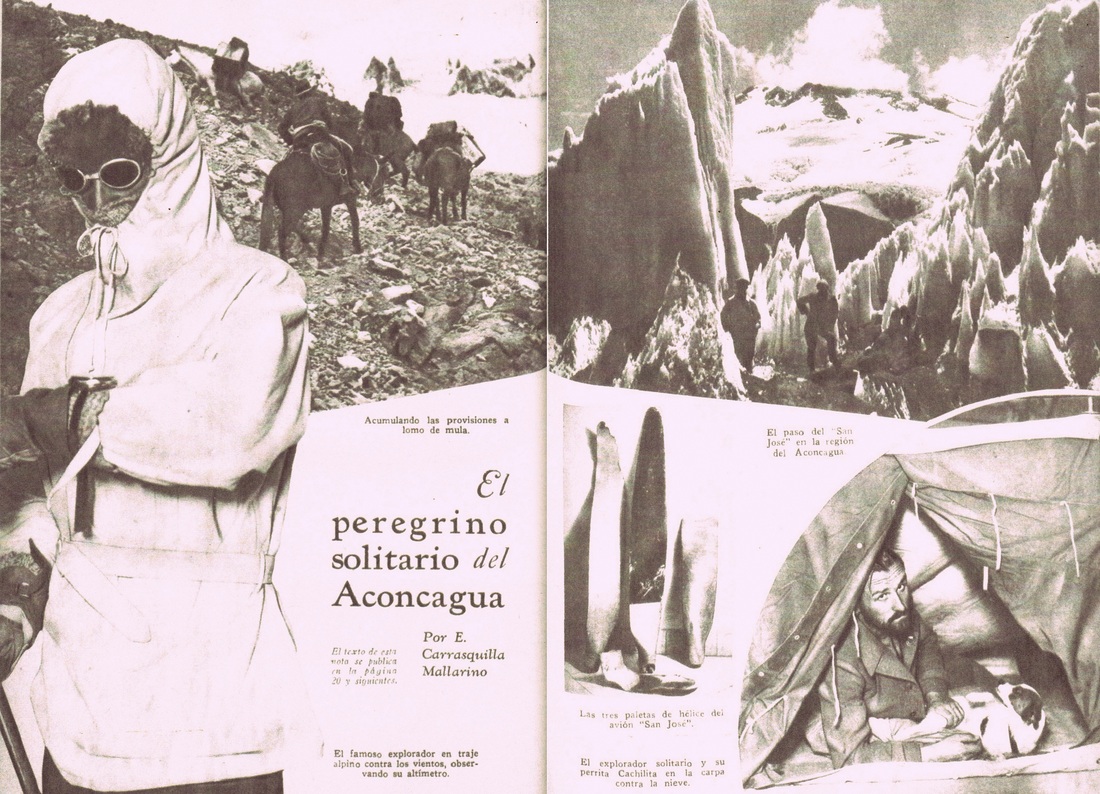
Caras y Caretas 1936.

In 1936, Hans Georg Link (often known as Juan Jorge Link in Argentina) led a historic expedition to Mount Aconcagua (6,961m) that established him as a legendary figure in Andean mountaineering. 

The 1936 "Cóndor de los Andes" Ascent. Link is widely celebrated for achieving the first solo ascent of Aconcagua in 1936. This feat, completed during the southern summer, earned him the nickname "Cóndor de los Andes".

Discovery of the Stepanek Mummy: During his descent from the summit in 1936, Link rediscovered the mummified body of Juan Stepanek, an Austrian climber who had died on the mountain in 1926. Link famously described seeing the figure seated in the snow by moonlight, initially doubting his own sanity due to extreme exhaustion before touching the "marble-hard" frozen corpse.

​Between 1936 and 1944, Link summited Aconcagua a total of five times. He was married to Adrienne Bance, a French mountaineer who in March 1940 became the first woman to reach the summit of Aconcagua.
The couple's involvement with the mountain ended in disaster. Both Hans Georg Link and Adrienne Bance perished on Aconcagua during their final expedition on February 17, 1944.

The 1938 expedition was the second of five successful ascents made by Hans Georg Link (Juan Jorge Link) on Mount Aconcagua.

Picture
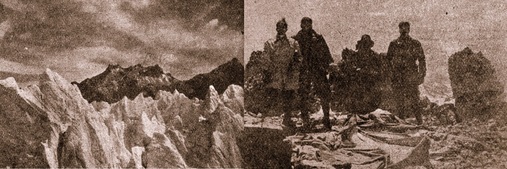
Plaza de las Mulas 4.235 mts. Right: Glaciales del Sud. 5000 mts.
Picture
Cerro Catedral (Aconcagua). 5.800 mts. Right 6.150 mts. Photos: Argentine NCO Magazine "revista del suboficial"

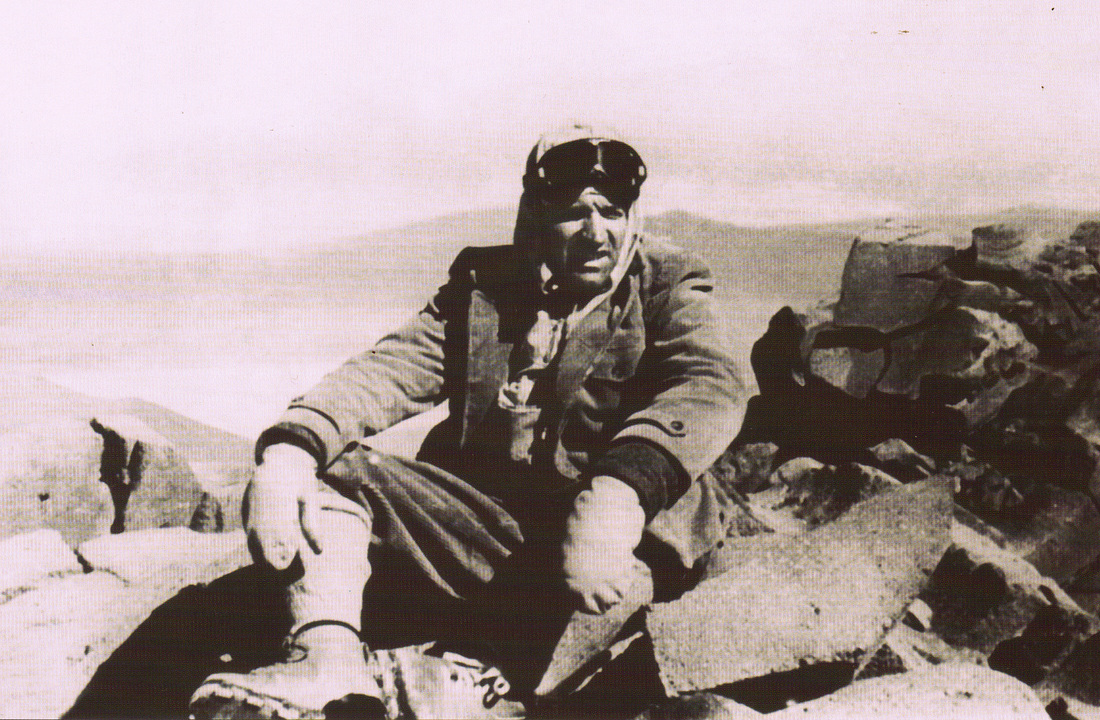
Hans - Urich Rudel Expedition:
Picture

Hans-Ulrich Rudel, the most decorated German pilot of WWII, led a second life as an elite mountaineer in the Andes after fleeing to Argentina in 1948. Despite having a prosthetic leg, he undertook several high-altitude expeditions that left a lasting mark on Andean history.
 
The Llullaillaco Expedition (1953)
His most famous expedition was the ascent of Volcán Llullaillaco (6,739m) in Salta, Argentina. 

In 1953, Rudel reached the summit and was the first modern person to document the presence of Inca ruins and a sanctuary at the peak. This discovery eventually led decades later to the finding of the "Children of Llullaillaco," the best-preserved Inca mummies in the world.
Picture
Because of his familiarity with the mountain and his connections to the Argentine Air Force, Rudel was occasionally consulted or involved in high-altitude rescue operations for stranded climbers. Rudel’s mountaineering was often supported by his close relationship with Juan Domingo Perón. 

Scientific Support
​

Some of his expeditions were framed as "scientific explorations" supported by the Argentine government.
He shared technical mountain survival knowledge with Argentine mountain troops, who were already heavily influenced by the Alpini traditions Perón had studied in Italy.
Picture
The Ice Axe Mystery: Rudel reportedly left a silver-plated ice axe at the summit as a commemorative offering, which became a piece of Andean mountaineering legend. 

Rudel was also a frequent climber of Mount Aconcagua (6,961m), the highest peak in the Western Hemisphere. 

Record with Prosthesis
He famously climbed the mountain several times with his artificial leg, demonstrating extreme physical endurance that surprised the local climbing community
After the war finished, Rudel started an unparalleled sporting career. Despite his leg prosthesis in 1953 he made his first ascent of 6920 meters high to the volcano llullay-Yacu.  He leads a second ascent in December 1953.  In February 1954, he takes his third climb.

Source: Stuka-As Hans Urich Rudel by Dieter Vollmer.

Picture
Picture

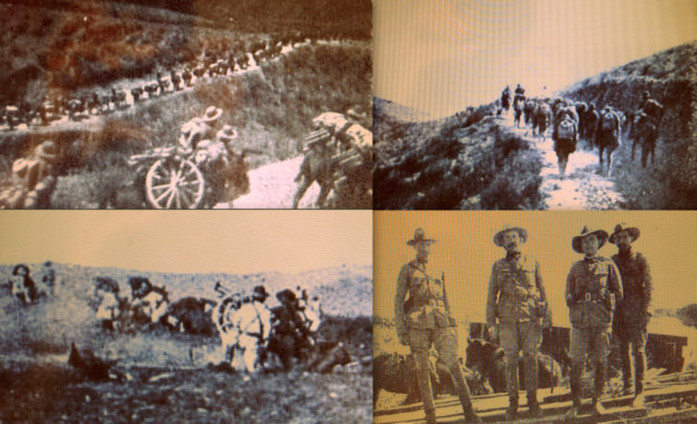
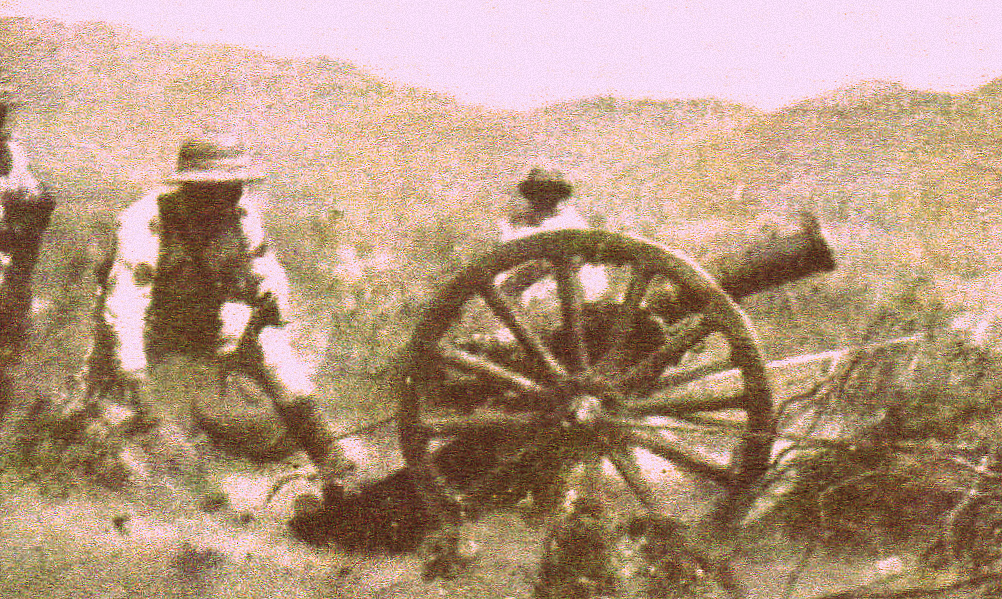
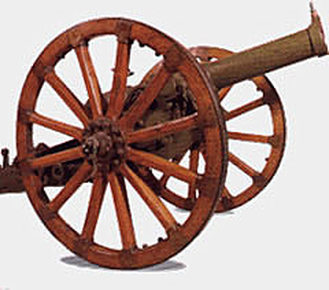
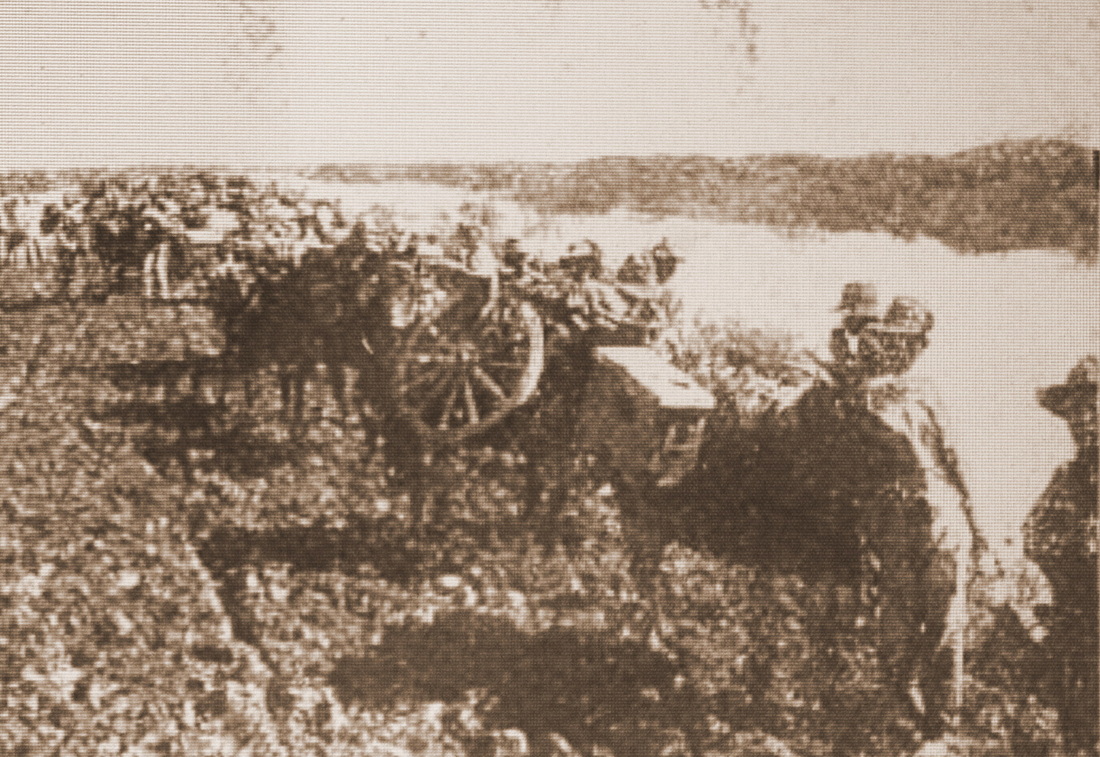
Argentine Mountain Artillery. Link:

Picture
Powered by Create your own unique website with customizable templates.