Militariarg.com
  • Home
  • Army
  • Aviation
  • Navy
  • Uniforms and Badges
  • Arms and Weapons
  • Equipment
  • Vehicles
  • Operational and Organizational Structure, Security Forces, Transportation, Books, Models and More.
  • Argentine Confederation Era. 1829 - 1852.
  • From 1852 to 1910 (French fashion)
  • Bunker 1982: South Atlantic War Militaria
  • International Militaria
  • Argentina WWII Era (Neutral) Reenactment Impression
  • Links ~ Enlaces
Picture
Picture
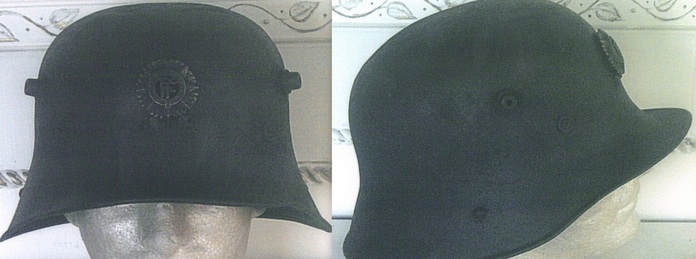
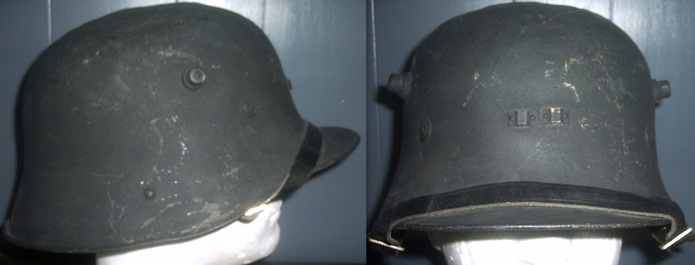
Irish Helmet M 1927 Vickers.
The Irish M1927 Vickers helmet was an Irish Army combat helmet based on the German M1916 design, used from 1927 to 1939, and it is a scarce and sought-after collector's item today.

​Thee choice of the German Stahlhelm shape was heavily motivated by the Irish Free State's desire to forge a distinct national identity and move away from British military influence. The newly formed Irish Army wanted a uniform that looked fundamentally different from the British "Tommies" they had just fought during the War of Independence
Choosing the German design was a symbolic "middle finger" to the British. It ensured that Irish soldiers would not be mistaken for British troops, particularly along the border with Northern Ireland.
Military experts at the time generally considered the German M16 to be a superior combat design compared to the British "soup bowl" Brodie. It offered much better protection for the sides and back of the head. The diseign was good. the problem was the low-quality from Vickers Ltd.

Unique features included two small riveted loops on the front to hold an officer's pattern badge (featuring the "FF" for Fianna Fáil and "Óglaigh na h-Éireann" inscriptions), and each helmet was individually serial numbered with a stamp on the rear visor.The helmet was in service with the Irish Army from 1927 to 1939. It was replaced by the British Mark II helmet in 1940, partly due to the M1927's "German style" making it a target for anti-Irish British propaganda.

Many were painted white and reissued to Civil Defence units during World War II and the potwar too. A significant number of the original 10,021 produced were destroyed in the 1970s, making complete, original examples quite rare today. 
Most surviving examples were painted white for Civil Defence use, so finding one in its original green paint is very rare. Condition varies, with many showing signs of wear or damage due to the mild steel used. 

M27s were generally made in two shell sizes: large and small, indicated by a "+" or "-" stamp on the rear visor. The leather liners, made by T. Smith & Sons, were marked with an "S" for small or "L" for large (some sources also mention an "M" for medium, but S and L are most commonly cited). 
​Helmets in size medium (M) are noted as a size option in some collector resources.


Picture
The shell was made by the British firm Vickers Ltd (stamped "V. Ltd") while the liner and chinstrap were produced by T. Smith & Sons of Dublin. It was a copy of the German Model 1916 helmet, a decision made after the Irish military was unable to procure actual German surplus due to post-WWI treaty restrictions.

Vickers used low-quality steel that offered little ballistic protection, and surviving examples often show dents. 
While many military historians and collectors consider the Portuguese M1916 to be the worst mass-produced steel helmet of the modern era, the Irish M1927 Vickers is frequently cited as a close second due to its significant structural and ballistic failures. The Portuguese M1916 (and the subsequent M1917) shared several historical and technical parallels with the Irish Vickers helmet.

The low quality of the Irish M1927 Vickers helmet was primarily due to inadequate manufacturing techniques and the use of inferior materials, which it shared in common with several other "German-style" copies of the era, including the Portuguese M1916. The Vickers-produced helmets were notorious for being fragile and offering minimal ballistic protection compared to the original German M16. Unlike the original German manufacturing process, which used 12 meticulous steps to stamp the steel into shape (ensuring uniform thickness), Vickers used a single-step stamping process. This stretched the metal too thin at the crown, leading to structural fatigue and cracking.
Vickers used a lower grade of mild steel (low-manganese) rather than the high-quality nickel-manganese steel used by the Germans. This made the helmets soft enough to dent easily under minor stress.

The newly formed Irish Free State had limited funds and chose a cheaper production bid from Vickers over higher-quality alternatives. 

Ireland's involvement in World War I, World War II, the Cold War, and its relationship with NATO is defined by a consistent, long-standing policy of military neutrality that evolved with its path to independence.

World War I (1914-1918)

Ireland was a belligerent in World War I because the entire island was still part of the United Kingdom of Great Britain and Ireland. 

Participation: Over 200,000 Irishmen from all political backgrounds served in British forces, with many fighting in specific "Irish" divisions such as the 16th (Irish) Division and the 36th (Ulster) Division. 

Impact: The war effort was initially supported by major political parties, but the 1916 Easter Rising and the subsequent British response fractured this consensus among nationalists, driving support toward full independence. 

World War II (1939-1945)

By the outbreak of World War II, Ireland had achieved effective independence and its government, led by Taoiseach Éamon de Valera, declared a policy of military neutrality, a period known domestically as "The Emergency". 

Official Stance: Ireland remained formally neutral to assert its sovereignty and avoid a return to internal conflict.

Covert Aid: In practice, its neutrality often favored the Allies. The Irish military shared intelligence with the British, allowed Allied aircraft to use the "Donegal Corridor" for anti-submarine patrols, and released downed Allied airmen while interning Axis personnel.

Volunteers: An estimated 70,000 Irish citizens volunteered to serve in the British forces during the war. 

Cold War and NATO

Ireland maintained its policy of neutrality throughout the Cold War and is not a member of NATO.

NATO Refusal: When NATO was formed in 1949, Ireland was invited to join but refused. The primary obstacle was the Partition of Ireland; the Irish government made it a condition of membership that the UK end its sovereignty over Northern Ireland, a condition the UK did not accept.

Alignment with the West: Though not aligned militarily, Ireland was politically and economically aligned with Western Europe, joining the European Communities (EC) in 1973.

UN Peacekeeping: Irish neutrality became defined in part by an active foreign policy of participating in UN peacekeeping missions worldwide, which continues to this day. 

Ireland remains a non-aligned country and is one of four EU members that are not full NATO members (along with Austria, Cyprus, and Malta). It does, however, have a formal relationship with the alliance through the Partnership for Peace (PfP) program, which it joined in 1999 to cooperate on peacekeeping and crisis management.

During World War II (known as "The Emergency" in Ireland), the Irish Army was mobilized for national defense but was largely equipped with a mixture of World War I vintage and interwar period British-designed weapons, often supplemented by domestically produced or acquired vehicles. 

Weapons

Rifles: The standard issue rifle was the Short Magazine Lee–Enfield No. 1 MkIII (.303 British). The Local Defence Force (LDF) also used the U.S. M1917 Enfield and Springfield M1903 rifles.
    
Sidearms: The standard issue was the Webley Mk IV revolver, although some Enfield No. 2 revolvers and a small number of Mauser C96 pistols were also in service.
    

Machine Guns: 

Light: The Bren gun was widely used.
        
Medium/Heavy: The Vickers machine gun and the Lewis gun were the primary medium and heavy machine guns.
    
Submachine Guns: Small quantities of M1921 Thompson and Bergmann MP-18 submachine guns, leftover from the Irish War of Independence and Civil War, were in army stockpiles and issued.

Anti-Tank Weapons: Anti-tank capabilities were limited. The main anti-tank weapons were the Boys anti-tank rifle and a small number of QF 2-pounder anti-tank guns. The Irish also produced their own anti-tank mines, including the "De Valera" mine. 

Vehicles and Tanks

The Irish Army had a small armored corps that was largely equipped with armored cars, as it only had a few actual tanks. 

Tanks: The army possessed only two operational light tanks: the Landsverk L-60 (a modern Swedish design) and one older Vickers Mk. D medium tank.
    
Armoured Cars: The bulk of the armored vehicles were armoured cars, many of them produced in Ireland using commercial chassis.

British-made Rolls-Royce and Landsverk L180 armored cars were in service.
Domestically produced vehicles included various models like the Ford Mk IV, Mk V, Mk VI, and Dodge Mk VII and Mk VIII.

Other Vehicles: The army used Universal Carriers (often called Bren Carriers), Morris Commercial trucks (including the C8 FAT artillery tractor), Leyland trucks, and BSA motorcycles for transport and logistics. 

Artillery

The Artillery Corps primarily used British WWI-era field guns, many of which were modernized with pneumatic tires for towing. 

Field Artillery: Main guns included the QF 18-pounder gun and the QF 4.5-inch howitzer. A small number of BL 60-pounder guns were also available.

Anti-Aircraft Guns: Ireland acquired some effective Bofors 40 mm anti-aircraft guns, as well as QF 3-inch and 3.7-inch AA guns.

Coastal Defence: Fixed coastal defense armaments included large BL 9.2-inch and 6-inch guns.  
Powered by Create your own unique website with customizable templates.