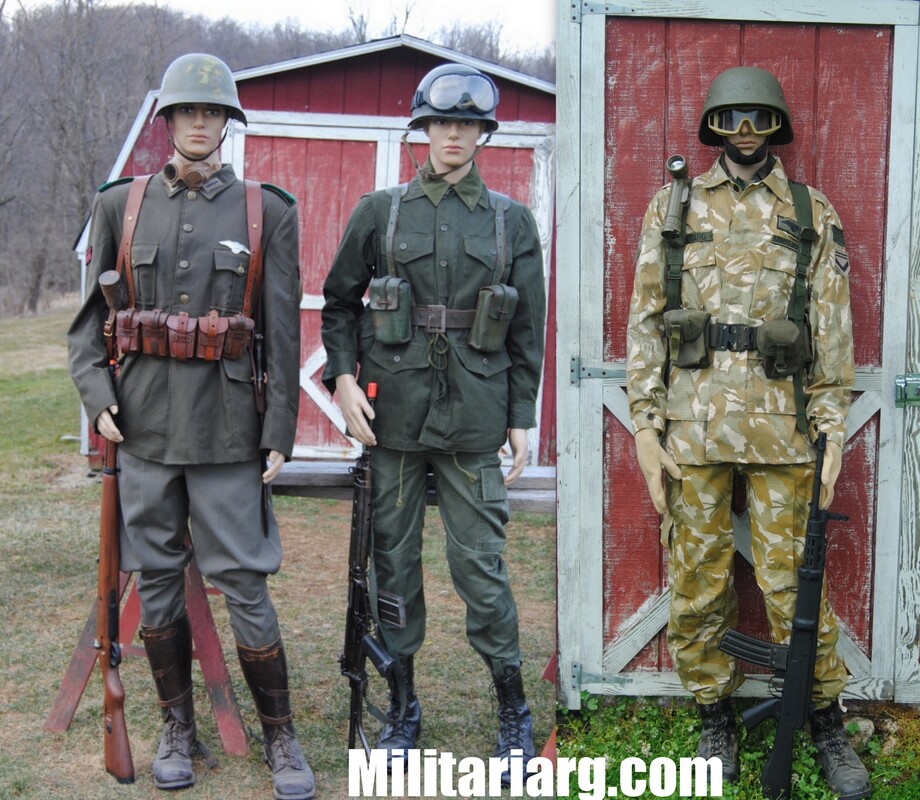
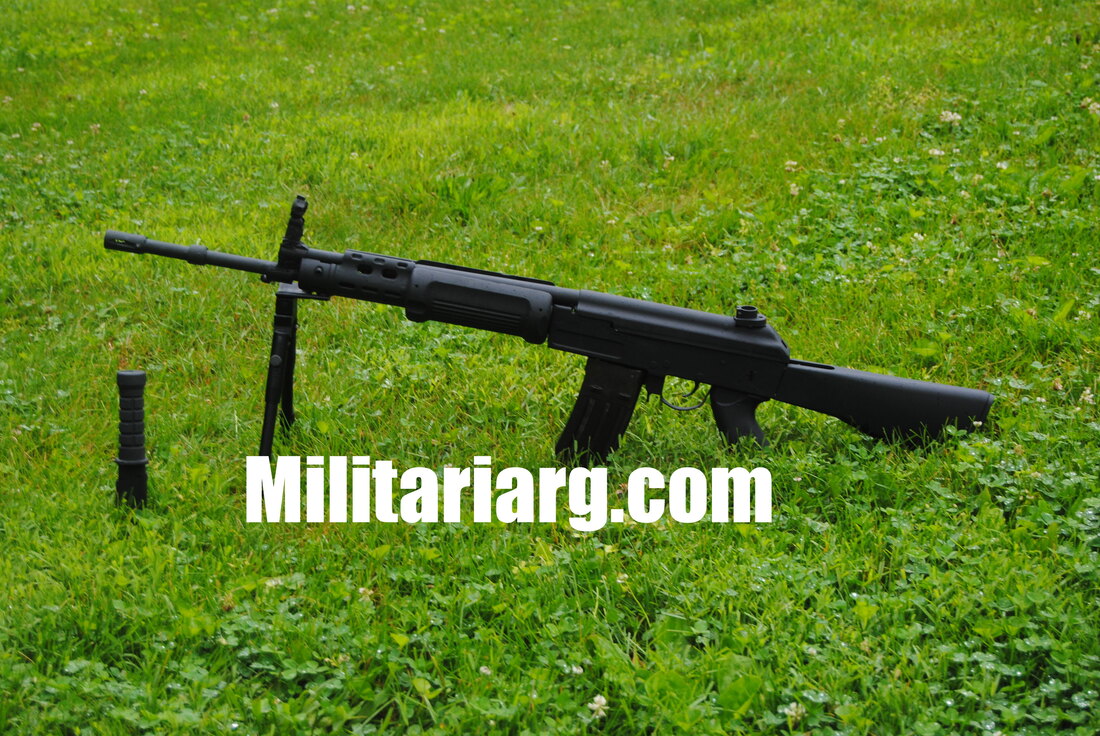
Replica of an automatic rifle in resin, inspired in the FARA 83.
The FARA 83 (Fusil Automático República Argentina 83, or "Argentine Republic Automatic Rifle") was an indigenously designed and developed 5.56x45mm NATO assault rifle for the Argentine Army in the 1980s.
The FARA 83 project was started in the early 1980s, driven by the desire to replace the aging FN FAL with a modern, domestically produced 5.56mm weapon, a need highlighted by the 1982 Falklands War.
Production began in 1984, but was severely limited due to the country's economic crises in the late 1980s.
Cancellation: Under President Carlos Menem's administration, a number of military projects were cancelled due to insufficient funds, including the FARA 83. Production halted in 1990.
Only around 1,200 units were completed. For the most part, the Argentine Armed Forces are still equipped with the older FN FAL rifle, while the small number of FARA 83s produced serve as secondary or specialized weapons.
Production began in 1984, but was severely limited due to the country's economic crises in the late 1980s.
Cancellation: Under President Carlos Menem's administration, a number of military projects were cancelled due to insufficient funds, including the FARA 83. Production halted in 1990.
Only around 1,200 units were completed. For the most part, the Argentine Armed Forces are still equipped with the older FN FAL rifle, while the small number of FARA 83s produced serve as secondary or specialized weapons.
Caliber: 5.56x45mm NATO.
Action: Gas-operated reloading system with a two-lug rotating bolt.
Design Influences: The rifle's design drew inspiration from several established systems, primarily the Israeli IMI Galil and the Italian Beretta AR70, while incorporating local engineering.
Features: It included tritium sights for low-light aiming, a folding tubular stock (based on the Para-FAL), and a trigger group enabling semi-automatic and fully automatic fire.
Feed System: It used proprietary 30-round steel magazines (visually similar to early Beretta AR70 magazines), though plans existed to switch to STANAG-compatible magazines for large-scale production.
Manufacturer: Produced by the state-owned Fábrica Militar de Armas Portátiles "Domingo Matheu" (FMAP-DM).
Action: Gas-operated reloading system with a two-lug rotating bolt.
Design Influences: The rifle's design drew inspiration from several established systems, primarily the Israeli IMI Galil and the Italian Beretta AR70, while incorporating local engineering.
Features: It included tritium sights for low-light aiming, a folding tubular stock (based on the Para-FAL), and a trigger group enabling semi-automatic and fully automatic fire.
Feed System: It used proprietary 30-round steel magazines (visually similar to early Beretta AR70 magazines), though plans existed to switch to STANAG-compatible magazines for large-scale production.
Manufacturer: Produced by the state-owned Fábrica Militar de Armas Portátiles "Domingo Matheu" (FMAP-DM).
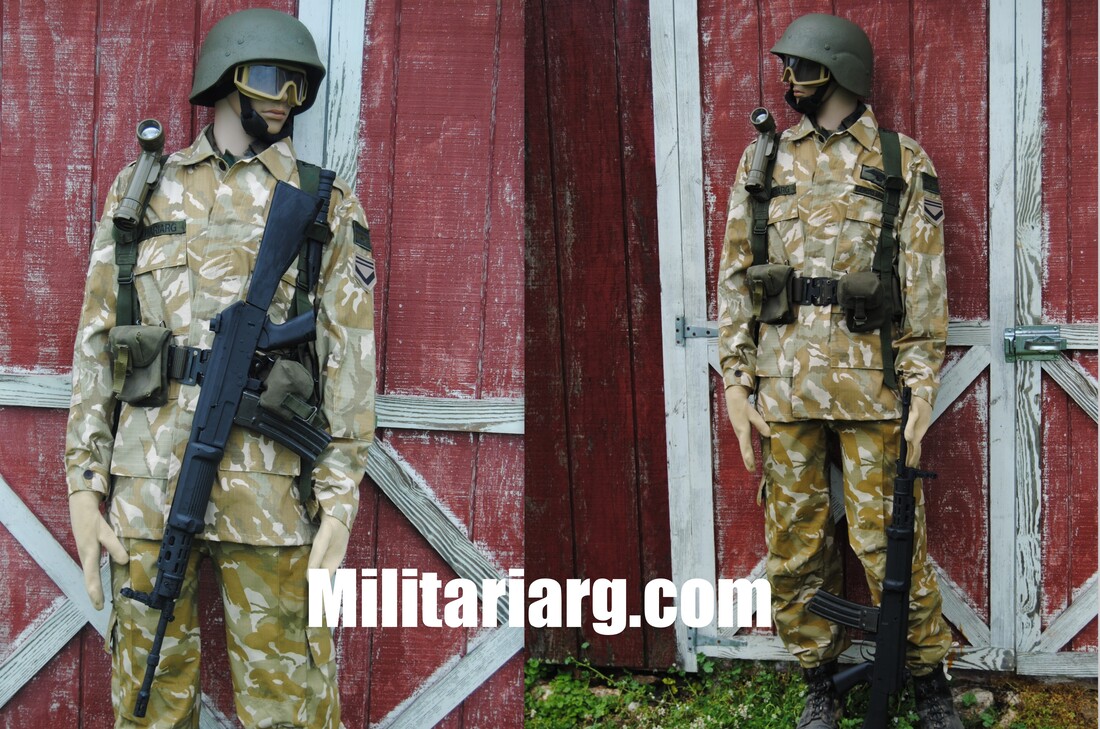
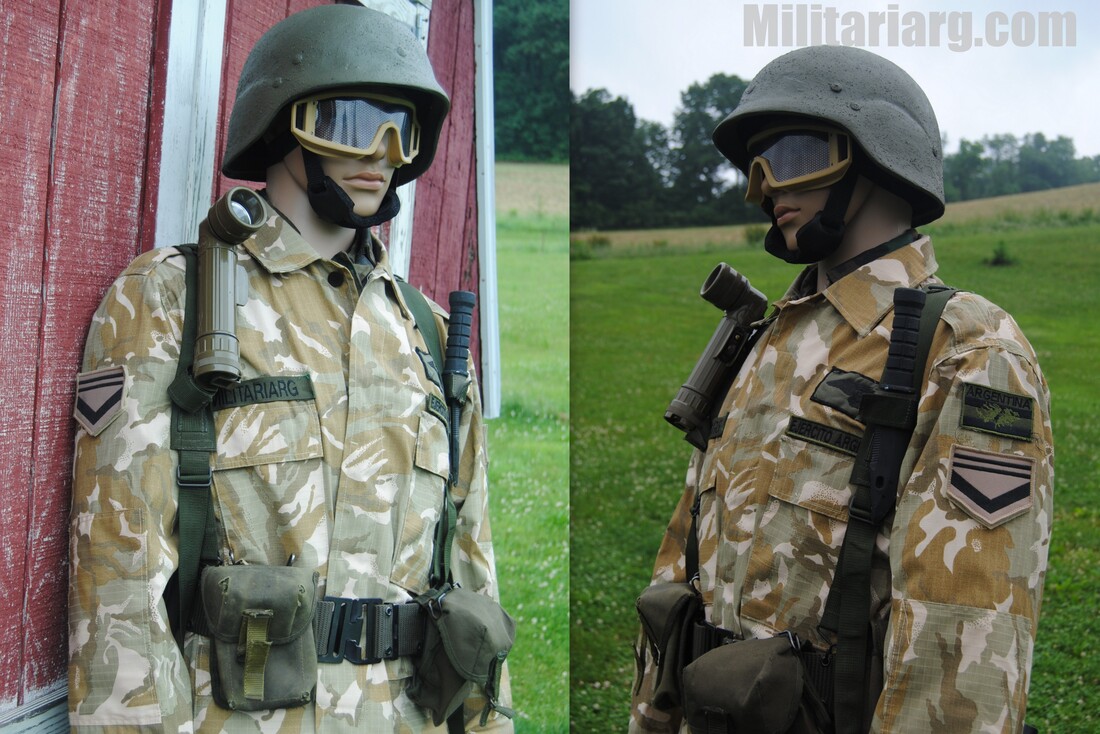
Tempex webbing and Patagonian Pattern Camo. The helmet is a replica inspired by the Post-Falklands War Cabal II prototype.
In the post South Atlantic War period, Argentina developed developed the British DPM camouflage, which became known as the "Selva pattern". Also an specific camouflage pattern for use in the arid and mountainous southern regions of the country, known as the Camuflaje Patagónico (Patagonian Camouflage) or sometimes the "Pampa" pattern. The Patagonian camouflage pattern is an arid/desert variation of the British Disruptive Pattern Material (DPM) design.
Cabal II Prototype
In the South Atlantic War (Malvinas/Falklands), the British paratroopers used a lightweight helmet prototype made of some hard plastic material. On the Argentine side, US M1-type steel helmets were used. However, a British veteran brought back from the islands as a trophy a very rare plastic-type helmet in the shape of the M1. These helmets were probably of South Korean origin (like the ones used by Iraq and others TWC) and were imported by an Argentine company that supplied them to the Army for testing. It is likely that this test helmet was the "Cabal I. " It is worth mentioning that since the '70s, other Argentine companies have been developing M1 (Type liners) lightweight helmets, but without ballistic properties. This US M1 shape export model South Korean helmet was made of ballistic nylon material,
In the 1990s, a local company, in partnership with the government, developed a local version of the PASGT helmet in order to replace the US M1, which, in the eyes of progressive left-wing governments, symbolized interventionism and coups during the Cold War. This new model was called the M6 (Cabal II), whose similarity to the helmets used in the Gulf War did not sit well with the government officials in charge of defense, since, according to them, the design had an " imperialist " shape. Paradoxically, these same governments began to import from the United States batches of helmets used in the Gulf War (that is, the " imperialists ") with their ballistic capabilities already expired by time.
By the 2000s, despite the drastic reduction in the number of soldiers due to the abolition of conscription, the number of Kevlar helmets did not reach the number necessary to equip what was left of the army. The situation became dramatic when the old M1 steel helmet was still in service. Here, the political officials in charge of defense began to look for helmets from anywhere, including the British MK.6 models (probably imported from some Commonwealth country if it were not from the United Kingdom itself), for the military to have in parades and events.
In the South Atlantic War (Malvinas/Falklands), the British paratroopers used a lightweight helmet prototype made of some hard plastic material. On the Argentine side, US M1-type steel helmets were used. However, a British veteran brought back from the islands as a trophy a very rare plastic-type helmet in the shape of the M1. These helmets were probably of South Korean origin (like the ones used by Iraq and others TWC) and were imported by an Argentine company that supplied them to the Army for testing. It is likely that this test helmet was the "Cabal I. " It is worth mentioning that since the '70s, other Argentine companies have been developing M1 (Type liners) lightweight helmets, but without ballistic properties. This US M1 shape export model South Korean helmet was made of ballistic nylon material,
In the 1990s, a local company, in partnership with the government, developed a local version of the PASGT helmet in order to replace the US M1, which, in the eyes of progressive left-wing governments, symbolized interventionism and coups during the Cold War. This new model was called the M6 (Cabal II), whose similarity to the helmets used in the Gulf War did not sit well with the government officials in charge of defense, since, according to them, the design had an " imperialist " shape. Paradoxically, these same governments began to import from the United States batches of helmets used in the Gulf War (that is, the " imperialists ") with their ballistic capabilities already expired by time.
By the 2000s, despite the drastic reduction in the number of soldiers due to the abolition of conscription, the number of Kevlar helmets did not reach the number necessary to equip what was left of the army. The situation became dramatic when the old M1 steel helmet was still in service. Here, the political officials in charge of defense began to look for helmets from anywhere, including the British MK.6 models (probably imported from some Commonwealth country if it were not from the United Kingdom itself), for the military to have in parades and events.