The Dutch Armed Forces have seen a significant transition from a neutral, conscripted army with a colonial empire to a modern, professional force fully integrated into the NATO alliance.
World War I (1914–1918)
The Netherlands maintained a policy of strict armed neutrality during World War I. The Dutch military was fully mobilized and stationed at the borders to ensure national sovereignty was respected by all warring parties. The primary role of the armed forces during this time was deterrence, border patrol, and the internment of foreign soldiers and refugees.
World War II (1939–1945).
Despite the official policy of neutrality, Germany invaded the Netherlands in May 1940.
The Invasion: The Dutch military was quickly overrun in just five days, largely due to being outmatched in equipment and tactics and the devastating bombing of Rotterdam.
Government-in-Exile & Resistance:
Queen Wilhelmina and the government went into exile in London. Elements of the Royal Netherlands Navy and the Princess Irene Brigade continued to fight alongside the Allies. Back in the occupied Netherlands and the Dutch East Indies, substantial resistance movements gathered intelligence and conducted sabotage operations.
Colonial Conflicts
After World War II, the Dutch armed forces were heavily engaged in conflicts to maintain their colonial empire as decolonization movements spread.
World War I (1914–1918)
The Netherlands maintained a policy of strict armed neutrality during World War I. The Dutch military was fully mobilized and stationed at the borders to ensure national sovereignty was respected by all warring parties. The primary role of the armed forces during this time was deterrence, border patrol, and the internment of foreign soldiers and refugees.
World War II (1939–1945).
Despite the official policy of neutrality, Germany invaded the Netherlands in May 1940.
The Invasion: The Dutch military was quickly overrun in just five days, largely due to being outmatched in equipment and tactics and the devastating bombing of Rotterdam.
Government-in-Exile & Resistance:
Queen Wilhelmina and the government went into exile in London. Elements of the Royal Netherlands Navy and the Princess Irene Brigade continued to fight alongside the Allies. Back in the occupied Netherlands and the Dutch East Indies, substantial resistance movements gathered intelligence and conducted sabotage operations.
Colonial Conflicts
After World War II, the Dutch armed forces were heavily engaged in conflicts to maintain their colonial empire as decolonization movements spread.
Dutch colonial troops and the First Indonesian Army.The People's Security Army. Note the Japanese 90 type helmets. A significant portion of the weaponry was taken from Japanese forces after their surrender in 1945, including various small arms and, in some cases, artillery.
Indonesian War of Independence (1945–1949):
The Netherlands did not recognize Indonesia's declaration of independence and sent over 100,000 troops, including both volunteers and conscripts, to the Dutch East Indies to restore colonial rule. This brutal conflict, which the Dutch euphemistically called "police actions," involved widespread use of extreme violence and heavy weaponry.
International pressure, especially from the U.S., forced the Netherlands to eventually recognize Indonesian sovereignty in late 1949.
The Netherlands did not recognize Indonesia's declaration of independence and sent over 100,000 troops, including both volunteers and conscripts, to the Dutch East Indies to restore colonial rule. This brutal conflict, which the Dutch euphemistically called "police actions," involved widespread use of extreme violence and heavy weaponry.
International pressure, especially from the U.S., forced the Netherlands to eventually recognize Indonesian sovereignty in late 1949.
West New Guinea Dispute (1961–1962):
The dispute over Dutch New Guinea (West Irian) with Indonesia escalated into a low-level conflict. The Netherlands increased its military presence, including the deployment of the aircraft carrier HNLMS Karel Doorman and Hawker Hunter jet fighters. The conflict ended through the New York Agreement, brokered by the U.S. and U.N., which transferred control of the territory to Indonesia in 1963.
Cold War and NATO
Following the war and the end of neutrality, the Netherlands became a founding member of NATO in 1949. This alliance became the cornerstone of Dutch defense policy.
Integration:
The Royal Netherlands Army formed I (Netherlands) Corps, which was assigned a major defensive sector in West Germany to counter a potential Soviet invasion as part of NATO's Northern Army Group (NORTHAG).
Korean War Contribution: As a committed U.N. and NATO member, the Netherlands sent a destroyer (HNLMS Evertsen) and a volunteer infantry battalion (the Netherlands Detachment United Nations, or NDVN) to fight in the Korean War (1950–1953) under U.S. command, earning a U.S. Presidential Unit Citation for their actions.
Structure: The Navy's focus reoriented towards anti-submarine warfare (ASW) within the NATO framework, defending shipping lanes in the North Sea and the East Atlantic. The military transitioned from a conscription army to a professional army in the 1990s as the Cold War ended.
The dispute over Dutch New Guinea (West Irian) with Indonesia escalated into a low-level conflict. The Netherlands increased its military presence, including the deployment of the aircraft carrier HNLMS Karel Doorman and Hawker Hunter jet fighters. The conflict ended through the New York Agreement, brokered by the U.S. and U.N., which transferred control of the territory to Indonesia in 1963.
Cold War and NATO
Following the war and the end of neutrality, the Netherlands became a founding member of NATO in 1949. This alliance became the cornerstone of Dutch defense policy.
Integration:
The Royal Netherlands Army formed I (Netherlands) Corps, which was assigned a major defensive sector in West Germany to counter a potential Soviet invasion as part of NATO's Northern Army Group (NORTHAG).
Korean War Contribution: As a committed U.N. and NATO member, the Netherlands sent a destroyer (HNLMS Evertsen) and a volunteer infantry battalion (the Netherlands Detachment United Nations, or NDVN) to fight in the Korean War (1950–1953) under U.S. command, earning a U.S. Presidential Unit Citation for their actions.
Structure: The Navy's focus reoriented towards anti-submarine warfare (ASW) within the NATO framework, defending shipping lanes in the North Sea and the East Atlantic. The military transitioned from a conscription army to a professional army in the 1990s as the Cold War ended.
WW1
The Netherlands maintained strict neutrality during World War I and mobilized its forces for border protection to ensure national sovereignty was respected by the warring powers.
Weapons
Dutch small arms were a mix of domestic and imported designs.
Rifles: The standard infantry rifle was the Geweerkamer M.95 (KNIL designation), an adaptation of the Austro-Hungarian Steyr-Mannlicher M1895 bolt-action rifle, chambered in 6.5×53mmR.
Pistols: The primary sidearm was the Pistool M.1903, a domestically produced version of the FN Model 1900, chambered in 9mm Browning Long.
Machine Guns: The army utilized the German Maxim machine gun, produced under license in the Netherlands as the Spandau M.25 (a post-war designation, the WWI variant was the M.08), for heavy use.
Artillery
Dutch artillery was primarily of German and Swedish design, with Bofors being a key supplier.
Field Artillery:
7.5 cm Feldkanon: The primary field gun was the Bofors-designed 7.5 cm field gun, produced under license.
10.5 cm Haubits: Bofors 105mm howitzers were used for medium support.
Coastal and Anti-Aircraft Defense: The Dutch military placed a strong emphasis on coastal and air defense, utilizing various large-caliber Bofors guns to protect their neutrality zone.
Tanks and Vehicles
The Dutch Army did not operate any tanks during World War I.
The Netherlands did not begin serious experimentation with armored vehicles until after the war. In the 1920s and 1930s, the army acquired a small number of French Renault FT-17 light tanks and developed some of its own armored car designs.
The Netherlands maintained strict neutrality during World War I and mobilized its forces for border protection to ensure national sovereignty was respected by the warring powers.
Weapons
Dutch small arms were a mix of domestic and imported designs.
Rifles: The standard infantry rifle was the Geweerkamer M.95 (KNIL designation), an adaptation of the Austro-Hungarian Steyr-Mannlicher M1895 bolt-action rifle, chambered in 6.5×53mmR.
Pistols: The primary sidearm was the Pistool M.1903, a domestically produced version of the FN Model 1900, chambered in 9mm Browning Long.
Machine Guns: The army utilized the German Maxim machine gun, produced under license in the Netherlands as the Spandau M.25 (a post-war designation, the WWI variant was the M.08), for heavy use.
Artillery
Dutch artillery was primarily of German and Swedish design, with Bofors being a key supplier.
Field Artillery:
7.5 cm Feldkanon: The primary field gun was the Bofors-designed 7.5 cm field gun, produced under license.
10.5 cm Haubits: Bofors 105mm howitzers were used for medium support.
Coastal and Anti-Aircraft Defense: The Dutch military placed a strong emphasis on coastal and air defense, utilizing various large-caliber Bofors guns to protect their neutrality zone.
Tanks and Vehicles
The Dutch Army did not operate any tanks during World War I.
The Netherlands did not begin serious experimentation with armored vehicles until after the war. In the 1920s and 1930s, the army acquired a small number of French Renault FT-17 light tanks and developed some of its own armored car designs.
WW2
The Dutch military in World War II was equipped with a mix of outdated and moderately modern weaponry, often outmatched by the rapid, mechanized forces of the German army in May 1940. The army had minimal armored forces and limited mechanization.
Weapons
Rifle: The standard issue was the Dutch Mannlicher M1895 (Geweer M.95), a bolt-action rifle chambered in 6.5x53mmR. It was a reliable but outdated weapon compared to the semi-automatic rifles used by other nations later in the war.
Machine Guns: The Dutch utilized a variety of machine guns: Lewis gun M.20: The standard light machine gun (LMG), a licensed copy of the American design. It was widely used but had reliability issues when moving. Schwarzlose MG M.07/12 (M.8) and Vickers machine gun (M.18): These heavy machine guns formed the backbone of the static defenses and were typically used on tripods.
Anti-Tank Weapons: The primary anti-tank weapon was the Bofors 47 mm anti-tank gun. They also had a small number of Solothurn S-18/100 anti-tank rifles, but overall anti-tank capabilities were limited.
Artillery
The Dutch field artillery was a mix of WWI-era and some modern pieces, often horse-drawn.
Field Artillery:
Krupp 7.5 cm Model 1903 (7-veld): The main field gun, a competent but aging weapon with a limited range.
10.5 cm Cannon Model 1927 (10-veld): A more modern howitzer, considered quite effective and capable of out-ranging some German counterparts, but few were available at the time of the invasion.
BL 6-inch 26 cwt howitzer (15 lang 15): A heavier howitzer used for fire support.
Anti-Aircraft Artillery: The Dutch had a number of modern Bofors 40mm anti-aircraft guns, which proved highly effective against the Luftwaffe.
Tanks and Vehicles
The Dutch Army was severely lacking in modern, armored, tracked vehicles in Europe.
Tanks: The Dutch Army in the Netherlands had only one operational tank at the time of the German invasion: a single, obsolete Renault FT-17 tank used mostly for demonstrations and training. Other modern tanks and tankettes ordered (e.g., Marmon-Herrington CTLS and Carden-Loyd M1934 tankettes) were primarily intended for the Dutch East Indies Army (KNIL) and most did not arrive in time for the fighting in Europe.
Armored Cars: The Dutch had a number of indigenous armored cars, such as the DAF Pantserwagen M.39, which were better armed than their German counterparts but were few in number and lightly armored.
Transport Vehicles: Mechanization was limited; most transport was still horse-drawn. Some units used Ford trucks and motorcycles for transport, particularly for light artillery or reconnaissance.
The Dutch military in World War II was equipped with a mix of outdated and moderately modern weaponry, often outmatched by the rapid, mechanized forces of the German army in May 1940. The army had minimal armored forces and limited mechanization.
Weapons
Rifle: The standard issue was the Dutch Mannlicher M1895 (Geweer M.95), a bolt-action rifle chambered in 6.5x53mmR. It was a reliable but outdated weapon compared to the semi-automatic rifles used by other nations later in the war.
Machine Guns: The Dutch utilized a variety of machine guns: Lewis gun M.20: The standard light machine gun (LMG), a licensed copy of the American design. It was widely used but had reliability issues when moving. Schwarzlose MG M.07/12 (M.8) and Vickers machine gun (M.18): These heavy machine guns formed the backbone of the static defenses and were typically used on tripods.
Anti-Tank Weapons: The primary anti-tank weapon was the Bofors 47 mm anti-tank gun. They also had a small number of Solothurn S-18/100 anti-tank rifles, but overall anti-tank capabilities were limited.
Artillery
The Dutch field artillery was a mix of WWI-era and some modern pieces, often horse-drawn.
Field Artillery:
Krupp 7.5 cm Model 1903 (7-veld): The main field gun, a competent but aging weapon with a limited range.
10.5 cm Cannon Model 1927 (10-veld): A more modern howitzer, considered quite effective and capable of out-ranging some German counterparts, but few were available at the time of the invasion.
BL 6-inch 26 cwt howitzer (15 lang 15): A heavier howitzer used for fire support.
Anti-Aircraft Artillery: The Dutch had a number of modern Bofors 40mm anti-aircraft guns, which proved highly effective against the Luftwaffe.
Tanks and Vehicles
The Dutch Army was severely lacking in modern, armored, tracked vehicles in Europe.
Tanks: The Dutch Army in the Netherlands had only one operational tank at the time of the German invasion: a single, obsolete Renault FT-17 tank used mostly for demonstrations and training. Other modern tanks and tankettes ordered (e.g., Marmon-Herrington CTLS and Carden-Loyd M1934 tankettes) were primarily intended for the Dutch East Indies Army (KNIL) and most did not arrive in time for the fighting in Europe.
Armored Cars: The Dutch had a number of indigenous armored cars, such as the DAF Pantserwagen M.39, which were better armed than their German counterparts but were few in number and lightly armored.
Transport Vehicles: Mechanization was limited; most transport was still horse-drawn. Some units used Ford trucks and motorcycles for transport, particularly for light artillery or reconnaissance.
M16 Dutch Helmet
The Dutch M16B helmet is a scarce interwar military collectible, produced from 1926 to 1928, primarily distinguished by the absence of the two ventilation holes found on its M16A predecessor.
The M16B model is a variation of the original Dutch M16 helmet (also called M16A), which was the first helmet model produced in the Netherlands. This M16 is for sale on eBay. Many thanks to viper_706 for sharing the photos with us.
The Dutch M1916 helmet (or M16), sometimes referred to as the M16A, was the Netherlands' first domestically produced steel helmet similar to the British Brodie helmet, with a shallow, "soup bowl" shape and a wide brim. It was a departure from the German "coal scuttle" shape seen in many later interwar European helmets.
It was primarily manufactured by the Dutch firms "Van Heijst" and the Swedish firm "Eskilstuna".
This initial variant, produced between 1916 and 1922, is identified by two ventilation holes on the upper sides of the helmet.
M16B.
Introduced around 1926, this version did not have the side ventilation holes. The Netherlands remained neutral during World War I, so the M16 was introduced for general military use during the interwar period. The version of the Dutch M16 helmet that features the distinctive "slots" for transport straps is the M16B, along with its later specialized variations, the M16C and M16D.
M16D.
The Dutch M16D helmet is a rare interwar variation of the M16 helmet, produced from 1927 to 1928, primarily identified by having a rimmed edge and a single chinstrap slot at the rear of the shell. This last M16 variant was succeeded by the Dutch M27 helmet in 1927.
While the early M16B had three slots, the M16C/D simplified it to a single rectangular slot in the rear. This served the exact same purpose as the hole in the M28 and M34: it allowed the helmet to be hooked onto the "sluitstuk" (attachment bracket) of the soldier's rucksack or belt.
Reissue and WWII.
Due to helmet shortages in the 1930s, many M16s were repainted and reissued with updated chinstraps. They were still in service with some units during the 1940 German invasion. After the invasion, large numbers were captured and reissued by the Germans to civil defense units (like the Luftschutz) after the Dutch insignia was removed.
Original, complete Dutch M16 helmets in their original configuration and paint are considered rare and highly valuable to collectors. They are a hard-to-find example of a WWI-era helmet produced by a neutral nation
It was primarily manufactured by the Dutch firms "Van Heijst" and the Swedish firm "Eskilstuna".
This initial variant, produced between 1916 and 1922, is identified by two ventilation holes on the upper sides of the helmet.
M16B.
Introduced around 1926, this version did not have the side ventilation holes. The Netherlands remained neutral during World War I, so the M16 was introduced for general military use during the interwar period. The version of the Dutch M16 helmet that features the distinctive "slots" for transport straps is the M16B, along with its later specialized variations, the M16C and M16D.
M16D.
The Dutch M16D helmet is a rare interwar variation of the M16 helmet, produced from 1927 to 1928, primarily identified by having a rimmed edge and a single chinstrap slot at the rear of the shell. This last M16 variant was succeeded by the Dutch M27 helmet in 1927.
While the early M16B had three slots, the M16C/D simplified it to a single rectangular slot in the rear. This served the exact same purpose as the hole in the M28 and M34: it allowed the helmet to be hooked onto the "sluitstuk" (attachment bracket) of the soldier's rucksack or belt.
Reissue and WWII.
Due to helmet shortages in the 1930s, many M16s were repainted and reissued with updated chinstraps. They were still in service with some units during the 1940 German invasion. After the invasion, large numbers were captured and reissued by the Germans to civil defense units (like the Luftschutz) after the Dutch insignia was removed.
Original, complete Dutch M16 helmets in their original configuration and paint are considered rare and highly valuable to collectors. They are a hard-to-find example of a WWI-era helmet produced by a neutral nation
Dutch 6-veld (5.7 cm infantry gun). The 6-veld was a 57 mm light field gun based on a late 19th-century Krupp design (Krupp 57 x 250 R) and was produced by both Krupp in Germany and Schneider in France.
M27 Dutch Helmet
The Dutch M1928 helmet was a domestically produced helmet used in small numbers by the Netherlands Army before and during the German invasion of 1940. It was largely phased out by the superior M1934 and saw varied use during World War II. Pre-WWII Characteristics
The M28 helmet (sometimes referred to as M23/27 or M28) was an attempt to create a unique Dutch design, moving away from other nations' styles. The helmet was a steel helmet produced by the United Tin Factories (Verblifa) in the Netherlands and based on the German Röchling steel type, featuring a distinctive, broad, swept neck guard.
It featured an embossed copper badge of the Dutch Rijkswapen (Coat of Arms) with the Dutch lion on the front.
It had a distinctive, high-domed shape with a very broad, sloping neck guard. This was intended to provide extensive protection to the rear of the head. They were produced in the Netherlands by the United Tin Factories (Verblifa).
It featured a prominent embossed copper badge of the Dutch coat of arms (the "Rampant Lion") affixed to the front.
Original pre-WWII helmets were painted a flat dark olive or a grey-blue rust-proofing color.
The helmet used a three-pad leather liner system, which was basic but functional.
The M28 helmet (sometimes referred to as M23/27 or M28) was an attempt to create a unique Dutch design, moving away from other nations' styles. The helmet was a steel helmet produced by the United Tin Factories (Verblifa) in the Netherlands and based on the German Röchling steel type, featuring a distinctive, broad, swept neck guard.
It featured an embossed copper badge of the Dutch Rijkswapen (Coat of Arms) with the Dutch lion on the front.
It had a distinctive, high-domed shape with a very broad, sloping neck guard. This was intended to provide extensive protection to the rear of the head. They were produced in the Netherlands by the United Tin Factories (Verblifa).
It featured a prominent embossed copper badge of the Dutch coat of arms (the "Rampant Lion") affixed to the front.
Original pre-WWII helmets were painted a flat dark olive or a grey-blue rust-proofing color.
The helmet used a three-pad leather liner system, which was basic but functional.
Vickers machine gun and Mannlicher 1995 carbines. This HMG crew has the M27 helmet.
M27 "KNIL" Dutch Helmet
It's a shorter M27 shell without pre-drilled badge holes is the KNIL version.These were manufactured for colonial service in the Dutch East Indies. Royal Netherlands East Indies Army or Koninklijk Nederlands Indisch Leger (KNIL).
Unlike the mainland Dutch army helmets, these typically lacked the front plate entirely. Many were produced in the United States by Milsco (Milwaukee Saddlery Co.) and may feature a painted stencil (such as the Royal Netherlands Navy anchor) instead of a physical metal badge.
During development, it was known as the "Model B". It was based on the standard M27 but adapted for tropical use by shortening the brim (skirt) by about 2 cm (roughly one inch).
This shorter brim was specifically designed to make it easier for soldiers to fire their rifles from a prone position without the back of the helmet hitting their pack or the front obstructing their vision.
The M27/M28 Label: In many contexts, the "M27" and "M28" labels are used interchangeably for the same general shell design, with "M28" sometimes referring to the Nieuw Model (New Model) adopted in late 1927 or 1928.
While the "Model B" was the modified M27, also there are references to the M38 KNIL, which is a separate evolution:
Model B (c. 1930): The short-brimmed M27 shell. It was produced by Verblifa in the Netherlands and later by Milsco in the US. It lacks the front badge and typically features a leather neck flap for sun protection.
M38 KNIL: This was a further modification based on the later M34 shell. It also featured a trimmed rear skirt and no front badge, but it had a more pronounced "swooping" shape along the rim compared to the M27/Model B.
Unlike the mainland Dutch army helmets, these typically lacked the front plate entirely. Many were produced in the United States by Milsco (Milwaukee Saddlery Co.) and may feature a painted stencil (such as the Royal Netherlands Navy anchor) instead of a physical metal badge.
During development, it was known as the "Model B". It was based on the standard M27 but adapted for tropical use by shortening the brim (skirt) by about 2 cm (roughly one inch).
This shorter brim was specifically designed to make it easier for soldiers to fire their rifles from a prone position without the back of the helmet hitting their pack or the front obstructing their vision.
The M27/M28 Label: In many contexts, the "M27" and "M28" labels are used interchangeably for the same general shell design, with "M28" sometimes referring to the Nieuw Model (New Model) adopted in late 1927 or 1928.
While the "Model B" was the modified M27, also there are references to the M38 KNIL, which is a separate evolution:
Model B (c. 1930): The short-brimmed M27 shell. It was produced by Verblifa in the Netherlands and later by Milsco in the US. It lacks the front badge and typically features a leather neck flap for sun protection.
M38 KNIL: This was a further modification based on the later M34 shell. It also featured a trimmed rear skirt and no front badge, but it had a more pronounced "swooping" shape along the rim compared to the M27/Model B.
Colonial KNIL Ford V8 (4x4 Marmon Herrington), Marmon-Herrington began offering these 4x4 conversions on Ford vehicles in the 1930s. It is equipped with a M2 50 cal heavy AA water-cooled machine gun. The troops wear the M27 KNIL helmet with neck guard.
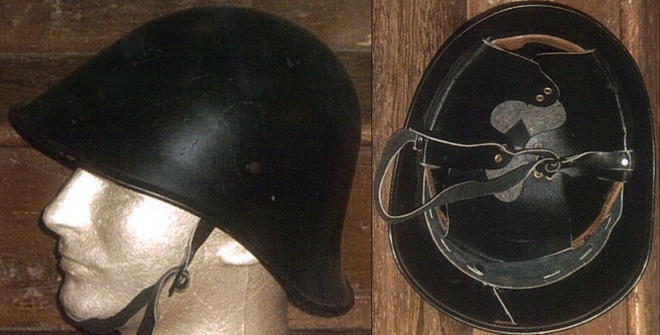
"Verlifa" Dutch M40C Helmet. The "C" standing for Civiel or Civilian)
The Domestic "KNIL-Style" Helmet (M40C). These were produced during the German occupation (starting around 1940-1941) by the Verblifa factory for domestic use. Verblifa (De Vereenigde Blikfabrieken)
They were issued to the Luchtbeschermingsdienst (LBD - Air Raid Protection), police, and fire brigades.
During the liberation of the Netherlands, these helmets were famously used by the Binnenlandse Strijdkrachten (BS - Dutch Resistance/Domestic Armed Forces).
Unlike the army's olive green, these were often factory-painted black or a dark grey-blue. Resistance members frequently used them in black, sometimes with "camo" paint or orange markings to identify themselves.
They were issued to the Luchtbeschermingsdienst (LBD - Air Raid Protection), police, and fire brigades.
During the liberation of the Netherlands, these helmets were famously used by the Binnenlandse Strijdkrachten (BS - Dutch Resistance/Domestic Armed Forces).
Unlike the army's olive green, these were often factory-painted black or a dark grey-blue. Resistance members frequently used them in black, sometimes with "camo" paint or orange markings to identify themselves.
"Milsco" American Production (M41 KNIL)
When the Netherlands was occupied in 1940, the Dutch government-in-exile contracted the Milwaukee Saddlery Company (Milsco) in the USA to produce helmets for the KNIL forces fighting in the East Indies.
These American-made helmets were produced without the frontal lion badge from the start.
They still featured the rear slot for the neck flap.
After the war, many of these unused or salvaged Milsco shells were sent to the Netherlands, stripped of their tropical liners, and refurbished with standard civilian/police liners.
These American-made helmets were produced without the frontal lion badge from the start.
They still featured the rear slot for the neck flap.
After the war, many of these unused or salvaged Milsco shells were sent to the Netherlands, stripped of their tropical liners, and refurbished with standard civilian/police liners.
M34 Dutch Helmet
The Dutch M1934 helmet (M34) was the Netherlands' standard combat helmet during the May 1940 German invasion, designed to be a more robust replacement for the earlier, less practical M28 model.
|
M34 with neckguard and without Royal shield badge in front.
|
The M34 retained the deep neck guard of the M28 but featured a more rounded dome and a slightly shorter brim, which improved acoustics and practicality in the field.
A Dutch helmet with a neck guard is almost always either a colonial (KNIL) variant or a post-WWII Civil Defense model. You can distinguish them by the material of the guard and the shape of the helmet |
|
The M34 introduced a more modern and comfortable liner system with a band and multiple leather pads for stability and comfort.
|
They were produced domestically by the United Tin Factories (Verblifa) in the Netherlands.
The M34 was made of manganese steel and offered better ballistic protection than the M28. It featured the same embossed copper badge of the Dutch coat of arms (the "Rampant Lion") affixed to the front as the M28. (That this one on the photos don't has). Original pre-WWII helmets were typically painted a smooth, glossy olive green or grey-blue. |
A variation of the M34 was produced for the Royal Netherlands East Indies Army (KNIL), which defended Dutch colonial interests in Indonesia.
They are highly collectible today because they featured two decals: the standard Dutch Lion crest on the front and a red-and-white shield decal on the left side, representing the Dutch national colors.
WWII and Post-War Use
The M34 was the primary helmet used by Dutch forces during the invasion.
Like the M28, most M34s were captured by the Germans. The lion insignia was removed, the holes welded shut or filled, and the helmets were repainted feldgrau (field grey) for use by German civil and paramilitary organizations.
The M34 remained in service with the Netherlands post-war until it was finally replaced by a clone of the British MKIII Turtle helmet in 1953.
The M34 was the primary helmet used by Dutch forces during the invasion.
Like the M28, most M34s were captured by the Germans. The lion insignia was removed, the holes welded shut or filled, and the helmets were repainted feldgrau (field grey) for use by German civil and paramilitary organizations.
The M34 remained in service with the Netherlands post-war until it was finally replaced by a clone of the British MKIII Turtle helmet in 1953.
MKII Dutch (VB56) Helmet
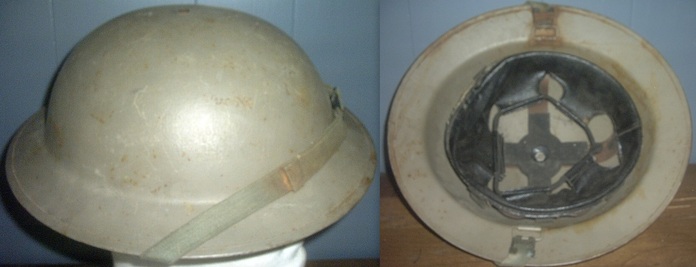
The Dutch MK II helmet (often referred to as the VB56) was a post-WWII Dutch-produced version of the British Mark II "Brodie" helmet. While it shares the iconic "soup bowl" silhouette of the British wartime original, it was manufactured in the Netherlands during the 1950s for the Dutch Army and Civil Defense.
Differences from the British MK II
Although they look nearly identical at a distance, several technical details distinguish the Dutch version:
The Dutch shells are typically stamped on the underside of the rim with "VB" (for Verenigde Blikfabrieken) followed by a year, most commonly VB56 (1956).
The steel rim on the Dutch model is butt-welded (the ends meet evenly), whereas the original British MK II rims usually have a visible overlap. The Dutch version uses a specific leather liner and a quick-release canvas chinstrap with hardware similar to the swivel bales found on American M1 helmets.
They were factory-finished in a distinct grey-green or brownish-olive paint, which differs slightly from the British "khaki green" or "textured brown".
Service History
Following WWII, the Dutch Army was largely modeled after the British military and initially used surplus British equipment.
In the mid-1950s, the Netherlands began producing their own MK II clones (like the VB56) to equip the army before eventually transitioning to the M51 (an M1 clone).
Differences from the British MK II
Although they look nearly identical at a distance, several technical details distinguish the Dutch version:
The Dutch shells are typically stamped on the underside of the rim with "VB" (for Verenigde Blikfabrieken) followed by a year, most commonly VB56 (1956).
The steel rim on the Dutch model is butt-welded (the ends meet evenly), whereas the original British MK II rims usually have a visible overlap. The Dutch version uses a specific leather liner and a quick-release canvas chinstrap with hardware similar to the swivel bales found on American M1 helmets.
They were factory-finished in a distinct grey-green or brownish-olive paint, which differs slightly from the British "khaki green" or "textured brown".
Service History
Following WWII, the Dutch Army was largely modeled after the British military and initially used surplus British equipment.
In the mid-1950s, the Netherlands began producing their own MK II clones (like the VB56) to equip the army before eventually transitioning to the M51 (an M1 clone).
M53 Dutch M1 Clone. NATO
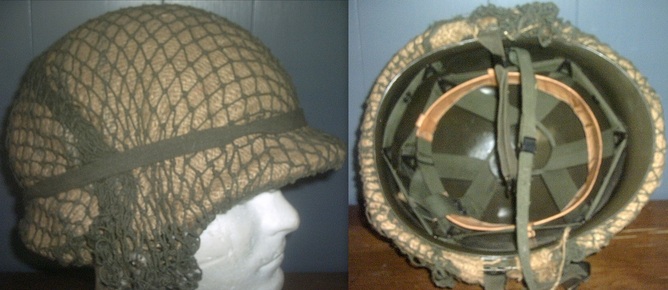
The Dutch M53 is often referred to by collectors as a "Euroclone" of the U.S. M1 because it copied the basic design but used domestically sourced materials and specific hardware.
Like the original U.S. M1, it features a heavy steel outer shell (the "steel pot") and a separate inner liner, designed to be worn together.
The steel shells were produced in the Netherlands, primarily by the United Tin Factories (Verenigde Blikfabrieken or VB).
The liner was typically made of plastic or fiber and featured an internal webbing suspension system, often with an adjustable headband and nape strap, similar to U.S. models.
Distinguishing Marks.
They were usually painted a smooth olive green.
The steel shells often have manufacturer stamps on the underside of the rim, such as the "VB" logo followed by a date stamp.
While some early use M1s by specific Dutch units had painted insignia like an orange lion or number, standard M53s were generally plain.
The chinstraps were made of canvas and utilized a friction buckle mechanism. The bales (loops) on the shell were typically the swivel type, which became standard on U.S. M1 helmets from late 1943 onward.
The M53 entered wide service in the mid-1950s, replacing the M34 and British MKII clones, and remained the standard Dutch Army helmet until it was replaced by a composite Kevlar helmet in the 1990s.
Like the original U.S. M1, it features a heavy steel outer shell (the "steel pot") and a separate inner liner, designed to be worn together.
The steel shells were produced in the Netherlands, primarily by the United Tin Factories (Verenigde Blikfabrieken or VB).
The liner was typically made of plastic or fiber and featured an internal webbing suspension system, often with an adjustable headband and nape strap, similar to U.S. models.
Distinguishing Marks.
They were usually painted a smooth olive green.
The steel shells often have manufacturer stamps on the underside of the rim, such as the "VB" logo followed by a date stamp.
While some early use M1s by specific Dutch units had painted insignia like an orange lion or number, standard M53s were generally plain.
The chinstraps were made of canvas and utilized a friction buckle mechanism. The bales (loops) on the shell were typically the swivel type, which became standard on U.S. M1 helmets from late 1943 onward.
The M53 entered wide service in the mid-1950s, replacing the M34 and British MKII clones, and remained the standard Dutch Army helmet until it was replaced by a composite Kevlar helmet in the 1990s.
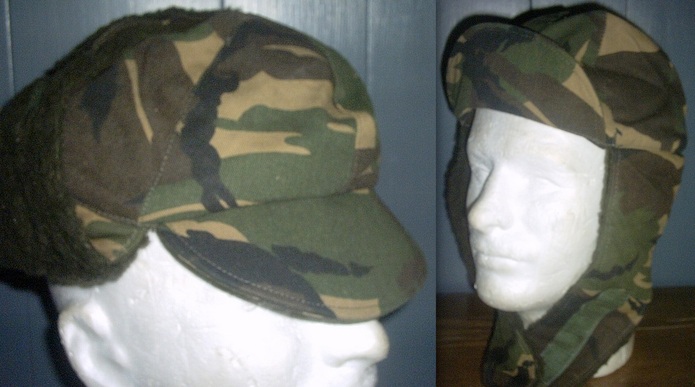
Dutch (British) Winter Hat. NATO DPM camo.
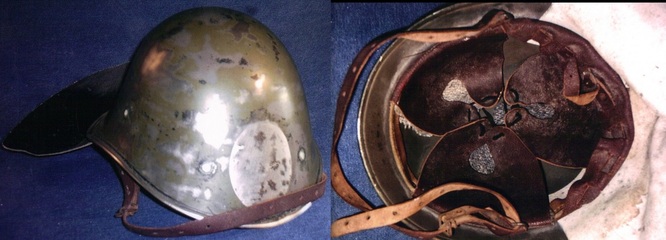
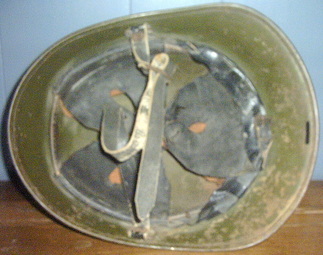
M40C Steel Helmet. (Re-issued, Transitional or Hybrid Knil type shell and civilian type liner).
This one from the collection is olive green and has a rear slot. It has a civilian-style liner. It could be a re-issued piece. Technically a reissued KNIL military shell that has been fitted with an M40C civilian liner. The presence of
black paint inside this helmet is a strong indicator that it was refurbished for Civil Defense (LBD/BB) or Police use after its initial military life.
M27 Dutch Helmet
Dutch M27 and M34 Helmet
Dutch M34 Helmet
Recommended Website:
The German Fallschirmjäger (paratrooper) units were central to key operations in the Netherlands during World War II, most notably the 1940 invasion and the German defense against the Allied Operation Market Garden in 1944.
The 1940 Invasion (Battle of the Netherlands)
On May 10, 1940, the Germans launched the first large-scale strategic airborne assault in history, aimed at quickly defeating the Netherlands. The primary goals were to capture key airfields around The Hague (Ypenburg, Ockenburg, and Valkenburg) to facilitate the capture of the Dutch government and Royal Family, and to seize vital bridges at Moerdijk and Dordrecht to allow ground forces to advance rapidly.
The Battle for The Hague: While the Fallschirmjäger successfully landed and captured airfields, fierce Dutch resistance and counterattacks prevented them from seizing The Hague or capturing the Queen. The Germans lost many transport planes and surviving paratroopers retreated to the dunes until the country's general surrender.
Bridge Captures: The operations to capture the Moerdijk and Dordrecht bridges were successful and critical to the German invasion plan, as holding these crossings allowed the German 18th Army to bypass the main Dutch defenses and force the Dutch to surrender after the bombing of Rotterdam.
Operation Market Garden (1944)
In September 1944, the Netherlands was a battleground for the Allied airborne operation, Operation Market Garden, where German Fallschirmjäger (acting as ground infantry due to heavy losses earlier in the war) played a crucial defensive role.
The 1940 Invasion (Battle of the Netherlands)
On May 10, 1940, the Germans launched the first large-scale strategic airborne assault in history, aimed at quickly defeating the Netherlands. The primary goals were to capture key airfields around The Hague (Ypenburg, Ockenburg, and Valkenburg) to facilitate the capture of the Dutch government and Royal Family, and to seize vital bridges at Moerdijk and Dordrecht to allow ground forces to advance rapidly.
The Battle for The Hague: While the Fallschirmjäger successfully landed and captured airfields, fierce Dutch resistance and counterattacks prevented them from seizing The Hague or capturing the Queen. The Germans lost many transport planes and surviving paratroopers retreated to the dunes until the country's general surrender.
Bridge Captures: The operations to capture the Moerdijk and Dordrecht bridges were successful and critical to the German invasion plan, as holding these crossings allowed the German 18th Army to bypass the main Dutch defenses and force the Dutch to surrender after the bombing of Rotterdam.
Operation Market Garden (1944)
In September 1944, the Netherlands was a battleground for the Allied airborne operation, Operation Market Garden, where German Fallschirmjäger (acting as ground infantry due to heavy losses earlier in the war) played a crucial defensive role.