Militariarg.com
  • Home
  • Army
  • Aviation
  • Navy
  • Uniforms and Badges
  • Arms and Weapons
  • Equipment
  • Vehicles
  • Operational and Organizational Structure, Security Forces, Transportation, Books, Models and More.
  • Argentine Confederation Era. 1829 - 1852.
  • From 1852 to 1910 (French fashion)
  • Bunker 1982: South Atlantic War Militaria
  • International Militaria
  • Argentina WWII Era (Neutral) Reenactment Impression
  • Links ~ Enlaces
Picture
The Argentine Army's munitions have evolved significantly since 1870, reflecting major global shifts in military technology, from black powder single-shot rifles to modern NATO-standard weaponry and indigenous designs. The key changes involved the transition to smokeless powder, bolt-action repeating rifles, and finally to modern automatic weapons.
 
Late 19th Century (1870-1900): Modernization and Mauser Adoption 
This period was characterized by a push to modernize and standardize the army's diverse arsenal. 

Rifles:
Remington Rolling Block: In the 1870s, the Argentine Army began the process of modernization by incorporating single-shot breech-loading Remington rifles and carbines.

Mauser Model 1891: Argentina became an early adopter of modern, small-bore, smokeless powder rifles when it purchased the Mauser Model 1891. This rifle used the 7.65×53mm Argentine (also known as 7.65×53mm Belgian Mauser) rimless cartridge, which became the standard caliber for the army's main rifles for decades.

Artillery: Early artillery included various systems, such as Gatling guns around 1870, and Maxim-Nordenfelt machine guns and Krupp field guns (e.g., 75mm and 105mm models) were in service by the late 19th century. 

Early to Mid-20th Century (1900-1950s): Refinement and Local Production

Rifles: The Mauser Model 1909
(also in 7.65 mm) was adopted, a refined version of the Mauser design, and remained the standard service rifle into the mid-20th century.

Pistols: The Colt M1911 in .45 ACP
and later the FN Hi-Power in 9×19mm Parabellum
became standard issue for officers and other personnel.

Submachine Guns: Argentine-designed and manufactured submachine guns, such as the Halcón series in 9mm, also entered service. 

Late 20th Century to Present (1960s-Today): NATO Standardization
In the latter half of the 20th century, the Argentine Army transitioned to NATO-standard calibers and acquired equipment from various international and domestic sources. 

Small Arms (7.62mm NATO and 5.56mm NATO):

FN FAL: The 7.62×51mm NATO caliber FN FAL battle rifle (locally produced by Fabricaciones Militares) became the standard issue rifle from the 1960s onward, seeing action in the Falklands War.
5.56mm transition: The army began a transition to the 5.56×45mm NATO caliber for some units, adopting rifles like the Steyr AUG, Colt M4 carbine, and the indigenous FARA 83 (though in limited service).
Pistols/SMGs: The 9mm Parabellum is the standard pistol and SMG caliber (e.g., FN Hi-Power, FMK-3 submachine gun).

Artillery and Support Weapons: The army diversified its heavy weaponry, using a mix of imported and Argentine-made systems, including:

Mortars: 60mm, 81mm, and 120mm mortars.
Howitzers: Various 105mm (e.g., OTO Melara Mod 56) and 155mm systems (e.g., CITER 155mm L33 gun, VCA Palmaria).
Anti-tank: Weapons like the BGM-71 TOW missile, AT4 rocket, and 105mm recoilless guns were introduced.
Grenades and Mines: Various domestically produced hand grenades (e.g., FMK-1, FMK-2) and mines have been used.

Krupp: 75 x 280mmR and 77 x 230mmR.

​In late 1890s Argentina was very clever in how they modernized their older C/80 inventory. By fitting Maxim-Nordenfelt breech systems to their modified C/80 frames, they were able to use separate-loading ammunition (bagged charges). The Maxim-Nordenfelt eccentric screw breech was better suited for this because it could be fitted with an obturator (the seal). This allowed Argentina to use up cheaper, domestic bagged powder, avoid the massive cost of brass cartridge cases for every single shot; And extend the life of the older C/80 barrels while upgrading the firing mechanism. 

The Krupp horizontal sliding-block was fundamentally designed to be "metal-to-metal." It relied on the brass case to stop gas leakage. However, as the pressures of World War I set in, Krupp was forced to adapt. The "Economic Reality" of the war meant they couldn't produce enough brass. 

For this gun, Krupp could not easily switch to bagged charges. Because the gun was designed for high-speed "Quick-Firing," the horizontal sliding-block breech required a metal seal. Instead of changing the breech, they changed the cartridge.
As brass (copper/zinc) became scarce, Krupp and the German war ministry developed lacquered steel cases. These were much harder to manufacture because steel doesn't "spring back" as easily as brass after firing, which often caused the cases to get stuck in the chamber.
The "Ersatz" Materials. They began using explosive fillers that were less "pure" than pre-war TNT and moved to cast-iron shells (rather than steel) for some projectile types to save high-grade ore.

Cartridges: 75 x 280mmR (75mm L/30 Modelo Argentino and the rest of 7.5 FK 1902/03). An the 7.7 x230mmR. (7.7 L/25 FK96 n.A).

​Both the 7.7 cm FK 96 n.A. and the 7.5 cm FK Model 1903/1909 were designed strictly for Fixed Ammunition (cartridge cases), which is the opposite of the "economic" bagged charges from the last C/80 (FK Fedkanone and GK Gebirgskanone) generation.

The 75 x 280mmR was the "universal" technical standard that Krupp marketed to the world. It was the heart of the Model 1903 family, which turned Krupp into a global artillery supermarket. Here the 75 x 280mmR (7.5 cm FK Modelo Argentino QF (Quick-Firing) type with customized Welin breech instead the factory Krupp breech.

Both the 7.7 cm FK 96 n.A. and the 7.5 cm FK Model 1903/1909 were designed strictly for Fixed Ammunition (cartridge cases), which is the opposite of the "economic" bagged charges .

The German Empire chose 77mm so that if the French captured German ammunition, it would be too large to fit into their 75mm guns. Conversely, if the Germans captured French 75mm ammunition, it would be too small for their 77mm barrels. While it would physically fit in the chamber, it would not engage the rifling, making it dangerously inaccurate and prone to "rattling" down the barrel, potentially damaging the gun. During WWI, Germany did use captured French 75mm guns, but they typically either used them with captured French ammunition until stocks ran out.

Re-bored/Re-chambered the captured French guns to 7.7 cm so they could fire standard German shells.
Modified the breech and chamber of the French guns to safely accommodate German 77mm cartridges.
The decision to rebarrel the 7.7 cm FK 16 into the 7.5 cm FK 16 n.A. (neuer Art) during the 1930s was driven by a mix of logistics, international politics, and military Standardization (The Most Important Reason)
By the 1930s, the 75mm caliber had become the unofficial "world standard" for light field artillery.
Maintaining two separate production lines for 75mm (for export and specialized units) and 77mm (for the old WWI guns) was inefficient.
The Reichswehr (and later Wehrmacht) was developing new weapons, like the 7.5 cm Le.IG 18 (infantry gun) and early tank guns, which used 75mm. It made sense to consolidate everything into one caliber to simplify the supply chain.
After WWI, the Treaty of Versailles severely limited the number of guns and the amount of ammunition Germany could possess.
Since they were forced to have a very small stockpile, the German military wanted that stockpile to be as flexible as possible.
By converting the old 77mm guns to 75mm, they ensured that their existing fleet of WWI-era guns could use the same shells being developed for their newer, modern weapons.

When they rebarreled the guns to 7.5 cm, they typically used a longer barrel relative to the bore. This allowed for the use of more modern, higher-pressure propellants, which actually increased the range and accuracy of the WWI-era carriages, making them viable for a few more years until the 10.5 cm leFH 18 (howitzer) could replace them.
Germany had huge amounts of captured 75mm equipment and data from the Krupp export lines (like the Model 1903/1909). Moving to 7.5 cm across the board allowed them to potentially utilize captured stockpiles and existing industrial tooling that was already geared for the 75mm export market.

Picture
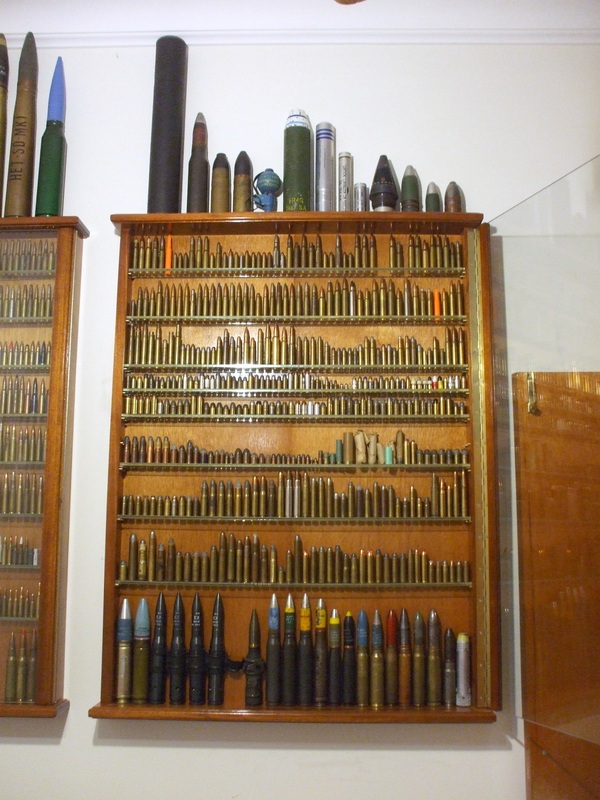
This above is an astonishing collection of inert projectiles and grenades used by the Argentine Army from the Remmington Patria to Malvinas. 

Argentina's transition from a self-sufficient arms producer to a nation dependent on foreign ammunition is a central theme in its modern military history. The "Military-Industrial Complex" (FM) was once a point of national pride, but a combination of post-war scandals, economic crises, and political shifts dismantled much of this infrastructure.

Founded in 1941, Fabricaciones Militares (DGFM) was established to ensure Argentina's strategic independence during World War II. During the 1880s and 1990s, many plants were sold to private firms or simply closed as the country moved toward a neoliberal economic model.

Between 1991 and 1995, the Argentine arms trafficking scandal involving the illegal sale of 6,500 tonnes of weapons and ammunition to Croatia and Ecuador severely damaged the credibility of FM and led to further defunding.

The Rio Tercero Explosion (1995).
The catastrophic explosion at the Río Tercero Military Factory, believed to be an attempt to cover up evidence of the aforementioned illegal arms sales, destroyed one of the country's most critical ammunition production facilities.

In the 2020s, facilities like the Fanazul gunpowder plant in Azul and the Jáchal plant have faced repeated closures and inactivity due to budget cuts and lack of investment. 

Today, while some limited domestic production remains, Argentina increasingly relies on foreign suppliers to meet the needs of its Armed Forces.

11.15x58mmR (43 Spanish)

The Remington Modelo Argentino 1879, popularly known as the "Patria," was primarily chambered in .43 Spanish (also designated as 11.15x58mmR). It served as the first standard national weapon for the Argentine Army, replacing older muzzleloaders until the adoption of the Mauser in 1891. 
​The rifle used a large-bore, centerfire cartridge designed for the black powder era. The .43 Spanish (11.15x58mmR) was the standard chambering for the roughly 75,000 units purchased by Argentina.

In the late 1950s, approximately 300 of these rifles were rechambered to 11mm Mannlicher (Werndl) because surplus .43 Spanish ammunition had become scarce. The original .43 Spanish load typically consisted of a .439 diameter projectile propelled by approximately 65 grains of black powder. 

7.65x53mm Mauser

General Pablo Ricchieri, the architect of the modern Argentine Army, initially insisted that the new Mauser bolt-action rifles be chambered in the old .43 Spanish (11.15x58mmR). This wasn't an obsession with the caliber's performance, but rather a pragmatic (and ultimately flawed) decision based on logistics, economics, and "sunk cost."

In the late 1880s, Argentina had just spent a fortune equipping its entire force with the Remington Patria. They had tens of millions of rounds of .43 Spanish ammunition in warehouses across the country. Ricchieri feared that introducing a new, smaller caliber (like the 7.65x53mm Mauser) would create a logistical nightmare where frontline troops might receive the wrong ammunition during a conflict.

Standardization. He wanted the "new" rifle to use the "old" bullet so that the Remington and the Mauser could fight side-by-side without complicating the supply chain.

At the time, smokeless powder and "small-bore" high-velocity rounds were brand new and unproven in South American climates.

The .43 Spanish was a massive, heavy lead slug that moved slowly but hit with incredible "stopping power."
Many traditionalist officers in the Argentine Commission believed the heavy .43 caliber was more effective for stopping a charge than the "tiny" 7.65mm bullet, which they feared would simply pass through an enemy without dropping them.

The 1887/89 "Transitional" Mausers
This obsession resulted in a very rare variant of the Mauser. Argentina ordered a small batch of Model 1887 and Model 1889 Mausers specifically chambered in .43 Spanish. These rifles used a tubular magazine (similar to a Winchester or a Kropatschek) because the fat, rimmed .43 Spanish cartridges didn't stack well in a vertical box magazine.
These rifles were heavy, clunky, and quickly became obsolete as the rest of the world proved that small-bore smokeless powder was the future.

The "Great Pivot" of 1891
Ultimately, Ricchieri was convinced (largely by the German engineers at Mauser and the observation of European trends) that sticking with the .43 Spanish was a mistake. He realized that the ballistic advantages of the 7.65mm longer range, flatter trajectory, and lighter weight (allowing soldiers to carry more ammo) far outweighed the convenience of using old stock.

This led to the adoption of the Mauser 1891, which became one of the finest rifles of its era and firmly ended the reign of the .43 Spanish in Argentina.

7.92mm "S" (Spitzer) cartridge.

By 1907, Ricchieri and the Argentine Military Commission in Europe observed that the German Empire had upgraded to the 7.92mm "S" (Spitzer) cartridge. Ricchieri wanted Argentina to adopt the most modern European standard to ensure their rifles would remain cutting-edge for decades. The 7.92mm offered superior terminal ballistics and armor penetration compared to the existing 7.65mm.

Despite Ricchieri's preference, Argentina ultimately rejected the 7.92mm for the Model 1909 and stuck with the 7.65mm. Argentina already had roughly 200,000 Model 1891 rifles and millions of rounds of 7.65mm ammunition in stock.

The German manufacturers (DWM) had massive tooling and barrel blanks ready for 7.65mm due to a large Turkish contract. Switching to 7.92mm would have significantly delayed delivery and increased costs.
To avoid the exact "two-caliber nightmare" Ricchieri had feared with the .43 Spanish, the Commission decided it was better to have a slightly older caliber (7.65mm) that was uniform across the entire army than to split the supply chain again.

7.92x57mm J (Patrone 88)

​In the early 1890s, General Ricchieri’s acquisition of the Gewehr 88 (Commission Rifle) is one of the most interesting "hidden" chapters of Argentine military history, were approximately 5,000 units involved, but the story is more about a desperate backup plan than a change of heart regarding calibers.

While Argentina had officially committed to the 7.65x53mm Mauser 1891, the early 1890s were a time of extreme tension with Chile (the "Puna de Atacama" dispute). Ricchieri and the government were terrified of being caught without enough modern rifles if war broke out before the full Mauser order arrived.

Germany was phasing out the Gewehr 88 in favor of the newer Mauser 98. Surplus stocks were suddenly available. Ricchieri bought the 5,000 Gewehr 88s (and some Karabiner 88s) as a "stop-gap" measure to arm secondary units and ensure the country wasn't defenseless during the Mauser transition. 

These rifles were chambered in the original German service round, the 7.92x57mm J (Patrone 88). This created exactly the problem Ricchieri usually tried to avoid, (Ammunition Chaos). Argentina now had a military using .43 Spanish (Remington), 7.65mm (Mauser 1891), and 7.92mm (Gewehr 88) all at once.
To minimize the headache, these 7.92mm rifles were largely relegated to the National Guard and police units rather than the front-line Army, keeping the "weird" caliber away from the main supply lines. 

Technically, converting a Gewehr 88 to 7.65mm was possible but risky. The Gewehr 88 used a barrel shroud and a specific bore diameter (.318) that was smaller than the later "S-bore" (.323) 8mm Mauser rounds. Converting them to the higher-pressure Argentine 7.65mm would have been expensive and potentially dangerous for the older actions. Ricchieri decided it was cheaper to just buy the 7.92mm ammo from Germany and leave the rifles as they were. 

These 5,000 rifles became a footnote because the war with Chile was avoided through diplomacy. Most of them ended up in the hands of the Provincial Police or were eventually sold off as surplus (Peru). They are rare today and are often distinguished by Argentine "shield" markings or specific police stamps on the receiver.
It’s ironic that Ricchieri, the man who fought so hard for ballistic uniformity, ended up being the one to introduce the 7.92mm to Argentina out of pure necessity.

Post-WWII Surplus.
After 1945, the world was flooded with 7.92x57mm ammunition. Argentina eventually converted many of its Model 1891 and 1909 carbines and adopted the Madsen machine gun in 7.92mm.
For a brief period before the move to the 7.62x51mm NATO (for the FN FAL), the 7.92mm became a secondary standard in the Argentine inventory.

Picture
​FMAP-DM 7,92x33 Kurz Model CAM-  (Argentine STG44) clone. Photo: Courtesy EJFG.
The 7.92x33mm Kurz caliber in Argentina

Around 1947, a small number of German StG 44s found their way to Argentina. Reports indicate a small number of complete rifles were purchased from Czechoslovakia around 1949 for evaluation purposes. The Argentine military's scientific and technical institutes (CITEFA and FMAP-DM) reverse-engineered the weapon and produced their own local prototype version, designated the CAM 1, in the early 1950s.

Indigenous Ammunition: A crucial aspect was the local development and manufacture of the 7.92×33mm Kurz caliber ammunition by the state-owned Fábrica de Cartuchos San Lorenzo. 

The StG 44 prototypes were produced and tested alongside other potential candidates for Argentina's next service rifle, including the American M1 Garand and the M1941 Johnson rifle. 

Trials and Rejection

Ultimately, the StG 44 project was dropped around 1953-1954 in favor of the FN FAL. The decision was influenced by the prevailing military consensus of the time, which favored more powerful, full-caliber battle rifle cartridges (7.62×51mm NATO) for longer engagement ranges, and the global trend toward NATO standardization. The 7.92mm Kurz was seen as an obsolete, war-era round with limited international support. 

The Argentine StG 44 prototypes and accompanying 7.92mm Kurz ammunition remained in storage until rediscovered decades later. Today, a surviving example of the Argentine-made prototype is on display at the Museo de Armas de la Nación in Buenos Aires.
Was it a mistake and a loss of innovation to have abandoned the Kurz caliber early?

The shift from full-power battle rifle cartridges (like the 7.62mm NATO) to intermediate cartridges (like the 5.56mm NATO and the earlier 7.92mm Kurz). It is plausible to argue that Argentina made a decision based on the prevailing military consensus of the time (the 1950s), but hindsight suggests that adopting an intermediate caliber earlier would have aligned better with future trends.

Why Argentina Chose the FN FAL (7.62mm NATO). Argentina's decision was rational given the global military landscape of the immediate post-WWII era:

The 1950s saw NATO nations adopt the 7.62×51mm cartridge as their standard full-power rifle round. To align with major military powers for logistics and compatibility, adopting the FAL was the logical choice. The 7.92mm Kurz was a German war-era round with limited international support.

Military doctrine at the time still emphasized engaging targets at longer ranges (400-600 meters) and prioritizing penetration and "stopping power," which the full-power 7.62mm round offered.

The FN FAL was considered "The Right Arm of the Free World"—a reliable, cutting-edge battle rifle being adopted globally. The StG 44, while pioneering, was a relic of a defeated nation.

Why Discarding the Kurz Might Have Been a "Mistake" (In Hindsight)
The argument that it was a mistake rests on the later adoption of the 5.56mm NATO intermediate caliber:

The Kurz Was the Future: The 7.92×33mm Kurz was the world's first true intermediate cartridge. It was designed for effective, controllable automatic fire and high hit probability in typical combat ranges (under 300 meters)—exactly the characteristics that led the U.S. to develop the 5.56mm M16/AR-15 system in the 1960s.

The 7.62mm NATO Was Overkill: Militaries soon realized that the 7.62mm NATO was too powerful for an assault rifle in a select-fire role. It generated heavy recoil, making full-automatic fire difficult to control and necessitating heavy, expensive rifles.

Missed Opportunity for Innovation:

Argentina had the technology to locally produce weapons chambered for the Kurz caliber (like the prototype Citer assault rifle). Had they formalized and standardized an intermediate caliber system in the 1950s, Argentina could have been a pioneer alongside the U.S. in the intermediate-caliber shift, potentially saving decades of transition costs and aligning earlier with modern combat realities.

Conclusion

Argentina's decision was a reflection of the best information available in the 1950s, adhering to international standards and established military doctrine. However, from the perspective of modern small-arms philosophy, which favors intermediate calibers, they discarded a system (the Kurz) that was fundamentally ahead of its time.
​Today, the Argentine Armed Forces still primarily use the FN FAL chambered in 7.62×51mm NATO. The 5.56mm caliber is used by special forces units, who employ a mix of imported rifles such as the Colt M4 carbine, Daniel Defense M4 variants, and Steyr AUGs. The army is currently exploring options to upgrade or replace its aging FAL rifles with a more modern 5.56mm system, but the transition has been gradual and incomplete.

Picture
​FG-42 and P38 Walther (Trial Guns). Source: "Las Armas Modernas de la Infanteria:, by Colonel Julio S. Guzman. 1953.

Picture
The Batallón *or Company de Depósitos de Municiones 601 (BDM 601). Both terms are commonly used. Historically and strategically, it functioned as a Battalion, but its official downsizing to a Company was a direct result of the "de-fanging" and restructuring of the Armed Forces after the war.  
​"Los Polvorines" was a strategic military installation located in the Malvinas Argentinas district of Greater Buenos Aires.

​
Foundation and History

Los Polvorines (later home to Compañía de Munición 601) was established during the significant military modernization period led by General Pablo Riccheri. The Argentine Army installed the original gunpowder and ammunition depot in 1903 on approximately 59 hectares of land in what was then the General Sarmiento district.

The facility was a product of the "Riccheri Law" (Law 4301) of 1901, which reorganized the War Department, created mandatory military service, and modernized the Army's logistics and infrastructure.
The surrounding area and the railway station (opened in 1909) were named "Los Polvorines" precisely because of the presence of these military "polvorines" (gunpowder magazines). 

 From its Riccheri-era origins through the 1982 conflict, it remained the central point for the storage and distribution of explosives for the Argentine Army.​ BDM 601 serves as the primary ammunition depot for the Comando de Arsenales. It is situated on a vast tract of land designed with reinforced bunkers and safety perimeters to house heavy ordnance.  It was a specialized, smaller-scale unit (Company-sized) focused on the storage and maintenance of explosives.
It was the ammunition depot of the mega-military complex of Campo de Mayo. For safety, these depots had to be kept away from military facilities in case of accidents. A military train entered the ammunition depot through a branch of the same railroad in the town. That same train returned to the provinces with the supply of ammunition.

The logistical layout of the Compañía de Munición 601 (Los Polvorines) was designed around the exact railroad branch illustrating a critical link between the Campo de Mayo military complex and the rest of the country. The rail branch at Los Polvorines was a spur of the Ferrocarril General Belgrano (formerly the Central Córdoba Railway). This specific gauge (meter-gauge) connected the military depots of Greater Buenos Aires to the "Military-Industrial Corridor" of Rosario.
 This track split off from the main line near the Los Polvorines station, crossing through the town to reach the reinforced bunkers.This railway connection allowed for the "industrial-scale" movement of heavy ordnance. Military trains would arrive at the depot to be loaded with shells, gunpowder, and missiles, then depart to supply provincial units across Argentina. 


The South Atlantic War (1982)
During the conflict, the Polvorines was the nerve center for the logistics of explosives:


Supply Chain. It was responsible for the rapid mobilization of ammunition, specifically the 35mm Oerlikon and 30mm Hispano-Suiza shells which were shipped from the mainland to the islands.
Technical Support: Ordnance experts from this battalion were deployed to the theater of operations to manage munitions dumps and troubleshoot fuse issues in the field. 
​
On April 20, 1982, a major accidental explosion occurred at the Compañía de Munición 601

The incident took place during the height of the Falklands War (Guerra de las Malvinas) mobilization and had a significant impact on both the military facility and the surrounding civilian population.

Los Polvorines explosion is a textbook case of unplanned urban encroachment colliding with strategic military infrastructure. When Riccheri established the site in 1903, it was isolated "in the middle of nowhere." However, by 1982, the reality had shifted dangerously.

Decades of institutional neglect allowed the "urban footprint" to crawl right up to the base’s wire fences. Neighborhoods grew around the 59-hectare site without proper safety buffers or "buffer zones" required for high-explosive depots.
Because houses and schools were built so close, the April 20, 1982, blast caused far more civilian damage and panic than it would have in a properly zoned area. Shrapnel and wood splinters from the base became projectiles in people's living rooms.
While the military government demanded secrecy and security for their war effort, they had spent years turning a blind eye to the lack of zoning laws that placed civilians in a "kill zone" should an accident occur.

If the British had attacked Los Polvorines (Compañía de Munición 601) during the war in 1982, the consequences likely would have been a humanitarian and political disaster for both nations due to the high density of the surrounding civilian population.
Picture
Picture

Before the South Atlantic War, Malvinas/Falklands 1982, and during the third presidency of Juan Perón (1973–1974) and the subsequent administration of his widow, Isabel Perón (1974–1976), Argentina experienced a surge in guerrilla violence that targeted military arsenals, garrisons, and factories to seize weapons and ammunition. 
Major Attacks on Arsenals and Garrisons

Monte Chingolo Arsenal (December 23, 1975): The ERP launched a massive assault on the 601st Arsenal Battalion at Monte Chingolo. It involved several hundred guerrillas and was the largest urban battle of the period. The attack failed disastrously; over 60 guerrillas were killed, along with several soldiers, police, and civilians. This defeat effectively broke the guerrillas military capacity.

Azul Military Garrison (January 19, 1974): The guerrillas attacked the 1st Armored Cavalry Regiment and the 1st Artillery Group in Azul to seize weapons. The attack resulted in the kidnapping of a Colonel Jorge and the killing of the garrison commander and his wife.

Munro Armaments Factory (December 1975): The urban guerrillas raided a weapons factory in the Munro neighborhood of Buenos Aires, successfully escaping with approximately 250 assault rifles and sub-machine guns. December 1975 raid on the armaments factory in Munro (Buenos Aires) was specifically targeted at the Halcon firearms factory.
The guerrillas produced their own weaponry. Specifically, the People's Revolutionary Army (ERP) designed and clandestinely manufactured a submachine gun known as the JCR Modelo 1 (or simply the JCR-1), named after the Junta de Coordinación Revolucionaria. It was a copy of the Carl Gustav M/45. Both, the Swedish and this copy was 9x19mm Parabellum​ and relied on a blowback action and a simple tubular receiver.

Villa María Arsenal (August 10, 1974): The guerrillas attacked the 141st Powder and Explosives Factory in Villa María, Córdoba. During this operation, they kidnapped Colonel Argentino del Valle Larrabure, who later died in captivity.

Formosa Regiment 29 (October 5, 1975): In "Operation Primicia," the urban guerrillas hijacked a civilian airliner and attacked the 29th Infantry Regiment barracks. While not strictly an "arsenal," the goal was to demonstrate military power and seize equipment. The battle left 12 soldiers and 16 guerrillas dead. 

Strategic Goals of These Attacks
Tucumán (1974–1976). The guerrillas goal was establishing a "liberated zone" in the rural mountains and jungles, the ERP intended to transition from a clandestine guerrilla group to a recognized belligerent force under international law, aimed to meet the specific legal criteria for recognition by international bodies like the United Nations and the International Committee of the Red Cross (ICRC). Their plan involved. This scenario highlights the risk of a "failed state" or a protracted rural insurgency, which was precisely why the Argentine military and  (Isabel Peron), viewed the Tucumán campaign with such alarm.​

Weapon Procurement: Guerrillas lacked heavy weaponry and relied on these raids to obtain standard-issue military rifles (such as the FN FAL) and explosives.
Psychological Warfare: Attacking high-security military installations was intended to humiliate the armed forces and project an image of guerrilla strength.
Provocation: The attacks aimed to provoke the government into repressive measures that might radicalize the general population. 

1973 elections. When democracy was restored, the Argentine people overwhelmingly chose Juan Perón (receiving over 60% of the vote).By attacking a government that had a clear democratic mandate, the guerrillas were no longer seen as "liberators" fighting a dictatorship (as they claimed during the Lanusse years), but as insurgents challenging the popular will.

The attack on the La Tablada barracks (3rd Mechanized Infantry Regiment January 23–24, 1989) is often cited as the final significant episode of guerrilla violence in Argentina, serving as a "chilling anachronism" of the 1970s. ​
In the attack on La Tablada (January 1989), the soldiers who bore the brunt of the initial assault and died defending the garrison were primarily young conscripts, many belonging to the "Class of 1969". 
Powered by Create your own unique website with customizable templates.